The ERP Solution for the Year” 2025 in Agtech Breakthrough Awards 2025


The evolution of modern agriculture into a data-driven enterprise has delivered unprecedented efficiency, but this reliance on digital threats in agribusiness has introduced a formidable new set of data security challenges in agriculture.
Today’s farm is a network of precision tools, sensors, and cloud services, a sophisticated, high-value target for global cybercriminals. When critical systems are compromised, the impact is immediate, affecting not just spreadsheets but the physical operation: irrigation, automated feeding, and harvest logistics.
The agriculture sector has recently experienced the largest year-over-year global increase in cyberattacks, registering a staggering 101% spike. This dramatic surge proves that the industry has definitively moved into the crosshairs of organized cybercrime, making the importance of data security for farmers non-negotiable. Protecting these complex, interconnected systems is essential for safeguarding productivity and consumer confidence.
In this blog, we detail the top 10 data security challenges in agriculture that modern agribusinesses can no longer afford to ignore, and listed down some mitigation measures.
Why Is Agriculture Data Exposed To Threats?
The unique operating environment of agriculture creates inherent data vulnerability in farming sector systems, making them highly susceptible to intrusion. While large-scale farm operations often possess high-value intellectual property, such as crop data and financial records, the maturity of their cybersecurity defenses often lags behind their complexity.
Research shows that a significant portion of security breaches across all industries stems from intentional or unintentional human actions. Farming is no different, with basic human error being the starting point for most successful common data threats for farmers. Many farm operators lack the resources or specialized expertise for robust, ongoing security protocols, creating fundamental gaps in digital safety for farms.
Top 10 Data Security Challenges in Agriculture
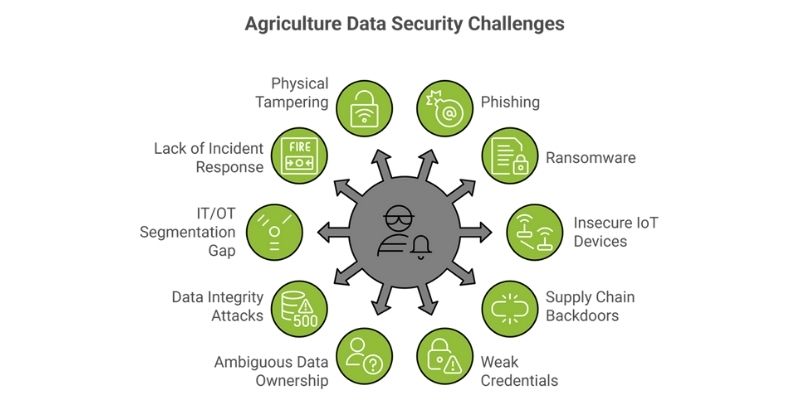
To effectively implement protecting farm data, farm owners must first understand the specific nature of the threats they face. The following challenges represent the most urgent agriculture cyber attack risks confronting agribusiness today.
1. Phishing
Phishing remains the single most common attack, reported by 39% of agricultural operations that experience a cyber incident. These deceptive communications, often masquerading as trusted partners (e.g., banks or suppliers), rely on tricking employees into compromising credentials or installing malware. Phishing exploits the reliance on human judgment, making the lack of training a core vulnerability in safeguarding farmers’ information.
2. Ransomware
Ransomware locks down files, sensitive information, and critical infrastructure until a ransom is paid. This attack ranks among the top common data threats for farmers because its operational impact is devastating.
It can immediately freeze essential systems, from automated feeders to inventory databases, leading to catastrophic operational downtime and potential product loss. Effectively preventing farm data loss requires tested, segmented backup strategies.
3. Insecure Internet of Things (IoT) Devices
The sheer number of poorly secured IoT devices, such as environmental sensors and actuators, dramatically expands the attack surface. These devices often lack strong authentication, making them vulnerable to hijacking.
Unauthorized access introduces the risk of a kinetic attack: an attacker could manipulate systems to alter pesticide usage or change ventilation controls, causing irreversible damage to crops or livestock and presenting severe farm cybersecurity risks.
4. Supply Chain Backdoors
Modern farms rely heavily on third-party Agricultural Technology Providers (ATPs) for everything from software to data analysis. This dependency creates supply chain risk, importing the security weaknesses of external vendors into the farm’s own network.
A breach at a small, weakly secured vendor can grant criminals unauthorized access to the entire agricultural network. Effective risk management for farm data demands strict vetting and continuous compliance monitoring of all suppliers.
5. Weak Credentials and Authentication Failures
Simple credential theft remains a primary high-volume attack vector, tied for the third most common cyberattack against Canadian farms. Once accessed, criminals can compromise financial accounts and essential management software.
Furthermore, Business Email Compromise (BEC), which relies on hijacked credentials, resulted in approximately $2.4 billion in financial losses across various sectors, including agriculture. Implementing Multi-Factor Authentication (MFA) is a core cybersecurity tip for farmers to fortify the protection of farm data.
6. Ambiguous Data Ownership and Privacy
Farm data is valuable proprietary intellectual property, but its legal ownership remains ambiguous since raw data is often ineligible for patent or copyright protection. ATPs often lack transparency regarding how they collect, use, and share this data.
This lack of legal clarity and farmer-centric governance models leads to significant farm data privacy concerns and a reluctance to adopt new technologies.
7. Data Integrity Attacks (AI Poisoning)
These attacks go beyond theft by intentionally tampering with or altering collected data to compromise decision-making. Attackers can “poison” AI datasets used for predictive modeling or manipulate sensors to cause faulty resource management, such as the overuse or underuse of critical inputs. Compromised data integrity leads to flawed resource management, negatively impacting yields or even altering food safety records.
8. The IT/OT Segmentation Gap
The failure to physically or digitally isolate administrative networks (IT) from industrial control systems (OT) creates a critical vulnerability. If an IT system is breached (e.g., via a phishing email), the attacker gains direct access to the physical controllers for equipment and environmental systems. Proper network segmentation is essential to isolate these systems and limit damage.
9. Lack of Incident Response Planning
In the chaos following a breach, the absence of a documented, practiced recovery plan turns an incident into a full-scale disaster. Nearly 80 percent of farms lack a formal incident response plan.6 Without a clear roadmap, response time slows, compounding financial losses and severely prolonging operational downtime.
10. The Threat of Physical Tampering
While the focus is often digital, the physical security of equipment is frequently overlooked. Physical components like control panels, network equipment, and remote sensors may be housed in poorly secured, easily accessible locations.
Physical tampering can provide attackers with direct access to local controls, allowing data extraction or system manipulation without ever needing to breach a digital firewall.
Impact of Data Security Challenges on Farm Operations
The consequences of security failures in the agricultural sector are unique because they are kinetic; they move instantly from the digital realm to physical operations, threatening food security and profitability.
- Massive Financial Losses and Downtime: Data breaches in farming and ransomware attacks translate directly into millions of dollars in losses. The 2023 breach on Dole Foods cost the fresh produce giant $10.5 million in the first quarter alone, forcing shipments to be halted. In an industry where timing is critical, even a short outage can be catastrophically costly.
- Supply Chain Disruption: Attacks often cascade throughout the food ecosystem. When large processors are attacked, independent farmers are forced to cancel shipments, disrupting the entire value chain. Conversely, if a single farm’s data is manipulated, it can impact contracts and downstream trust.
- Compromise of Food Safety: When hackers tamper with equipment settings or manipulate food testing data, such as storage temperatures, they directly risk consumer health and confidence. This type of data integrity attack presents a severe public safety issue.
Best Practices to Mitigate Data Security Challenges in Agriculture
Addressing these complex threats requires a holistic, three-pillar defense strategy encompassing technology, people, and legal oversight. Adopting these agricultural data protection measures is crucial for operational resilience.
- Implement Universal MFA: Multi-Factor Authentication (MFA) should be implemented across all digital platforms, especially those linked to critical systems or financial accounts, serving as the single most effective cybersecurity tip for farmers to combat weak credentials.
- Mandatory Training: Provide mandatory, ongoing security training to staff that emphasizes critical thinking and recognizing phishing attempts. This strengthens the weakest link in safeguarding farmer information.
- Network Segmentation: Enforce strict network segmentation, isolating critical OT systems (irrigation, climate control) from administrative IT networks. This ensures that if the administrative side is compromised, physical controls remain insulated.
- Data Encryption and Backups: Sensitive farm data must be encrypted both when stored (at rest) and when transmitted (in transit). Critically, maintain offline, segmented, and regularly tested data backups to ensure rapid recovery and effectively prevent farm data loss following a ransomware attack.
- IoT Management: Apply strong access controls, consistent patching, and enforce Role-Based Access Control (RBAC) to restrict who or what can access critical infrastructure.
- Demand Data Processing Agreements (DPAs): Farmers must become proactive negotiators, demanding DPAs from ATPs that strictly define the scope of data use, retention, and processing. This is key to mitigating risk management for farm data associated with third parties.
- Explicit Consent and Transparency: Data contracts must mandate explicit consent before any data is shared, sold, or repurposed (such as for training AI models). Farmers must ensure that third parties comply with the same terms regarding the processing, sharing, and retention of data. This fosters trust and addresses farm data privacy concerns.
- Physical Security: Ensure that physical security measures, such as locks, restricted access, and monitoring, complement all digital protocols to prevent physical tampering and theft of network equipment.
Conclusion
The digital transformation of agriculture has unlocked unprecedented efficiencies, but it has also exposed farms to complex cyber threats that can directly impact operations, revenue, and food safety. From phishing and ransomware to insecure IoT devices and supply chain vulnerabilities, the modern farm faces risks that traditional security measures can no longer address.
For farm operators seeking a comprehensive solution to manage these challenges, AgriERP offers enterprise-grade tools designed to secure, monitor, and optimize every aspect of farm operations, from orchard to market. Partner with AgriERP today to fortify your farm’s digital infrastructure and ensure resilient, data-driven growth.