The ERP Solution for the Year” 2025 in Agtech Breakthrough Awards 2025
 AgriERP Recognized & Mentioned On Forbes Magazine
Key Takeaways
- Nut processing has specific ERP requirements that most agriculture ERP software does not cover natively. Grower settlement automation, aflatoxin lot segregation, hull split logistics, marketing order assessment deductions, and export documentation all require purpose-built logic rather than customizations bolted onto a generic platform.
- The market splits into three categories: full field-to-finance ERP systems built for agriculture, processing-specialist platforms that plug into your existing ERP, and fresh produce ERPs that cover intake through distribution but not upstream farming.
- ExtendAg is the strongest processing-layer competitor. It covers nut and seed supply chains in depth but operates as an ERP-agnostic add-on rather than a full ERP replacement.
- NorthScope serves mid-size processors well for grower accounting and processing-side inventory, but it does not cover orchard operations or enterprise-grade financials.
- AgriERP is the only option on this list that covers the full operation: orchard block management, harvest logistics, grower settlements, processing, compliance, and financials in one connected system.
What Nut Processors Actually Need from an ERP
Choosing the right agriculture ERP software is not the same decision for a nut processor as it is for a wheat farmer or a fresh produce distributor. The workflows that define a nut processor’s operation: receiving loads from dozens of growers, running them through hulling, drying, and grading, segregating by aflatoxin results, calculating settlements against a sliding price scale tied to insect damage levels, and generating export documentation for buyers across multiple countries, all require software built with those workflows in mind.
Generic ERP platforms treat all of this as custom configuration. Agriculture-native platforms, by contrast, treat it as standard functionality. That distinction drives most of the differences between the platforms reviewed here. It also explains why food processing ERP software built specifically for agricultural processors consistently outperforms horizontal platforms adapted for the category after the fact.
Six Criteria That Separate the Right Platform from the Wrong One
Before comparing options, it helps to define what nut processors actually need from their software.
Grower settlement automation covers the ability to calculate payments automatically from grading results, contract terms, marketing order assessment rates, and sliding-scale pricing tied to quality outcomes, without manual reconciliation between systems.
Lot traceability from intake through finished goods means every load is tracked from the grower’s orchard block through hulling, drying, grading, storage, packing, and shipment, with recall-ready records accessible in hours rather than days.
Aflatoxin and quality management involves lot segregation decisions driven by test results, the ability to put lots on hold, route them to appropriate processing lines, and maintain complete audit trails for every quality decision.
Processing stage management means tracking hulling, drying, sizing, and sorting as discrete production steps with inputs, outputs, yield calculations, and cost accumulation at each stage.
Export compliance covers phytosanitary certificates, certificates of origin, and destination-specific documentation generated from the same lot data used across the rest of the system. For processors producing nut butters, FSMA 204 traceability requirements also apply, making export-linked lot documentation a compliance requirement as well as a commercial one.
Financial integration ties together cost per pound by lot, variety, and customer; grower settlement accounts payable; and multi-entity consolidation for operations spanning more than one facility or entity.
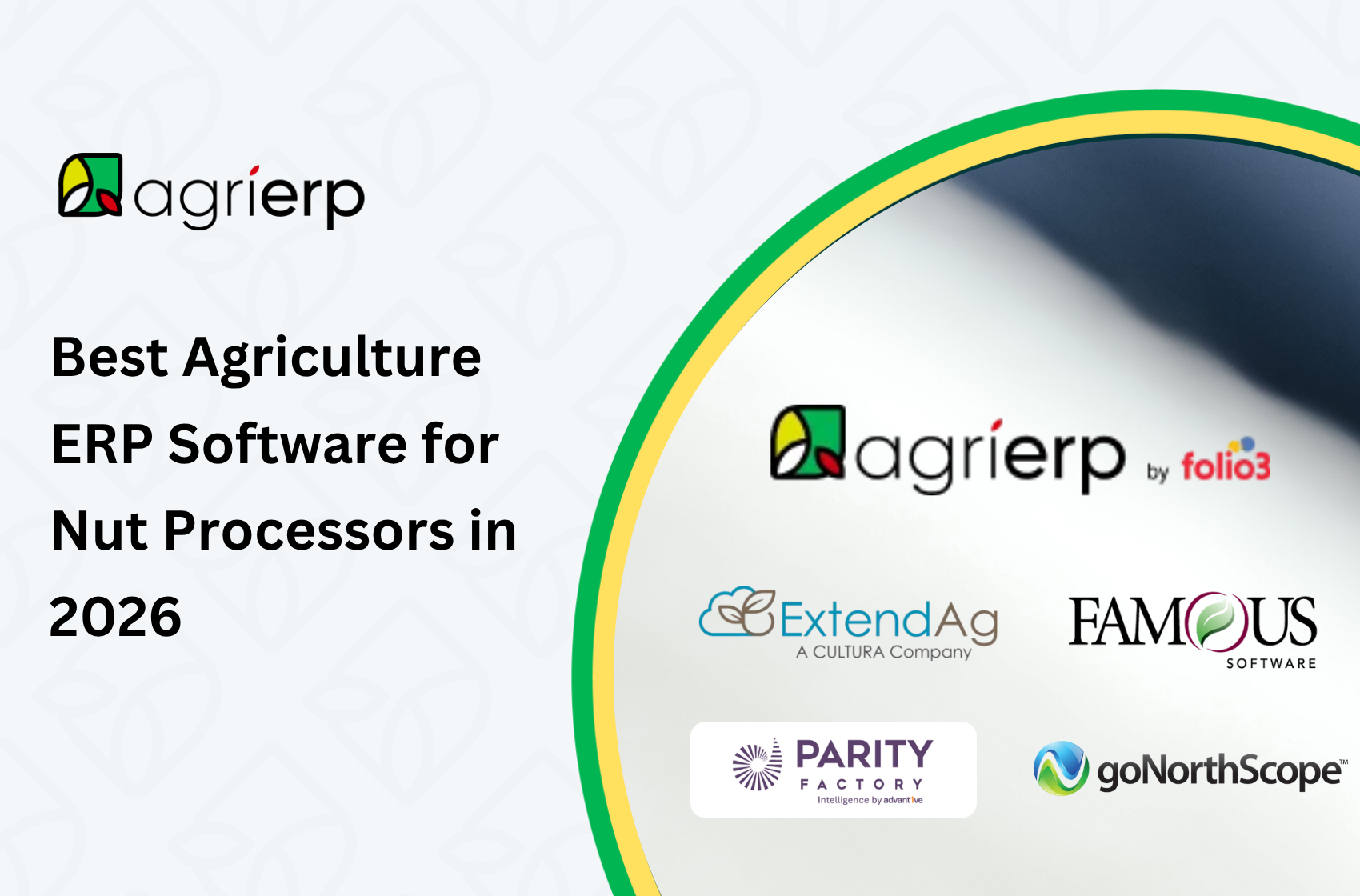
The 5 Best Agriculture ERP Platforms for Nut Processors in 2026
With those criteria established, here is how the leading platforms compare.
1. AgriERP
Best for: Nut processors who also manage growing operations, or handlers receiving from multiple growers across pistachio, almond, walnut, and other tree nut crops.
AgriERP covers the full nut and dried fruit operation on a single platform, connecting orchard block management, harvest logistics, grower settlements, processing, inventory, compliance, and financials. Because it runs on Microsoft Dynamics 365 or NetSuite as the financial backbone, processors who choose AgriERP do not trade enterprise-grade accounting for agriculture-native operations. They get both.
What It Covers
For nut processors specifically, AgriERP includes grower-level visibility into orchard costs, yields, and profitability by block and season; huller and sheller workflows for intake, lot creation, and processing stages; processor control over quality, grading, storage, packaging, and order fulfillment; end-to-end lot traceability connecting grower intake to finished goods and exports; and unified financials across settlements, processing costs, inventory valuation, and revenue. Quality and aflatoxin protocols align with standards set by the Administrative Committee for Pistachios and equivalent almond and walnut handler bodies.
Grower Settlement Logic
The grower settlement module handles the complexity that most systems cannot. Sliding scale pricing tied to insect damage levels, marketing order assessment deductions that update when rates change, multi-year contract terms, and quality premium calculations all apply automatically across every grower in a receiving run. That eliminates the manual reconciliation that turns settlement season into a multi-week project for operations still relying on spreadsheets.
Packages and Recognition
AgriERP was named ERP Solution of the Year 2025 by the AgTech Breakthrough Awards and offers three tiers: Lite for standalone farm operations, Standard for growing agribusinesses integrating farm management with a mid-sized ERP backbone, and Advance for large or multinational operations needing advanced financial management, integrated pest management, and advanced contract and grower management. For pistachio-specific operations, the AgriERP pistachio ERP covers the full grower-to-processor workflow, including a detailed breakdown of how pistachio grower payments are structured and automated.
Pros
- Only platform on this list covering both orchard operations and processing in one connected system
- Native grower settlement automation with marketing order logic, sliding-scale pricing, and multi-year contract support
- AI farm assistant and multilingual mobile apps including Spanish for field crews
- ERP-compatible with Dynamics 365 and NetSuite, so enterprise-grade financials come built in
Cons
- Broader scope than a pure processing-only operation may need; processors with no growing operations use a subset of the platform’s full capabilities
Best fit: Integrated grower-processor operations, pistachio and almond handlers receiving from multiple growers, operations managing both farming and processing under one entity.
2. ExtendAg
Best for: Large nut processors with existing ERP infrastructure who need a purpose-built processing layer for grower management, quality tracking, and supply chain coordination.
ExtendAg describes itself as an operational intelligence platform trusted by food processors for over 45 years. Rather than replacing your existing financial system, it plugs into it as an ERP-agnostic layer, focusing specifically on the raw ingredient supply chain from contracted growers through processing plant operations.
What It Covers
For nut and seed processors, ExtendAg covers grower contract administration, aflatoxin and quality parameter tracking at receiving (moisture content, foreign material, oil content), load sequencing to route loads to the right processing lines based on size, grade, moisture, and intended end-use, settlement and payment processing, cold-chain monitoring, and audit-ready compliance records.
Aflatoxin Tracking Depth
The aflatoxin tracking capability is notably mature for a processing-side tool. Real-time data tracks and notifies the operation of incoming raw product while recording critical quality parameters. Furthermore, the load sequencer automatically assigns loads to the right processing lines based on pre-specified criteria, a genuine operational advantage during high-volume harvest windows when manual routing decisions slow throughput.
Limitations to Consider
However, ExtendAg does not cover upstream farm operations. Because it is ERP-agnostic rather than a full ERP, it requires a separate financial system to handle accounting, accounts payable, and general ledger functions. Processors without dedicated IT or systems staff may also find configuration of contract templates, grower tenants, quality grades, and settlement formulas more demanding than lighter-weight alternatives. FitGap’s analysis places ExtendAg 15th of 19 in ease-of-management and affordability evaluations. Pricing starts at $10,000 per year, with support charged additionally.
Pros
- Deeply specialized for nut and seed processing workflows with mature aflatoxin and quality parameter tracking
- Automated load sequencing routes incoming product to the right line without manual intervention
- Largest enterprise market share in crop management software for operations with 500 or more employees
Cons
- Not a full ERP. It requires a separate financial system for general ledger, accounts payable, and accounting functions
- Ease-of-management and affordability ranked below the midpoint among processing-focused platforms, which may challenge smaller processors without dedicated systems staff
Best fit: Large, established nut processors with existing ERP infrastructure who need a specialized processing and grower management layer without replacing their financial system.
3. NorthScope

Best for: Mid-size fruit, vegetable, and nut processors who need strong grower accounting and processing inventory in one system without enterprise ERP complexity.
NorthScope is a food ERP built by Northlake Partners specifically for processors buying direct from the field. It covers grower accounting, delivery ticket management, inventory tracking, production management, and sales, with all transactions updating a connected general ledger. For mid-size processors feeling the friction of managing grower payments in spreadsheets alongside a disconnected accounting system, NorthScope addresses that specific gap well.
Grower Accounting Strength
The grower accounting module stands out at this price point. NorthScope manages delivery tickets that compute purchase price, taxes, and deductions automatically; handles seasonal repricing; tracks charges and accruals for grower receiving in real time; and processes grower settlements directly within the system. Customer testimonials from nut processor deployments cite the ability to access grower reports in seconds and track settlement data without exporting to a separate accounting tool.
Processing and Inventory
For processing operations, NorthScope additionally covers work-in-progress production and finished goods manufacturing, multi-facility inventory transfers in real time, lot traceability with quality test result assignment, and automated lot certifications and holds. It also handles multi-currency management for processors selling to export markets.
Where It Falls Short
NorthScope does not cover orchard or field operations. Its primary customer base skews toward seafood, which means the nut processor reference base is smaller than ExtendAg’s or AgriERP’s. Pricing is not publicly listed and implementation is handled by Northlake Partners as a consulting engagement.
Pros
- Strong grower accounting with delivery ticket automation, seasonal repricing, and real-time accrual tracking
- Integrated general ledger means grower settlements and financials live in one system, not two
- Multi-facility inventory and multi-currency support for processors with export markets
Cons
- Does not cover orchard or farm operations. It picks up at grower receiving only
- Seafood is the primary published focus; nut processor reference base is smaller than competing platforms
Best fit: Mid-size nut processors and handlers whose primary software gap is grower accounting complexity and processing inventory management.
4. ParityFactory (Advantive)
Best for: Nut processing plants that need real-time inventory control and lot traceability at the shop floor level and want to layer that capability onto an existing ERP.
ParityFactory, now owned by Advantive, is a WMS and MES platform designed specifically for food and beverage processors. It explicitly lists nuts as one of its industry specialties alongside seafood, produce, meat, dairy, and bakeries.
What It Covers
ParityFactory covers real-time inventory tracking, end-to-end lot tracing, paperless shop floor management, GS1 scanning and labeling, SQF traceability, yield calculation, and FIFO and FEFO management. Its quality module supports rapid full-lot tracking from raw ingredients to finished goods and enables instant recall execution well within the two-hour retail standard. The platform integrates with Dynamics, QuickBooks, Sage, and Intacct rather than replacing them.
Implementation Model
One genuine differentiator is the implementation model. ParityFactory offers fixed-cost, 90-day deployment with on-site visits and training. That timeline is significantly faster and more predictable than a full ERP implementation, which matters for processors who need to be operational before harvest season without a multi-month rollout.
User-Reported Issues
That said, user reviews flag some consistent issues. One reviewer on Software Advice described the system as running slowly since implementation, with a performance issue outstanding for over a year. Additionally, navigating between related inventory records can require moving through multiple screens, which adds friction in high-volume receiving periods. Limited advanced manufacturing features were also cited as a gap for more complex processing operations.
Pros
- Food-processor-native WMS and MES with strong lot traceability and recall execution capability
- Fixed-cost 90-day implementation is the fastest and most predictable on this list
- Integrates with major accounting systems including Dynamics, QuickBooks, and Sage
Cons
- Not a full ERP. It has no general ledger, grower settlements, or financial management
- User-reported performance issues and multi-screen navigation friction during high-volume operations
Best fit: Nut processing plants with an existing ERP that handles financials but need a dedicated inventory control and lot traceability layer at the shop floor level.
5. Famous Software
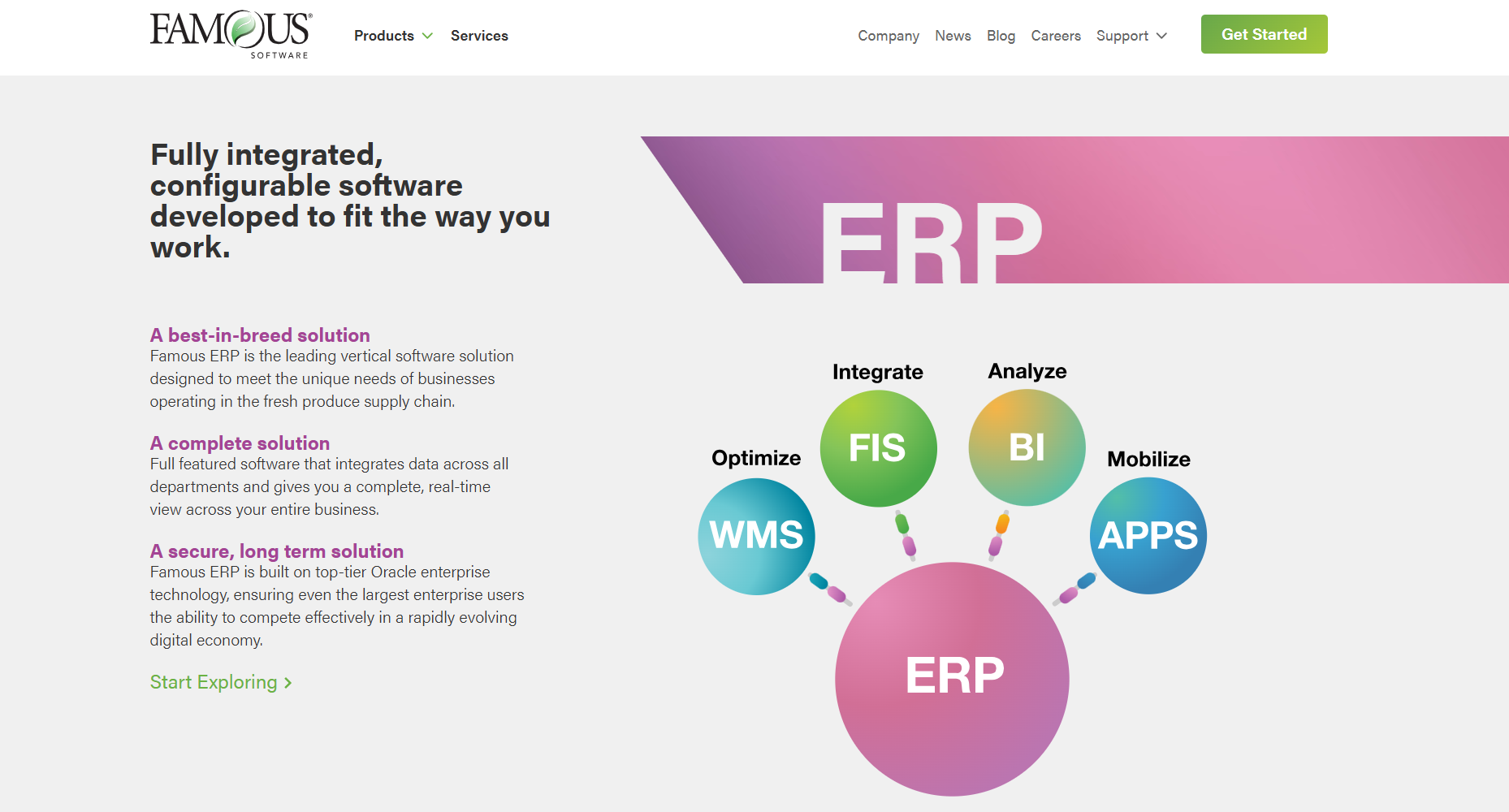
Best for: Nut processors operating primarily as fresh produce distributors, handlers, or packers without upstream growing operations.
Famous Software has served the fresh produce industry since 1975 and reports over 1,500 installation sites. For nut processors who operate primarily at the receiving, packing, and distribution end of the supply chain, Famous ERP’s depth in produce-specific operations is relevant.
What It Covers
Famous ERP covers inventory management, sales management, sourcing management including source-to-settle transactions for vendors and growers, and financial management including agriculture-specific payroll with H-2A and piece-rate support. Its Oracle-based OLTP database replicates changes across the system in real time, which Famous Software positions as a key differentiator over generic ERPs that sync periodically.
Scope Limitations
Nevertheless, the ceiling for nut processors evaluating Famous Software is its scope limitation. The platform begins at intake and ends at distribution. It does not include crop planning, orchard management, or irrigation scheduling. Processors who also manage growing operations will find the upstream side of their business unaddressed. Independent reviews including SelectHub’s analysis and user reviews on Capterra describe a steep learning curve and an interface rooted in legacy Windows desktop conventions. A G2 reviewer additionally noted that Famous Software has been slow to innovate and would not recommend it for operations planning a 10 to 20-year software commitment.
Pros
- Deep fresh produce industry experience spanning 50 years with an established installation base
- Strong source-to-settle grower transaction management within the sourcing module
- Real-time Oracle OLTP database keeps inventory, settlements, and financials in sync without periodic sync delays
Cons
- Scope limited to intake through distribution with no upstream farm, orchard, or crop operations coverage
- Legacy desktop interface with a reported steep learning curve and independently documented slow pace of innovation
Best fit: Fresh produce distributors, handlers, and packers in the nut industry who do not manage growing operations and prioritize produce-specific depth over modern interface or upstream ag functionality.
Side-by-Side Comparison
| Criteria | AgriERP | ExtendAg | NorthScope | ParityFactory | Famous Software |
|---|---|---|---|---|---|
| Orchard and farm operations | ✓ Yes | ✗ No | ✗ No | ✗ No | ✗ No |
| Grower settlement automation | ✓ Yes | ✓ Yes | ✓ Yes | ✗ No | − Sourcing onlySource-to-settle for vendors; no sliding-scale pricing or marketing order deductions |
| Aflatoxin and quality tracking | ✓ Yes | ✓ Yes | − PartialQuality test result tracking; no automated lot hold or line routing | ✓ Yes | − PartialBasic incoming quality inspection; limited segregation workflow |
| Processing stage management | ✓ Yes | ✓ Yes | ✓ Yes | ✓ Yes | ✗ No |
| Full ERP with general ledger | ✓ Yes | ✗ No | ✓ Yes | ✗ No | ✓ Yes |
| Lot traceability | ✓ Yes | ✓ Yes | ✓ Yes | ✓ Yes | ✓ Yes |
| Export compliance documentation | ✓ Yes | − PartialAudit-ready compliance records; phytosanitary docs require additional configuration | − PartialMulti-currency support; destination-specific docs not native | ✗ No | − PartialHandles produce-standard shipping docs; limited export certification support |
| AI capabilities | ✓ Yes | ✗ No | ✗ No | ✗ No | ✗ No |
| Mobile apps | ✓ Yes | ✓ Yes | ✗ No | ✓ Yes | − Add-onSeparate mobile product; not included in core platform |
| Multilingual interface | ✓ Yes | − PartialEnglish primary; some localization available via configuration | ✗ No | − PartialEnglish primary; limited language options in mobile interface | ✗ No |
| Deployment model | Cloud, on-premise, hybrid, SaaS | Cloud | Cloud | Cloud and on-premise | On-premise |
How to Choose the Right Platform
The right platform depends on what part of the nut supply chain your operation covers and where your current software is failing you.
Managing Orchards and Processing Together
If you manage orchards alongside processing, you need a platform that covers both without requiring separate systems that must stay in sync. AgriERP is the only option on this list built to do that. The grower settlement complexity, block-level yield tracking, and orchard cost analysis your operation needs are not available in ExtendAg, NorthScope, ParityFactory, or Famous Software. It’s important to understand where farm management software ends and a full agriculture ERP begins, that boundary is what determines which category your operation actually needs.
Adding a Processing Layer to Existing ERP
If you have an existing ERP and need a specialized processing layer, ExtendAg is the most mature option for larger processors, particularly on aflatoxin tracking and load sequencing. Alternatively, ParityFactory fits operations whose main gap is shop floor inventory and lot traceability rather than grower management.
Fixing Grower Accounting Specifically
If your primary pain point is grower accounting complexity and you are a mid-size processor buying direct from the field, NorthScope addresses that problem directly and integrates it with your financials in one system.
Pure Receiving and Distribution
If you only receive, pack, and distribute without managing growing, Famous Software’s produce-specific depth is relevant, though its legacy architecture and innovation pace are worth factoring into a long-term software commitment.
Frequently Asked Questions
What features should agriculture ERP software include for nut processors?
At minimum: grower settlement automation, lot-level traceability from intake through finished goods, aflatoxin and quality parameter tracking, processing stage management covering hulling, drying, sizing, and grading, inventory management with FIFO and FEFO, export compliance documentation, and financial integration. If your operation includes growing, orchard block management and harvest logistics should also be native to the platform rather than requiring a second system.
Is an ERP-agnostic processing platform like ExtendAg better than a full ERP for nut processors?
It depends on whether you already have a financial ERP in place. An ERP-agnostic platform gives you specialized processing functionality without replacing your existing financial system, which is valuable if that system works well. A full agriculture ERP like AgriERP, however, gives you a single system for everything, which eliminates the integration maintenance between a processing layer and a separate financial platform.
How long does it take to implement agriculture ERP software for a nut processing operation?
Timelines vary by scope. ParityFactory’s fixed-cost 90-day model is the fastest on this list but covers WMS and MES only. A full ERP deployment covering grower management, financials, processing, and compliance typically takes two to four months for mid-size operations, and up to nine months for large multi-entity deployments with legacy data migration.
Which agriculture ERP software handles pistachio-specific requirements like ACP marketing order assessments?
AgriERP handles pistachio-specific workflows including marketing order assessment deductions, sliding-scale pricing tied to insect damage thresholds, hull split timing coordination, and grower settlement automation across multiple growers. None of the other platforms on this list include pistachio-specific operational logic as native functionality. For a broader overview of what pistachio ERP software covers across the full grower-to-processor workflow, that provides additional context on the category.
Does agriculture ERP software help with FSMA 204 compliance for nut processors?
Yes, for processors whose products fall under the FDA Food Traceability List. Pistachio butter, for example, falls under the FTL’s nut butters category. A full agriculture ERP maintains lot codes from grower intake through processing and shipment as part of normal operations, which means FSMA 204-compliant records are a byproduct of running the system rather than a separate compliance data-entry task.