The ERP Solution for the Year” 2025 in Agtech Breakthrough Awards 2025


Key Takeaways
- Famous Software and AgriERP solve different scopes of the same problem. Famous Software specializes in fresh produce receiving, packing, and distribution. AgriERP spans field operations through processing and export.
- Famous Software runs on Oracle enterprise technology dating back to 1975. The platform has deep produce-specific functionality, but that age shows in its interface and its independently reported learning curve.
- AgriERP is ERP-compatible, not locked to a single platform. It connects to Microsoft Dynamics 365, NetSuite, or runs standalone, giving it a modern browser-based interface, AI agents, geospatial mapping, and real-time weather monitoring, along with crop, orchard, and livestock management that Famous Software does not offer.
- AgriERP publishes three defined packages (Lite, Standard, Advance), scaling from single-farm operations to multinational agribusinesses. Famous Software does not publish pricing and quotes per deployment.
- The right choice depends on how much of your operation the software needs to cover. A pure produce packer or distributor may find Famous Software’s depth sufficient. An operation managing orchards, row crops, or livestock alongside processing needs broader coverage.
Two Systems Built for Different Starting Points
If you are evaluating Famous Software and AgriERP side by side, you are probably not comparing two generic ERPs. Both were built specifically for agriculture, and both show up on the same shortlists for produce and specialty crop operations. That similarity makes the comparison harder, not easier.
The real differences sit underneath the surface, in what each platform actually covers, how each one was architected, and what it feels like to use day to day. This comparison works through both systems category by category: company background, interface and technology, operational scope, core modules, grower settlements, compliance, deployment, and pricing.
Famous Software vs AgriERP: Overview
These two companies come from different eras and different corners of the agriculture industry.
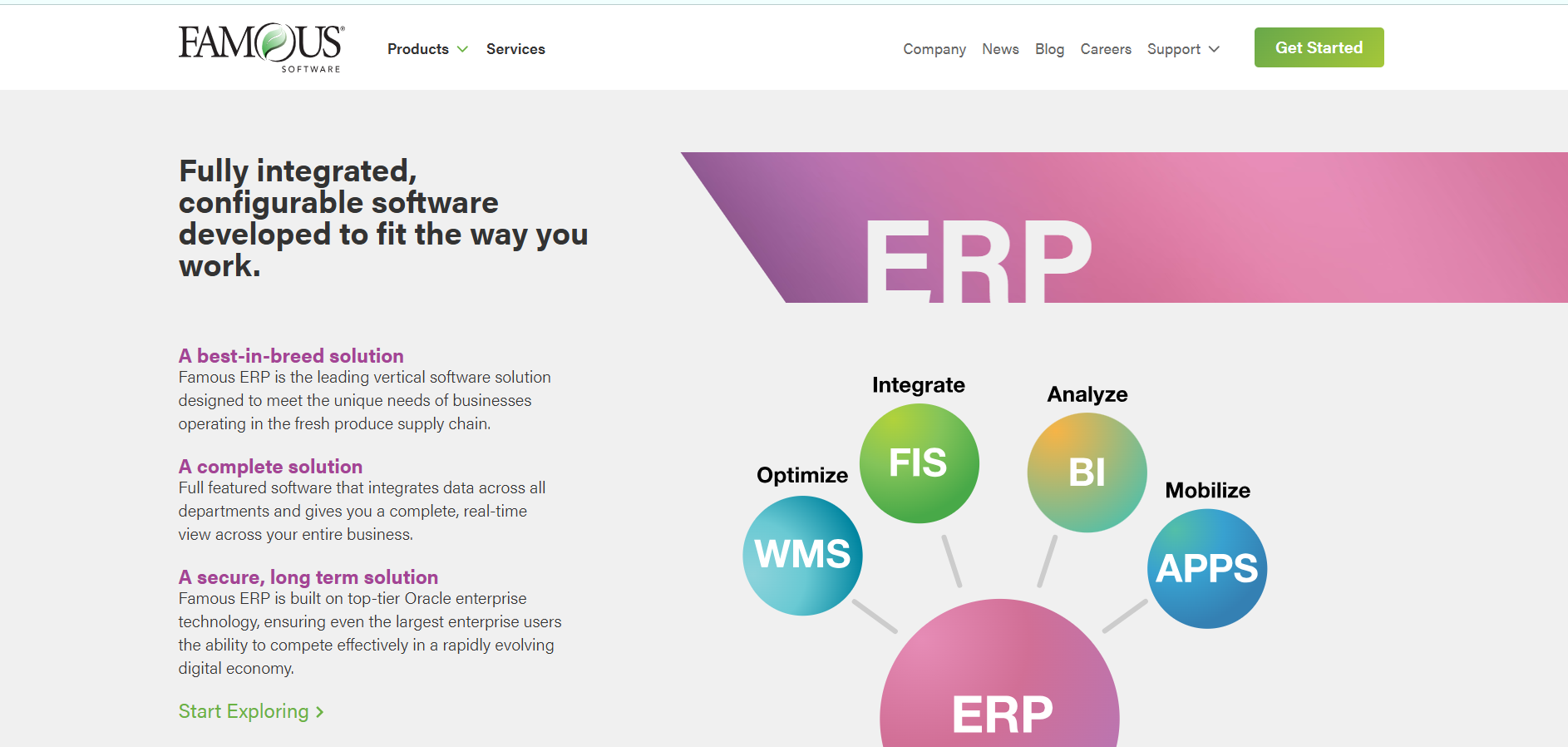
Famous Software has served the fresh produce industry since 1975 and is headquartered in Fresno, California. The company reports over 1,500 installation sites and more than 20,000 users among growers, packers, shippers, and wholesalers. Its customer base sits almost entirely within fresh produce.
AgriERP is an ERP-compatible farm management platform that connects to your choice of ERP backbone, whether that is Microsoft Dynamics 365, NetSuite, or another system. It covers a broader agricultural footprint than Famous Software, including row crops, orchards, tree nuts, potatoes, greenhouse operations, indoor vertical farms, and livestock, alongside post-harvest processing and export. For operations not yet ready for a full ERP investment, AgriERP also offers a standalone Lite package for core farm operations. Folio3, a Microsoft Solutions Partner with implementation experience across manufacturing, distribution, and agriculture, develops and supports the platform.
Interface and User Experience
This is one of the most visible differences between the two platforms. Your team will spend hours a day inside whichever system you choose, so the way screens look and behave affects adoption speed, training costs, and daily efficiency more than most buyers expect during the evaluation phase.
Famous Software ERP
Famous ERP is built on a legacy Windows desktop application model. Screens like the Receiving List function as dense data grids, which works for power users who already know the software cold. However, the layout, fonts, and interaction patterns come from the client-server era of enterprise software rather than a modern web application. New hires who grew up on browser-based tools will notice the gap immediately.
AgriERP
AgriERP runs as a modern, browser-based application with card-based layouts, progress indicators, and clean typography, closer to what most staff already expect from current business software. Screens are designed for quick scanning, surfacing status, progress, and resource data in a layout that reduces training time for new users. Built-in messaging and media sharing keep field crews connected in real time without leaving the platform. Geospatial integration lets teams visualize soil health, NDVI data, yield maps, and active operations on interactive maps directly inside the system, and real-time weather and climate monitoring feeds into irrigation and spray scheduling decisions. AgriERP’s mobile apps also support multiple languages, including Spanish, so non-English-speaking farm hands and field workers can navigate the system in their own language without relying on a supervisor to translate every screen.
The innovation pace matters here too. Famous Software’s roadmap depends entirely on its own development team, and at least one G2 reviewer has noted that the platform has been slow to react to industry trends. AgriERP inherits continuous platform-level updates from whichever ERP backbone it connects to, on top of its own agriculture-specific development, including AI agents that automate tasks across finance, sales, and reporting.
Technology Foundation
The two platforms are built on fundamentally different architectures, and those architectural choices affect what each system can do today and what it can add tomorrow.
Famous ERP runs on Oracle enterprise technology, and the company positions its Online Transaction Processing database as a differentiator. According to Famous Software’s own technical explanation, their system replicates changes continuously, so an update in grower accounting reflects across the entire platform immediately rather than waiting for a periodic sync.
AgriERP takes a different approach. Rather than locking to a single database vendor, it connects to Microsoft Dynamics 365, NetSuite, or runs as a standalone farm operations application. When connected to Dynamics 365, it gets access to the Power Platform, Microsoft Copilot, and Azure security infrastructure. When connected to NetSuite, it inherits that platform’s financial and distribution strengths. Either way, AgriERP’s own agriculture-specific modules, including AI agents for automating finance, sales, and reporting tasks, layer on top of whatever ERP backbone fits your operation. The platform runs on Microsoft Azure Cloud, providing multi-layered security across physical and cloud infrastructure regardless of which ERP option you choose.
Operational Scope
This is where the two platforms diverge most clearly. The question is not which system has better features, but which one covers enough of your operation to serve as a real single source of truth.
Famous Software’s scope begins at intake and ends at distribution. It does not include crop planning, orchard management, irrigation scheduling, or livestock tracking. If your operation extends upstream into growing, and not just receiving and processing, Famous Software was not built to cover that part of the business.
AgriERP was built to manage agriculture from field operations through financials. Crop lifecycle planning, harvest logistics, orchard block management, material requirement planning, and export compliance all sit upstream of anything Famous Software addresses. On top of that, AgriERP includes geospatial integration and mapping for visualizing soil health and active operations, real-time weather and climate monitoring that feeds into irrigation and spray scheduling, integrated pest management, and regulatory compliance reporting for USDA, FSA, and other authorities. These capabilities sit alongside the post-harvest processing and grower accounting functions the two platforms share.
Famous Software vs AgriERP
The table below compresses the category-by-category analysis into a side-by-side view across the dimensions that matter most during an evaluation.
| Category | Famous Software | AgriERP |
|---|---|---|
| Primary scope | Receiving through distribution | Field operations through processing and export |
| Crop/field management | Not included | Included (row crops, orchards, greenhouse, vertical farms) |
| Livestock management | Not included | Included |
| Grower settlement automation | Included (sourcing module) | Included (grower management module) |
| Technology foundation | Proprietary Oracle OLTP database | ERP-compatible (Dynamics 365, NetSuite, or standalone) |
| AI capabilities | Not available | AI agents for finance, sales, and reporting automation |
| Geospatial mapping | Not available | NDVI, soil health, yield maps, and active operations overlay |
| Weather & climate monitoring | Not available | Real-time feeds integrated with irrigation and spray scheduling |
| In-app communication | Not available | Built-in messaging and media sharing for field crews |
| Material requirement planning | Not available | Included for season and input forecasting |
| Ag-specific payroll (crew, H-2A) | Included | Included |
| Traceability and FSMA 204 | Included, produce-specific | Included, across crop and export compliance |
| Mobile access | Separate add-on app | Built in from Lite tier, offline-capable, multilingual (Spanish) |
| Cloud infrastructure | Oracle-based, cloud-hosting available | Cloud-native on Microsoft Azure |
| Pricing transparency | Not published, quote-only | Three defined tiers (Lite, Standard, Advance) |
| Best fit | Produce-only packers, shippers, wholesalers | Operations spanning growing and processing |
Core Modules
Both platforms cover accounting, inventory, sales, and grower management. The difference is how far each one reaches beyond that shared center.
Famous Software covers four main areas: Inventory Management, Sales Management, Sourcing Management, and Financial Management. Sourcing Management includes what Famous Software calls source-to–settle transactions, covering vendor and grower contract evaluation, performance tracking, and settlement calculation. Financial Management extends into agriculture-specific payroll, including crew and piece-rate calculations, H-2A processing, and guaranteed minimum wage compliance. BI, WMS, Integration Services, and mobile Apps are separate add-on products rather than part of a single integrated package.
AgriERP’s nuts and dried fruits and broader crop modules cover crop and field management, grower and contract management, inventory and warehouse tracking, financials, and reporting, plus crop lifecycle planning, harvest logistics, and export compliance. It also includes work order management for planning, scheduling, and tracking field activities; material requirement planning for accurate season and input forecasting; an AI farm assistant for automating repetitive tasks across finance, sales, and reporting; geospatial mapping with NDVI and yield overlays; and built-in communication tools for field crews. Grower settlement automation lives inside this broader structure rather than as a standalone sourcing function. Because AgriERP connects to your choice of ERP backbone rather than bundling its own, each of these modules feeds data into the financial, supply chain, and HR systems your operation already runs or plans to adopt.
Grower and Vendor Settlement
Both platforms handle grower settlements, but they apply the function at different points in the supply chain.
Famous Software’s Sourcing Management module handles source-to-settle transactions specifically for produce vendors and growers, evaluating contracts and performance and calculating settlements based on that data. It is scoped to the sourcing relationship itself.
AgriERP’s Grower Management module ties settlement automation to the rest of the operation. Contract terms, quality grading, delivery records, and financials all live on the same platform, so a grower payment reflects field-level and processing-level data without a separate reconciliation step between systems.
Compliance and Traceability
Compliance matters for both platforms’ users, but the scope of what each system can trace differs.
Famous Software built traceability specifically around fresh produce timelines and requirements. The company has positioned its platform for FSMA 204 compliance, citing an existing traceability report structure that required only incremental additions to meet the new requirement.
AgriERP’s compliance coverage extends across crop and export requirements more broadly, including USDA, FDA, and destination-specific export documentation, alongside FSMA-relevant traceability for processed nuts and dried fruit. Because compliance data originates from the same system that manages field operations, lot traceability can trace back to the orchard block or field, not just the point of intake.
Deployment and Mobile Access
How each system is deployed and accessed in the field affects both the IT team’s workload and the daily experience of field crews.
Famous ERP is built on Oracle enterprise technology with deployment options that include cloud hosting, though its architecture originates from an on-premise, database-driven model. It offers a separate mobile Apps product for on-the-go access rather than a fully native mobile-first design.
AgriERP is cloud-native on Microsoft Azure, with mobile and desktop accessibility built into its packages from the entry tier up, including offline-capable mobile apps for field crews working without connectivity. The mobile apps support multiple languages, including Spanish, so crews whose first language is not English can log activities, track tasks, and communicate through the system without a translation barrier. Because AgriERP connects to your choice of ERP backbone rather than mandating one, deployment flexibility extends to the financial and operational layer as well.
Pricing and Packaging
Pricing visibility during evaluation can save weeks of back-and-forth. The two platforms handle this differently.
Famous Software does not publish pricing. G2 lists pricing details as unavailable, with quotes provided directly by the vendor based on deployment scope.
AgriERP publishes three defined packages, each scoped to a different operational tier:
AgriERP Lite is standalone farm operations software for farmers and smaller agribusinesses digitalizing core daily operations without a full ERP investment. It includes work order management, mobile and desktop access, inventory tracking, harvest and yield tracking, resource allocation, and labor tracking.
AgriERP Standard is the complete AgriERP suite with a mid-sized ERP backbone, designed for growing agribusinesses migrating from siloed or legacy systems. It includes everything in Lite plus financial management, supply chain management, production management, sales and receivables, reporting and analytics, third-party integrations, asset management, human resource management, warehouse management, grower accounting, and an AI farm assistant.
AgriERP Advance is the complete suite with advanced ERP capabilities, designed for large agribusinesses and multinational corporations. It includes everything in Standard plus advanced financial management, advanced season planning, advanced resource planning, quality control and compliance management, production control and management, supply chain and logistics automation, advanced warehouse management, harvest management, integrated pest management, advanced contract management, grower management, and document management.
Pricing for all three AgriERP tiers is available by requesting a quote directly.
Famous Software vs AgriERP: Reviews
Third-party ERP analysts give a consistent picture of Famous Software.
SelectHub’s comparison analysis notes that Famous Software has a clunky interface and a steep learning curve, and that it lacks the flexibility and customization of platforms like Microsoft Dynamics 365. Their conclusion positions Famous Software as best suited for companies deeply invested in the fresh produce industry who prioritize industry-specific depth over ease of use.
User reviews on Capterra echo that pattern. Reviewers describe the software as genuinely useful for daily operations once learned, while independently flagging that the interface takes time to understand at first. One such G2 reviewer was more direct, noting that Famous Software has been slow to innovate and would not recommend it for operations seeking 10 to 20 years of longevity from their ERP investment.
The consistent theme across independent sources: Famous Software is deep, specific, and capable once mastered, but not the easiest system to onboard or the fastest to evolve. That is worth weighing if your team includes new hires who need to get productive quickly, or if you need your ERP to keep pace with AI, mobile, and integration capabilities that are now standard in modern agriculture.
Choosing Between AgriERP and Famous Software
The decision comes down to how much of your operation the software actually needs to run.
If your business is purely receiving, packing, and shipping produce, with growing handled separately or by outside suppliers, Famous Software’s decades of produce-specific refinement are a real asset. It was built for exactly that workflow.
If your operation includes growing alongside processing, whether that is orchard crops, row crops, or livestock, AgriERP covers ground that Famous Software was never built to reach, on a modern interface with AI agents, geospatial mapping, and weather monitoring built in, connecting to the ERP backbone that fits your operation rather than locking you into one vendor’s proprietary stack.
People Also Ask
Does Famous Software include crop or orchard management features?
No. Famous Software’s scope covers receiving, inventory, sales, sourcing, and financial management for fresh produce operations. It does not include crop planning, orchard management, or irrigation scheduling.
Which platform handles grower settlements?
Both do, but differently. Famous Software’s Sourcing Management module handles source-to-settle transactions for produce vendors and growers. AgriERP’s Grower Management module handles settlement automation as part of a broader system that also covers field operations and processing.
Is Famous Software built on the cloud or on-premise?
Famous ERP is built on Oracle enterprise technology with deployment options that include cloud hosting, though its architecture originates from an on-premise, database-driven model rather than a cloud-native design.
What packages does AgriERP offer?
AgriERP offers three tiers: Lite, for smaller operations digitalizing core daily operations; Standard, a complete ERP suite for growing agribusinesses; and Advance, for large or multinational operations needing advanced financial, quality, and logistics management. Pricing for each is available by request.
Which system has a shorter learning curve?
Independent reviews consistently describe Famous Software as having a steeper learning curve, while noting it becomes genuinely useful once mastered. AgriERP uses a modern, browser-based interface and connects to established ERP platforms like Dynamics 365 and NetSuite, so operations and finance teams work with interface conventions they already recognize.