The ERP Solution for the Year” 2025 in Agtech Breakthrough Awards 2025


Modern farm management software is transforming how small farms operate. As a small-scale farmer, you face tight margins, unpredictable weather, and limited labor. Embracing digital agriculture software tools can level the playing field for your farm.
In fact, technology adoption in farming is on the rise, over 63% of farmers use farm software in some capacity today. These farm management solutions let you manage your farm more efficiently by centralizing data and guiding decisions.
In the following blog, we will discuss the importance and need of farm management software for small-scale farmers, and how these software solutions are beneficial for managing farming operations.
Why Small Farms Can’t Ignore Agriculture Software?
Walk through any farming community, and you’ll hear similar conversations. Fertilizer prices keep climbing. Weather patterns become more unpredictable each year. Regulatory paperwork multiplies like weeds. Equipment breakdowns always happen at the worst possible moment.
Traditional farming practices, historical records on paper, relying on experience, and intuition worked only when farming was simpler two decades ago. Today’s agricultural operations have become more complex, and to operate your farm efficiently, precision is required.
Your farm produces enormous amounts of data daily. Soil moisture level, temperature deviation, hours worked by equipment, quantity of fuel used, quantity of yield in the various parts of the field, the list is long.
You will make crucial business decisions using incomplete information unless you have the right tools to capture and analyze this information. The modern farm management solution converts this data mess into understandable and actionable information, leading to profitability. Hence, in 2025 and beyond, small-scale farmers cannot ignore the implementation of farm management software.
Top 10 Benefits of Farm Management Software
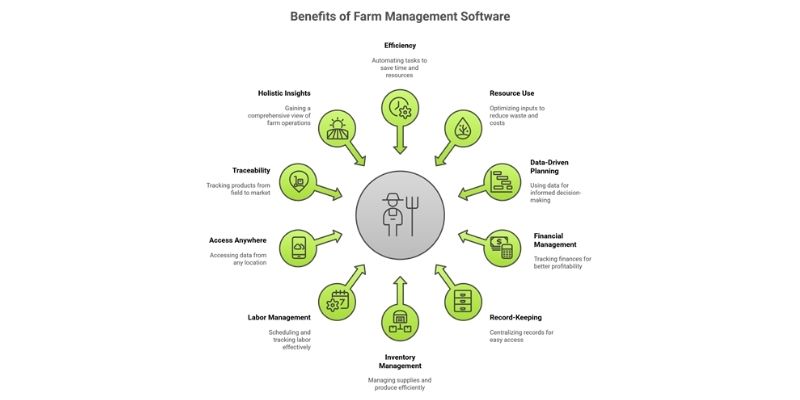
Now, let’s explore the top benefits you can expect from adopting a modern farm management solution for your small farm.
1. Boosted Efficiency
Time is precious on a small farm, and farm management software helps you make the most of it. By automating routine tasks and consolidating information, these farm management tools significantly increase your operational efficiency.
For instance, GPS-guided apps can optimize tractor routes and field work, saving fuel and labor. Many farmers find that once they go digital, they spend far less time on paperwork and manual data entry.
Also, using farm software cuts administrative workload so much that it is like gaining an extra set of hands during peak season. A good farm management system helps you by saving on redundant labor and minimizing human error; this leaves your day free.
You and your team can use time productively by engaging in cultivating crops, rearing livestock, or planning for the next season, instead of hustling paperwork. The outcome of such activities leads to increased productive farm operations.
2. Optimal Resource Use
One of the most important benefits of farm management software is that it helps you in resource optimization. These tools help ensure you apply just the right amount of inputs, avoiding waste and improving sustainability.
For example, sensors and data analytics in the software can monitor soil moisture and crop health in real time, guiding you to irrigate or fertilize only as needed. This is a huge benefit for areas facing water scarcity or high irrigation costs.
Efficient input use also means lower expenses on costly fertilizers, chemicals, and fuel. Environmentally, this translates to less chemical leaching into waterways and healthier soil over time.
Farm management software essentially encourages sustainable farming methods inadvertently by analyzing your usage patterns, it discourages excess. Many platforms even have modules for tracking carbon footprints or integrated pest management, helping small farms adopt eco-friendly practices.
3. Data-Driven Planning
There will never be certainty in farming, however, having more data will help remove much of the guesswork in your decisions. The collection and analysis of information to enable data-based decision-making is one of the greatest advantages of farm data management software.
Rather than just having to plan based on gut feeling or what was in the notes last year, you will be able to access hard facts about your fields and operations. For instance, farm management platforms will have access to weather forecasts, satellite images, sensor data, and previous yield data. The software can help you make agronomic decisions on a timely basis, such as when to plant, when to irrigate, how to rotate crops, and so on.
Some high-tech agricultural management software will even predict outbreaks of pests or disease based on environmental conditions using AI. This implies that you can take early action (like using pest control) to avoid loss of crops, either because of weather conditions or pests.
4. Improved Farm Financial Management
Every farmer is also a business manager. Farm business management software implements powerful financial tracking in your business. This directly affects your profits and cost management. The use of centralizing the calculations of all costs (in terms of seed, fertilizer, labor, fuel) and incomes (sold crops, grants, etc.) allows you to have a real-time perspective of the finances of your farm.
Most of them have dashboards or reports that will tell you how your budget is performing compared to actual spending, cost per acre, or money per crop. With these at your fingertips, you will be able to see where you are spending unnecessarily and where you can save.
Also, you will be in a better position to make better business decisions because of the close monitoring of your farm financial data, such as what crop will make the most profit per acre, or whether that new tractor is going to pay off.
There are even platforms that are integrated with accounting or provide farm accounting functionality. Think of it as having a digital farm accountant that keeps you on top of your budget and helps you gain control over your farm finances.
5. Simplified Record-Keeping
One of the unsung benefits of farm management software is how it streamlines your administrative work. Instead of juggling notebooks, spreadsheets, and random slips of paper, all your records, planting dates, input applications, harvest yields, and sales can be entered (or even automatically logged) into one system.
This farm data management software approach means all your farm data stays in one place, neatly organized and backed up. No more losing vital records to a misplaced notebook or, worst-case scenario, a disaster.
Also, small farms increasingly need to comply with food safety rules, organic certifications, or sustainability standards. Good farm management software automatically logs the information needed for audits and reports.
For example, it can track every pesticide spray and fertilizer batch to generate compliance reports with a click. Instead of scrambling to assemble paperwork for an inspector, you can quickly pull up digital records that are complete and timestamped.
6. Better Inventory Management
Keeping track of farm inventory is another area where software provides a big boost. For small farms, inventory management includes monitoring your supplies (seeds, chemicals, feed, fuel) as well as tracking harvested produce and storage.
Relying on memory or hand-written notes for this can lead to costly mistakes. Farm inventory management software takes the guesswork out of this process. It allows you to log quantities of each input in stock and updates those levels as you use or purchase materials.
Many farmers use it to set re-order alerts as well, so you know when it’s time to buy more fertilizer or veterinary meds before you run out. By maintaining optimal inventory levels, you avoid emergency purchases (which are often more expensive) and prevent waste from overstocking.
Essentially, by managing inventory digitally, small farms can run much leaner and efficiently, much like larger operations do. The software becomes your digital storehouse manager, tracking every bag of seed and gallon of fuel so you can focus on farming. In the end, better inventory control contributes to lower costs and smoother operations across the farm.
7. Improved Labor Management and Workflow Scheduling
Farm management software functions as a smart scheduling and farm planning software tool to optimize labor use. You can assign tasks to specific people, set reminders for time-sensitive jobs, and get an overview of what everyone should be working on each day or week. This level of organization helps ensure that nothing critical slips through the cracks during busy seasons.
More importantly, it helps you plan for labor needs. By having all your crop and livestock activities mapped out in a calendar, you can identify crunch times when you’ll need extra hands (for example, during harvest or lambing season) and schedule accordingly. Conversely, you can also spot periods when the workload will be lighter and avoid overstaffing or unnecessary labor hours then.
Better farm and ranch management software may even include features for tracking labor performance or hours, which is useful if you pay by the hour or want to analyze labor efficiency. Overall, by streamlining workforce management, small farms can get more done with the same team and avoid the chaos of peak-season labor crunches.
8. Access Anywhere
Currently, one of the most important strengths of the cloud-based farm management software is that it gives you the ability to access it anytime and anywhere. Since data about your farm will be safely stored in the cloud, you can access records or add new data to it with your smartphone or tablet when on the tractor or checking crops.
This is because you do not need to leave till the end of the day to update a log or even check your to-do list; this is because everything is at your fingertips. For instance, when you add a task or mark it as ‘done’ in the app, your partner may immediately notice that and move on to the next priority instead of spending time on non-priority tasks.
Cloud access also provides the assurance of having your information stored safely. You won’t lose data if a device crashes or is lost, you simply log in from another device. Another benefit of being cloud-based is integration: many farm apps can connect with other online services (like satellite weather data, or even your equipment’s telematics) to import data in real time.
Some can also integrate with sales platforms or co-op networks, making it easier to share your crop inventory or receive market price updates.
9. Enhanced Traceability
This is an area where farm management software provides significant benefit to small farmers. By digitally tracking your operations from field to market, you can trace each product’s history quickly.
For example, you can pull up which field a batch of produce came from, what inputs were used on that field, and when it was harvested, all through your software’s records. This level of traceability is nearly impossible to achieve with paper logs on a small farm,
From a compliance standpoint, traceability features help you meet food safety regulations with ease. If there’s ever a recall or a need to demonstrate that you followed proper protocols, you can generate a report of all relevant data in minutes.
In essence, farm and ranch management software with traceability functions helps ensure that the food you grow is not only safe and compliant, but that you can prove its quality. This builds trust with customers and can translate into a stronger brand for your small farm.
10. Holistic Farm Insights
Small-scale farmers often wear many hats and juggle countless details. It’s easy to get caught up in reacting to daily crises or focusing on one area while neglecting another. A digital farm management solution brings all the threads of your operation together, giving you a bird’s-eye view.
With all your data in one dashboard, you can see how the pieces interconnect: how does the weather this month affect your cash flow? Which fields consistently produce the best yields (and why)?
Many farm management platforms include reporting and analytics tools that analyze your performance and suggest optimizations. In short, you gain the kind of analytical insight that large agribusinesses employ, but tailored to a small farm scale.
This holistic oversight turns your farm into a more adaptive, learning organization. You can set benchmarks, track improvements, and celebrate measurable progress, whether it’s in yield, cost reduction, or sustainable metrics.
How AgriERP Empowers Small-Scale Farming?
Implementing farm management software can seem like a big step, but the rewards for small-scale farmers are clear. From saving time and cutting costs to improving yields and sustainability, the benefits we’ve discussed all translate into a more resilient and profitable farm business.
AgriERP offers an all-in-one agriculture management software platform specifically tailored to streamline farm operations, from crop planning to inventory and finances. Visit AgriERP to learn how it can help transform your day-to-day farm management.