The ERP Solution for the Year” 2025 in Agtech Breakthrough Awards 2025


Key Challenges in Fresh Produce Distribution
Fresh produce distribution faces unique issues and requires high precision, quick response, and real-time decision-making. Here are some of the biggest challenges faced by producers and distributors:
Short Shelf Life and Perishability
Fresh produce is highly perishable and comes times also delicate. Some items like berries last only a few days. Hence if is not stored and transported with care, it can spoil quickly.
Besides that, it is also important to maintain temperature control, minimize handling time, and expedite delivery to preserve its freshness until it reaches the consumers.
This is very important for organic produce, where synthetic preservatives are not used to elongate the life of food.
Supply Chain Complexities
As compared to durable items, fresh produce has to be sourced, stored, and transported with careful supervision.
Distributors constantly struggle with facilitating smooth delivery, coordinating with multiple suppliers, and maintaining quality during storage.
As an example, if the product is purchased from several suppliers, a delay from a single supplier can cause the entire timetable to be tipped off, resulting in spoiling or missed deliveries.
Demand Forecasting and Seasonal Fluctuations
Accurately predicting demand in the fresh produce industry is very challenging because of multiple factors such as weather conditions, seasonal changes, and consumer demand shifts.
Overproduction can result in waste, but on the other hand, underproduction causes supply shortages.
A harsh winter, for example, can immensely affect the availability of certain crops, making it tough to meet retailer expectations. With the help of AI-driven forecasting,g you can balance supply and demand effectively.
Compliance with Food Safety Regulations
According to WHO, an estimated 600 million people in the world become ill after eating contaminated food and 420000 die every year.
Hence over the past years food safety regulations have become very tough. Both, producers and distributors must comply with FDA, HACCP, and global food safety regulations.
Real-time monitoring, audits, and documentation are mandatory to avoid hefty fines. Fresh produce logistics that do not provide traceability can also lead to recalls.
These recalls that are caused by a single contamination problem can harm the reputation of a company and bring about large financial losses.
Inventory Management and Wastage Control
Mismanaged inventory results in massive waste. Without efficient supply chain management ERP software, it becomes a challenge to track stock levels, keep an eye on expiration dates, and rotate inventory efficiently. This causes inventory losses.
For example, a distributor might unknowingly store older stock behind newer arrivals, leading to premature spoilage. An ERP system prevents all this by automating stock rotation and giving timely expiry alerts.
How ERP Systems Optimize Fresh Produce Distribution
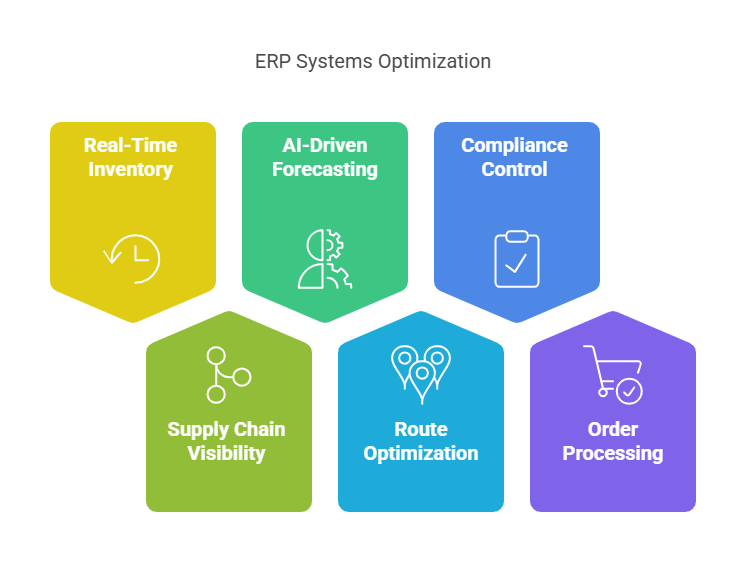
An ERP that caters exclusively to the needs of the produce industry provides a complete solution to overcome these challenges by automating processes, increasing visibility, and strengthening decision-making. Let us have a look at how:
Real-Time Inventory Management
ERP systems facilitate us by live tracking of stock levels and their expiration dates. This helps the distributors to move goods quickly across the supply chain.
Automated restocking prevents stockouts and overstocking, minimizing waste and saving costs.
For example, if a certain type of lettuce is low on stock, the system can automatically initiate purchase orders before stock gets very low.
Supply Chain Visibility and Coordination
Complete end-to-end traceability in fresh produce ERP enables tracking of the produce from the farm to the store while maintaining both compliance and quality.
ERP integration for fresh produce also connects suppliers, logistics providers, and retailers on a single platform and facilitates smooth coordination. This eliminates miscommunication and prevents delays caused by manual processes.
AI-Driven Demand Forecasting
By using past data and AI models, ERP accurately predicts seasonal demand.
Moreover, improved procurement and distribution minimize spoilage and prevent overproduction.
For example, if historical data shows an increase in demand for tomatoes during summer, the ERP system can suggest adjusting stock levels to meet it.
Route Optimization and Fleet Management
Fleet management is the process of monitoring and coordinating the vehicles that transport fresh produce, such as trucks, vans, refrigerated units, etc.
ERP improves fleet management, by chalking out the fastest routes and reducing transportation delays and fuel costs.
Also, the temperature tracking guarantees that perishable goods remain fresh during transit. A delivery truck equipped with IoT sensors can send instant alerts if the temperature rises beyond the pre-set safe levels.
Compliance & Quality Control
The automated documentation process further makes compliance with food safety standards such as FDA, HACCP, and GAP a breeze.
Quick audit trails enable producers to quickly prove compliance during inspections. This is very beneficial for exporters who must strictly meet international safety requirements.
Seamless Order Processing & Customer Management
Fast order fulfillment and invoicing are the secrets to keeping customers satisfied and businesses running smoothly.
ERP facilitates improved collaboration with distributors and retailers, guaranteeing on-time delivery.
For example, the ERP system may instantly alter the production and delivery schedules if a supermarket chain unexpectedly raises the number of its orders.
Why Choose AgriERP for Fresh Produce Distribution?
Selecting an ERP system is a make-or-break decision for the fresh produce business, you need a solution that fulfills the unique demands of fresh produce logistics.
AgriERP is developed exclusively for farmers, distributors, and agricultural businesses. It offers the following:
- Comprehensive Traceability: You can track every item from farm to fork, and guarantee compliance.
- AI-Led Demand Forecasting: With the power of AI, you can accurately predict seasonal demand, improve procurement, and minimize waste in produce distribution.
- Integrated Cold Chain Management: Maintain temperature control during storage and transit to elongate the shelf life of fresh produce.
- Automated Inventory and Order Management: You can avoid losses with the help of real-time tracking, expiration date monitoring, and optimized restocking.
- Regulatory Compliance: Automatically generate reports, maintain audit logs, and comply with the global food safety standards.
- Scalability and Cost-Effectiveness: From small farms to large distributors, AgriERP grows with you without breaking the bank, and scaling easily.
AgriERP is far more than just software, it is an intelligent, automated solution that makes your fresh produce business function more smoothly, profitably, and efficiently.
Conclusion
Efficiently managing fresh produce distribution with an ERP on your side has become essential in today’s tough market.
ERP solutions help firms simplify operations, minimize losses, and maintain quality, from logistics management and compliance to AI-led forecasting and inventory tracking.
Problems like supply chain disruptions, waste, and compliance issues can have a big effect on your bottom line without having an effective system in place.
So are you looking for an ERP software for agriculture that provides powerful features without involving unnecessary complexity?
If so, then AgriERP is your go-to solution that provides a budget-friendly, scalable solution customized to meet your fresh produce needs.
Do not be held back by inefficiencies, rather upgrade your operations today and watch your business thrive tomorrow!