The ERP Solution for the Year” 2025 in Agtech Breakthrough Awards 2025


If you are managing a large-scale agribusiness, you know that farming today is less about intuition and traditional methods and more about precision documentation and risk mitigation. The pressure on your farm to maintain safety standards, manage worker data, and trace every pound of produce has never been higher.
Modern growers face intense, constantly evolving compliance regulations in agriculture, from the stringent requirements of the Food Safety Modernization Act (FSMA), the Federal Insecticide, Fungicide, and Rodenticide Act (FIFRA), USDA export standards, and extensive EPA environmental rules. Non-compliance is no longer just a legal hurdle; it is a financial crisis waiting to happen.
To shift from reactive risk management to proactive certainty, an organization requires a solution built on an enterprise-grade foundation. A robust Microsoft-backed agriculture ERP like AgriERP, built on Microsoft’s globally trusted cloud infrastructure, provides this necessary security backbone.
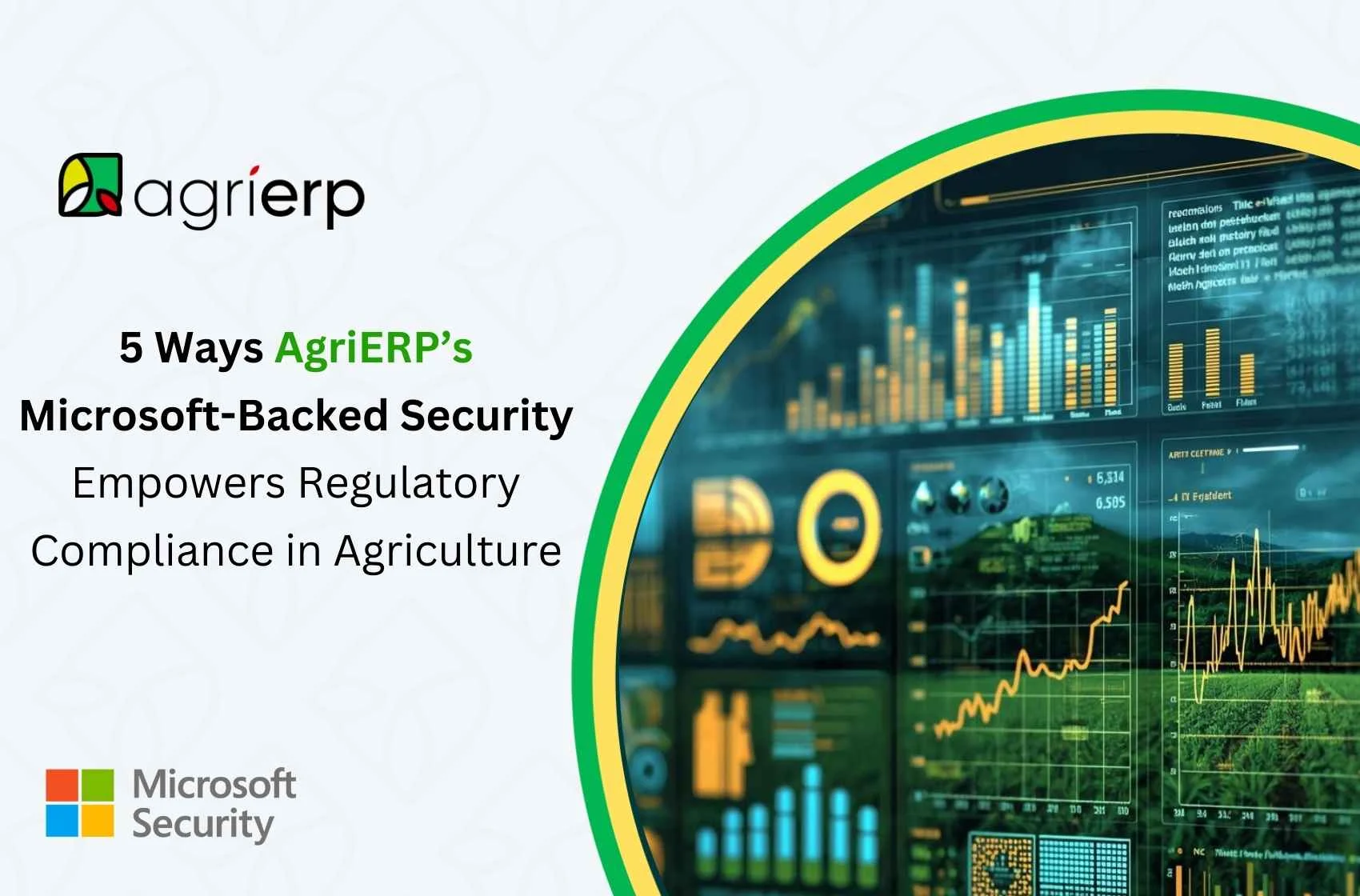
In this blog, we have highlighted the five ways AgriERP’s security empowers regulatory compliance of agriculture, giving large-scale operations the confidence and control needed to meet every regulatory demand.
The Compliance Burden Modern Farms Face
The sheer volume and complexity of federal and international requirements now necessitate a fully digital, integrated management approach. For large agribusinesses, failing to invest in modern solutions is choosing to accept disproportionate operational and financial risk.
Why Regulatory Compliance Matters More Than Ever
Regulatory bodies are rapidly embracing digital infrastructure, signaling a concurrent demand for data modernization within the industry. A significant precedent was set when the USDA chose to migrate 120,000 employees to the Microsoft Cloud, consolidating 21 disparate messaging systems into a single, trusted, security-enhanced enterprise solution.
This move was intended to streamline operations and achieve cost savings using a security-enhanced, enterprise-ready platform. This commitment to cloud migration by the primary regulator sets a clear benchmark for the expected level of security and consolidation in agricultural data management.
Large-scale farms must simultaneously manage the detailed requirements of multiple federal acts:
- FSMA Produce Safety Rule: Dictates that critical records, such as water system inspection logs and worker training documents, must be accurate, legible, indelible, dated, signed by the performing individual, and formally reviewed and signed by a supervisor.
- FIFRA and Worker Protection Standard (WPS): Requires extensive documentation regarding pesticide Restricted-Entry Intervals (REIs) and detailed worker training history, alongside measures for protecting sensitive worker safety data.
- Plant Protection Act: Governs the interstate and international movement of plant materials, requiring precise quarantine and disease spread prevention records.
- EPA Clean Water Act (CWA): Involves detailed logging related to pollutant discharge control and water quality monitoring, particularly under the National Pollutant Discharge Elimination System (NPDES) permit program.
Effectively managing this massive scope requires a unified, consolidated system to handle the myriad of rules under compliance regulations in agriculture.
Common Risks for Farms That Lack Adequate Data Security
Farms relying on legacy processes face significant operational vulnerabilities that translate directly into compliance risk.
- Operational Inefficiencies and Data Silos: Dependence on manual logging or unconnected software systems inherently creates data silos, preventing managers from seeing a complete, unified operational picture. This lack of integrated visibility is the primary obstacle to achieving rapid, field-to-fork traceability during a public health investigation.
- Human Error in Manual Logs: Paper-based or spreadsheet compliance introduces inherent human error into critical records. This inaccuracy or incompleteness can lead to immediate audit failures because the documentation fails to meet the stringent, legally mandated standards, such as the FSMA requirement for indelibility.
- Rising Cyber Threats in Critical Infrastructure: The agriculture sector is officially categorized as critical infrastructure and is now a high-value target for cybercrime. Cyberattacks are increasing due to the proliferation of IoT devices and the increasing data volume. Weak data security in agriculture leaves sensitive operational records and worker data exposed. Relying on basic, fragmented agriculture compliance software is inadequate when systems are under constant threat of ransomware and data exfiltration.
Why Microsoft Matters: The Foundation Behind AgriERP’s Compliance Strength
The security and reliability demands of modern agribusiness exceed the capabilities of localized, on-premise IT infrastructure. AgriERP provides an agriculture-specific solution built directly upon Microsoft’s proven global cloud platform, offering an immediate and powerful advantage.
Microsoft’s Global Compliance Framework Built for Agriculture
AgriERP benefits from Microsoft’s massive, sustained investment in enterprise compliance and regulatory clearance. Microsoft Azure is certified against hundreds of global and industry standards, including critical frameworks like ISO 27001, SOC 1, 2, and 3, and FedRAMP (for US Government systems). This compliance pedigree is central to AgriERP’s inherited Microsoft security compliance.
For large farms involved in global trade and export, this level of foundational certification is crucial. AgriERP’s foundation automatically facilitates compliance with international standards, such as the General Data Protection Regulation (GDPR), which is essential for managing global client data.
This baked-in Microsoft compliance agriculture capability is critical for accelerating market access and reducing the costs of undergoing separate, time-consuming compliance audits for individual jurisdictions.
Why USDA, Large Growers, and Food Distributors Trust Microsoft Cloud
The USDA’s decision to move its critical services to the Microsoft Cloud demonstrated the platform’s trusted ability to meet stringent federal security requirements, including adherence to the Federal Information Security Management Act (FISMA). This validation by the primary regulator ensures that AgriERP’s infrastructure is based on a proven foundation.
The Microsoft Cloud offers several advantages specific to securing agriculture’s unique operational data risks:
- End-to-End Encryption and Resilience: Microsoft ensures data is protected through encryption both at rest (when stored on Azure servers) using advanced standards like AES 256, and in transit (when moving between systems). This rigorous commitment forms the backbone of Microsoft security for agriculture.
- Operational Standardization: Large agribusinesses leverage Microsoft Dynamics 365 to standardize processes and improve data consistency across a distributed workforce. This resilience and standardization are critical components for achieving continuous Microsoft security agriculture compliance.
- Advanced Data Monitoring: The Azure platform incorporates advanced analytics and AI capabilities that can monitor integrated data sources, like IoT sensors and temperature logs, to detect safety issues, such as disruptions in the cold chain, helping prevent spoilage and food safety incidents before they require a public response.
5 Ways AgriERP’s Microsoft-Backed Security Empowers Regulatory Compliance in Agriculture

AgriERP’s platform combines Microsoft’s world-class security features with specialized agricultural regulatory modules, translating technological power into tangible compliance outcomes.
End-to-End Traceability to Meet FSMA and Global Export Requirements
Modern food safety legislation, particularly FSMA 204, demands rapid and comprehensive traceability. AgriERP addresses this by providing real-time, consolidated lot tracking, digitally linking every critical event from seed sourcing and field treatments to harvest, packing, and shipment. AgriERP functions as specialized regulatory software for agriculture by:
- Providing real-time, consolidated lot tracking from planting to shipment.
- Capturing necessary information, including lot codes, field ID, input usage, and quality metrics.
- Delivering the electronic, sortable spreadsheet that the FDA requires during an investigation. This capability minimizes the potential scope of a recall and provides undeniable proof of AgriERP regulatory compliance. The solution ensures legally defensible and comprehensive lot identification, a critical requirement for maintaining consumer trust and avoiding costly operational shutdowns.
Secure Data Management & Audit Trails Powered by Microsoft Cloud
The integrity and security of compliance records are fundamental. AgriERP utilizes Microsoft Azure’s enterprise-grade storage, which includes advanced encryption, immutable audit logging, and centralized identity protection via Microsoft Entra ID. AgriERP leverages Microsoft Cloud security to support compliance records by providing:
- Advanced encryption for data at rest and in transit.
- Enforced Multifactor Authentication (MFA) and Role-Based Access (RBAC) for critical access control.
- Immutable audit logs that track every user action, ensuring an irrefutable record of who accessed and modified data. This structure secures critical documentation such as pesticide application logs, water testing data, and worker training records, meeting the “legible and indelible” mandates while protecting against unauthorized access or modification.
Automated Reporting for Faster, Error-Free USDA & EPA Compliance
The manual process of compiling regulatory reports is prone to errors and consumes excessive labor hours. AgriERP eliminates this inefficiency by translating real-time field data, such as fertilizer application rates and water usage metrics, into pre-formatted, agency-ready reports automatically. The platform automates mandatory filings, simplifying compliance for:
- USDA APHIS reporting (for plant health records).
- FIFRA/WPS required documentation.
- EPA Clean Water Act compliance (for water quality logs).
Real-Time Monitoring & Alerts to Prevent Violations Before They Happen
Proactive compliance is achieved by leveraging the Internet of Things (IoT) infrastructure. AgriERP integrates operational data from IoT sensors, equipment telemetry, and defined regulatory schedules into its alert system. The system shifts compliance from reactive firefighting to proactive prevention by triggering alerts that mitigate critical risk events, such as:
- Alerts are triggered if harvest is scheduled before the required Pesticide Pre-Harvest Interval (PHI) has elapsed.
- Notifications that ensure water quality monitoring records are current, avoiding CWA and FSMA violations.
- Immediate alerts if storage temperatures fall outside regulatory limits, ensuring continuous product safety. This proactive approach, empowered by the real-time monitoring capabilities inherent in Microsoft security for agriculture, ensures continuous adherence to complex compliance regulations in agriculture, acting as an indispensable agriculture compliance software.
Role-Based Access Control That Protects Worker Data & Meets WPS Requirements
The management of employee data, especially sensitive training and health records, requires stringent privacy measures. AgriERP utilizes the powerful identity tools of Microsoft Entra ID to enforce granular Role-Based Access Control (RBAC).
The Worker Protection Standard (WPS) mandates the maintenance of detailed worker training and safety records. To protect this sensitive data, RBAC ensures security through:
- Strictly limiting access based on the employee’s function (need-to-know basis).
- Allowing only authorized personnel (e.g., HR or safety managers) to access sensitive worker health histories.
- Restricting field supervisors to only see operational information relevant to task assignments. This fulfills the data protection requirements inherent in Microsoft compliance agriculture and secures sensitive data critical to regulatory compliance agriculture ERP. This specialized layer of control protects the farm from internal data breaches and associated legal liabilities, minimizing the risk posed by unauthorized access.
How AgriERP Simplifies Compliance Across the Entire Farming Operation
AgriERP’s architecture is designed to ensure that regulatory demands are integrated seamlessly into daily workflows, preventing compliance from being treated as a separate, burdensome administrative task. This comprehensive approach unifies operational oversight.
Unified Compliance Dashboard
Executives gain a single, integrated view of all mandatory checks, pending regulatory deadlines, and real-time risk scores across all fields, processes, and sites. This centralization allows for immediate action and strategic allocation of compliance resources.
Automated Logs & Digital Recordkeeping
The platform eliminates reliance on unreliable paper systems. All critical data from soil input to harvest logistics is captured digitally at the point of origin, ensuring records are automatically compliant with FSMA’s stringent standards for immediate, indelible data capture and accessibility. This function is the core value proposition of effective regulatory software in agriculture.
Integration with Devices and Partners
AgriERP natively connects with farm infrastructure, including IoT sensors, autonomous equipment, and third-party packing house systems. This integration guarantees a continuous, verified data flow, eliminating manual transcription errors and strengthening the integrity of the audit trail.
Export-Readiness with Global Standards
Built-in modules simplify adherence to international food safety and trade standards, ensuring products meet global market entry requirements instantly. AgriERP provides comprehensive agriculture compliance solutions by unifying operational and compliance data on a single, trusted platform.
Conclusion
The escalating cost and complexity of regulations, coupled with growing cyber risks targeting critical infrastructure, mean that relying on legacy systems is an existential threat to modern agribusiness profitability.
AgriERP offers the definitive competitive advantage by combining the unmatched security and trust of Microsoft security agriculture compliance with deep, industry-specific features that automate and standardize your regulatory workflows.
Don’t wait for the next audit to expose your vulnerabilities. Book a demo to see how AgriERP simplifies your regulatory compliance in agriculture.