The ERP Solution for the Year” 2025 in Agtech Breakthrough Awards 2025


Key Takeaways
- Your Alternatives Cover More Ground: The top famous software alternatives offer cloud-native delivery, embedded AI, and in some cases full crop lifecycle management that Famous does not provide.
- Famous ERP Has Real Gaps: Despite 30+ years in the market, Famous ERP remains on-premise only with no cloud deployment and no AI capabilities, which is a real constraint for operations that need to move faster in 2026.
- Match the Tool to Your Operation: A large terminal market has different needs than a grower-packer. The right platform depends on where your operation sits in the supply chain.
- Traceability Is No Longer a Differentiator: Every serious platform on this list handles FSMA 204 compliance and lot-level traceability. The real differentiators in 2026 are cloud, AI, and farm-side capabilities.
- Take Action: If your current system cannot grow with your business, the cost of staying put is higher than the cost of switching.
Introduction
When was the last time your produce ERP got a meaningful update? Not a patch, but a real capability upgrade? If your operation runs on Famous ERP, the honest answer is probably: not recently. And that’s likely one of the many reasons you may be on the hunt for viable Famous Software Alternatives.
Famous has served fresh produce distributors well for over 30 years, and that track record is real. But the fresh produce industry in 2026 looks nothing like it did when Famous was architected. Cloud accessibility, embedded AI, real-time mobile visibility, and FSMA 204 compliance tooling are no longer extras your team can plan for later. They are what buyers expect now.
According to Panorama Consulting Group’s 2024 ERP Report, 78.6% of organizations implementing new ERP systems selected cloud deployment. This is the kind of figure that tells you that produce and fresh food companies don’t want to deal with the hassle of setting up, implementing, maintaining, and updating their infrastructure. Especially not when FSMA 204 traceability requirements mean that a compliance failure can carry consequences that far outweigh the cost of a platform migration.
This, of course, puts on-premise-only platforms like Famous ERP well outside the direction the market is moving. If your team is evaluating what comes next, this guide breaks down the five strongest Famous ERP alternatives: what each does well, where each falls short, and which type of operation each fits best.
What Should a Famous Software Alternative Actually Do in 2026?
Before comparing Famous Software Alternatives, it helps to be clear on what the category actually demands today. Generic ERP feature lists miss the specifics that make or break a fresh produce operation.
Lot and case-level traceability
FSMA 204 requires traceability to the case level across most fresh produce categories. Your ERP needs to capture this natively as part of the standard workflow, not through a workaround, a separate compliance module you configure post-go-live, or a data export to a spreadsheet.
When a recall event happens, which it will, your team needs to be able to execute a forward and backward trace in minutes, not hours. The system should make that fast, not require your compliance team to reconstruct records from multiple sources.
Grower and sourcing management
If your business sources from growers, you need purchase contracts, price-per-unit agreements, deduction tracking, settlement calculations, and payment management built into the system.
Running these processes in a spreadsheet alongside your ERP is not just operationally messy. It is a compliance and accuracy risk that grows with every new grower relationship you add. When grower payment data lives outside your ERP, the likelihood of discrepancies, delayed payments, and audit gaps rises with scale.
Perishability controls
FIFO, FEFO, shelf-life monitoring, and expiry alerts are non-negotiable for any system handling fresh product. If your ERP cannot automatically prioritize inventory nearing its shelf-life limit and surface that in the warehouse pick workflow, that’s a problem.
That means you are relying on manual oversight to catch what the system should catch automatically. At volume, that oversight fails. Margin goes to spoilage, not profit.
Cloud accessibility
Your team makes decisions at the dock, in the field, in the truck, and on the road. A system that only works from a desktop in a fixed location limits the speed and accuracy of every one of those decisions. While Famous ERP can be configured with remote access through VPN setups, that requires hiring a qualified network engineer and building out infrastructure your team has to maintain…on top of running a produce operation.
Cloud access is not a premium feature in 2026. It is the expected default, and the baseline expectation from any operation managing multiple sites, remote grower relationships, or distributed warehouse footprints.
AI and predictive tools
Demand forecasting, inventory optimization, and automated restocking alerts are standard expectations in enterprise software. If your ERP does not surface these insights automatically, your team is generating that analysis manually, or not at all.
In a category with tight margins, short shelf lives, and volatile supply, the operations that use AI to anticipate inventory needs rather than react to them will consistently outperform those that do not. This isn’t a case of what-ifs. These are gaps that are visible in the margin per pallet and the spoilage rate at the end of every week.
The 5 Best Famous Software Alternatives in 2026
Several Famous ERP Alternatives exist on the market today. Some of these platforms will be immediately right for your operation. Some will be immediately wrong. A few will require a harder look. Here is what you need to know about each one before you make the jump.
1. AgriERP: Best for Farm-to-Distribution Operations
Built on: Microsoft Dynamics 365 / Business Central / Oracle NetSuite
Deployment: SaaS, On-prem, Hybrid, Cloud
Best for: Growers, packers, shippers, and distributors managing both field operations and supply chain
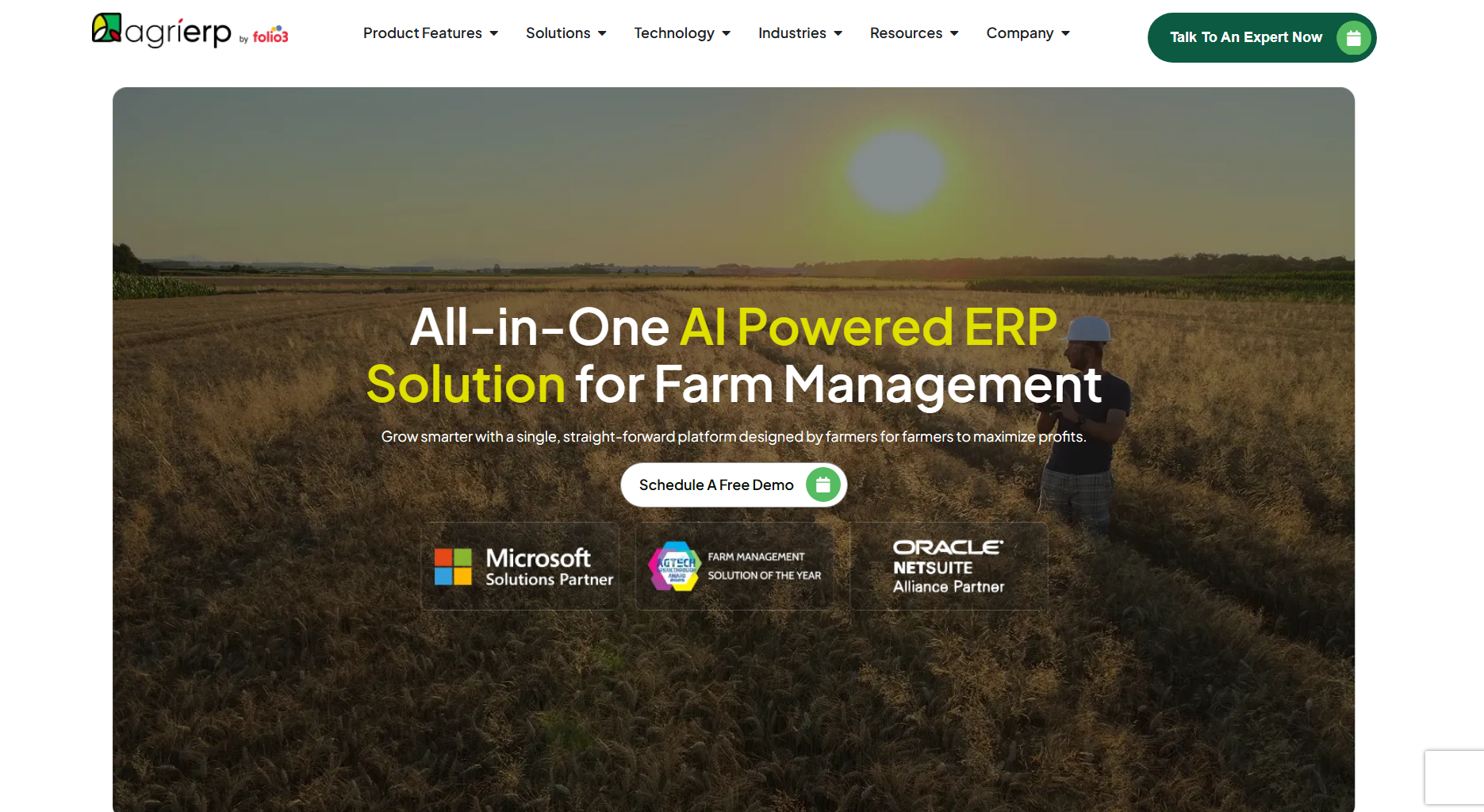
AgriERP covers more of the fresh produce supply chain than any other platform on this list. That breadth is its defining characteristic. And, depending on where your operation sits, it is either exactly what you need or more than you do. It covers the full agricultural lifecycle, from crop planning and soil management in the field, through packing, warehousing, and final distribution. Most produce ERPs, including Famous ERP, begin at the receiving dock. AgriERP begins at the farm.
Platform Flexibility
AgriERP runs on Microsoft Dynamics 365 and Business Central, which means it inherits the full Microsoft ecosystem: Azure cloud infrastructure, Power BI analytics, Microsoft Teams integration, and native Copilot AI. It is a modern, continuously updated platform that improves with every Microsoft release cycle, not a proprietary system running on architecture built a decade ago.
The platform also gives your team a choice: run it on Business Central for mid-market operations, Dynamics 365 for enterprise, or Oracle NetSuite if that is already your ERP backbone. No other produce-specific platform offers that kind of flexibility.
Domain Specific AI Automation
AI in AgriERP is not a separate analytics dashboard you check at the end of the week. AI agents automate tasks across finance, sales, reporting, and harvest planning, surfacing in the same screens your team already uses for daily operations. Irrigation scheduling adjusts automatically based on soil moisture data. Inventory restocking alerts fire before you run short, not after. Demand forecasting models pull from historical sales and seasonal patterns to surface recommendations your purchasing team can act on the same day.
This is a meaningful operational difference compared to Famous ERP, which has no AI capabilities as of 2026. If your team is currently doing demand analysis manually, building restocking schedules in spreadsheets, or managing irrigation based on fixed schedules rather than real-time soil data, those are exactly the workflows AgriERP is built to automate.
Coverage that starts at the field
For growers, the crop management module covers soil health tracking, fertilizer and pest management, irrigation scheduling, and harvest planning with resource allocation. These capabilities do not exist in Famous ERP, Farmsoft, or most other produce ERPs. If your operation grows what it distributes, AgriERP is the only platform that manages the full journey without a second system running alongside it.
To better understand how AgriERP handles the field-to-distribution workflow, explore the AgriERP fresh produce ERP page for a breakdown of features by operation type.
Where to be realistic
AgriERP’s produce-specific iTradeNetwork EDI integration is less established than Famous ERP’s FIS module. Instead it uses middleware to connect your ERP to other tools. Unless you’re invested in EDI, this isn’t a major problem, as middleware is often a far superior ERP integration method to EDI or API.
AgriERP is the right choice if your operation covers both the farm and the packhouse, you want cloud-native deployment on a modern Microsoft or Oracle platform, and you want AI tools embedded across the system today, not on a future roadmap.
Schedule a free AgriERP demo to see the platform in action.
Pros:
- Full farm-to-distribution coverage: The only platform on this list that manages crop planning, soil health, irrigation, and harvest alongside packing, warehousing, and sales, all in one system.
- Cloud-native on Microsoft Azure: Deploy on Dynamics 365, Business Central, or NetSuite with full remote access, automatic updates, and multi-site visibility from day one.
- Embedded AI across all modules: AI agents automate tasks in finance, sales, reporting, and harvest planning, built into the same screens your team already uses.
- Multi-ERP flexibility: Run AgriERP on the ERP backbone that fits your business today, with the ability to scale as your operation grows, without platform lock-in.
- Broad industry coverage: Dedicated solutions for almonds, pistachios, potato, leafy greens, berries, citrus, row crops, greenhouse, and vertical farming. The platform adapts to your crop type rather than forcing you to adapt to it
Cons:
- iTradeNetwork EDI is less established: For operations with deep existing iTradeNetwork dependencies, AgriERP’s EDI coverage is newer than Famous ERP’s long-running FIS integration and may require additional configuration during migration.
2. Aptean Fresh Produce ERP (formerly Produce Pro): Best Enterprise Distribution Platform
Built on: Microsoft Business Central Deployment: Cloud-native Best for: Large produce distributors, wholesalers, foodservice providers, and terminal markets
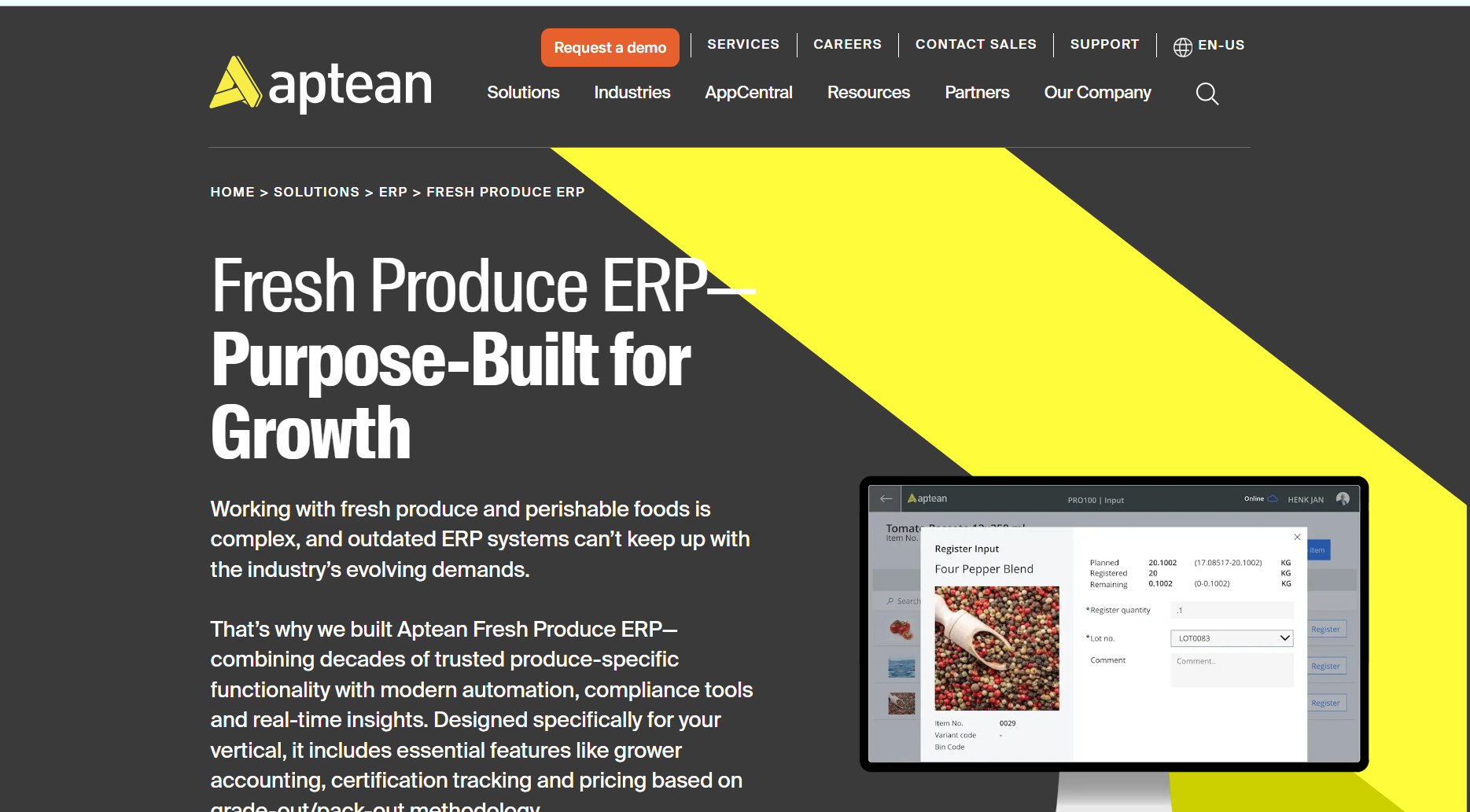
Aptean Fresh Produce ERP is the most direct competition to Famous ERP in the enterprise distribution segment. It is the evolution of Produce Pro Software, which spent 30 years as the operational backbone for large produce distributors across North America before Aptean acquired and relaunched it on a cloud-native, AI-powered architecture in 2025.
What Aptean brings that Famous does not
Aptean keeps the operational depth that made Produce Pro the market standard. That means FIFO and FEFO inventory management, shelf-life tracking, lot-level traceability, and a large installed base of enterprise produce customers, now with cloud-native delivery, Business Central infrastructure, and AI-powered analytics added on top. Optional TMS, EDI, e-commerce, and BI modules give it breadth comparable to Famous ERP’s full product suite, but with a modern cloud platform underneath.
For operations that were previously Produce Pro customers, or that need deep feature coverage for large-scale distribution, Aptean Fresh Produce ERP is the most complete Famous ERP replacement available today. According to Aptean’s product announcement, the platform was designed to bring decades of produce expertise into a cloud-native architecture built for a fast-moving, high-stakes market.
Where it falls short
Like Famous ERP, Aptean Fresh Produce ERP does not cover farm-level operations. No crop management, irrigation, or soil tracking. It is a post-harvest distribution platform from the receiving dock forward. Implementation timelines and costs at enterprise scale can also be significant. This is not a platform your team configures in a few weeks.
Aptean is the right choice for terminal markets, large wholesalers, and foodservice distributors that need maximum feature depth for post-harvest distribution and are comfortable with enterprise implementation complexity.
Pros:
- Proven installed base: Built on 30 years of Produce Pro’s produce-specific expertise, with an established base of large North American distributors who have used the platform through repeated industry changes.
- Cloud-native with modern AI: Relaunched on Microsoft Business Central in 2025, bringing the operational depth of Produce Pro into a cloud architecture with AI-powered analytics and Microsoft Copilot capabilities.
- Comprehensive distribution modules: FIFO and FEFO inventory management, shelf-life tracking, lot-level traceability, and optional TMS, EDI, e-commerce, and BI modules cover the full distribution workflow.
- Strong FSMA 204 and compliance tooling: Built for the compliance requirements of large-scale produce distribution, with recall management and food safety reporting in the core platform.
Cons:
- No farm-side coverage: Aptean covers the supply chain from the dock forward. Operations that also manage growing, harvesting, or field logistics will still need a separate system for that side of the business. It is the same limitation that drives many produce companies away from Famous ERP in the first place
- Enterprise implementation overhead: The platform’s depth comes with implementation complexity and cost that can stretch timelines considerably for large operations, making it a significant commitment before you see any return on the investment.
3. Farmsoft: Best for Packhouses and Mid-Sized Packers
Built on: Proprietary SaaS Deployment: Cloud, multi-site Best for: Fresh produce packers, processors, and fruit and vegetable exporters
What if you need serious traceability and grower payment automation, but you do not need, or cannot justify, a full enterprise ERP? Farmsoft is built for exactly that position. It is a cloud-based fresh produce management platform focused on packing, quality control, and traceability, deploying in days at a fraction of the cost of Famous ERP or Aptean.
Traceability that goes beyond lot-level
Farmsoft’s traceability is multi-level and cascading, meaning it tracks how produce moves through processing batches and into subsequent batches, something many competitor platforms do not handle at this depth. Instant recall capability covers multiple criteria simultaneously: lot number, invoice, purchase order, delivery date, pallet number. For quality and compliance teams, that flexibility matters during an audit or an actual recall event.
The quality control workflow is a standout based on user reviews. Mobile QC tablets guide staff through inspection processes step by step, automatically triggering corrective actions when quality issues are detected. Your QC manager can see in real time whether inspections are happening on time and by the right people, rather than finding out during an audit that records were incomplete.
To better understand how produce traceability requirements have changed under FSMA 204, read our guide to FSMA 204 compliance for fresh produce operations.
Where it falls short
Farmsoft does not include full financial management. No general ledger, no multi-entity accounting. It works alongside a separate accounting system, which creates an integration dependency that Famous ERP’s full-stack approach avoids. For large distribution operations needing enterprise shipping management and dock scheduling, Famous ERP’s depth is not replicated here.
Farmsoft is the right choice for mid-sized packers, processors, and exporters that need strong traceability and QC without the cost and complexity of a full enterprise ERP.
Pros:
- Multi-level cascading traceability: Tracks produce through multiple processing batches in sequence, with instant multi-criteria recall capability that goes deeper than the standard lot-level traceability most platforms offer.
- Fast deployment at low cost: Configures in days rather than months at a starting price around $500 per month, making it accessible for operations that cannot absorb an enterprise ERP budget or timeline.
- Mobile QC with automated corrective actions: Step-by-step guided inspections on mobile tablets automatically trigger corrective action workflows when quality issues are detected, keeping your compliance process consistent without manual follow-up.
- Automated grower payment calculations: Grower settlement and payment processing is automated within the platform, removing a manual process that many operations still manage in spreadsheets.
Cons:
- No general ledger or full financial management: Farmsoft requires a separate accounting system to run alongside it, which means your financial data and operational data live in two places, a gap that full-stack platforms like AgriERP do not have.
- No AI or predictive capabilities: Farmsoft does not include demand forecasting, automated restocking, or any AI-driven insight tools. As these capabilities become standard in the category, the gap between Farmsoft and more modern platforms will widen over time.
4. Inecta Food: Best for Broad Food Industry Coverage
Built on: Microsoft Dynamics 365 Business Central Deployment: Cloud Best for: Produce distributors, food manufacturers, and agribusinesses managing multiple product categories
Does your business handle more than fresh produce? If you process or distribute across seafood, dairy, meat, or other food categories alongside your produce operation, Inecta Food gives you a single Microsoft-based ERP that covers the full food industry without requiring separate platforms by category.
Full ERP on a modern Microsoft stack
Inecta covers the complete ERP spectrum: financial management, purchasing, sales, inventory, HR, EDI, reporting, HACCP compliance, catch-weight management, and recall management, all within Business Central. The integrated WMS is particularly strong for produce distributors managing complex warehouse operations across multiple temperature zones and product types.
Being built on Business Central also means Inecta benefits directly from Microsoft’s ongoing AI investment. As Copilot capabilities expand across the Business Central platform, Inecta customers receive those improvements without waiting on a niche vendor’s development cycle.
Where it falls short
Inecta serves many food sub-verticals, which means it is less deeply specialized in fresh produce than Famous ERP, Aptean, or AgriERP. Grower settlement management and produce-specific EDI networks like iTradeNetwork are less prominent in Inecta’s feature set. The breadth of the platform can also make implementation more complex than a purpose-built produce tool, particularly for operations that only need produce-specific functionality.
Inecta is the right choice for mid-to-large food businesses that process or distribute across multiple categories and want a single Microsoft-based ERP rather than a produce-only system.
Pros:
- Complete ERP on Business Central: Financial management, purchasing, sales, inventory, HR, EDI, HACCP compliance, catch-weight management, and WMS in a single cloud platform. Nothing needs to be bolted on separately.
- Microsoft AI roadmap included: Copilot and AI improvements flow into Inecta automatically as Microsoft develops them, so customers benefit from platform-wide AI advances without waiting on a niche vendor’s development cycle.
- Strong multi-category food coverage: Handles seafood, dairy, meat, and other food categories alongside produce in one system, which is a genuine advantage for businesses that distribute across multiple product lines.
- Integrated WMS for complex warehouse environments: Particularly capable for operations managing multiple temperature zones, catch weights, and varied product types across large warehouse footprints.
Cons:
- Less produce-specific depth: Inecta’s breadth across food categories means it is not as finely tuned to fresh produce workflows as platforms built exclusively for the industry. Grower settlement management and produce-specific EDI are less developed, which matters if those are core to your operation.
- Implementation complexity for produce-only operations: If your business is purely fresh produce, the broad scope of Inecta’s platform can make implementation longer and more involved than a purpose-built tool would require, adding time and cost without adding relevant functionality.
5. Croptracker: Best for Growers Focused on Compliance and Labor Tracking
Built on: Proprietary cloud SaaS Deployment: Cloud, mobile-first Best for: Fresh produce growers, orchard operations, and packhouses prioritizing compliance and labor management
Not every operation needs a full ERP. If your primary pain points are food safety compliance, audit readiness, and agricultural labor records, and you want a system that works from the field on a mobile device. Croptracker covers those needs at considerably lower cost and complexity than any full ERP on this list.
Built for field teams, not just office staff
Croptracker is mobile-first by design. Your harvest crew can log activities, record lot information, and complete QC inspections from the field on any device. That real-time data capture feeds directly into compliance records and audit logs, so your food safety documentation builds itself as your team works, rather than in a catch-up data-entry session at the end of the week.
For growers managing agricultural labor compliance, Croptracker’s labor tracking captures the records you need for food safety audits and regulatory reporting without a separate HR or payroll system.
Where it falls short
Croptracker is not a full ERP. No general ledger, no multi-entity financial management, no EDI, no enterprise warehouse management, and no grower settlement accounting. Operations that need finance, purchasing, sales, and supply chain in a single platform will find its scope too narrow.
Croptracker is the right choice for smaller growers, orchard operators, and packing shed operations that need compliance, traceability, and labor tracking without the overhead of a full ERP deployment.
Pros:
- Mobile-first field access: Designed specifically for field use, so your harvest crew and QC staff can log data, complete inspections, and record lot information on any device without returning to a desktop.
- Low cost and fast setup: One of the most accessible options on this list for smaller operations, with a straightforward setup process that does not require a lengthy implementation project.
- Strong compliance and audit tooling: Food safety audit records, labor compliance documentation, and lot traceability build automatically as your team works, reducing the administrative burden of audit preparation.
- Specialist depth in labor tracking: Agricultural labor records, task assignments, and compliance documentation are handled with more precision than most full ERPs offer as a secondary module.
Cons:
- Not a full ERP: Croptracker covers compliance and field operations well, but has no financial management, grower settlements, sales order management, or warehouse management. As your operation grows, you will likely need a full ERP alongside it, or instead of it.
- Limited scalability for complex operations: The platform is built for smaller growers and packhouses. Operations managing multiple sites, large distribution networks, or complex supply chain workflows will reach the ceiling of what Croptracker can support relatively quickly.
Which Famous Software Alternatives Fit Your Operation?
Famous Software alternatives are a dime a dozen, but that that doesn’t mean every option is the right fit for you. Here is how you can decide which option to choose based on your requirements:
- If your operation spans both the farm and the packhouse: AgriERP is the only platform that covers the full lifecycle without a second system. The cloud and AI capabilities make it the most future-ready investment on this list.
- If your team is accustomed to legacy produce ERP workflows: Aptean Fresh Produce ERP offers a recognizable environment for existing users. However, it is often evaluated by companies seeking incremental change rather than broader operational transformation.
- If you are a mid-sized packer or processor watching costs: Farmsoft delivers strong traceability and grower payment tools at a fraction of the enterprise price, deploying in days rather than months.
- If your business spans multiple food categories: Inecta Food on Business Central gives you the widest functional coverage with Microsoft’s full ecosystem behind it.
- If you are a smaller grower prioritizing compliance and labor records: Croptracker handles field-level compliance and traceability without the complexity or cost of a full ERP deployment.
Need to Migrate from Famous Software?
Your produce operation moves fast. Your ERP should keep up. AgriERP is one of the best famous software alternatives built for businesses that need a platform as modern as the market demands, cloud-native, AI-powered, and covering the full journey from field to customer.
Schedule a free demo with the AgriERP team to see how it compares to your current system and whether it fits your operation.
Related reading:
- To understand the specific traceability requirements your ERP must meet, read our guide to FSMA 204 compliance for fresh produce operations.
- For a deeper look at how AgriERP handles grower-side operations, explore the AgriERP grower management module overview.
Frequently Asked Questions
What is Famous Software ERP used for?
Famous Software ERP is an enterprise resource planning system designed for fresh produce distributors, wholesalers, growers, packers, and shippers. It covers inventory management, sales order management, grower sourcing and settlement management, and financial management including agricultural payroll. Famous ERP runs on an Oracle database and is deployed on-premise, meaning it does not currently offer a cloud-hosted option. It has an installed base of over 1,500 enterprise sites, primarily in North America.
Why would a produce company switch away from Famous ERP?
The most common reasons produce operations consider switching from Famous ERP are its on-premise-only deployment, the absence of AI or predictive analytics capabilities, and limited coverage of farm-side operations. As fresh produce businesses grow to include grower-side management, field data, and crop planning alongside distribution, Famous ERP’s scope, which begins at the packing and receiving stage, becomes a constraint. Cloud accessibility for remote teams at docks, in the field, and on the road is also a frequent driver of migration conversations.
Are there cloud-based Famous Software Alternatives?
Yes. Every platform on this list offers cloud deployment, which Famous ERP does not. AgriERP runs on Microsoft Azure via Dynamics 365 and Business Central. Aptean Fresh Produce ERP (formerly Produce Pro) is cloud-native on Business Central. Farmsoft and Croptracker are cloud SaaS platforms. Inecta Food runs on Business Central in the cloud. For operations that need remote access, automatic updates, and multi-site visibility without managing on-premise infrastructure, any of these alternatives addresses that gap.
What is the best fresh produce ERP for a grower-packer operation?
AgriERP is the strongest fit for a grower-packer operation because it covers both sides of the business in one platform. It manages crop planning, soil health, irrigation, fertilizer, pest management, and harvest logistics on the farm side, then handles packing, warehousing, sales, and distribution on the supply chain side. Most other fresh produce ERPs, including Famous ERP, Aptean, and Farmsoft, cover only the post-harvest portion of that workflow, which means a grower-packer would need a second system for field management. To see how AgriERP handles your specific operation, book a free demo with the AgriERP team.
How does AgriERP compare to Famous ERP on traceability?
Both platforms support lot-level and case-level traceability for FSMA 204 compliance, including forward and backward recall capability. Famous ERP has 30 years of produce-specific traceability tooling and granular documentation at the individual case level. AgriERP’s traceability covers the full chain from seed to delivery, tracking product from field inputs through to the end customer, a scope that Famous ERP, which begins at the receiving dock, does not match. For operations where traceability must start before the packing shed, AgriERP covers ground that Famous ERP cannot.
What should a fresh produce company look for when replacing Famous ERP?
When replacing Famous ERP, the key questions to answer are: does the replacement offer cloud deployment for remote and multi-site access; does it cover grower settlement management and agricultural payroll if those are part of your operation; does it have native FSMA 204 traceability tooling; and does its scope match where your operation sits in the supply chain: farm, packhouse, distribution, or all three. For operations that only need post-harvest distribution, Aptean Fresh Produce ERP is the closest feature match. For operations that also manage the farm, AgriERP is the more complete replacement.