The ERP Solution for the Year” 2025 in Agtech Breakthrough Awards 2025


Many agribusinesses still attempt to fit their uniquely dynamic operations into rigid, generic Enterprise Resource Planning (ERP) platforms designed for stable manufacturing floors. These generic systems often prove incapable of managing the biological variability and seasonal complexities inherent to farming.
The reality is that technological integration is no longer an optional upgrade; it is a competitive necessity. The global AgTech market is projected to reach an estimated $56.6 Billion by 2032, reflecting a 15% Compound Annual Growth Rate (CAGR), demonstrating a massive industry shift toward specialized tools.
In this blog, we will explore the critical differences between generic and agriculture-specific ERP, review 10 leading US-based top agricultural software solutions, and provide a strategic roadmap for adopting the right best agriculture ERP software for your enterprise.
Generic vs. Agriculture ERP: Why You Cannot Afford a Mismatch
Attempting to manage a modern agribusiness with a generic ERP is often an exercise in frustration and risk management failure. The fundamental challenge lies in the nature of agricultural operations, which are driven by perishable inventory, seasonal cycles, and biological variables like weather and pests. Generic systems struggle to manage this complexity, leading to operational uncertainty that translates directly into financial risk.
A specialized ERP for the agriculture industry is essential because generic systems fail in four key strategic areas critical to profitability:
1. Biological Inventory and Yield Variability
Standard ERPs track static inventory (SKUs) suitable for manufacturing, but they cannot manage dynamic, perishable agricultural inventory. Crop yields are highly variable based on climate and in-season inputs.
Generic systems cannot integrate with field technologies (e.g., IoT sensors) to forecast yields accurately or link data to crucial variables like soil moisture and fertilizer allocation, compromising sales forecasting and creating potential supply chain inefficiencies.
A specialized platform tracks genetics, quality, and dynamic input allocation, managing perishable commodities essential for high-value crops.
2. Financial Oversight and Cost-Per-Yield
The strategic goal is not just tracking the cost of goods sold, but profitability realized down to the specific field or management practice. A generic accounting module only sees a general expense, but a specialized agricultural business erp links input costs (e.g., fertilizer) directly to a geo-fenced plot’s eventual yield and revenue.
This provides finance teams with field-level profitability analysis and real-time cost-per-unit metrics, enabling informed decisions on land use, rotation, and procurement strategy. This seamless integrated data flow unlocks true strategic oversight.
3. Compliance and Traceability
Generic systems offer only limited record-keeping and manual audit support. In contrast, agriculture ERPs ensure automated, bi-directional traceability (Farm-to-Fork) and real-time regulatory reporting, which is essential for audit readiness and food safety mandates.
4. Supply Chain Management
Generic platforms assume linear, stable processes. Specialized agriculture software, however, adapts to the reality of seasonality, extreme weather variability, and short harvest windows, optimizing refrigerated logistics and ensuring efficiency across the dynamic ag supply chain.
Top Agriculture ERP Alternatives Beyond Generic ERP Software
To help your organization achieve strategic alignment between field operations, financial management, and compliance, we have compiled 10 leading US-based agriculture ERP alternatives designed for specialized needs within the industry.
1. AgriERP
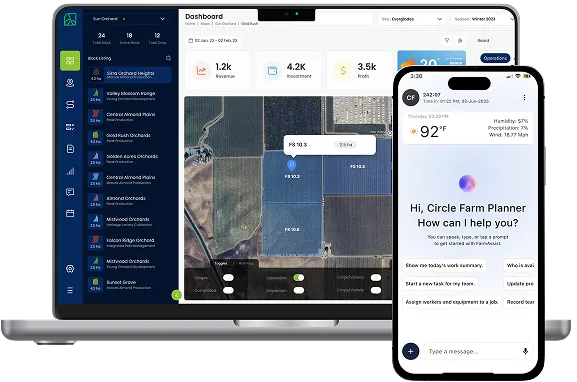
Key Features: AgriERP provides an all-in-one Integrated ERP Suite for Farm Management, built on the highly secure and scalable Microsoft Dynamics 365 platform. It manages end-to-end operational activities, including financial management, season planning, crop lifecycle management, supply chain logistics, and sales and contracting. It offers customizable tools for precision farming and predictive analytics.
Best For: Large, complex agribusinesses and multinational corporations requiring a centralized, holistic, and future-proof enterprise ERP solution. AgriERP offers a tiered approach (Lite, Standard, Advanced) allowing large operations to select the package that precisely matches their need for advanced financial management, rigorous quality control, and integrated supply chain logistics on a scalable Dynamics 365 foundation.
2. Conservis
Key Features: Conservis offers comprehensive tracking of inputs, field activities, and associated costs during both production and harvest seasons. It is known for its ability to integrate with external agricultural technologies, such as John Deere and Climate FieldView, which allows for the automatic creation of application and harvest tickets. This capability provides an essential, real-time overview of day-to-day processes.
Best For: Large, diversified row crop operations requiring superior integration with heavy farm equipment telemetry and detailed, easily auditable cost-per-field tracking.
3. Agsquared
Key Features: This solution focuses intensely on detailed farm management planning and operational execution. It provides robust tools for field mapping, precise task assignment for labor and machinery, and sophisticated input logistics planning necessary for complex crop rotations and sequencing.
Best For: Agribusinesses prioritizing centralized, end-to-end farm management planning and streamlined documentation for quality assurance across large, complex acreages.
4. ProducePro
Key Features: ProducePro offers deep specialization in the fresh produce supply chain, focusing on minimizing spoilage and maximizing inventory turnover. Key functionalities include robust inventory management for highly perishable items, optimized warehouse management, and instant logistics coordination across distribution networks.
Best For: Wholesale fresh produce distributors, large packing operations, and shippers where rapid movement, minimal spoilage, and high-volume, dynamic order fulfillment are critical to profitability.
5. Aptean
Key Features: Built on an enterprise-grade ERP architecture, Aptean is specifically designed to handle the volatile pricing, complex spot procurement, and long-term sales contracts unique to the fresh produce trade. It is equipped to address multi-jurisdictional compliance and global trade requirements for perishable tracking.
Best For: Global agribusinesses, importers, exporters, and large packers involved in sourcing and distributing fresh commodities internationally.
6. JustFoodERP
Key Features: This solution is explicitly built for food manufacturers and distributors. It offers critical functionality for managing food quality and safety, including bi-directional ingredient and finished product traceability, allergen management, and quality hold management.
Best For: Agribusinesses engaged in food processing (e.g., meat, dairy, grain milling, packaged goods) that require auditable, end-to-end food safety protocols and immediate recall readiness.
7. Inecta
Key Features: Often focused on the scalable Microsoft Dynamics 365 Business Central (BC) platform. Inecta provides strong emphasis on lot tracking, catch weight management (where product weight varies), and quality control specific to sectors like meat, seafood, and poultry processing. It is designed to streamline complex regulatory reporting.
Best For: Agribusinesses involved in complex batch-based food manufacturing, aquaculture, or meat processing that need a flexible, scalable, and Dynamics-based foundation.
8. FBS Systems
Key Features: FBS Systems is renowned for its comprehensive farm financial and accounting modules. It offers excellent inventory tracking capabilities for essential inputs like seeds, fertilizers, and feed. Importantly, it facilitates online bidding and procurement of these inputs, helping optimize purchasing and ensuring best pricing.
Best For: Cooperatives and large farms where detailed financial reporting, granular budgeting, and proactive input supply chain management are the core drivers of business decisions.
9. Argos Software
Key Features: Argos provides an integrated solution covering back-office functions specific to farming: automated accounting, detailed Payroll and Human Resources management for complex seasonal labor, and robust Farming & Equipment Asset Management. It ensures assets are utilized efficiently and maintenance is tracked seamlessly, contributing to reduced capital costs.
Best For: Large farming operations that manage significant machinery capital assets and complex seasonal workforces, requiring integrated cost tracking across finance, maintenance, and human resources.
10. Redbud
Key Features: Redbud focuses specifically on modern Greenhouse Management Software for Controlled Environment Agriculture (CEA). Key features include automated pest management tracking, detailed equipment maintenance scheduling, and advanced lab testing and sample capabilities to ensure regulatory compliance and optimal growing conditions.
Best For: Indoor farming, hydroponic/aquaponic facilities, and large-scale greenhouse operators requiring precise, climate-controlled, resource monitoring and compliance documentation.
Summary Table: Top 10 Specialized US Agriculture ERP Solutions Comparison
Farm ERP Solution | Primary Specialization | Key Strategic Advantage |
| AgriERP | Integrated Dynamics 365 Farm Management | Holistic management of financials, crop lifecycle, and supply chain on a scalable platform. |
Conservis | Large-Scale Field Operations | Real-time input tracking & cost monitoring across diverse crops. |
| Agsquared | Farm Management & Planning | Centralized crop rotation planning and detailed input logistics. |
ProducePro | Fresh Produce & Distribution | Optimized warehouse management and streamlined cold chain logistics. |
| Aptean | Perishable Supply Chain & Trading | Management of volatile pricing, sales contracts, and global trade compliance. |
JustFoodERP | Food Manufacturing & Processing | Superior bi-directional traceability and stringent food safety compliance. |
| Inecta (Food ERP) | Food and agriculture supply chain, from farming and processing to distribution | Enhanced batch/lot tracking, quality control, and catch weight management. |
FBS Systems | Farm Accounting & Input Inventory | Detailed cost accounting and proactive input supply level management. |
| Argos Software | Comprehensive Farm Financials & Assets | Integrated payroll, equipment asset management, and core financial linkage. |
Redbud | Controlled Environment Agriculture (CEA) | Integrated lab testing, precise resource monitoring, and compliant CEA documentation. |
Conclusion
The decision to invest in a specialized ERP for the agriculture industry is a core strategic move that defines your enterprise’s longevity and competitive edge in a volatile global market. By selecting one of the agriculture ERP alternatives listed above, you are ensuring your operations are scalable, compliant, and data-optimized from the field to the financial ledger.
If your organization requires a holistic, centralized, and future-proof agricultural business ERP solution designed for large-scale, data-driven precision farming, we encourage you to explore the capabilities of AgriERP. Built on the secure and highly scalable foundation of Microsoft Dynamics 365, AgriERP offers a comprehensive suite managing everything from farm financials and crop lifecycle management to logistics and sales contracting.
Ready to unify your entire agribusiness and gain true operational visibility? Contact AgriERP today to schedule a strategic assessment.