The ERP Solution for the Year” 2025 in Agtech Breakthrough Awards 2025


By 2037, the world’s population is projected to reach 9 billion. With climate change straining water supplies, geopolitical shocks disrupting supply chains, and an expanding global population demanding diverse diets, the question isn’t whether agriculture matters; it’s how we harness its full potential.
The sector’s productivity and resilience underpin everything from national security to corporate profitability. But why is agriculture important beyond merely producing food? This article unpacks the economic, social, and environmental significance of agriculture for business leaders looking to navigate today’s complex agribusiness landscape.
In this blog, you will discover the advantages of agriculture, its positive effects on society and the economy, and how strategic investments in sustainable farming can unlock new growth.
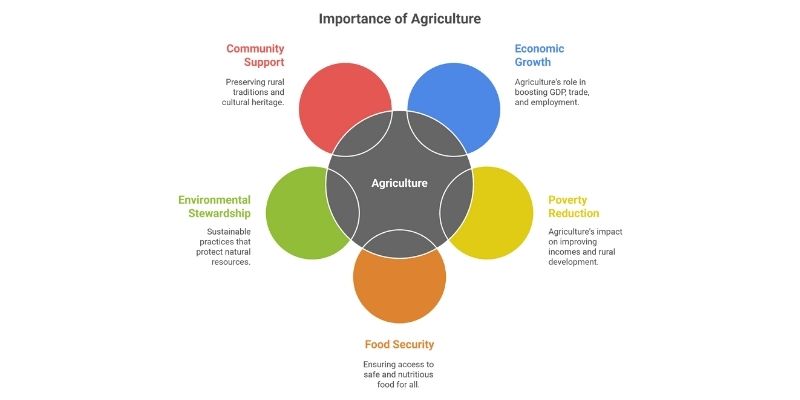
The Importance of Agriculture to Economic Growth
1. Agriculture Fuels GDP and Trade
In the United States, the Department of Agriculture estimates that agriculture and food industries contribute over $1.5 trillion to the country’s GDP, or about 5.5% of total GDP, with farms themselves generating roughly $222 billion.
These figures highlight that agriculture is not a peripheral sector; it is a critical driver of agriculture and economic growth for both industrialized and emerging economies.
Agriculture also stimulates trade and export revenues. For developing nations, agricultural exports are often the primary source of foreign exchange. As you consider global expansion or supply‑chain diversification, understanding how agriculture helps the economy will inform decisions on sourcing, investments, and partnerships.
2. Agriculture as a Poverty-Reduction Engine
World Bank analysis shows that growth in agriculture is two to four times more effective at raising incomes among the poorest populations than growth originating in other sectors. In many low-income economies, agriculture accounts for more than 25% of GDP, compared with about 4% globally.
Investing in farming technology, training, and infrastructure, therefore, delivers outsized benefits for poverty reduction and rural development. For agribusiness executives, these findings underscore the significance of agriculture not only as a revenue stream but also as a strategic tool for stabilizing communities and expanding consumer markets.
3. Agriculture Supports Millions of Jobs
The agrifood system provides livelihoods for a significant portion of the global workforce. The FAO’s 2025 employment update shows that two out of every five employed people worldwide work in agrifood systems.
While farming’s share of employment declines with urbanization, the broader agrifood system, including processing, logistics, and retail, continues to grow, ensuring agriculture’s importance to employment.
Corporate strategies that support rural workforce development, such as training in modern agronomy or digital supply‑chain management, can mitigate labor shortages and foster social license to operate.
4. Impact of Agriculture on Government Revenues
Agriculture’s contribution to tax revenues and public goods is often overlooked. Crop and livestock exports create fiscal space for governments to invest in infrastructure, education, and health. Additionally, farmland is a major asset on corporate balance sheets, affecting property taxes and investment returns.
When evaluating the impact of agriculture on public finances, leaders must consider how changes in commodity prices, subsidies, and trade policies ripple through government budgets and influence macroeconomic stability.
Benefits of Agriculture: Feeding and Fueling Society
1. Ensuring Food Security and Nutrition
Fundamentally, agriculture is the guarantee of the existence of humankind since it provides safe and healthy food. With technological progress, hunger is an urgent problem. The value of agriculture globally has gone up significantly, but to feed an increasing population, there should be a closure in yield gaps, post-harvest losses, and distribution.
Adjustments in agriculture, such as modern high-yield crops, precision irrigation, and controlled-environment agriculture, are some of the benefits of agriculture that allow farmers to produce more using less input.
2. Providing Raw Materials
The advantages of agriculture extend beyond food. Farms produce fibers (cotton, hemp), biofuels (corn, sugarcane), oils (soybean, palm), timber, medicinal plants, and biochemicals used in pharmaceuticals, cosmetics, and bioplastics.
As industries look to decarbonize, demand for bio‑based alternatives will likely increase, creating new revenue streams for agribusinesses and opportunities for circular economy models.
3. Sustaining Rural Communities and Cultural Heritage
Farming is more than an economic activity; it forms the backbone of rural communities, preserving traditions and landscapes. Small farms maintain agricultural biodiversity by cultivating local crop varieties and livestock breeds.
These systems support cultural heritage, local cuisines, and agritourism. Agribusiness leaders who respect and invest in community-based farming not only secure supply but also build brand trust among consumers seeking authentic, ethically sourced products.
4. Health and Well‑Being
A thriving agricultural sector supports public health in multiple ways. Diverse diets rich in fruits, vegetables, and whole grains lower the risk of chronic diseases. Farming also offers psychological benefits; contact with soil and nature reduces stress and promotes mental well‑being.
Corporate wellness programs that encourage employee engagement with gardening and local farms can enhance workforce morale while promoting sustainability.
Agriculture’s Role in Society and the Environment
1. Stewardship of Natural Resources
Agriculture is deeply intertwined with natural resource management. It uses approximately 70% of global freshwater withdrawals and shapes soil health and biodiversity. Poorly managed agriculture can degrade ecosystems through deforestation, over‑grazing, and chemical runoff.
Conversely, positive effects of agriculture are realized when farmers adopt conservation tillage, cover cropping, and integrated pest management to build soil carbon, improve water retention, and reduce pesticide use.
For executives, investing in suppliers that practice regenerative agriculture reduces supply‑chain risk and helps meet environmental, social, and governance (ESG) commitments.
2. Climate Change Mitigation and Carbon Sequestration
Agriculture can be both a source of greenhouse gas emissions and a powerful carbon sink. Soil carbon credits, agroforestry, and methane‑reducing feed additives offer business opportunities while helping to achieve global climate targets.
With governments and investors increasingly linking finance to emissions reductions, the positive impacts of agriculture on climate are a strategic imperative.
3. Water and Energy Efficiency
Water scarcity is a key risk. Sustainable water management in agriculture is vital because the sector dominates freshwater use. Precision irrigation technologies, drought‑resistant seeds, and smart sensors optimize water use, reduce energy consumption, and cut costs.
For agribusiness leaders, adopting water‑efficient practices enhances resilience to climate variability and regulatory pressures.
4. Enhancing Biodiversity and Ecosystem Services
Farm landscapes provide habitat for pollinators, birds, and wildlife. Diverse cropping systems and hedgerows support beneficial insects and natural pest control. Integrating conservation corridors into farmland not only fulfills corporate conservation commitments but also improves yields by boosting pollination and soil fertility.
Understanding the role of agriculture in society as a steward of biodiversity informs strategic land‑use planning and partnerships with conservation organizations.
The Strategic Importance of Farming in Supply Chains and Business Resilience
1. Supply Chain Stability and Risk Management
Geopolitical disruptions have exposed vulnerabilities in global food supply chains. Heavy reliance on a few crops or regions can disrupt production and inflate costs. Diversifying suppliers across geographies, investing in localized production, and building buffer stocks are essential strategies for executives seeking supply‑chain resilience.
Agriculture’s integration into manufacturing, particularly food processing, textiles, and bio‑chemicals means disruptions have far‑reaching consequences.
2. Innovation and the Digital Transformation of Agriculture
Digital technologies are transforming agriculture. Precision farming tools such as drones, satellite imagery, sensors, and autonomous equipment, allow farmers to monitor crop health, apply inputs with surgical precision and predict yields.
For agribusiness leaders, investments in ag‑tech startups and partnerships with tech providers can unlock efficiency, traceability and sustainable branding advantages.
3. Financial Services and Agri‑Investment Opportunities
The financial sector is increasingly recognizing agriculture’s potential. Impact investors are funding regenerative farming and climate‑smart technologies, while banks are developing loan products for smallholders using satellite data and mobile platforms.
Insurance innovations such as parametric weather index insurance help manage climate risk. Leaders who understand the importance of farming to financial markets can capitalize on new investment vehicles and risk‑management tools.
4. Strengthening Food Systems Through Policy Advocacy
Policy environments shape the agricultural landscape. Subsidies, tariffs, land-tenure laws, environmental regulations, and public‑private partnerships influence farm profitability and consumer prices.
Executives engaged in policy advocacy can steer reforms towards fair trade, sustainable practices, and innovation incentives. By aligning corporate objectives with public goals, businesses can enhance competitiveness and social impact.
Conclusion
Agriculture is a crucial engine for economic growth, contributing significantly to GDP, driving exports, and acting as a powerful tool for poverty reduction. Growth in agriculture is two to four times more effective at raising incomes among the poorest populations than growth in other sectors. The sector supports millions of jobs globally, from farming to logistics, ensuring social stability.
Beyond economics, agriculture safeguards food security and provides essential raw materials for diverse industries. It’s also central to environmental stewardship, offering solutions for climate change mitigation through carbon sequestration and promoting water and energy efficiency. Strategic investments in sustainable, digitized farming practices enhance supply chain resilience against global shocks.
Don’t wait for the next disruption to act. Explore integrated platforms like AgriERP to gain the operational control and data-driven insights essential for pioneering sustainable, profitable agriculture. Start building your resilient supply chain today.