The ERP Solution for the Year” 2025 in Agtech Breakthrough Awards 2025


What if the crops you’re planting habitually could be costing you serious revenue? For today’s agricultural enterprises, selecting the most profitable crops to grow isn’t about tradition; it’s strategic business planning.
Farms achieving the most profitable farming outcomes are diversifying beyond commodities into high value crops like specialty produce, nuts, and fruits that deliver consistent premium pricing.
The best cash crops for your operation blend reliable base income from high yield crops with premium-priced specialties. Net farm income is forecast to reach $180.1 billion in 2025, up 29.5% from 2024, meaning, there’s serious money available when you optimize your crop portfolio correctly.
What crop makes the most money depends on matching market demand to your land’s capabilities. The most profitable farm crops aren’t always the highest-yielding varieties. Sometimes your high profit crops are specialty varieties that command premiums with manageable risks.
Your cropping strategy separates average returns from industry-leading profits. In this blog, we’ll explore the most profitable crops to grow and reveal proven strategies for maximizing your farm’s revenue potential.
What Factors Should You Consider When Choosing the Most Profitable Crops?
When you’re planning your crop mix for maximum returns, profitability isn’t just about yield, it’s about matching the right crops to market demand, your land, and your operation’s strengths.
- Market demand drives everything: You want crops tied to growing consumer trends like organics, health foods, and plant-based products. These consistently command premium prices that boost your bottom line. Stay connected to your buyers and watch forward contract opportunities closely.
- Time your harvests wisely: The fastest way to multiply income is through crops that allow multiple harvests per year. Leafy greens can give you 4-6 cycles in warm climates, while even traditional commodities become more profitable when you optimize varieties and farm management practices for higher yields.
- Track your true costs ruthlessly: Non-land expenses for crops like corn are projected at $750 per acre, with total costs exceeding $1,050 per acre in many regions. High yields mean nothing if production costs eat your margins. Know your cost per acre for every input, seed, fertilizer, labor, fuel, and look for precision tools that can cut unnecessary expenses.
- Match crops to your conditions: Your most profitable crop is one that thrives naturally on your land. Fighting your soil type or climate with expensive interventions kills profitability. Drought-tolerant crops in dry regions often outperform water-intensive alternatives when you factor in irrigation costs.
- Diversify strategically: Net farm income is forecast at $180.1 billion for 2025, an increase of 29.5 percent from 2024, but smart operators don’t put all their acres into one basket. Balance reliable commodity crops for base income with higher-risk specialty crops. Crop insurance costs are expected to decrease 5% to 15% through 2025 , giving you more budget flexibility for risk management tools and diversification strategies.
What Are the Most Profitable Crops to Grow?
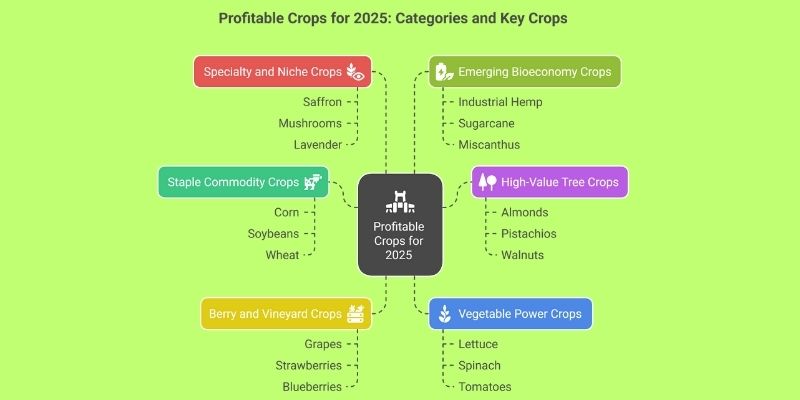
Here’s a breakdown of the most profitable farm crops by category, along with reasons they’re lucrative and tips for achieving higher yields.
1. Staple Commodity Crops
Row crops like corn and soybeans aren’t your biggest money-makers per acre anymore, but they’re still essential for large operations. They keep cash flowing consistently, work with your existing equipment, and give you the stable foundation you need to take risks on higher-value specialty crops that could really boost your bottom line.
Key Crops:
- Corn – The leading U.S. crop, central to livestock feed, food products, and biofuels. Margins are slim, but demand and export markets keep it vital. Precision planting and drought-tolerant hybrids can improve yields.
- Soybeans – Critical in global oilseed and feed markets. Premiums for organic or non-GMO soy make it a potential high-value crop. Also key for crop rotation, boosting soil nitrogen.
- Wheat – A global staple and reliable export product. While less profitable than specialty crops, wheat offers resilience in cooler climates and supports crop rotation cycles.
- Cotton – The backbone of the textile industry. Profitable mainly for Southern farms with irrigation, but strong global demand keeps cotton attractive.
- Sorghum – A drought-tolerant grain increasingly valuable in feed and bioenergy. Its lower input needs make it a cost-efficient option in arid regions.
Why is it Profitable for Your Farm:
- Suited to large-scale mechanization.
- Consistent demand from feed, exports, and biofuels.
- Risk hedging through futures contracts and crop insurance.
Growing Tips:
- Rotate with legumes to improve nitrogen levels.
- Use GPS-guided fertilizer and precision planting.
- Adopt drought-resistant varieties to reduce weather risks.
2. High-Value Tree Crops
Tree crops like nuts and citrus require patience and significant upfront investment, but once established, they provide decades of reliable income. In 2025, U.S. cash receipts for fruits and nuts are projected to reach nearly $30 billion, highlighting their role as some of the most profitable farm crops today.
These crops are especially appealing to large-scale operations that can absorb the initial costs of orchard establishment and irrigation systems.
Key Crops:
- Almonds – Among the highest-value nuts per acre, almonds thrive in warm climates with irrigation. Global demand for almond-based products keeps prices strong.
- Pistachios – Another export powerhouse, pistachios offer high margins and strong consumer demand, particularly in international markets.
- Walnuts – Popular for both domestic consumption and exports, walnuts provide steady yields and strong processing opportunities.
- Avocados – In high demand due to health trends, avocados are profitable but require careful water and pest management.
- Pecans – Native to the U.S., pecans are valued for their versatility and long-term productivity, often exceeding 20 years of steady harvests.
Why is it Profitable for Your Farm:
- Long productive lifespans that deliver consistent revenue.
- Premium pricing driven by consumer demand and exports.
- Ability to diversify into value-added products (e.g., nut oils, avocado-based goods).
Growing Tips:
- Secure reliable irrigation, these crops are water-intensive.
- Use integrated pest management to protect long-term orchard health.
- Regular pruning and canopy management optimize yield and fruit quality.
3. Berry and Vineyard Crops
Berry and vineyard crops are among the most profitable crops to grow because they combine relatively fast production cycles with strong consumer demand. Unlike tree crops that may take years to mature, berries and grapes often deliver returns within the first few seasons.
Key Crops:
- Grapes – Versatile in both table and wine markets, grapes are a top-value crop for large farms. Wine grapes, in particular, can deliver exceptional returns in the right regions.
- Strawberries – A high-demand fruit with multiple harvests per season. Strawberries are perishable but fetch premium prices in fresh markets.
- Blueberries – Known as a “superfood,” blueberries enjoy surging demand in health-conscious consumer segments.
- Raspberries – Smaller acreage but very high value per pound; popular in fresh and frozen categories.
- Blackberries – Gaining traction in niche and organic markets with strong local demand.
Why is it Profitable for Your Farm:
- Shorter maturity time compared to tree nuts.
- Premium pricing driven by consumer health trends.
- High export demand, especially for wine grapes and berries.
Growing Tips:
- Use drip irrigation to maintain soil moisture without disease pressure.
- Install trellising for grapes to maximize sunlight and airflow.
- Protect berries with netting or row covers to prevent pest and bird damage.
- Time harvests strategically, as quality and shelf life directly affect profitability.
4. Vegetable Power Crops
Vegetables are some of the easiest crops to grow for profit because they offer multiple harvests per year, quick cash cycles, and strong consumer demand. For medium and large farms, vegetables deliver consistent sales opportunities through grocers, restaurants, and direct-to-consumer markets.
Key Crops:
- Lettuce – A staple in both fresh and processed markets, with the potential for 4–6 harvests per year in warmer climates.
- Spinach – A fast-growing leafy green popular in health-conscious diets and ideal for continuous planting cycles.
- Tomatoes – High demand across fresh, processing, and export markets, with greenhouse systems extending production seasons.
- Bell Peppers – A versatile, colorful crop that commands premium pricing in fresh markets.
- Cucumbers – Thrive in both field and greenhouse systems; high turnover makes them attractive for large-scale growers.
- Melons (Watermelon, Cantaloupe) – Popular summer fruits with high yields and strong demand in both wholesale and retail markets.
Why is it Profitable for Your Farm:
- Multiple harvests increase revenue per acre.
- Premium pricing for organics and locally sourced produce.
- Flexibility to supply retail, wholesale, and institutional buyers.
Growing Tips:
- Stagger plantings to ensure a steady harvest window.
- Use drip irrigation and mulching to conserve water and prevent disease.
- Consider greenhouses or hydroponics for season extension and higher yields.
- Build retailer contracts in advance to avoid gluts and waste.
5. Specialty and Niche Crops
Specialty and niche crops may not dominate acreage, but they deliver some of the highest profit margins per acre. For large farms, dedicating even a small percentage of land to specialty crops can significantly lift overall profitability while diversifying income sources.
Key Crops:
- Saffron – Known as “red gold,” saffron fetches thousands of dollars per pound, making it one of the most profitable crops to grow in the world, though highly labor-intensive.
- Mushrooms (Shiitake, Oyster, Gourmet Varieties) – Require minimal space but provide dense yields and steady demand in restaurants and health markets.
- Lavender – Profitable through fresh sales and value-added products such as oils, teas, and cosmetics.
- Ginseng – A high-value medicinal root with long growth cycles but exceptional returns when mature.
- Exotic Fruits (Dragon Fruit, Goji Berries, Passion Fruit) – Increasingly popular in health-food and export markets.
Why is it Profitable for Your Farm:
- High per-acre value compared to staples or even most fruits.
- Diversifies farm income, reducing reliance on commodity pricing.
- Growing demand for organic, natural, and specialty foods.
Growing Tips:
- Research local and export markets before planting to secure demand.
- Consider protected cultivation (greenhouses, shade nets) for sensitive crops.
- Add value through on-farm processing—lavender oils, dried herbs, or packaged mushrooms often double margins.
- Ensure strong security and labor management for crops like saffron and ginseng, which are labor- and theft-sensitive.
6. Emerging Bioeconomy Crops
Beyond traditional food and fiber, a new category of crops is emerging in 2025—those tied to the bioeconomy. These include plants grown for renewable energy, industrial uses, or health supplements.
While not yet as mainstream as corn or soybeans, these crops are gaining traction as demand for sustainable energy and alternative fibers increases.
Key Crops:
- Industrial Hemp – Used for CBD, textiles, building materials, and bio-composites. Profitability varies by regulation and market, but hemp can deliver strong margins when aligned with processing facilities.
- Sugarcane and Sugar Beets – Long-standing cash crops now tied to ethanol and renewable fuel markets, making them strategic for farms near biofuel facilities.
- Miscanthus – A perennial grass grown for biomass energy; low input needs and long-term soil benefits make it appealing for marginal land.
- Energy Beets – Developed specifically for biofuel, they offer high sugar yields per acre, boosting ethanol production potential.
Why is it Profitable for Your Farm:
- Tied to growing renewable energy and sustainability sectors.
- Often suited for large tracts of land where food crops underperform.
- Government incentives and research programs continue to support bioenergy adoption.
Growing Tips:
- Focus on regions with nearby processing facilities to cut transport costs.
- Use marginal land or rotation fields to maximize value without sacrificing staple crop acreage.
- Monitor regulatory developments, especially for hemp and energy-focused crops.
Beyond Crops: Smart Strategies to Maximize Farm Profitability
Finding the most profitable crops is just the starting point. For large operations, real money comes from combining the right crops with smart business strategies. Here are four approaches that separate profitable farms from the rest in 2025.
1. Technology That Actually Pays
Your farm generates massive amounts of data every season, including yields, input costs, weather patterns, and soil variations. The farms pulling ahead are using systems like AgriERP to track profitability per field in real time, not just at harvest.
Precision tools like drones and soil sensors aren’t just tech toys anymore; they’re cutting waste and identifying your most profitable zones.
When you’re managing thousands of acres, these systems turn overwhelming data into agricultural analytics for clear decisions about where to plant your high value crops.
2. AI-Powered Decision Making
Artificial intelligence is revolutionizing how large farms optimize profitability. AI systems analyze weather patterns, soil data, market prices, and historical yields to predict which crops will deliver the highest returns on specific fields.
These platforms can forecast optimal planting dates, recommend variable-rate applications, and even predict harvest timing for maximum quality premiums.
You can incorporate AI to eliminate guesswork from your most expensive decisions. Instead of relying on experience alone, you can leverage machine learning to identify your most profitable farm crops for each field based on dozens of variables that human analysis might miss.
3. Value-Added Revenue Streams
Instead of selling raw almonds, what if you could capture the premium that almond oil commands? Or turn your tomatoes into paste instead of selling them fresh? Large farms with processing capabilities or partnerships can often double their per-acre returns by moving up the supply chain.
This strategy lets you capture more profit from the same land without expanding your footprint.
4. Export Market Positioning
Global buyers pay premiums for quality American crops. Almonds, pistachios, and wine grapes dominate export markets, while even commodity crops like soybeans command better prices through export contracts. Large farms positioned for export can turn standard crops into high-profit crops by accessing markets that pay above domestic prices.
Success in 2025 isn’t just about what crop makes the most money; it’s about building systems that maximize every acre’s potential through technology, smart crop choices, value-adding, and global market access.
Conclusion
Asking what crop makes the most money isn’t enough; you need systems that maximize every acre’s potential. The most successful operations combine reliable commodities with high-value crops and high profit crops like specialty produce, all guided by data instead of guesswork.
Tools like AgriERP let you track real profitability across every field, identifying which crops actually deliver the highest returns on your specific land. When you can see true cost-per-acre data in real time, you stop gambling on crop choices and start making calculated profit decisions.
Maximize your farm’s profits with crops that suit your soil, gear, and market. Let AgriERP help you grow smarter, harvest higher, and earn more