The ERP Solution for the Year” 2025 in Agtech Breakthrough Awards 2025


The food industry is one of the most complex and fast-moving sectors in today’s economy. From sourcing raw ingredients to ensuring safety compliance, every step in the food supply chain comes with high stakes.
One small disruption, be it a recall, delay in logistics, or inaccurate inventory count, can ripple across the entire business. This is why the importance of ERP in the food industry has become undeniable.
Enterprise Resource Planning (ERP) software is no longer just a back-office tool. It’s now the backbone of efficient food operations, enabling companies to streamline processes, improve decision-making, and remain compliant in an increasingly regulated market. In fact, research shows that 94% of businesses that implement ERP report improvements in business processes.
In this guide, we’ll walk through why ERP is essential for food companies, the problems that arise without it, and the features you should prioritize when considering ERP systems for food processing and distribution.
Problems Food Businesses Encounter Without ERP Systems
Running a business without ERP may be effective in small businesses, but in the case of larger businesses, the cracks are soon revealed. The following are the main issues that food companies experience due to the lack of ERP.
“The clock is ticking for food and beverage brands plagued by outdated ERP software and slow-moving consulting models that no longer serve the needs of today’s market. Our latest research confirms a shifting mindset from outdated playbooks to modern solutions capable of delivering impact right away and deployed in weeks, not months.” _ Paul Bradley, Senior Director of Product Marketing at TraceGains
1. Inefficient Processes
Many tasks are manual or handled in separate systems. This causes bottlenecks, duplication of work, and slow turnaround times. 69% of food & beverage companies still rely on manual systems like spreadsheets and email, even though most recognize the need for modernization.
2. Lack of Integration
When procurement, production, finance, and quality control are all handled separately, you lose holistic visibility. Disconnected workflows mean miscommunication and missed opportunities to adjust in time.
3. Insufficiency in Real-time Information
Food production moves fast. Without ERP, managers often rely on outdated reports, which leads to missed opportunities and poor decision-making in dynamic markets.
4. Lack of Scalability
Legacy systems break down as businesses grow. When new product lines or distribution channels are added, outdated systems fail to support expansion. ERP provides the flexibility needed to scale.
5. Misleading Financial Management
Financial mismanagement and reporting errors are costly. According to the Association of Certified Fraud Examiners reports, weak financial controls cost businesses about 5% of annual revenue. Inaccuracies in cash flow, reconciliations, and reporting leave businesses vulnerable to losses.
6. Limited Traceability
Traceability is one of the most pressing challenges in the food industry. The average cost of a food recall in the U.S. is $10 million. Without strong tracking systems, identifying affected batches and managing recalls becomes difficult, leading to higher financial and reputational damage.
7. Inadequate Planning and Forecasting
Guesswork in forecasting often leads to waste or shortages. With only 29% of U.S. farms using the internet for marketing, predictive analytics, and digital forecasting tools remain underused, which limits the ability to align production with demand.
8. Weak Customer Relationship Management
Managing customer expectations and loyalty is challenging without structured tools. A recent survey found that over 80% of U.S. consumers are willing to pay more for sustainable food products. A business is not able to track the customers’ interactions, thus poor services and loss of sales.
9. Compliance Risk and Regulatory Risk
Regulatory compliance continues to be a growing challenge. On average, the FDA oversees more than 1,200 food recalls every year in the U.S. Without effective compliance measures, businesses with Non-compliance can mean recalls, fines, and damage to brand reputation.
Top 11 Reasons ERP Is Essential for Food Businesses
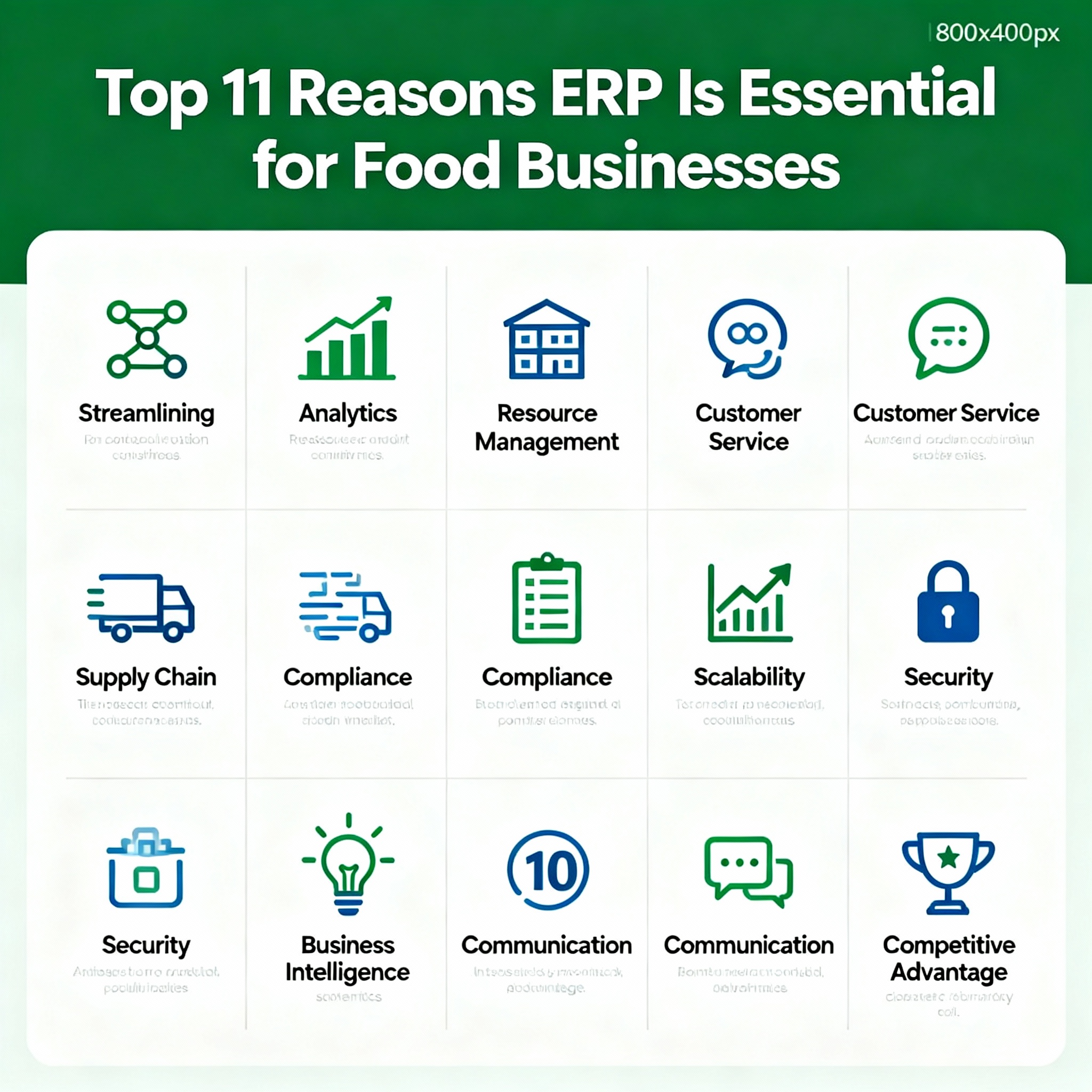
ERP is not just about technology; it’s about giving food businesses the tools they need to thrive in a competitive environment. Below are the top reasons companies in the food sector can’t afford to operate without ERP.
1. Streamlined Operations
Food companies juggle production, quality control, warehousing, and logistics daily. ERP systems unify these functions into one platform, eliminating duplicate work and reducing costly manual errors. This centralization ensures smoother workflows from farm to fork.
2. Enhanced Decision-Making
ERP provides real-time insights into production, sales, and finances. With access to accurate data, managers can forecast demand more effectively and adjust strategies quickly. Considering that 60% of food companies face challenges with demand forecasting. ERP-driven analytics becomes invaluable.
3. Efficient Resource Management
From labor scheduling to ingredient tracking, integrated resource management ensures optimal use of labor, materials, and inventory. By improving visibility across operations, you can reduce waste, maximize output, and maintain efficiency, an especially critical advantage when profit margins are razor-thin.
4. Improved Customer Service
Timely deliveries and consistent product quality build strong customer relationships. ERP integrates sales and logistics, helping companies keep commitments and reduce service complaints.
5. Supply Chain Optimization
According to a McKinsey report, companies with advanced supply chain visibility improve service levels by 20% to 30% while cutting inventory by 10% to 15%. ERP provides end-to-end visibility into the supply chain. Food distributors, for example, can track shipments in real time and reroute when disruptions occur.
6. Regulatory Compliance and Risk Management
Food safety regulations, such as FSMA (Food Safety Modernization Act), require detailed traceability. ERP for food safety compliance helps maintain digital records, batch tracking, and audit-ready reports, reducing the risk of fines and protecting brand reputation.
7. Scalability and Flexibility
As companies expand product lines or enter new markets, ERP scales with them. Modular ERP software for food manufacturing allows businesses to add features like warehouse management or CRM without starting from scratch.
8. Data Security and Integrity
Data breaches in the food sector are growing, with 34% of food and beverage companies reporting cyber incidents in 2023 (PwC). ERP systems strengthen cybersecurity with encryption, access controls, and centralized monitoring.
9. Business Intelligence and Analytics
Analytics and reporting tools built into ERP enable tracking of KPIs (key performance indicators), trend detection, and continuous improvement. These insights help with forecasting, expense control, and strategic planning.
10. Improved Communication
ERP breaks down silos across departments. Sales, finance, and production teams can access the same information, ensuring alignment and reducing miscommunication.
11. Competitive Advantage
Using robust ERP tools tends to be better positioned: quicker to respond to market changes, more reliable in customer service, safer in compliance, and leaner in operations. All these combine to give food companies a real competitive edge.
Conclusion
ERP has moved beyond being just a back-office tool; it has become a critical foundation for competitive food businesses. The ability operations, ensure compliance, improve traceability, and optimize supply chains make ERP adoption nearly inevitable for companies that want to stay ahead in today’s demanding food industry.
The real question isn’t whether to implement ERP, it’s when and how to do it most effectively for your business. Market pressures, razor-thin margins, and increasingly strict food safety regulations will continue to challenge food manufacturers and distributors. ERP systems provide the visibility, control, and efficiency needed to thrive under these conditions.
For food operations ready to take this step, AgriERP delivers industry-specific ERP solutions tailored to the unique challenges of food and agribusiness.
Discover how AgriERP can help your business improve compliance, cut costs, strengthen supply chains, and make smarter, data-driven decisions.