The ERP Solution for the Year” 2025 in Agtech Breakthrough Awards 2025


Food supply chains have been pushed to their limits in recent years. From geopolitical conflicts to labor shortages and extreme weather, disruptions have exposed vulnerabilities in how food gets from farm to fork. The impact on businesses is clear, 94% of companies saw their revenue hit by supply chain disruptions in a recent survey.
Moreover, supply chain executives are now striving to make their networks more flexible and resilient. This resilience refers to the ability to withstand, adapt to, and recover from shocks while keeping the food supply moving.
The food sector, with its perishable goods and strict safety standards, is especially in need of robust solutions to ensure continuity. In this blog, we explore the challenges food supply chains face, ERP features for food supply, and the key ways an industry-specific ERP can help your organization adapt and thrive despite disruptions.
Challenges in the Food Supply Chain
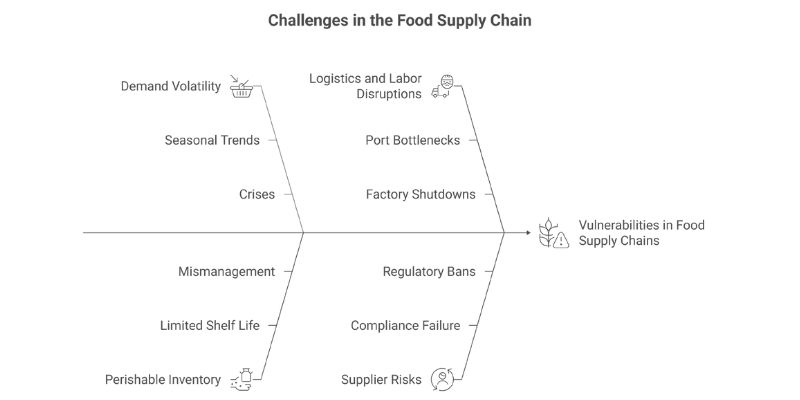
Building resilience starts with understanding why food supply chains are vulnerable. Some of the common challenges include:
1. Demand Volatility
Consumer demand for food can swing quickly due to seasonal trends, shifting diets, or crises. For example, lockdowns during the pandemic caused a surge in grocery sales and a steep drop in restaurant demand. Such fluctuations make it hard to forecast needs, often resulting in overstock (waste) or shortages.
2. Perishable Inventory
Unlike durable goods, foods (especially fresh produce, dairy, and meats) have limited shelf lives. Delays or mismanagement in the supply chain can lead to spoilage and lost product. Without precise inventory tracking and fast logistics, quality suffers and waste increases.
3. Logistics and Labor Disruptions
Food supply chains depend on smooth logistics, farming, processing, trucking, warehousing, and retail. Events like port bottlenecks, truck driver shortages, or factory shutdowns create cascading effects. A single weak link can ripple through, causing empty shelves or production halts.
4. Supplier Risks
Many food manufacturers rely on a few key suppliers for ingredients or packaging. This concentration is risky, if one supplier faces a crop failure, quality issue, or regulatory ban, your supply can grind to a halt. Lack of visibility into supplier conditions (e.g., weather disasters or political issues in a region) makes it hard to react quickly.
5. Regulatory Compliance and Recalls
Food companies must comply with stringent safety regulations (FDA, USDA, HACCP, FSMA, etc.) and be ready for recalls if contamination is discovered. Keeping thorough records and traceability is challenging with manual or siloed systems. A recall handled slowly or inaccurately can not only harm consumers but also shatter a company’s brand and finances.
How ERP for Food Supply Chain Improves Resilience?
1. End-to-End Visibility
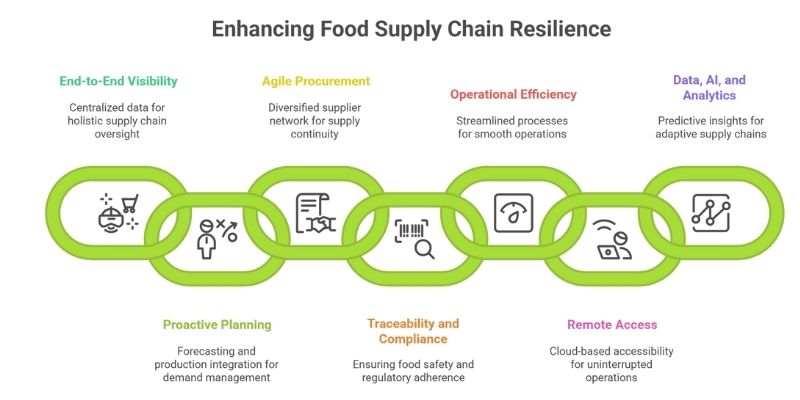
In many organizations, data is scattered, sales forecasts in one system, inventory in another, supplier updates in emails, etc. This fragmentation slows reaction time and creates blind spots. An ERP acts as a centralized “single source of truth” for your entire operation, bringing together purchasing, production, inventory, distribution, and finance data in one platform.
With all information in one place, decision-makers gain a holistic view of the supply chain from end to end. Real-time updates are especially crucial in food supply chains. An ERP with live inventory tracking lets you see stock levels, production output, and shipment statuses at a glance, helping you stay ahead of potential shortages or delays.
2. Proactive Planning
ERP systems help food companies move from reactive “firefighting” to proactive planning. One core ERP capability is demand forecasting. Modern food & beverage ERP solutions use historical sales data, seasonality, and even real-time demand signals to forecast future needs.
This allows you to anticipate demand surges or dips with much greater accuracy than manual guesswork. Good forecasts prevent the whiplash of overstock (which causes spoilage) or stockouts (lost sales).
Another advantage is production planning integration. ERP systems give production planners real-time visibility into order backlogs and inventory, so they can adjust schedules on the fly to balance supply with demand.
If demand suddenly jumps for a particular product, planners can identify capacity or ingredient constraints immediately and initiate overtime or alternate sourcing as needed.
3. Agile Procurement
A resilient food supply chain is also built on having the right supplies at the right time, even when usual sources are unavailable. ERP systems dramatically improve procurement and supplier management, which strengthens resilience.
An ERP provides centralized supplier data and communication. Instead of buyers relying on emails and spreadsheets, all vendor information lives in the system. This makes it easier to qualify multiple suppliers and switch sources when needed.
ERP also helps companies diversify their supplier network as a strategy. Rather than relying on one or two vendors for a critical ingredient, you can maintain a list of approved suppliers and let the system assist in spreading orders among them.
By using ERP to build an agile, multi-source supplier strategy, you greatly reduce the risk that any single point of failure will break your supply chain.
4. Traceability and Compliance
In a world of strict food safety standards and watchdog consumers, being able to ensure quality and respond to problems quickly is paramount. Here, ERP systems play a critical role by providing end-to-end traceability and automating compliance tasks.
ERP solutions built for food include advanced lot tracking and recall management features that let you trace raw materials and finished goods through every transformation and handoff.
Moreover, ERP maintains the audit trail needed for regulatory compliance. Quality checks, safety certifications, and handling procedures can be recorded directly in the system.
Automated compliance tracking and documentation mean you’re always ready for audits, and you reduce the chance of human error in record-keeping. All of this contributes to resilience by making the supply chain safer and more transparent.
5. Operational Efficiency
Efficiency and resilience go hand in hand. An ERP not only helps you during disruptions, but also streamlines day-to-day operations so that your supply chain runs like a well-oiled machine.
By unifying departments on one system, ERP breaks down silos. When procurement, production, warehouse, and sales are all updating the same database, there is less miscommunication. Orders flow through automatically from sales to fulfillment; inventory counts update instantly after production or shipments. This prevents the delays and mistakes that often exacerbate disruptions.
ERP-driven efficiencies free up your team to focus on problem-solving and strategy, rather than chasing paperwork or correcting errors. The result is an organization that can respond swiftly to changes.
Whether it’s reallocating inventory from an oversupplied region to one that’s undersupplied, or fast-tracking a substitute ingredient when a recipe change is needed, a well-implemented ERP provides the agility to make it happen.
6. Remote Access
Modern ERPs are often cloud-based, adding resilience by hosting data securely online and enabling access anywhere, anytime. Teams can log in from office, home, or even mobile devices, critical during the pandemic and equally valuable during travel or natural disasters.
A manager can approve orders or reroute shipments with just a few clicks, ensuring swift responses without being tied to a control room.
Cloud ERPs also reduce downtime risks. With provider-managed backups, redundancy, and disaster recovery, operations continue even if local servers fail. Enhanced cybersecurity further protects against growing threats like ransomware.
Finally, cloud systems scale easily with business needs and deliver regular updates, ensuring your supply chain tools stay current, agile, and future-proof.
7. Data, AI, and Analytics
Modern ERPs increasingly integrate analytics and AI, giving businesses stronger tools for resilience. Predictive analytics can forecast delays, demand mismatches, or supplier risks before they occur, allowing proactive adjustments. By tapping into big data, companies can anticipate market shifts and prepare accordingly.
AI takes this further with demand sensing, risk scoring, and automated decisions, like rerouting shipments during a storm or optimizing supplier mixes for cost and quality. In the food industry, AI is already being used for quality inspection and predictive maintenance, reducing downtime and boosting reliability.
Even without full AI adoption, intuitive dashboards track supplier and ERP impacts on food logistics KPIs in real time, highlighting weak links early. This ensures supply chains become not just resilient but adaptive and self-optimizing.
Final Thoughts
Significant disruptions are likely to remain a fact of life for the food industry. However, as we’ve seen, the right ERP solution can dramatically increase your food supply chain resilience, enabling you to weather storms and emerge stronger.
By providing end-to-end visibility, data-driven forecasting, agile supplier management, strict traceability, and streamlined operations, an industry-specific ERP gives your team the tools to make the right decisions at the right times to keep product flowing.
If you are evaluating solutions to fortify your supply chain, consider an ERP tailored to the food industry. AgriERP is one such solution, an all-in-one, cloud-based ERP designed for agricultural and food enterprises.
To learn how AgriERP can future-proof your business, visit AgriERP and explore how you can make your food supply chain resilient.