The ERP Solution for the Year” 2025 in Agtech Breakthrough Awards 2025


Managing a modern farm demands more than simple bookkeeping. Today’s agribusinesses operate complex, interconnected processes, from planting schedules and machinery logistics to labor management and finance. QuickBooks, a popular accounting tool for small businesses, handles invoices and payroll, but it only covers financial tasks.
In contrast, an agricultural ERP like AgriERP unifies all farm operations on one platform. Industry analysts note that the farm ERP market is booming, projected to nearly triple to over $3.4 billion by 2034, as farms seek integrated solutions.
In short, using QuickBooks means stitching together multiple reports and spreadsheets, while AgriERP brings everything under one roof, so you see the full picture in real time. The result? Faster, smarter decisions that directly boost profitability and sustainability.
AgriERP’s mission is to give you the data and tools needed to make those decisions confidently. Below, we compare the two approaches and show how AgriERP’s built-for-farming design delivers insights that QuickBooks simply cannot match.
Financial Management for Farms: ERP vs Accounting
Good financial control is vital, but on a farm, it must be integrated with operations. AgriERP handles accounting and financial planning within the same system that runs your fields and supply chain.
This integrated approach provides a panoramic view of your finances. For instance, every harvest or livestock sale automatically updates revenue; every seed purchase or labor bill hits the right cost categories instantly. Because these financial transactions are tied to actual field activities, your ledgers stay accurate without extra work.
In practice, this means AgriERP lets you do things like:
- Real-time budgets and forecasts: See how actual yields and prices compare to your projections mid-season. You can adjust plans quickly if the weather or market changes.
- Multi-entity accounting: Manage multiple farm units or legal entities in one place, yet consolidate reports across the whole business.
- Accounting Charts: Track costs by enterprise (e.g., by crop, orchard, or herd) automatically, a feature QuickBooks lacks out of the box.
- Compliance and reporting: Built-in features for tax, audit trails, and agricultural regulations ensure data accuracy and traceability across the farm.
By unifying finance and operations, AgriERP eliminates the blind spots that occur when using QuickBooks alone. Centralizing data improves operational insights and mitigates financial risks because you can strategize with a single source of truth. With QuickBooks, in contrast, you’d need to export data and manually piece together reports (often too late to act on).
QuickBooks vs AgriERP: Scope and Focus
QuickBooks is accounting software, not a full farm management system. It focuses on financial workflows like invoicing, expense tracking, and basic inventory. If your requirements are purely financial/accounting, QuickBooks may be sufficient, but if you need to manage complex processes such as multi-location inventory planning, production schedules, advanced sales fulfillment, or integrated CRM, an ERP is a better choice.
In other words, QuickBooks helps you record what’s happening; an ERP like AgriERP helps you plan, execute, and analyze everything from seed to table.
Key differences: QuickBooks is best for bookkeeping. It lacks modules for crop planning, field operations, supply chain, and field staff. AgriERP, by contrast, combines farm-specific modules (crop management, equipment tracking, labor scheduling, supply-chain, compliance, and more) with core finance and inventory.
In AgriERP, your order-to-cash cycle is built into the system, whereas QuickBooks focuses narrowly on the financial side. This means AgriERP gives you real-time visibility into operations (planting progress, inventory levels, resource use) alongside the ledger, so you can correlate field activities with profits. QuickBooks simply doesn’t provide that kind of operational insight, leading to siloed data and slower decisions.
QuickBooks Limitations for Farmers
QuickBooks is a solid small-business tool, but it has clear limits on a large farm. Its design assumes businesses with relatively short cycles, not multi-year growing seasons. For example, general accounting software often can’t plan a seed-to-harvest timeline.
Farm accounting software (or ERP) is needed to plan expected harvest quantities and manage costs per field, whereas generic tools don’t handle those cases. Farming is inherently seasonal, crops take months or years to mature, and QuickBooks simply isn’t built for that inherent lag.
Other QuickBooks shortcomings for agribusinesses include:
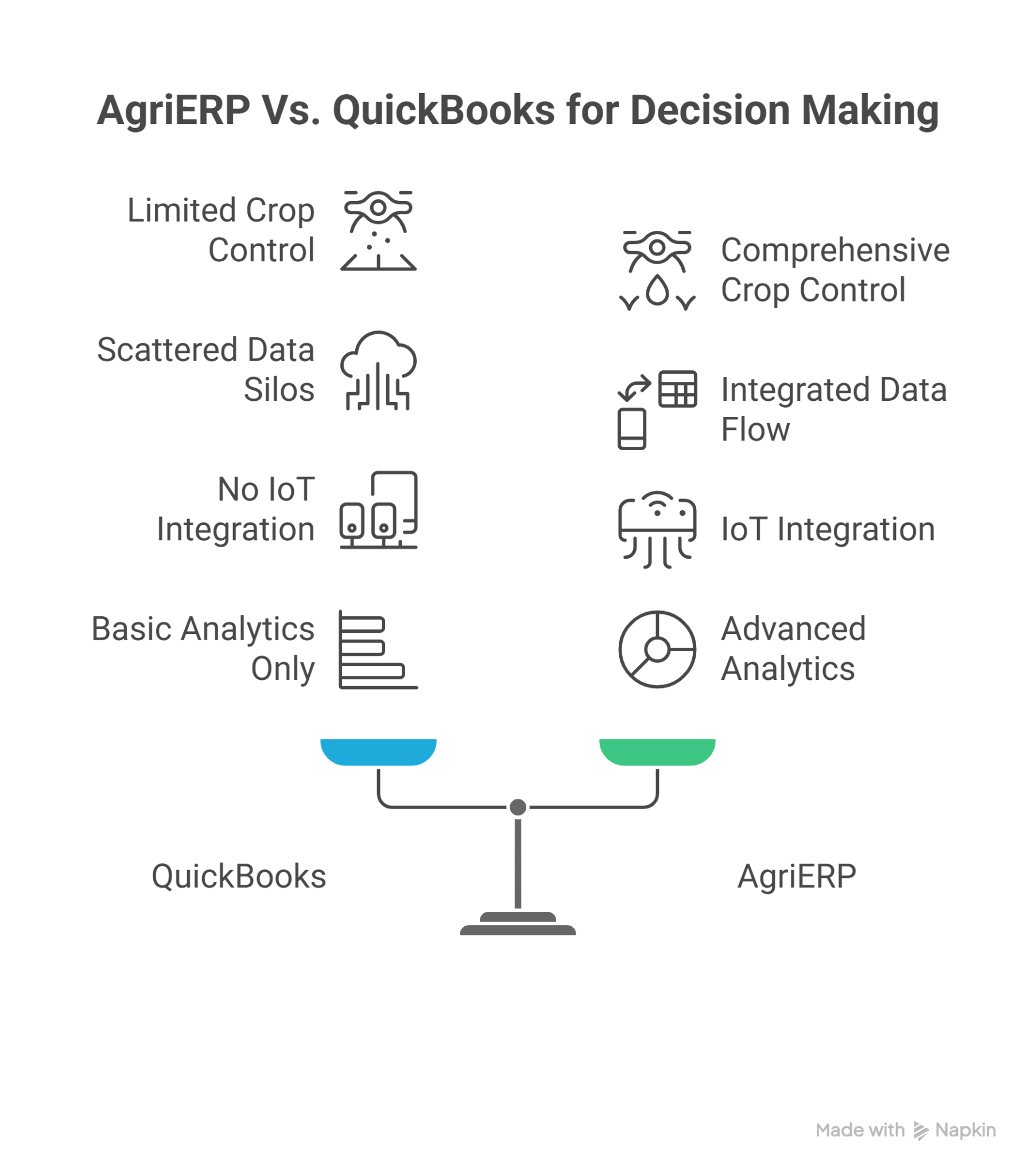
- Limited Crop & Inventory Control: QuickBooks lacks crop-specific inventory tracking or soil/field data. It can’t automatically allocate fertilizer usage or track yield per acre. You’d have to maintain separate spreadsheets.
- Scattered Data Silos: Using QuickBooks often means running a separate farm ERP or manual records. Data ends up siloed, financial vs field vs inventory, making cross-analysis a chore. Without integration, mistakes creep in, and feeding data manually into accounting systems costs time and invites errors.
- No IoT or Sensor Integration: Modern farms use IoT devices (soil sensors, weather stations). AgriERP can ingest that data for risk management; QuickBooks cannot. For example, AgriERP can alert you to a frost risk or soil nutrient drop in real time, whereas QuickBooks would know nothing about it.
- Basic Analytics Only: QuickBooks provides standard financial reports (P&L, balance sheet), but no custom dashboards for farm performance. You get snapshots of money, not of production. This leaves decision-making “in the dark,” whereas AgriERP’s analytics highlight trends and anomalies as they happen.
AgriERP Features and Farm Data Analysis Tools
AgriERP is designed for agriculture first. It offers a rich set of modules and tools that cover every major aspect of a farm’s business. For example, at its core AgriERP includes:
1. Crop and Field Management
Plan planting schedules by field, track each crop’s progress, record yields, and allocate resources (seed, fertilizer, labor) accordingly. AgriERP’s field mapping and planting modules ensure costs and outputs are tied directly to specific fields.
2. Inventory and Supply Chain
Handle inputs, like seed, feed, chemicals, and outputs efficiently. The system provides multi-warehouse inventory, batch/lot tracking, and vendor management. You can auto-replenish supplies based on field needs, avoiding both shortages and waste.
3. Financial Management for Farms
Unlike generic accounting, AgriERP’s finance tools are built around farm needs. It supports multiple entities (farms or divisions), multi-currency, and even government subsidies. You get real-time budget vs. actual reports for each project or crop cycle, plus automated billing and fixed-asset tracking. All financial data flows in automatically from field activities.
4. Human Resources and Labor
Schedule workers and equipment by task or field. Record attendance and work completed through a mobile app. Labor costs are automatically allocated to jobs, giving you instant visibility on labor productivity and costs.
5. Reporting and Analytics
Built-in dashboards show key metrics (profit by crop, cost per acre, yield trends). AgriERP includes farm data analysis tools and AI-powered analytics that spot trends and forecast outcomes. You can model scenarios like “what if” planting different crops or adjusting inputs using actual farm data.
In short, AgriERP transforms scattered farm data into actionable insights. Its mobile FarmApp links the field and office, workers enter tasks and harvest info on their phones or tablets, and managers see it live.
VentureBeat highlights that AgriERP’s FarmApp “empowers managers with up-to-the-minute data on everything from planting progress to harvest yields and equipment productivity, enabling agile and informed decision-making”.
By contrast, with QuickBooks, you’d have to manually import or guess most of this information. QuickBooks has no way to record in-field activity or to analyze crop outcomes, only financial events.
That gap means you can’t answer questions like “Which field generated the best return last season?” or “Should we allocate more fertilizer to Area B next year?” in QuickBooks. AgriERP’s farm-focused features fill those gaps, giving you comprehensive farm data analysis tools that directly support your decisions.
The following table summarizes the differences between AgriERP and QuickBooks:
Feature | AgriERP (Agricultural ERP) | QuickBooks (Accounting Software) |
| Scope | Covers all farm operations (crop planning, inventory, finance, HR, supply chain, etc.) | Focuses on financial tasks (invoicing, expenses, basic inventory) |
Data Integration | One unified database (real-time field data, finance, analytics in one system) | Siloed data often requires manual export/import between systems |
| Farm-specific Tools | Advanced: crop mapping, yield analysis, equipment tracking, IoT integration, etc. | Generic: no crop or field-specific modules; needs add-ons for agriculture |
Financial Management | Built-in farm financials (multi-entity, multi-currency, budgets, cost tracking) | Standard accounting lacks farm-tailored budgeting or subsidy tracking |
| Analytics & Reporting | AI-driven analytics, forecasting, and custom dashboards for farm KPIs | Basic financial reports, limited forecasting, and no farm-centric dashboards |
Real-time Operations Visibility | Mobile FarmApp connects the field to the office instantly | Relies on end-of-period data entry; no field-to-office app |
| Scalability | Designed for large agribusiness (supports growth, multiple sites, global operations) | Best for small to mid-sized businesses; may hit limits on users/entities |
User Experience | Built for farming workflows; modules match agribusiness processes | Built for general business accounting; may require workarounds for farm needs |
How AgriERP Improves Decision Making?
AgriERP’s integrated data and analytics are specifically designed to give you actionable answers, not just numbers. Because all farm operations feed into one system, more data leads to better decisions. AgriERP provides valuable and voluminous data that can be analyzed to spot trends, predict future outcomes, and improve operations. In practice, this means:
1. Real-Time Intelligence
The moment a tractor’s harvest loader or a field scout logs data in the FarmApp, that information flows into AgriERP’s dashboards. Executives and managers are no longer reliant on outdated information; they are empowered with up-to-the-minute data on everything from planting progress to harvest yields, enabling agile decisions. No more waiting for end-of-day or weekly spreadsheets.
2. Predictive Analytics
Beyond raw data, AgriERP employs AI-driven forecasting. It can analyze past yields, current soil and weather data, and market trends to suggest optimal planting plans or supply orders. For example, it might recommend the best planting density or alert you to shift harvest schedules in response to a weather forecast.
3. Scenario Planning
You can run “what if” analyses easily. What if fertilizer prices rise 10%? Or a key worker goes on leave? AgriERP’s integrated financial and operations modeling lets you project impacts on costs and outputs. QuickBooks offers none of this, it only reports what has already happened.
4. Risk Management
By incorporating IoT and external data, AgriERP keeps you ahead of problems. It can trigger alerts (e.g., frost warnings, feed shortages) and immediately suggest countermeasures. Having all inputs visible in one system means you spot issues early and act.
Benefits of AgriERP’s Integrated Approach
Putting all the above together, AgriERP offers several compelling benefits over QuickBooks for your farm:
- Eliminate Data Gaps: All modules feed a single database. You’ll never have to export and reconcile data from disconnected tools. This reduces manual errors and saves time.
- Total Visibility: See cash flow next to crop performance. View labor costs next to machine utilization. That unified perspective means strategic decisions (like where to invest next) are grounded in reality.
- Scalability: As your farm grows or adds new products, AgriERP scales easily. It supports multi-entity operations and high data volumes, unlike QuickBooks, which maxes out beyond a certain size.
- Efficiency and Profitability: By automating routine tasks and optimizing inputs, farms routinely trim costs. Some farms report up to 35% reduction in errors and significant drops in waste when using integrated ERP tools.
- Custom Farm Reporting: Ad-hoc reports (profit per field, cost per kg, equipment downtime) become easy. This accelerates learning and continuous improvement on the farm.
- Precision and Control: AgriERP turns decision-making from a guessing game into a data-driven process. You gain precise control over resources and can shift operations dynamically. Using AgriERP, your farm leadership can move faster and with confidence, making smarter choices about crop mixes, investments, and growth strategies than teams relying on QuickBooks’ disjointed data.
Conclusion
As a farm owner or agribusiness executive, your choices set the course for productivity and profit. QuickBooks may keep the books, but AgriERP empowers you to optimize every aspect of farming through its truly integrated suite.
With AgriERP’s farm-centric ERP, you’ll have one connected system, combining field operations, inventory, HR and finance, so you can make smarter, faster decisions based on real data. This unified view of your operations translates directly into better yields, lower costs, and a more agile business.
Explore AgriERP’s capabilities or request a demo today. Take advantage of a platform built specifically for agriculture, and see firsthand how AgriERP’s tools and analytics outperform QuickBooks for farm decision making.