The ERP Solution for the Year” 2025 in Agtech Breakthrough Awards 2025



Labor is the single largest variable cost in farming, and the most difficult one to control. According to recent research in U.S. agriculture, farm labor wages and benefits account for nearly $37 billion annually, with some farm sectors spending 40% or more of their operating expenses on labor alone. For large-scale producers, even a small inefficiency in scheduling, payroll, or task allocation can translate into thousands of dollars lost every season.
The reality is that traditional labor management strategies are no longer working in an industry pressured by labor shortages, rising wages, and stricter compliance rules. Farm owners and agri-business leaders need data-driven labor management strategies that tie directly to cost-effective farming.
That’s where technology, particularly ERP-powered labor optimization, comes into action. By integrating scheduling, payroll, compliance, and workforce productivity into a single system, farms can transform labor from a volatile cost into a strategic advantage.
In this blog, we’ll unpack the best labor management strategies in farming, practical, tech-enabled approaches that help you cut costs, maximize efficiency, and future-proof your agricultural workforce.
The Labor Cost Challenge in Modern Agriculture
For today’s farm operators, labor is more than an expense; it’s a dynamic target that directly shapes profitability. In 2023, labor represented about 10.1% of total farm production expenditures across U.S. agriculture. But averages don’t tell the full story.
For labor-intensive sectors like fruits, vegetables, and nursery crops, that share can surge to 38–40% of total cash expenses, making labor the single largest operating cost. Below, we have listed some reasons why farming costs keep climbing, with labor consistently at the center of these rising expenses.
Why Farming Costs Keep Climbing?
- Seasonality and timing pressures: Peak labor demand during harvest and planting seasons makes workforce planning difficult. A delay of even a week in securing crews can lead to yield loss or reduced quality.
- Rising wages and compliance obligations: Minimum wage increases, safety standards, and stricter labor regulations are steadily pushing costs upward.
- Operational inefficiencies: Manual scheduling, lack of real-time data, or uneven allocation of tasks often result in overstaffing one area while underutilizing another.
- Labor shortages: Fewer skilled and seasonal workers are entering the agricultural labor pool, creating competition and wage inflation among farms.
For big farm owners and agri-businesses, the real challenge isn’t just paying for labor, it’s using that labor efficiently. Missed shifts, idle hours, or poorly planned task allocation can translate into tens of thousands of dollars in avoidable losses each season.
Traditional methods, spreadsheets, whiteboards, or verbal task assignments are no longer enough to manage this complexity. To stay competitive, your farms need structured, data-driven labor management strategies in farming that ensure every worker hour delivers maximum value.
Role of Technology in Farm Labor Optimization
As labor costs rise and workforces become harder to manage, technology has become one of the most practical solutions for agricultural businesses. Modern farms can no longer rely on manual scheduling or guesswork; data-driven tools are essential to achieving both cost-effective farming techniques and predictable outcomes.
Enterprise Resource Planning (ERP) systems designed for agriculture consolidate all aspects of workforce management into one platform. Instead of juggling payroll, compliance, and shift planning across multiple tools, an ERP solution like AgriERP centralizes them, helping you achieve:
- Efficient farm labor management through automated scheduling and workforce allocation.
- Labor cost control in agriculture by tracking wages, overtime, and seasonal labor budgets.
- Strategic labor planning in farming using predictive analytics to align crews with crop cycles.
- Agricultural labor efficiency by monitoring worker productivity across acres, tasks, and time.
What makes ERP powerful is its ability to turn labor from a volatile expense into a measurable, optimizable resource. For example, you can compare labor hours per acre across fields to identify inefficiencies, forecast seasonal hiring months in advance, and reduce compliance risks with built-in labor law tracking.
By combining automation, visibility, and predictive planning, ERP-driven systems lay the groundwork for effective labor use in farming. Instead of reacting to problems, you can proactively manage costs, maximize productivity, and align your workforce with long-term profitability.
10 Best Labor Management Strategies for Cost-Effective Farming
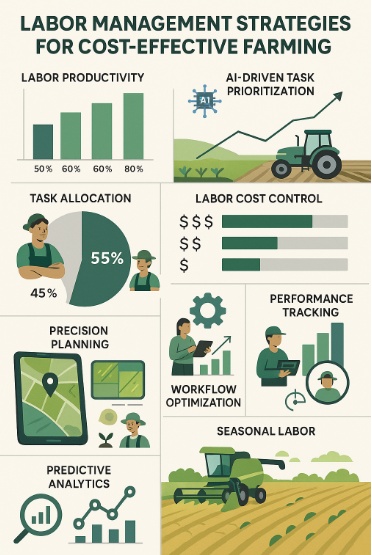
1. Precision Labor Planning
On large farms, mismatched labor supply and demand can quickly drain resources. Overstaffing during off-peak weeks or scrambling for workers during harvest both increase costs. An ERP-powered labor forecasting tool analyzes historical trends, crop cycles, and seasonal demand to help you allocate just the right number of workers.
With predictive insights, farm owners can build dynamic rosters weeks in advance. This not only cuts down on overtime but also ensures labor-intensive tasks, like harvesting or planting, are fully staffed without overspending. Precision planning transforms workforce management from guesswork into a strategic cost-saving practice.
2. Automating Repetitive Farm Operations
A major driver of labor costs is repetitive manual work, such as time tracking, payroll entries, and shift assignments. By automating these processes with ERP-integrated labor modules, managers save hours that would otherwise be spent on administrative tasks.
For example, digital timesheets connected to biometric attendance systems can sync directly with payroll. Automation also eliminates human errors like double booking or incorrect wage calculations, which often lead to disputes and added expenses.
By freeing supervisors from paperwork, farms can redirect labor oversight toward productivity monitoring and worker engagement, creating both cost savings and higher efficiency.
3. Real-Time Workforce Monitoring
Large-scale farms often struggle to monitor workers spread across fields, greenhouses, and facilities. Without visibility, it’s easy for productivity gaps to go unnoticed. By combining IoT-enabled devices with ERP dashboards, managers gain a live view of workforce activities.
For example, GPS-tracked equipment and mobile apps allow supervisors to see which tasks are in progress, who is falling behind schedule, and where labor bottlenecks exist. With this data centralized in ERP, managers can immediately reallocate workers to critical areas. Real-time monitoring ensures every hour of labor is optimized, making farming more cost-efficient and controlled.
4. Seasonal and Contract Workforce Optimization
Agriculture depends heavily on seasonal workers. But hiring too many or too few can severely impact profitability. ERP platforms simplify contract workforce management by storing worker profiles, past performance data, and availability.
With automated scheduling, farms can rehire top-performing seasonal laborers quickly, reducing onboarding time and costs. Payroll compliance for contract staff also becomes seamless when handled through ERP modules, preventing legal risks and penalties.
By balancing permanent and seasonal workers with accurate ERP insights, farm owners can maintain workforce flexibility while ensuring labor costs never spiral out of control.
5. AI-Powered Task Prioritization
AI can do more than just forecast labor needs; it can help you decide which tasks should be prioritized for maximum cost-effectiveness. By analyzing historical performance data, crop growth stages, weather conditions, and worker productivity, AI tools integrated with your ERP system can recommend the optimal sequence of tasks for each day or week.
This ensures that high-impact activities like harvesting or irrigation are completed first, while lower-priority tasks are scheduled efficiently. With AI-driven task prioritization, you can reduce wasted labor hours, minimize overtime, and increase overall agricultural labor efficiency.
This strategy allows you to make smarter, data-backed decisions on labor allocation, directly supporting farming labor cost reduction and effective labor use in farming.
6. Skill-Based Task Allocation
Assigning the right worker to the right job is a core labor management principle, but on large farms with hundreds of workers, manual allocation is inefficient. ERP systems store detailed skill profiles, certifications, and performance history for every worker.
Using this data, managers can assign specialized tasks, such as equipment handling, irrigation system checks, or crop treatment, to the most qualified workers. This reduces costly errors, rework, and accidents while ensuring efficiency. By aligning skills with responsibilities, farms not only reduce waste but also build a culture of accountability and productivity across the workforce.
7. Training and Continuous Upskilling Programs
Labor productivity often stagnates when workers aren’t trained on new techniques or technologies. ERP-driven training management allows farms to schedule skill development programs, track participation, and measure learning outcomes.
For example, upskilling workers on operating smart irrigation systems or automated harvesters reduces reliance on external specialists, cutting operational costs. Continuous training also improves retention, lowering turnover-related recruitment expenses.
With ERP analytics, farm owners can identify skill gaps across the workforce and plan targeted training sessions, ensuring long-term labor efficiency. Training becomes an investment, not an overhead.
8. Compliance and Labor Law Management
Labor laws in agriculture can be complex, with regulations around working hours, overtime, safety, and seasonal contracts. Manual compliance tracking often results in costly penalties. ERP systems automate compliance monitoring by flagging when labor hours exceed legal limits or when safety certifications are expiring.
Audit-ready reports can be generated instantly, saving legal costs and avoiding fines. For farms that employ workers across multiple regions, ERP platforms adapt compliance settings per location, ensuring managers stay aligned with local laws. Proactive compliance not only safeguards farms financially but also builds trust with workers.
9. Performance Tracking and Incentive Programs
High turnover is common in agriculture, largely due to low worker motivation. ERP-integrated performance dashboards let you set benchmarks for tasks, like acres plowed per hour or baskets harvested per shift, and track output per worker.
By tying incentives directly to ERP-tracked performance, you can encourage productivity among farmers while keeping wages aligned with measurable results. Digital records also allow you to recognize top performers, boosting morale and reducing attrition costs. Instead of flat wage increases, performance-based pay ensures you spend labor budgets on results-driven outcomes, making operations more cost-effective.
10. Data-Driven Decision Making
Ultimately, the best labor management strategies depend on actionable insights. ERP systems consolidate data on workforce availability, productivity, costs, and turnover trends. With predictive analytics, you can make smarter decisions, how many seasonal workers to hire, when to invest in automation, or how to balance overtime with contract labor.
By turning raw data into a strategy, you can identify inefficiencies in farming operations that might be overlooked. Data-driven decision-making reduces guesswork, enabling cost-effective scaling of operations without risking overstaffing, underutilization, or rising wage bills.
Measuring the Success of Labor Management Strategies
At the end of the day, every labor management strategy in farming should be judged by one thing: how well it helps you control costs on your farm. If your strategies don’t lower labor expenses or increase efficiency, they aren’t truly working.
The easiest way to measure success is by tracking cost-related metrics. With ERP and farm management systems, you can integrate labor hours, wages, and productivity into one dashboard. That makes it easier to see whether your changes are driving farming labor cost reduction and improving agricultural labor efficiency.
Here are the key cost-focused indicators you can measure:
- Cost per acre – This tells you if your strategies are creating real savings and supporting cost-effective farming techniques.
- Labor cost as a percentage of total farm expenses – Shows how well you’re achieving labor cost control in agriculture.
- Output per labor dollar spent – Reveals how effectively you’re turning labor investment into farm output.
- Overtime costs – High overtime is a sign your labor planning isn’t truly cost-efficient.
- Seasonal labor spend – Tracking peaks in seasonal costs helps you identify where strategic labor planning in farming can cut expenses.
When you measure results this way, you’re not just tracking numbers; you’re making sure every dollar spent on labor contributes directly to your farm’s profitability. Over time, these insights let you double down on effective labor use in farming and cut out practices that inflate costs.
Conclusion
Labor can either drain your profits or drive your farm forward, and it all depends on how you manage it. By adopting smart labor management strategies in farming, you gain control over costs instead of reacting to them. With efficient farm labor management and cost-effective farming techniques, every hour of work on your farm adds measurable value.
AgriERP lets you monitor real-time labor costs, optimize scheduling, and achieve true labor optimization in agriculture. By consolidating payroll, workforce allocation, and productivity tracking into one platform, AgriERP makes it easier to turn labor from a fixed expense into a strategic advantage.
By leveraging innovative labor strategies for farms and consistent strategic labor planning in farming through AgriERP, you can reduce waste, boost efficiency, and ensure your farm remains profitable and competitive for the long term. Ready to take control of your farm labor costs? Explore AgriERP today to streamline workforce management, maximize efficiency, and transform labor into a measurable driver of profitability.