The ERP Solution for the Year” 2025 in Agtech Breakthrough Awards 2025


There’s a moment that hits every growing farm or agribusiness around the time the vendor list crosses 30 active suppliers. The procurement folder stops being something one person can hold in their head. The Friday afternoon “I’ll just call Mike at the fertilizer company” approach starts cracking. Invoices go missing. A delivery slips and nobody can find the original PO. The food-safety auditor asks for a certification and the only copy is on someone’s laptop that’s currently in a service center.
Most operations don’t notice the breaking point until it’s already cost them a planting window, a buyer relationship, or a five-figure variance on a single line item. The good news: managing farm vendors at scale isn’t about hiring more people or building more spreadsheets. It’s about adopting a small set of practical strategies, the same ones that the best-run agribusinesses have been quietly using for years.
Here are nine of them.
Why scale breaks the way most farms manage vendors
The math is simple. Five vendors are easy. Fifteen are manageable. Fifty start cracking the system. Two hundred, and you’re in the territory most processors, contract farming operations, and multi-site farms already occupy, becomes impossible without dedicated tools.
Deloitte’s most recent Global CPO Survey found that procurement leaders running on modern systems exceed their cost and supplier performance goals roughly 84% of the time, versus 59% for those still using legacy approaches. That gap isn’t a small one, it’s the difference between a strong year and a missed one.
For agriculture, the pressure is even sharper. The FAO has documented that food loss across the supply chain runs above 13% globally, and a meaningful share of that loss happens because supplier coordination breaks down, late inputs, off-spec deliveries, unreliable freight, lost documentation. The cost of badly managed vendors isn’t just inefficiency. It’s missed harvests, blocked shipments, and audit failures.
Most farms running into the wall share the same four symptoms:
- Records scattered across spreadsheets, emails, drawers, and people’s heads. Nobody can answer simple questions in under 15 minutes.
- No structured onboarding. Every new vendor starts a 2–3 week back-and-forth that nobody enjoys and that frequently leaves compliance gaps.
- No performance tracking. Vendors who underperform keep getting orders. Vendors who outperform never get recognized, or scaled up.
- No connection between vendor data, inventory, and finance. When something goes wrong, three different teams spend a week reconciling what should have been a 30-second answer.
If you’ve seen any of those, the nine strategies below are how the operations that solved it actually solved it.
Strategies for Managing Farm Vendors
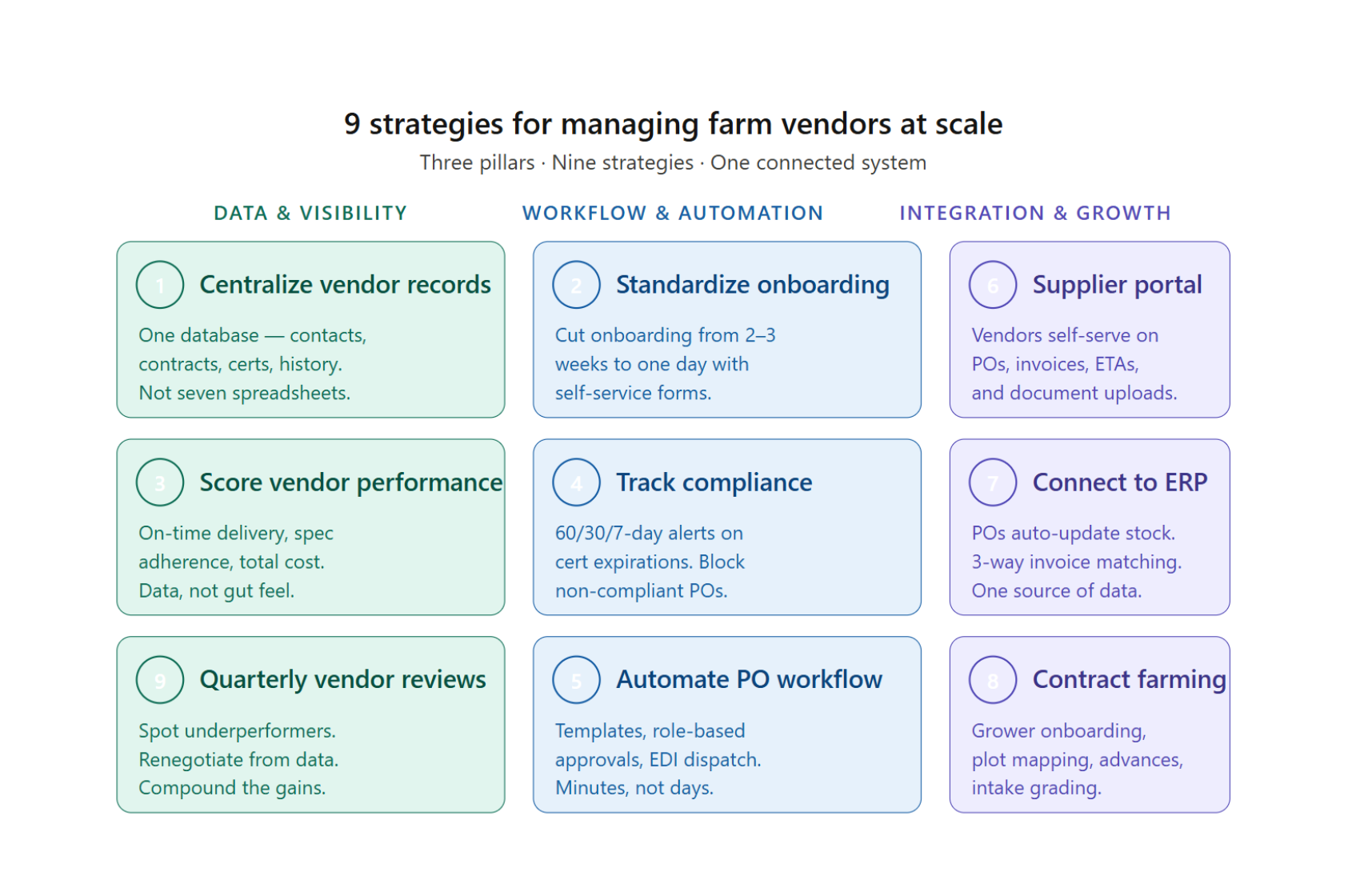
Centralize every vendor record in one source of truth
The single highest-leverage move you can make. Stop spreading vendor data across spreadsheets, contract folders, Outlook contacts, and your accountant’s QuickBooks. Pull every active supplier into one searchable database, contacts, contracts, certifications, banking, payment terms, and transaction history.
This is the foundation of every other strategy on this list. Skip it and the rest stop working.
Standardize your farm vendor onboarding process
A structured farm vendor onboarding process turns the 2–3 week scramble into a 1-day workflow. Build one guided form that captures everything a new vendor needs to submit, W-9s, insurance, banking, product catalogs, food-safety certifications, and let the vendor self-submit through a self-service portal. Your team reviews and approves in a single sitting.
| Manual onboarding | Standardized onboarding |
| Email back-and-forth, missed docs | Guided form, vendor self-submits |
| 2–3 weeks average | 1-day average |
| Compliance gaps discovered later | Compliance verified upfront |
| Inconsistent vendor data | Consistent fields across every supplier |
Score every vendor on the metrics that actually matter
Vendor evaluation in farming has to measure what actually moves the farm. Price matters, but it’s nowhere close to the only metric. Build a scorecard that tracks:
- On-time delivery during planting and harvest windows
- Spec adherence (quality, residue tests, moisture, grade)
- Price variance vs. quoted price
- Defect and rejection rates
- Compliance status (certifications current, lapsed, or missing)
Update the scorecard automatically after every delivery. Decisions on who gets the next order stop being gut calls and start being data calls.
Track contracts and certifications with automatic alerts
The single most expensive mistake in agriculture procurement is the certification you didn’t realize had expired. USDA Organic, FSMA, GAP, GlobalG.A.P., Non-GMO Project, every one cycles annually, and every one can pull your buyer relationships.
The strategy: every vendor contract and every certification gets logged with an expiration date. Automatic alerts at 60, 30, and 7 days before expiration. Non-compliant vendors automatically blocked from new POs until they renew. No exceptions.
Automate the purchase order workflow
Generate POs from templates instead of from scratch. Route approvals automatically by category and dollar value, a $3,000 fertilizer PO gets auto-approved at the farm manager level; a $50,000 equipment PO routes to the CFO. Dispatch POs by EDI to vendors that support it, or by email to those that don’t.
This single change usually cuts PO turnaround from days to minutes, and eliminates the most common source of vendor disputes (PO copies that don’t match invoices).
Open a supplier self-service portal
The fastest way to take 70% of vendor email volume off your team’s plate is to stop being the middleman. Give every vendor a login. Let them:
- Confirm POs themselves
- Upload invoices directly
- Update delivery ETAs
- Submit renewed certifications
- Check payment status without calling
Your procurement team stops being a vendor help desk and starts doing actual procurement work.
Connect vendor management with inventory and finance
The biggest hidden cost on most farms isn’t bad vendor data, it’s disconnected vendor data. Stock counts in one system, POs in another, vendor records in a third. When something breaks, three teams spend days reconciling what should be one answer.
Farm inventory and vendor management belong on the same platform. When a PO is received, inventory updates automatically. When an invoice is matched against PO and receiving, AP gets triggered without a single manual entry. This is where modern ERP earns its place.
Manage contract farming relationships as a distinct vendor type
If you run any contract growing or outgrower operations, your “suppliers” are also long-term partners with their own land and contracts. Farmers vendor contract management requires features generic procurement tools can’t handle: plot mapping, contract terms tied to specific quality grades, advances against future harvest, intake grading that drives grower payments.
Treat them as a distinct vendor category with their own workflow. Don’t try to force-fit them into the same template as your fertilizer dealer.
Run quarterly spend and vendor reviews
The data you’ve been collecting through Strategies 1–8 is useless if you never review it. Schedule quarterly vendor reviews that look at:
- Top 10 vendors by spend
- Bottom 10 vendors by performance
- Certification status across the entire base
- Total cost of ownership per vendor (not just unit price, including late fees, rejections, freight, quality issues, etc)
- Spend concentration risks (too much volume with one supplier)
Most farms renegotiate two or three contracts a year from these reviews and recover real margin without doing anything else.
Why These Strategies Fail without the right system
The strategy is only half the answer
You can write down all 9 strategies on a whiteboard. Most farms have, at some point, tried to run them on a combination of Google Sheets, Outlook, and the accounting system. It rarely sticks.
Here’s why: the strategies aren’t really 9 separate things. They’re one connected workflow that has to share data in real time. A scorecard (Strategy 3) is meaningless without the centralized record (Strategy 1) feeding it. Compliance alerts (Strategy 4) require a system that knows which vendor is on which PO (Strategy 5). The quarterly review (Strategy 9) needs every other strategy already running.
The farms that successfully scale vendor management to 50, 100, or 200+ active suppliers do it on a dedicated platform, not a stitched-together collection of tools. Deloitte’s 2025 CPO research found that digital procurement leaders outperform laggards by 25+ percentage points across cost, supplier performance, and risk management, and the gap keeps widening every year.
A few things to look for in a system actually built for this:
- Native to your ERP, not bolted on. If vendor management isn’t connected to inventory and finance, you’ve recreated the same disconnected-data problem with extra steps.
- Built for agriculture. Generic procurement software doesn’t understand seasons, lot traceability, or food-safety certifications. Forcing it into agriculture means expensive customization that breaks every upgrade.
- Supplier portal as a first-class feature. If vendors can’t self-serve, you’ll be the help desk forever.
- Lot-level traceability. Every input tied back to the supplier and PO behind it. Non-negotiable in 2026.
CONCLUSION
The bottom line for farms managing vendors at scale
If your operation has crossed 30 active suppliers, or is heading there, managing vendors with spreadsheets and email isn’t a strategy anymore. It’s a slowly compounding cost that shows up as missed planting windows, lapsed certifications, and unexplained margin loss.
The 9 strategies above are what the top operators run. The system they run them on matters as much as the strategies themselves.
If your farm is ready to centralize, automate, and finally get visibility on every supplier, see how AgriERP runs all 9 strategies on one platform, built on Microsoft Dynamics 365 and NetSuite, designed for the way agriculture actually buys.
Book a free demo or explore the full vendor management platform to see how it works.
FAQS
What’s the first strategy to fix when managing farm vendors at scale?
Centralization. Pull every active supplier, input vendors, farm equipment vendor management partners, freight carriers, packaging suppliers, contract growers, into one searchable database with their contacts, contracts, certifications, and payment terms. That single exercise reveals 80% of the gaps your current process has been hiding. Every other strategy in this list depends on this one being done first.
How do I score vendors fairly without bias?
Build a scorecard tied to objective data, not opinion. On-time delivery (measured against the original PO date), spec adherence (measured against quality tests), price variance (measured against the quote), defect rates (measured against received units), and compliance status (measured against certification database). Auto-update the scorecard after every delivery so it’s not someone’s gut feel at year-end.
What’s the best way to handle farm vendor compliance?
Make every certification a tracked field with an expiration date. Set automatic alerts at 60, 30, and 7 days before any cert lapses. Block POs to non-compliant vendors automatically until they renew. Most failures happen because nobody owns the calendar, once the system owns it, the failures stop.
How does farmers vendor contract management differ from input vendor management?
Contract growers and outgrowers are a distinct vendor type. They sign long-term contracts tied to specific quality grades, often receive advances against future harvest, and require intake grading workflows that drive their payments. Trying to manage them in the same template as a fertilizer dealer creates more problems than it solves. They need their own workflow.
Should farm inventory and vendor management be on the same system?
Yes. Disconnecting them is the single biggest hidden cost in most farm procurement operations. When a PO is received, inventory should update automatically. When an invoice is matched against PO and receiving, AP should trigger without manual entry. If you’re running them in separate systems, you’re paying for the disconnection in reconciliation time, errors, and lost visibility.
What kind of farm operation actually needs vendor management software?
Once you cross roughly 30 active suppliers, or any operation with compliance-driven buyer relationships, multiple sites, or contract growing, dedicated software typically pays for itself in the first season. If you’re still under 10 vendors and have no buyer compliance demands, a well-organized spreadsheet can hold for a while longer.
How long does it take to implement these strategies on a real farm?
With the right platform, most mid-size farms and processors go from spreadsheet-based to fully running all 9 strategies in 8 to 12 weeks. The implementation timeline is less about technology and more about pulling your existing vendor records together, which is usually the bottleneck on every implementation.
What’s the ROI of fixing vendor management?
ROI varies by operation, but the cost lines that move are consistent: reduced procurement admin time (your team stops chasing vendors over email), fewer missed planting windows from late inputs, fewer compliance failures, better unit pricing from data-driven renegotiation, and reduced inventory carrying costs from accurate stock data. For most mid-size farms, the system pays back within the first growing season.