The ERP Solution for the Year” 2025 in Agtech Breakthrough Awards 2025


Row crop farms win on thin margins, complex logistics, and weather-dependent timing. An Enterprise Resource Planning (ERP) system centralizes diverse business functions, finance, inventory, operations, into a single software platform, enabling real-time decision-making and efficiency across an agricultural business. By unifying financial management, input tracking, crop planning, and analytics, modern ERPs help farmers see true profit on each acre and act faster when markets or field conditions change.
Adoption is accelerating as cloud-first, agriculture-specialized platforms deliver measurable efficiency and margin gains for medium to large farms, with real-world operations reporting improved control, traceability, and planning accuracy and industry coverage of agriculture ERP trends.
The purpose of this playbook is to show how to align ERP capabilities with your farm’s realities, and convert integrated farm management into durable, profit-focused execution.
Core ERP Modules Essential for Row Crop Profitability
A row crop ERP should tightly connect agronomy, operations, and finance. The most important modules, and how they translate to ROI, are summarized below. Modern systems add field mapping, satellite imagery and NDVI layers, lot/batch tracking, offline mobile apps, and automated alerts for crop and input management to turn data into action.
| Module | Core function | ROI driver | Direct benefits for row crop farmers |
| Financials & accounting | General ledger, AP/AR, cost centers, P&L | Real-time cost and margin control | Profit-per-acre clarity; faster closes and cash flow |
| Agronomy & field management | Crop plans, field records, NDVI/growth stages | Optimized input timing; yield uplift | Better placement rates; fewer passes; timely actions |
| Inventory & equipment | Input stock, usage logs, maintenance scheduling | Reduced waste; fewer stockouts; higher uptime | Lower shrink; on-time field ops; fewer breakdowns |
| Compliance & traceability | Lot/batch tracking, COIs, audit trails | Risk mitigation; market access; program eligibility | USDA-ready records; recall readiness; certifications |
| Analytics & BI | Dashboards, KPIs, forecasting, benchmarks | Faster decisions; predictive planning | Clear KPIs; scenario planning; confident purchasing |
Financial Management and Profitability Tracking
Profitability starts with financial control. ERP ties every input, pass, and invoice to the right crop, field, and season so you can see real-time P&L and automate routine transactions, enabling precise profit-per-acre analysis and faster reportin. .
Key financial metrics to track:
- Profit per acre and by crop/variety
- Operating margin and cost of production (fixed and variable)
- Working capital, cash conversion cycle, and receivables days
- Input price variance and equipment cost per hour/acre
A practical workflow:
- Capture costs at the source (seed, chem, fertilizer, fuel, labor, equipment hours)
- Automated categorization to crop, field, and cost center via item/field codes
- Real-time dashboards show variance vs. plan by crop and farm
- Action: rebid inputs, adjust seeding or passes, re-time sales, update cash plans
Agronomy and Field Planning Integration
When agronomy and finance live in the same system, plans reflect both soil reality and market opportunity. ERP-integrated crop planning tools coordinate planting windows, growth stage tracking, and interventions against weather and price signals, so you can time inputs and logistics for maximum margin.
“Agronomy integration” means connecting real-time field conditions, crop records, and management zones directly to farm finances, enabling data-backed input decisions and more accurate yield forecasts. Linking NDVI imagery, soil test layers, and field activity logs within ERP improves placement rates, reduces over-application, and tightens yield predictions, so purchasing, storage, and marketing plans are aligned (see Bushel’s farm management perspective on data-driven operations).
Inventory, Equipment, and Input Management
Strong inventory and asset controls are the difference between an on-time pass and a missed window. ERP automates stock tracking from purchase to field use, triggers replenishment before shortages, and logs usage by field to prevent overbuying and out-of-stocks, while maintenance scheduling protects high-value equipment and boosts uptime (see Results’ industry-specific features for agriculture).
Best practices:
- Centralize input tracking with item masters, preferred vendors, and standard pack sizes
- Use barcode/RFID for real-time bin-to-field traceability and faster counts
- Set min/max levels and seasonal reorder points tied to crop plans
- Track equipment service intervals by hours and conditions; auto-create work orders
- Reconcile usage to plans weekly during peak season to curb shrinkage and slippage
Compliance, Traceability, and Audit Readiness
Traceability is the ability to track every stage of the farm production process, from planting and input use to harvest and sales, providing full visibility for audits, recalls, and market certification. ERPs capture lot/batch lineage, input applications, and handling steps automatically, producing audit-ready records that support USDA, food safety, and sustainability standards and open doors to premium supply chains.
These capabilities reduce recall risk, streamline third-party certification, and simplify participation in government programs, carbon/sustainability initiatives, and identity-preserved contracts, without pulling staff into spreadsheet archaeology during audits.
Advanced Analytics and AI-Driven Insights
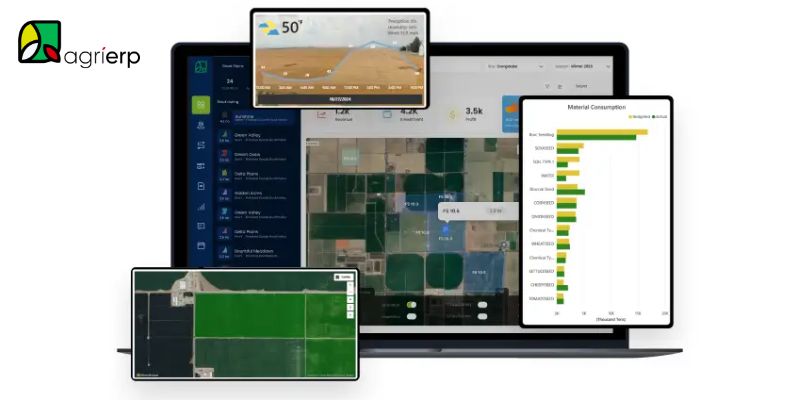
Dashboards and business intelligence show what happened; AI highlights what to do next. AI-driven insights are automated recommendations and forecasts generated by software algorithms using historical and real-time farm data, improving everything from real-time resource allocation to input purchases.
In practice, predictive analytics can flag fields trending below expected NDVI, recommend optimal reorder timing for constrained chem SKUs, or simulate margin by crop under multiple price/yield scenarios.
Examples:
- Demand forecasting aligns input purchasing and delivery with field schedules
- Prescriptive alerts trigger scouting when imagery deviates from baseline norms
- Copilot-style assistants surface variances (fuel, labor) and suggest corrective actions
Step-by-Step ERP Implementation for Row Crop Operations
- Define objectives and KPIs: profit-per-acre visibility, faster close, input variance control
- Map current processes: purchasing, field ops, harvest, logistics, accounting
- Select the right ERP: prioritize ag-specific modules, offline mobile, traceability, and integrations
- Integrate systems: bank feeds, equipment telemetry, scale tickets, merchandising tools
- Pilot: start with one crop, region, or business unit to validate data flows and ROI
- Train office and field teams: role-based learning with sandbox testing
- Go live in phases: financials and inventory first, then agronomy and advanced analytics
- Iterate and scale: expand modules and farms based on post-harvest reviews
For deeper planning, see Folio3’s guide to ERP implementation in agriculture.
Overcoming Common ERP Adoption Challenges
Typical hurdles include data migration quality, change resistance, customization scope, and field-team buy-in. Practical solutions: run a phased rollout with a tightly scoped pilot, involve agronomy and equipment leads in testing, standardize item/field naming early, and leverage cloud deployment for faster updates and ROI (see Consulting Prudence on ERP gains in cost control and profitability). Budget for integrations, allow extra time for seasonality, and align with risk-management and incentive programs to offset adoption costs.
Monitoring ROI and Scaling ERP Use Across Farms
Treat ERP as an operating system for the business and measure it accordingly. Set clear KPIs such as cost per acre, labor productivity, working capital improvement, stockout rate, and margin growth. Establish repeatable post-launch reviews: monthly KPI reporting, user feedback loops, cost-benefit recalculation each season, and staged module expansion by crop or farm. For an example of measuring impact over phases, see NetSuite’s ERP implementation case study.
Sample ROI dashboard metrics:
| KPI | What it measures | How ERP influences it | Cadence |
| Cost per acre (by crop) | Total cost allocation accuracy | Automated cost capture and categorization | Monthly |
| Operating margin | Profitability by crop/farm | Real-time P&L and variance alerts | Monthly |
| Input shrink (%) | Lost vs. applied materials | Usage logs, reconciliations, traceability | Weekly |
| Equipment uptime (%) | Asset availability in season | Preventive maintenance scheduling | Weekly |
| Working capital days | Liquidity and cash conversion | Faster invoicing, inventory turns | Monthly |
Conclusion
Row crop farms don’t lose money in one big mistake; they lose it in small leaks: missed timing, input shrink, disconnected records, and unclear cost-per-acre. A modern ERP fixes that by unifying agronomy, operations, inventory, equipment, compliance, and accounting into one system, so every pass, purchase, and harvest load ties back to real profitability.
With AgriERP, you get profit-per-acre visibility, tighter input control, audit-ready traceability, and faster decisions during tight windows. Ready to stop guessing and start managing margin? Book an AgriERP demo or request a profit-per-acre assessment today.