The ERP Solution for the Year” 2025 in Agtech Breakthrough Awards 2025


Managing a fresh-food operation is full of challenges, short shelf lives, complex traceability rules, and razor-thin margins. In fact, roughly one-third of all food produced globally is wasted, costing companies big money. As a produce grower or fresh-food processor, you need an ERP system built specifically for your needs, one that ties together farm-to-fork operations, inventory and lot control, quality checks, and finances.
The right food manufacturing ERP can help your business cut waste and avoid costly recalls by automating inventory tracking, FEFO (first-expiry-first-out) order picking, and instant traceability. In this blog, we’ll explain why a specialized food ERP is critical for your business and review the 10 leading food manufacturing ERP solutions for produce and fresh-food companies.
Why Fresh Food Companies Need Food Manufacturing ERP?
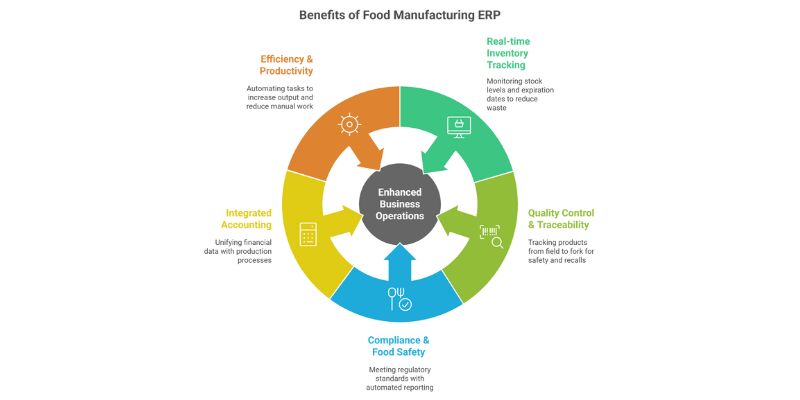
Your produce or fresh-food business faces unique demands: perishable inventory, strict safety regulations, and variable supply chains. A food-focused ERP gives you one system to handle it all. For example, with a modern ERP you get:
- Real-time Inventory and Waste Reduction: Track every bin, pallet, and lot by expiration date. ERP alerts prevent overstock and spoilage, enforcing FEFO stocking. Growers can go from minimal inventory oversight to a full understanding of our manufacturing process after ERP implementation.
- Quality Control and Traceability: Lot-by-lot tracking from field to fork means quick recalls and audits. A robust ERP lets you scan incoming shipments with batch codes and instantly trace ingredients through production. This protects your brand and reduces recall impact.
- Compliance and Food Safety: Built-in modules handle FSMA, HACCP, and other standards. Automated record-keeping and audit trails mean you can generate sanitation and quality reports on demand. This simplifies inspections and keeps you in compliance.
- Integrated Accounting: With built-in financials, your accounting software is unified with production. You see true production costs and margins in real time, rather than juggling spreadsheets. This tight cost control is essential for staying profitable.
- Efficiency and Productivity: Production scheduling, process automation, and real-time dashboards speed up throughput. In one case, a small manufacturer quintupled its output without extra staff after ERP implementation. You’ll minimize manual data entry and focus your team on growing the business.
Top 10 Food Manufacturing ERP Solutions for Produce and Fresh Food Companies
The market offers many ERP options, but the ones below excel in the food industry and fresh produce space. Each solution is designed to handle perishable inventory, quality management, and supply-chain visibility.
1. AgriERP – Farm and Produce-Focused Food Manufacturing ERP
AgriERP is a cloud-based ERP built on Microsoft Dynamics 365 for large farms, co-ops, and fresh-food producers. It combines farm management with food manufacturing features in one platform.
Core features include crop scheduling, harvest tracking, and integrated accounting. On the manufacturing side, AgriERP offers lot and expiration tracking, yield forecasting, and quality control modules that meet USDA and FDA compliance. It also includes mobile apps so your field team can log data in real time.
Key Features: Comprehensive farm-to-market workflows; batch/lot traceability for produce; first-expiry-first-out (FEFO) picking; detailed cost accounting for each batch; built-in quality checks, intuitive dashboard.
Best for: Large farms, vertical integrators, and agribusiness owners who need an ERP that covers both cultivation and food production.
2. Wherefour ERP
Wherefour provides an ERP geared toward food manufacturers and fresh-food distributors. It offers a strong MRP/forecasting engine and end-to-end traceability. For example, Wherefour tracks every ingredient lot and updates its status through processing.
It also integrates seamlessly with common accounting platforms (QuickBooks, Sage, Xero, Microsoft Dynamics). Inventory management tools let you set low-stock and expiration alerts, while their planning module shows “what-if” production scenarios.
Key Features: Inventory control across multiple locations (with barcode scanning and expiration alerts); built-in lot tracking; recipe/formula management; sales order automation; and real-time dashboards.
Best for: Medium-sized fresh produce operations and packers who need both manufacturing and distribution ERP in one.
3. Aptean ERP
Aptean’s Food & Beverage ERP is a global, enterprise-grade system for complex food producers. It offers end-to-end production control and compliance support. Key modules cover formulation/nutrition analysis, quality assurance, and multi-site manufacturing. Its “one-stop” platform handles everything from ingredient inventory to final shipment, with strong support for international regulations and audits.
Key Features: Full batch processing (including allergen management and nutrition tracking); automatic traceability reports; integrated financials; and extensibility (it can scale across many plants).
Best for: Large-scale food and beverage manufacturers (e.g., branded goods producers, co-packers) that require a robust, scalable ERP with global reporting and multi-company consolidation.
4. JustFood ERP
JustFood ERP is tailored for food manufacturers that need rigorous safety and traceability. It comes with built-in compliance for standards like SQF, HACCP, FSMA, and BRC. Its warehouse features include expiration-date (FEFO) inventory and full lot/batch tracking, so you use ingredients before they spoil and can trace any item through production. Quality managers can set mandatory audits at any stage.
Key Features: Bi-directional traceability and recall management; allergen and quality hold controls; warehouse management with FEFO picking; and strong reporting for food safety audits.
Best for: Food and beverage companies (including processors and co-packers) that must meet stringent safety standards and want end-to-end batch traceability.
5. Deacom ERP
Deacom’s ERP is a single-platform solution built for batch and process industries (including food). It follows a “one system” philosophy, there are no third‑party add‑ons required. Deacom provides in-house formulation and quality modules, plus a native warehouse management system. Its Hyper-Tight Process Control enforces mandatory quality steps so nothing gets skipped.
Key Features: Unified finance/production/inventory; built-in quality control and lab testing; advanced lot and catch-weight tracking; and real-time processing across all departments.
Best for: Mid-to-large food processors that want all functionality in one place, strong compliance controls, and minimal reliance on integration or custom coding.
6. Inecta Food ERP
iNECTA is an ERP built on Microsoft Dynamics 365 Business Central with a focus on food and beverage. It includes produce-specific workflows for sort-and-pack operations. iNECTA automates compliance tasks, supports catch weights, and offers flexible deployment (cloud or on-premise). Its integration with MS Office and e-commerce tools is tight, which helps agribusinesses modernize.
Key Features: End-to-end lot and traceability management; FEFO/expiry tracking; integration with third-party apps (Shopify, etc.); and Microsoft Office integration for reporting.
Best for: U.S. food processors and fresh produce companies already using Microsoft solutions who want industry-specific extensions (like built-in recall workflows and harvest tracking).
7. BatchMaster Manufacturing ERP
BatchMaster ERP specializes in formula and batch manufacturing for food and beverage. It plugs into popular accounting packages (SAP Business One, QuickBooks, etc.) to add manufacturing power. BatchMaster’s built-in lab testing and quality controls ensure compliance, and it automatically records yield and cost for each batch.
Key Features: Dynamic formula management; advanced lot traceability; QC/lab integration; allergen control; plus seamless links to financial systems.
Best for: Small-to-mid-sized food manufacturers (e.g., specialty foods, ingredient makers) that need a powerful batch-production and inventory solution without replacing their existing finance software.
8. ProcessPro ERP
ProcessPro is an ERP for food batch/process industries. It provides real-time dashboards and “what-if” tools for production planning. The system includes recipe/formula management, lot tracking, purchasing, and ledger on one platform. It also offers built-in BI analytics, so you can drill into KPIs for any production run. ProcessPro can be deployed on-premise or in the cloud with mobile support.
Key Features: Comprehensive process scheduling; formula creation and revision; full lot/traceability; audit trails; and mobile warehouse/production scanning.
Best for: Food and beverage processors (small and mid-size) that require a flexible, all-in-one ERP with strong support for recipes and compliance.
9. Food Connex
Food Connex is designed for fresh-cut produce and other perishable packers. It shines in batch tracking and warehouse management. For example, when a shipment arrives, Food Connex assigns each bin a unique lot number (with harvest date, supplier data, etc.) and then updates that lot’s status through each operation. It integrates with QuickBooks for finance, and its dashboards help you manage orders and inventory in real time.
Key Features: Powerful batch/lot tracking (with touch-screen data entry); multi-warehouse inventory control; integration with QuickBooks; and FIFO/FEFO picking.
Best for: Produce packers, fresh-cut processors, and produce distributors who need tight inventory control and want to extend QuickBooks with a food-specific ERP.
10. Prophet ERP
Prophet ERP by Prophetize is designed specifically for fresh produce, food processing, and distribution companies. It delivers complete operational visibility, enabling businesses to manage procurement, production, inventory, and sales within a unified system.
The software emphasizes traceability, ensuring every item from farm to shelf is tracked in real time. Prophet ERP also streamlines compliance and forecasting, helping food businesses minimize waste and maintain quality standards throughout the supply chain.
Key Features: End-to-end supply chain and inventory tracking; real-time lot and batch traceability; integrated quality and compliance management; production planning and demand forecasting; financial and accounting management tools.
Best for: Mid-sized to large fresh produce manufacturers, distributors, and food processing companies seeking a complete ERP solution for traceability, compliance, and operational efficiency.
How to Select Manufacturing ERP for Your Produce and Fresh Food Company?
As an agribusiness owner, you must evaluate more than just features. Here are critical factors to consider when selecting an ERP for your produce or fresh-food operation:
- Industry Fit and Compliance: Ensure the ERP was built for food manufacturing. Look for food ERP systems that support your regulations (FSMA, HACCP, organic labeling) and production methods (catch weights, co-packing). For example, does the vendor provide food industry software templates or regulatory libraries?
- Scalability and Integration: Choose a solution that can grow with you. It should handle your current volume and multi-site needs, and integrate seamlessly with your accounting (or even be the accounting system). A good food ERP will integrate finance, production, inventory, and even your e-commerce or distributor portals under one roof.
- Data and Analytics: Today’s ERPs offer real-time dashboards. As a leader, you want instant visibility into yield, waste, costs, and margins. Verify the ERP has built-in reporting or BI tools (e.g., Power BI integration, as with some systems). This turns raw ERP data into actionable insights for your executive team.
- User Adoption and Support: The best technical solution fails if your team won’t use it. Consider usability (mobile apps, intuitive interfaces) and vendor support. A proven food ERP vendor should offer hands-on implementation assistance and training.
- Total Cost of Ownership: Beyond license fees, consider implementation, customization, and training costs. Also, calculate expected ROI, inventory turnover, lower recall risk, and labor savings. Well-implemented ERP (like AgriERP for agribusinesses) can pay for itself through efficiency gains.
- Packaging and Supply Chain: If you produce packaged goods, ensure the system handles packaging, bill of materials, and labeling. If you source from many farms, ensure the ERP supports multi-supplier tracking and vendor scorecards.
Conclusion
Selecting the right food manufacturing ERP isn’t just a technology decision—it’s a strategic move toward better control, traceability, and profitability. A purpose-built ERP helps fresh food companies streamline everything from production and inventory to compliance and financials, ensuring every process stays connected and transparent.
AgriERP stands out as a robust option for agribusinesses and fresh-food producers, integrating farm management, quality control, and supply chain visibility in one unified platform. Its automation and real-time insights empower companies to minimize waste, maintain freshness, and meet evolving market demands with confidence.
To discover how AgriERP can transform your operations, talk to our expert and explore a solution designed for the future of food manufacturing.