The ERP Solution for the Year” 2025 in Agtech Breakthrough Awards 2025


If you’ve ever sat at a kitchen table with a stack of paper invoices, three open spreadsheets, and a phone full of WhatsApp messages from a seed dealer who still hasn’t confirmed delivery, you already know what vendor management feels like in agriculture. You just may not have called it that yet.
Every modern farm runs on suppliers. Seed, fertilizer, feed, equipment, packaging, freight, agronomy services, contract growers, most mid-size and large operations work with somewhere between 30 and 200 vendors a year. And the way you manage those relationships quietly decides whether you hit your planting window, pass your next audit, and finish the season in the black.
Why farm vendor management has quietly become a margin killer
Farming has always involved buying from a lot of people. What’s changed is the cost of doing it badly.
The FAO reports that over 13 percent of food produced globally is lost in the supply chain between harvest and retail, a loss valued at more than $400 billion every year. A meaningful slice of that loss happens because supplier relationships break down: late inputs miss planting windows, out-of-spec deliveries fail quality checks, and disconnected procurement leaves farms guessing what they actually have on hand.
On most farms, the problems show up in four predictable places:
- Late inputs at critical windows. A fertilizer dealer slips a delivery by ten days in April. By the time the truck arrives, you’ve already lost prime planting weather. Nobody flagged the slippage early because nobody was tracking lead times in the first place.
- Compliance gaps you discover at audit time. A feed supplier’s food-safety certification expired three months ago. You only find out when the buyer’s auditor pulls the records, and they pull your records too.
- Money quietly wasted on the wrong vendors. You’re paying a 14% premium to a vendor with worse on-time delivery than a cheaper backup. Without scorecards, this stays invisible season after season.
- Inventory and procurement running on parallel tracks. Stock counts live in one spreadsheet, purchase orders in another, and vendor records in a third. When something goes wrong, nobody can answer the simple question: which supplier delivered the lot that failed?
“If any of those sound familiar, you don’t have a procurement problem. You have a vendor management problem.”
What vendor management in agriculture actually covers
Vendor management isn’t just “buying things.” It’s the full process of selecting, onboarding, evaluating, paying, and getting consistent performance out of every supplier your farm depends on.
For agriculture specifically, that process spans seven core capabilities:
| Capability | What it means in practice |
| Centralized vendor database | One searchable record per supplier, contacts, contracts, certifications, banking, and history. Not seven spreadsheets. |
| Vendor onboarding | A structured process to bring on new suppliers, W-9s, insurance, certifications, banking, and product catalogs, without three weeks of email back-and-forth. |
| Purchase order automation | POs generated from templates, routed by role, dispatched by EDI or email, and tied to inventory in real time. |
| Vendor performance scoring | A scorecard system that measures every supplier on the metrics that matter in agriculture, on-time delivery during planting windows, spec adherence, price variance, and quality. |
| Contract and compliance tracking | Every contract, every certification, with automatic alerts before expirations or renewals. Audit-ready year-round. |
| Supplier self-service portal | Vendors confirm POs, upload invoices, update ETAs, and submit certifications themselves, instead of clogging your team’s inbox. |
| Lot-level traceability | Every input tied back to the supplier and PO it came from. When a quality issue surfaces, you trace the source in minutes, not days. |
The farms doing this well aren’t running these seven things in seven different systems. They’re running all of them in one, connected to their inventory, financials, and field operations.
Manual vs. modern vendor management
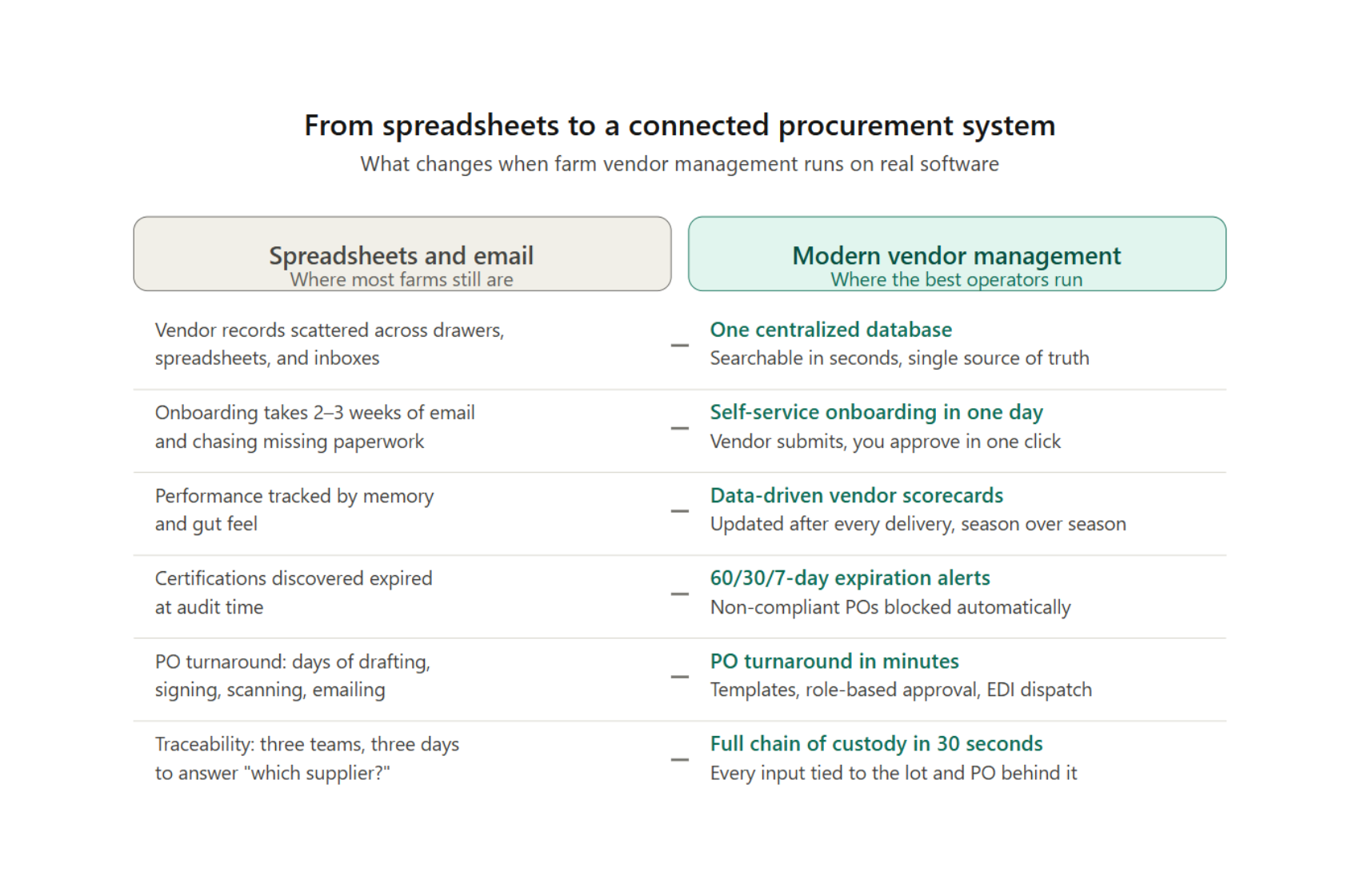
The contrast between the old way and the modern way is stark, and it shows up on the P&L:
| Manual / spreadsheet-based | Modern vendor management system | |
| Vendor records | Scattered across folders, drawers, and inboxes | One centralized database, searchable in seconds |
| Onboarding | 2–3 weeks of email and chasing paperwork | Guided link, vendor self-submits, approved in a day |
| PO process | Paper or PDF, signed manually, emailed | Auto-generated, role-routed, EDI-dispatched |
| Performance tracking | Memory and gut feel | Data-driven scorecards, updated after every delivery |
| Certification tracking | Expirations discovered at audit time | 60/30/7-day alerts before any cert lapses |
| Inventory sync | Manual reconciliation at month-end | Real-time, POs auto-update stock and bin/lot |
| Traceability | “Let me check… give me three days.” | One search, 30 seconds, full chain of custody |
Why agriculture is different from other industries
Generic vendor management software was built for businesses buying office supplies or SaaS subscriptions. It doesn’t understand seasons. It doesn’t track GlobalG.A.P. certifications or FSMA compliance. It can’t connect a fertilizer purchase to the field block it was applied on, or trace a feed batch back to the mill that produced it.
That’s why supplier management in agriculture has its own rules:
- Seasonality is non-negotiable. A late seed delivery in April can’t be made up in July.
- Lot-level traceability is regulated, not optional. The FDA’s FSMA Section 204 requires food businesses to maintain detailed records of where high-risk foods came from.
- Compliance certifications cycle annually. USDA Organic, GAP, GlobalG.A.P., Non-GMO Project, each one expires, each one needs renewal, and each one can pull your buyer relationships.
- Contract growers and outgrowers are a unique vendor type. They’re suppliers, but they’re also long-term partners with their own land, their own contracts, and their own compliance requirements.
USE CASES BY FARM TYPE
What good vendor management looks like across different operations
Row-crop and specialty farms You’re buying seed from one or two main companies, fertilizer from three or four dealers, chemistry from a regional distributor, and equipment service from a handful of local providers. Your biggest risk is the planting and harvest window, vendor delays don’t just cost you money, they cost you a season. Vendor management for you means lead-time alerts, scorecards by supplier, and a system that flags slippage before the planter sits idle.
Processors, hullers, and shippers You’re buying from dozens of growers plus a layer of input suppliers and packaging vendors. Your risk profile is compliance, one expired food-safety certification at a supplier can yank your buyer relationships. Vendor management for you means automatic certification tracking, blocking POs to non-compliant vendors, and full lot-level traceability from intake to outbound shipment.
Contract farming operations and outgrower networks. Your “vendors” are also your suppliers, growers under contract who deliver harvest under specific quality terms. Vendor management for you means onboarding workflows for new growers, plot-level contract terms, advances against future harvest, and intake quality grading tied to grower payments. The FAO has documented contract farming as one of the fastest-growing models in global agriculture, and the operations that scale it successfully run it on real software, not spreadsheets.
Multi-site farms and co-operatives You’re running procurement across multiple locations, each with their own vendor list, each negotiating their own prices. Without centralized vendor management, you’re losing buying power. With it, you consolidate volume, standardize approved-vendor policies across sites, and renegotiate from real spend data.
Farm equipment buyers Tractors, harvesters, irrigation systems, and machinery vendors aren’t your everyday input suppliers, but they represent some of the largest capital outlays on the farm. Farm equipment vendor management means tracking warranty terms, service contracts, parts availability, and dealer performance across the multi-year lifecycle of every machine.
CONCLUSION
From understanding to action
Knowing what vendor management is doesn’t fix the problem. The farms gaining real margin from it are the ones who’ve put a system in place, one that connects suppliers, purchase orders, inventory, and compliance into a single workflow.
The next step for most farms is auditing what they currently have:
- How many vendors are you actively buying from this year?
- Where do their records live right now?
- Can you tell, in 30 seconds, which supplier delivered the lot that failed your last quality check?
- When was the last certification renewal you almost missed?
If you can’t answer those questions confidently, you’re not alone. Most farms can’t. But the ones that fix it pull margin out of every season, the ones that don’t.
If your farm is ready to stop running procurement on spreadsheets, see how AgriERP centralizes farm vendor management on Microsoft Dynamics 365 and NetSuite.
FAQS
What is vendor management in agriculture?
Vendor management in agriculture is the full process of selecting, onboarding, evaluating, paying, and getting consistent performance out of every supplier your farm depends on, including input vendors, equipment dealers, packaging partners, freight carriers, agronomy consultants, and contract growers. Strong vendor management replaces spreadsheets, paper POs, and email chains with structured workflows that scale across seasons and sites.
What’s the difference between vendor management and supplier management?
The terms are often used interchangeably. Supplier management in agriculture tends to emphasize the operational relationship, onboarding, contracts, performance, payment. Vendor management tends to emphasize the broader procurement lifecycle including category strategy and spend analytics. In practice, most farms need both, and modern systems handle them as one workflow.
Why is vendor management more important now than five years ago?
Three reasons. First, input costs have risen sharply, so spend-side margin matters more than it used to. Second, food-safety regulations like the FDA’s FSMA traceability rule require farms and processors to keep far more detailed supplier records than before. Third, buyers, retailers, food service, exporters, are demanding chain-of-custody documentation that’s impossible to produce from spreadsheets.
What are common supplier management examples on a farm?
Onboarding a new fertilizer dealer with W-9s and insurance docs. Tracking a feed mill’s GlobalG.A.P. certification through annual renewal. Scoring a seed company on on-time delivery during planting. Auto-blocking POs to a vendor whose food-safety cert has lapsed. Reconciling a packaging vendor’s invoice against the matched PO and receiving record. Comparing two equipment dealers on total cost of ownership before signing a service contract. Every one of these is vendor management in action.
How do farm supplier management systems differ from generic procurement software?
Generic tools were built for office supplies and SaaS subscriptions, not for agriculture’s seasonality, lot traceability, or certification demands. Farm supplier management systems built for agriculture tie every supplier to crop cycles, harvest lots, food-safety certifications, and field-level operations. Generic systems can’t replicate that without expensive custom work.
Can a small farm benefit from vendor management software?
Yes, though the right system depends on scale. Operations with fewer than 10 active vendors can often manage with a well-organized spreadsheet plus a clear contract folder. Once you cross 30+ vendors, multiple sites, or any compliance-driven buyer relationships, dedicated software typically pays for itself in the first season.
What’s the first step to improving vendor management on a farm?
Centralize. Pull every active vendor into one list, with their contact, contract status, and current certification dates. That single exercise, usually one afternoon, reveals the gaps most farms have been carrying for years. Once you can see them, you can fix them.