The ERP Solution for the Year” 2025 in Agtech Breakthrough Awards 2025


You’re running a food operation in a world of perishables, strict regulations, and demand that can swing overnight. That’s exactly why automating food business processes with ERP has become a strategic must, not a back-office nice-to-have.
According to the recent report, 9.5% out-of-stocks across the cost of guessing is just too high. A purpose-built food ERP replaces scattered spreadsheets and siloed apps with one real-time system, so you always know what to buy, what to make, and what to ship next.
Forecasts sync directly to smart purchasing and production schedules. Receiving captures lots and shelf life with a quick scan, updating inventory everywhere instantly. On the line, recipe-controlled work orders enforce specs and allergens; as batches finish, the system auto-consumes raw materials by lot and calculates yields in the background.
Quality checks pop up at the right moments, receiving, in process, and pre-release, and nonconforming lots are automatically held until corrected. Finished goods follow FEFO pick paths so the freshest product ships first.
Orders validate pricing and allocations on the fly, while shipping updates inventory, billing, and customer tracking in one pass. The result: faster execution, fewer errors, stronger compliance, and confident, data-driven decisions, all orchestrated in one platform.
Why Automation Matters in Food Operations?
- Perishability punishes lag: If shelf life, inventory, and production aren’t synchronized with demand, you overproduce slow movers and short high movers. Automation keeps inventory fresh with FEFO (first-expire-first-out), age controls, and dynamic safety stocks, key to cutting the 9.5% out-of-stock drag.
- Compliance is high-stakes: HACCP, allergen control, and FSMA traceability require airtight documentation. Food ERP Automation captures data at the source (receiving, WIP, pack-out) so you’re audit-ready by design.
- Margins are thin: Small, systematic wins, auto-POs, FEFO picks, yield tracking, compound into big savings. That’s especially meaningful against food waste’s 8–10% emissions burden and $940B annual cost.
Core Business Processes in a Food Operation
Before exploring how automation works for you, it’s important to understand the interconnected processes that keep your food business running:
- Procurement & supplier management involves sourcing your raw materials, managing vendor relationships, and ensuring timely deliveries at optimal prices.
- Inventory management and stock control tracks your ingredients, packaging materials, and finished goods while managing expiration dates and storage conditions.
- Production and manufacturing operations transform your raw materials into finished products through recipes, work orders, and production schedules.
- Quality assurance and compliance ensures your products meet safety standards, regulatory requirements, and customer specifications through testing and documentation.
- Traceability and recalls maintain complete records of your ingredient origins and product destinations, enabling rapid response to food safety issues.
- Order fulfillment and distribution manages your customer orders, warehouse operations, shipping logistics, and delivery coordination.
- Sales and demand planning forecasts your future requirements based on historical data, market trends, and seasonal patterns.
- Financials & accounting tracks your costs, manages budgets, processes invoices, and generates financial reports.
- Reporting & analytics transforms your operational data into actionable insights for strategic decision-making.
These processes are interdependent: a delay in procurement affects production, which impacts fulfillment and customer experience. A food ERP connects them so that information flows in real time.
How Food ERP Automates Each Process?
1. Procurement & Supplier Management
A food ERP procurement automatically generates purchase orders the moment inventory drops below smart thresholds, factoring in lead times, open orders, and forecasted demand. Inside the same screen, buyers see supplier scorecards, on-time-in-full performance, non-conformances, and price trends, so reorders are prioritized with data, not guesswork.
Tight integrations with vendor systems (via EDI/API) send electronic POs and receive acknowledgments and ASNs without email ping-pong, while contract terms and pricing sync in the background. The result is fewer emergency buys, cleaner landing costs, and a steadier flow of the right ingredients to production.
2. Inventory Management
ERP in food gives you real-time visibility into on-hand, on-order, and allocated quantities across sites, bins, and lots, so you always know what’s available and what’s aging. Automatic alerts and smart reorder triggers kick in before you hit a stockout, factoring in lead times, seasonality, and service targets.
Batch/lot tracking is built in, and pick paths enforce FIFO or FEFO (first-expire-first-out) to keep product fresh and compliant. The net effect is fewer stockouts, less overstock, and tighter working capital.
3. Production / Manufacturing
On the plant floor, ERP automates recipe and formula management with controlled versions, tolerances, allergens, and nutrition data, so every batch runs to spec. Work orders are generated from demand and scheduled against real capacity, considering changeovers and constraints.
As production posts, the system automatically backflushes raw materials by scanned lot, capturing true usage in the background. Yield calculations and waste tracking surface variances in real time, helping teams find root causes and protect margins.
4. Quality Assurance & Compliance
Quality plans live inside the workflow, receiving, in-process, and finished-goods checks are prompted automatically, with results captured on the spot. If something fails spec, quality gates place the lot on hold and route corrective actions before the material can move forward.
Document generation is one click: certificates of analysis, audit logs, sanitation records, allergen statements, and SOPs are version-controlled and tied to items and lots for clean, fast audits.
5. Traceability & Recalls
End-to-end traceability is standard: every finished case knows exactly which raw materials and packaging lots went into it, and where it shipped. You can drill down to batch/lot level in seconds to answer supplier, customer, or regulator questions.
If a recall is needed, automated workflows identify all affected lots, generate customer and location lists, issue notifications, and track removal and credits, shrinking scope, time, and risk.
6. Order Fulfillment & Distribution
From order capture to shipment, ERP automates the flow: pricing and terms validate instantly, allocations respect FEFO, and pick/pack/ship updates inventory and invoicing in one pass. Integrations with carriers and 3PLs handle labels, tracking, and status updates without rekeying. For fleet or DSD operations, route optimization and delivery scheduling balance capacity, time windows, and service levels to cut miles and chargebacks.
7. Demand Planning & Forecasting
Forecasting runs on autopilot with models that learn from history, seasonal patterns, promotions, and other demand drivers. As forecasts refresh, procurement plans and production schedules adjust automatically, keeping material, labor, and capacity aligned. The result is smoother operations, better fill rates, and leaner inventories, even when demand is volatile.
8. Financials & Reporting
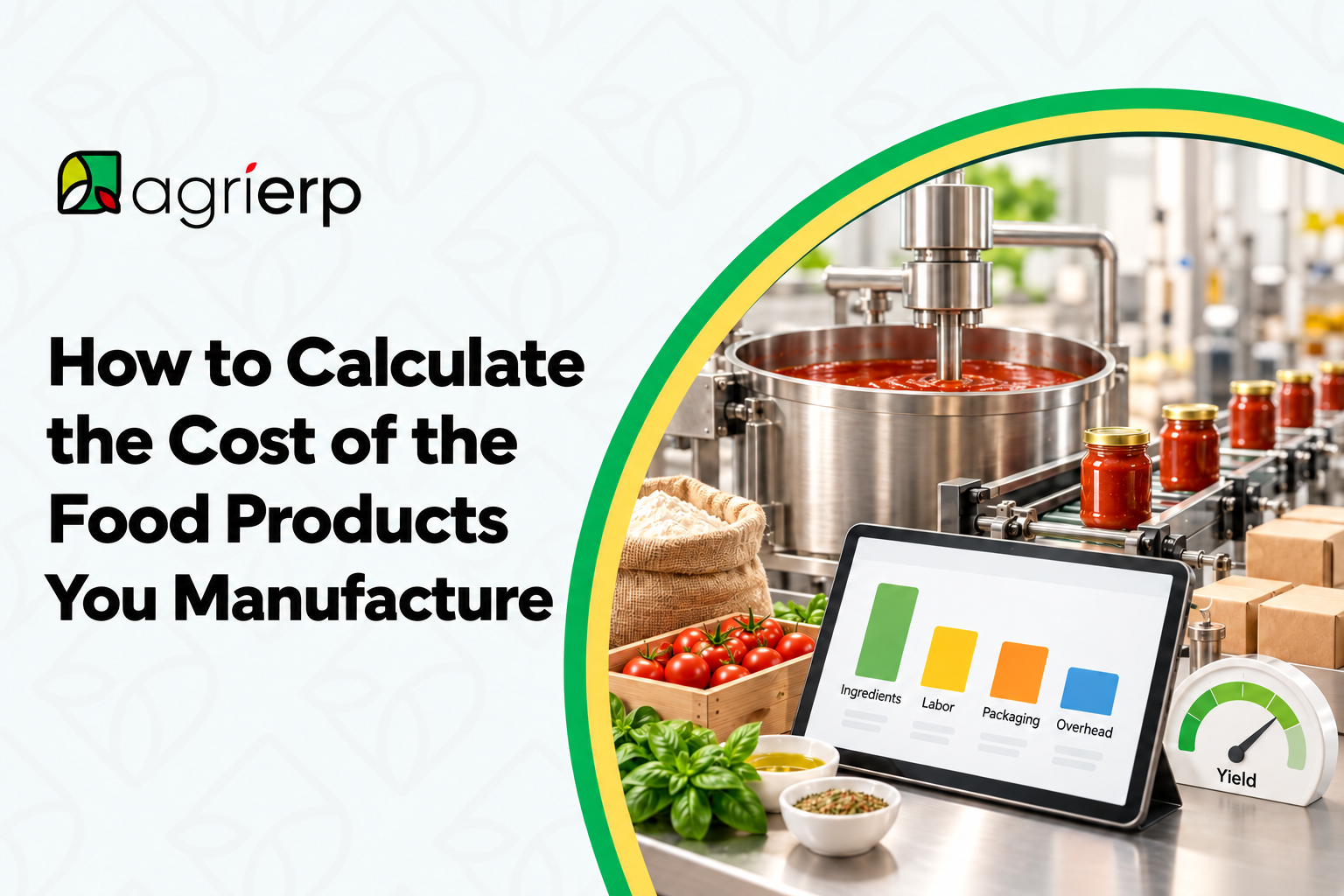
Cost accounting is baked into every transaction: materials, labor, and overhead roll up automatically to item, lot, and order, while allocations and variances post in real time. Because costing is integrated across operations, procurement, manufacturing, warehousing, and logistics, you get an accurate, granular view of product and customer profitability. Live dashboards and anomaly alerts (for yield dips, scrap spikes, or negative margins) help teams act fast, turning data into everyday decisions.
Benefits and Value Delivered
The benefits of food ERP systems extend far beyond simple automation. Let’s quantify the value these systems deliver:
- Efficiency gains are substantial and immediate. By eliminating manual data entry and automating routine tasks, companies can achieve significant improvements. In fact, one of the ERP statistics that will make every budget-conscious decision-maker happy is that 40% of businesses achieve IT savings after an ERP deployment. Production throughput increases as scheduling becomes more efficient and bottlenecks are identified and resolved quickly.
- Cost savings compound across multiple areas. Better purchasing decisions based on accurate demand forecasts and improved inventory management lead to substantial savings. Approximately 38% of businesses report reduced inventory levels after implementing ERP systems, which directly improves cash flow and reduces waste. For food manufacturers operating on thin margins, these savings can mean the difference between struggling and thriving.
- Accuracy improvements because Data entered once at the source flows throughout the system, removing transcription errors that plague multi-system environments. Studies show that 95% of businesses report that ERP implementation led to business process improvement, with significant reductions in order errors and inventory discrepancies.
- Compliance and audit readiness become systematic rather than stressful. Complete digital records, automated documentation, and built-in traceability mean you’re always prepared for inspections. Companies report reducing audit preparation time from weeks to days while improving audit results.
- Improved visibility when you can see real-time data across your entire operation, you identify opportunities and problems faster. This visibility enables data-driven decisions, particularly important given that 86% of employees want better tools and more accessible information to perform their jobs effectively. Imagine knowing exactly which products are most profitable, which suppliers are most reliable, and where production bottlenecks occur, all from a single dashboard.
- Scalability and flexibility as your business grows, adding products, facilities, or entering new markets, your ERP system scales with you. The advantages of food ERP include standardized processes that can be replicated across new locations, enabling faster expansion with lower risk. Whether you’re a regional producer planning national distribution or a specialty manufacturer adding new product lines, the right ERP grows alongside your ambitions.
Conclusion
The food industry’s complexity demands automation to remain competitive. From managing intricate supply chains and ensuring regulatory compliance to optimizing production and meeting customer expectations, the challenges are too numerous and interconnected for manual systems to handle effectively.
Automating food business processes with ERP isn’t about replacing people with technology, it’s about freeing your team from repetitive, error-prone tasks so they can focus on innovation, quality, and growth. It’s about having the visibility to spot problems before they become crises and the agility to capitalize on opportunities quickly.
Ready to transform your food business with ERP? Contact our team of experts to learn more about selecting the right ERP system for your needs and start your journey toward a more efficient and competitive operation.