The ERP Solution for the Year” 2025 in Agtech Breakthrough Awards 2025


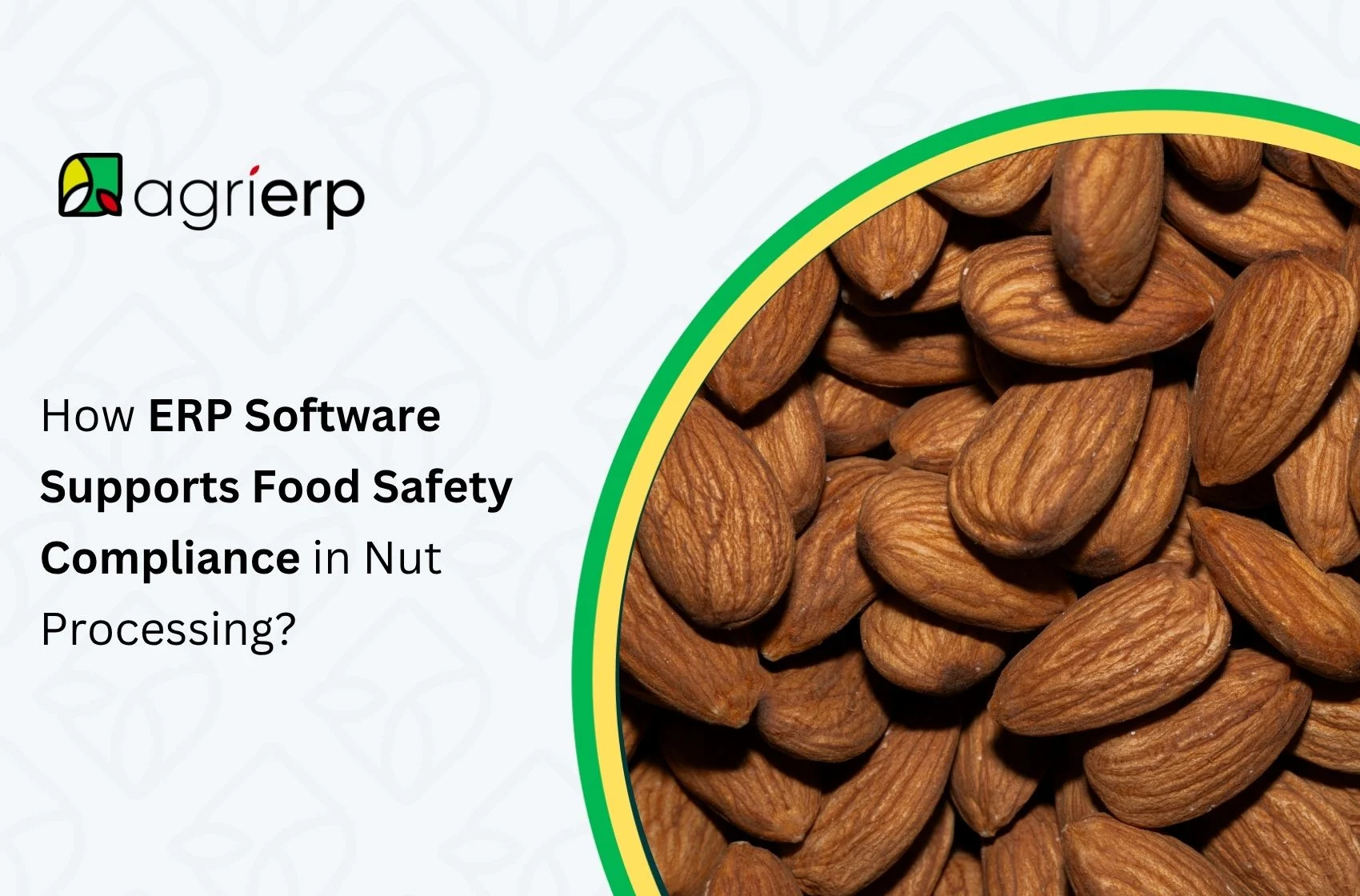
Food safety compliance in nut processing is both a regulatory obligation and a cornerstone of brand trust. From raw nut handling to finished-pack distribution, every step requires rigorous tracking, documentation, and hazard control.
Enterprise Resource Planning (ERP) software automates these demands, delivering complete traceability, auditable workflows, and compliance assurance across frameworks like FSMA, HACCP, and SQF.
For processors of nuts and dried fruits, ERP unifies quality, safety, and operational continuity, removing the guesswork from compliance and ensuring readiness for any audit or recall. This article walks through ten specific ways a purpose-built agricultural ERP transforms food safety management in nut processing facilities.
ERP for Nut Processing Compliance
In nut processing, compliance hinges on precise allergen management, end-to-end traceability, and consistent quality records, capabilities that paper-based or generic systems consistently fail to deliver at scale.
A purpose-built agricultural ERP unifies these requirements through automation designed specifically for nut and dried fruit operations, giving QA teams, compliance managers, and operations leaders a single platform for managing every food safety obligation from intake to shipment.
AgriERP, an all-in-one Integrated ERP Suite for Farm Management built on Microsoft Dynamics 365, recognized as the “ERP Solution of the Year 2025“ by AgTech Breakthrough Awards and featured in Forbes, is purpose-built to meet exactly these demands for nut processors.
ERP (Enterprise Resource Planning) is an integrated software platform that connects production, inventory, quality, and compliance data into one system, creating a single source of truth for all food safety records. Where traditional paper-based approaches are error-prone and slow to retrieve during audits or recalls, AgriERP eliminates those barriers through automated traceability and real-time visibility.
| Process Area | Traditional Approach | AgriERP Workflow |
| Record Keeping | Paper logs, manual entry | Automated digital records |
| Allergen Labeling | Inconsistent, manual checks | Rule-based validation at the batch level |
| Traceability | Partial or delayed | Real-time farm-to-fork tracking |
| Audit Preparation | Days of manual retrieval | On-demand export-ready reports |
| CCP Monitoring | Manual temperature logs | IoT-integrated automated capture |
Through real-time data integration and role-based dashboards, AgriERP gives QA teams full visibility for nut processing compliance under food safety regulations, enabling faster audits, stronger recall control, and safer products.
10 Ways ERP Guarantees Food Safety Compliance in Nut Processing

1. Recipe and Formulation Control
Recipe and formulation control in ERP means enforcing precise ingredient quantities and blocking unauthorized changes during production. For nut processors, this is critical for maintaining consistency in roasted blends, seasoning profiles, and allergen declarations across every batch.
AgriERP maintains full recipe versioning, tracking each modification with digital sign-off requirements and timestamped audit trails. When recipes are standardized and locked system-wide, nutritional compliance is maintained automatically, safeguarding labeling accuracy and ensuring reproducible quality from run to run. Any deviation triggers an alert before the product progresses to the next stage, keeping compliance embedded in the production flow rather than layered on top of it.
2. Lot and Batch Traceability
Lot and batch traceability links every ingredient, process step, and shipment across the nut supply chain, backward to suppliers and forward to customers, enabling rapid trace-back and targeted recall if a contamination issue arises.
With AgriERP’s farm inventory management and traceability modules, FSMA 204 requirements, covering Key Data Elements (KDEs) and Critical Tracking Events (CTEs), are met automatically. Each batch can be traced in seconds using automated lot genealogy reports that visualize product flow from source to shelf. For operations handling almonds, pistachios, walnuts, or mixed dried fruit SKUs, this level of granularity is not optional. It is what major retail and export buyers now contractually require.
For a deeper look at how AgriERP handles lot tracking across different nut and citrus operations, see our Nut and Citrus Farms industry page.
3. Allergen Management
Allergen management in ERP identifies, tracks, and prevents cross-contact between allergenic ingredients, a particularly high-stakes requirement in facilities handling multiple tree nut varieties alongside peanuts or sesame.
AgriERP enables:
- Allergen flagging at both product and batch levels, with automatic alerts when allergen-adjacent ingredients are scheduled
- Automated cleaning validation and scheduling between allergen runs, with documented completion records
- Changeover documentation that creates a timestamped, auditable record of every allergen transition in the facility
This automation keeps allergen-handling procedures compliant with SQF (Safe Quality Food) and BRCGS standards, preventing cross-contact and ensuring precise label integrity, the two areas where tree nut processors face the greatest liability exposure.
4. Shelf-Life and FEFO Picking
FEFO (First-Expired, First-Out) management ensures perishable nut products are shipped before expiry, minimizing spoilage losses and protecting retailers from receiving short-dated stock.
AgriERP automatically records receipt and expiration dates at intake, provides configurable alerts for inventory approaching its threshold, and enforces FEFO logic in warehouse picking workflows. The result is improved shelf-life compliance across nuts and dried fruits, meeting both retailer specification requirements and the food safety expectations of your third-party auditors. Manual FEFO management in spreadsheets or paper systems is one of the most common sources of shelf-life non-conformances; AgriERP removes that risk entirely.
5. Electronic Batch Records and CCP Monitoring
Electronic batch records (EBRs) replace paper production logs with detailed digital documentation for every production run. Each record in AgriERP links ingredient lot data, operator actions, equipment used, and quality test results directly to that batch, creating a complete, tamper-evident production history.
Critical Control Point (CCP) monitoring, such as roasting temperature ranges, moisture content thresholds, or water activity readings, can be automated through IoT (Internet of Things) sensor integration.
AgriERP continuously records these readings against defined HACCP limits and triggers immediate alerts if a deviation occurs, ensuring hazards are contained before the product moves downstream. This replaces the manual log-and-check cycle that creates both data gaps and significant labor overhead in traditional nut processing operations.
6. Quality Testing and Certificate of Analysis Integration
A Certificate of Analysis (COA) confirms that each nut batch meets established quality and safety parameters, covering moisture, aflatoxin, foreign material, microbiological counts, and nutritional values depending on buyer specifications.
AgriERP connects laboratory test data directly to batch records, automating the hold/release workflow until COA approval is received and validated. No batch ships without a verified COA on file.
This integration eliminates the manual matching of lab reports to lot numbers, a process that creates documentation errors and slows throughput in high-volume nut processing environments. For almond processors in particular, where Pasteurization Log compliance under the Almond Board’s marketing order adds a layer, see how AgriERP supports almond farming and processing operations.
7. Supplier Qualification and Inbound Inspection
Nut processors depend on diverse, often global supplier networks. A single noncompliant input, contaminated shells, unapproved pest treatments, or missing residue testing can put an entire production lot at risk.
AgriERP ensures every supplier is qualified, verified, and traceable before their inputs enter the facility. Supplier qualification in ERP involves auditing and storing vendor credentials, food safety certifications, and historical test results in a centralized, searchable database. AgriERP supports:
- Automated supplier onboarding and approval workflows that route new vendor applications through defined qualification steps
- Blocking or quarantine of unapproved lots at goods receipt, preventing unqualified inputs from entering production
- Real-time supplier audit documentation is accessible during third-party inspections without manual file retrieval
This proactive control strengthens supply chain integrity and significantly reduces contamination risk from noncompliant raw material sources, one of the most common root causes of food safety incidents in nut processing. For a broader context on navigating US food safety and agricultural regulations, see our guide on US agricultural regulations for compliance.
8. Automated Audit Trails and Reporting
An audit trail records every system action, who performed it, when, and what changed, creating the tamper-proof accountability chain that FDA and third-party auditors expect to see.
AgriERP automatically generates comprehensive audit logs across all compliance-relevant activities: recipe changes, batch releases, supplier approvals, allergen changeovers, CCP readings, and COA sign-offs. Reporting dashboards provide export-ready audit packages for FDA inspections, SQF audits, or customer-mandated third-party reviews.
With real-time access and configurable long-term retention, AgriERP eliminates the spreadsheet chaos and multi-day preparation burden that characterizes audit readiness in paper-based operations, reducing preparation time from days to hours. For a practical view of how work order management supports compliance documentation in agricultural operations, see our article on work order management for farm compliance.
9. Rapid Recall Orchestration
Product recalls cost the food industry millions per incident — and the window for action is narrow. FDA’s 24-hour recall report requirement means nut processors must be able to identify, isolate, and document affected lots within hours of a notification, not days.
AgriERP’s automated lot genealogy maps enable instant identification of every affected batch from a single compromised ingredient lot or supplier. The recall process in AgriERP follows a structured workflow:
- Identify and isolate affected lots across all facilities and storage locations
- Notify customers and regulators with system-generated communication logs within the required timeframe
- Generate complete traceability and corrective action reports ready for FDA submission
For pistachio and tree nut processors facing aflatoxin or foreign material risks specifically, AgriERP’s real-time trace data provides the granular lot genealogy that makes targeted recalls possible, limiting both financial exposure and brand damage. See how AgriERP’s Pistachio ERP handles recall orchestration within a complete nut processing management suite.
10. Integrated Training and SOP Management
Standard Operating Procedures (SOPs) define how every food safety process is executed, documented, and verified. In nut processing, where sanitation, allergen control, and CCP monitoring depend entirely on consistent human execution, SOP compliance is not administrative overhead, it is a food safety control.
AgriERP digitizes SOPs and employee training logs so workers always operate from the latest approved version, and managers have real-time visibility into training completion status across the workforce. Common SOPs managed include:
- Sanitation and cleaning verification
- Allergen control and changeover procedures
- Batch recording and CCP documentation
- Equipment calibration and preventive maintenance
ERP-based SOP control ensures end-to-end visibility over workforce qualification status, including seasonal workers and new hires, keeping compliance consistent across shifts and facilities. AgriERP’s AI-powered features further automate task assignment and completion tracking, reducing the manual oversight burden on QA and operations managers.
Conclusion
ERP systems like Microsoft Dynamics 365–powered AgriERP transform food safety compliance in nut processing from a reactive burden into a proactive, automated framework. By unifying traceability, quality control, and audit readiness in a single platform, processors can meet regulatory requirements with confidence while improving operational efficiency and protecting brand integrity.
Ready to see AgriERP in action for your nut or dried fruit processing operation? Talk to an expert today to schedule a personalized demo.
Frequently Asked Questions
1. How does AgriERP ensure FSMA 204 compliance for nut processors?
AgriERP captures the required data for each Critical Tracking Event (CTE) and Key Data Element (KDE) under FSMA Section 204, assigning lot codes at intake and creating electronic traceability records that meet FDA’s food traceability list requirements. This applies across raw nut receipt, processing steps, and finished product distribution. For a full overview of how AgriERP handles regulatory compliance for agricultural operations, see our guide on navigating US agricultural regulations.
2. What traceability features are essential for nut processing ERP?
The non-negotiables are batch tracking from supplier receipt through finished goods shipment, barcode or RFID scanning at key handoff points, quality test linkages at the lot level, and automated blocking of non-conforming lots. AgriERP’s farm inventory management module provides all of these within a single integrated platform purpose-built for nuts, dried fruits, and specialty crops.
3. Can AgriERP generate FDA-ready reports within 24 hours?
Yes. AgriERP automates traceability reporting with export-ready documentation packages that can be generated on demand. For processors subject to the FDA’s 24-hour recall reporting window, this is a core capability, not an optional feature.
4. How does AgriERP support quality control and recall management in nut facilities?
AgriERP integrates HACCP monitoring, automated COA-based hold/release workflows, allergen tracking, and recall orchestration into a unified compliance layer. When a recall trigger is identified, the system immediately surfaces all affected lots, generates customer notifications, and produces the corrective action documentation required by the FDA, all within the same platform used for day-to-day operations.
5. What record retention capabilities does AgriERP offer for audits?
AgriERP maintains secure, searchable archives of all digital records, batch records, COAs, supplier qualifications, CCP logs, training records, and SOP acknowledgments, ensuring immediate retrieval during unannounced inspections or scheduled third-party audits. Retention periods are configurable to meet both FDA requirements and individual customer specifications.
6. Does AgriERP support both almond and pistachio processing operations?
Yes. AgriERP offers purpose-built solutions for both: see our dedicated Almond ERP page for almond-specific capabilities, including Pasteurization Log management and handler coordination, and our Pistachio ERP page for aflatoxin monitoring, moisture tracking, and export compliance workflows.