The ERP Solution for the Year” 2025 in Agtech Breakthrough Awards 2025


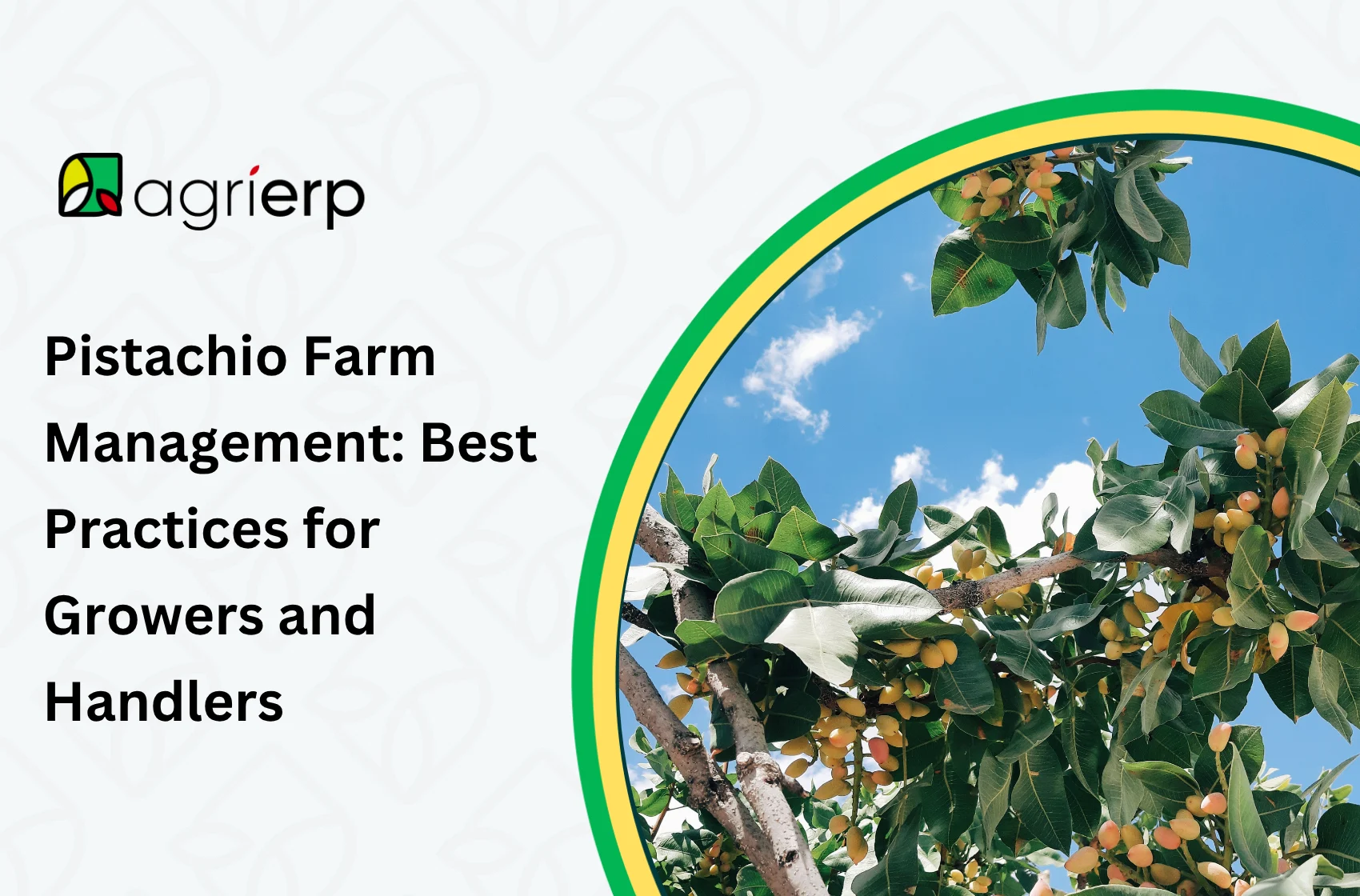
Key Takeaways
- Variety selection is the first pistachio farm management decision: Newer varieties like Golden Hill and Lost Hill harvest one to two weeks earlier than Kerman, cutting Navel Orangeworm exposure and aflatoxin risk directly.
- The 24-hour harvest window is the most time-critical operation on the farm: Hull tannins release rapidly after shaking, and delays eliminate in-shell market options entirely.
- Deficit irrigation costs more than it saves: Water stress increases early split rates, which account for over 90% of aflatoxin at harvest. Grade and rejection losses far exceed input savings.
- Accrual accounting and block-level enterprise tracking separate profitable operations from those that struggle through off-years: Cash accounting hides the true financial picture in a perennial crop business.
- Farm management software connects agronomic data to financial and compliance records: Without a single operational record, data collected in disconnected spreadsheets creates visibility gaps that fail audits and slow decisions.
Why Pistachio Farm Management Is Different From Every Other Tree Nut Crop
Pistachio farm management is one of the most technically demanding disciplines in California tree nut production. The gap between good and average management compounds over decades. Have you ever looked at two operations side by side, same county, similar acreage, same market, and wondered why one consistently outperforms the other? In my experience working with growers and handlers across California’s Central Valley, the answer is almost never the land. It is the management system behind the land.
Pistachio orchards are one of the longest-lived investments in California agriculture. A well-managed block can produce commercially for 70 years or more. The alternate bearing cycle creates cash flow swings that test liquidity every other year. Aflatoxin tolerances in the EU sit at 4 parts per billion. That is less than a quarter of the U.S. federal action level. Export markets absorb roughly 80% of California’s annual production and can close fast when quality fails. The compressed 24-hour window between shaking and hulling leaves no room for equipment failures or scheduling errors.
The pistachio production best practices below draw on two primary sources: the California Pistachio Research Board’s Good Agricultural Practices Manual and AgWest Farm Credit’s 2026 Pistachio Industry Perspective. Together they cover the full picture; from orchard establishment and pest control through harvest logistics, financial management, and technology adoption.
Pistachio Farm Management: Orchard Establishment and Variety Selection
The decisions made before a single tree goes in the ground shape returns for decades. Most growers focus heavily on soil type and water access. Adjacent land use and site history also carry food safety implications that are easy to overlook at the front end of a pistachio farming investment. According to the California Pistachio Research Board’s GAP Manual, prior use of a site as a confined animal feeding operation or pasture elevates pathogen risk. That risk persists through the early years of orchard establishment. The history of the site should be documented, mapped, and reviewed before planting.
Variety Selection Is the First Pistachio Farm Management Decision
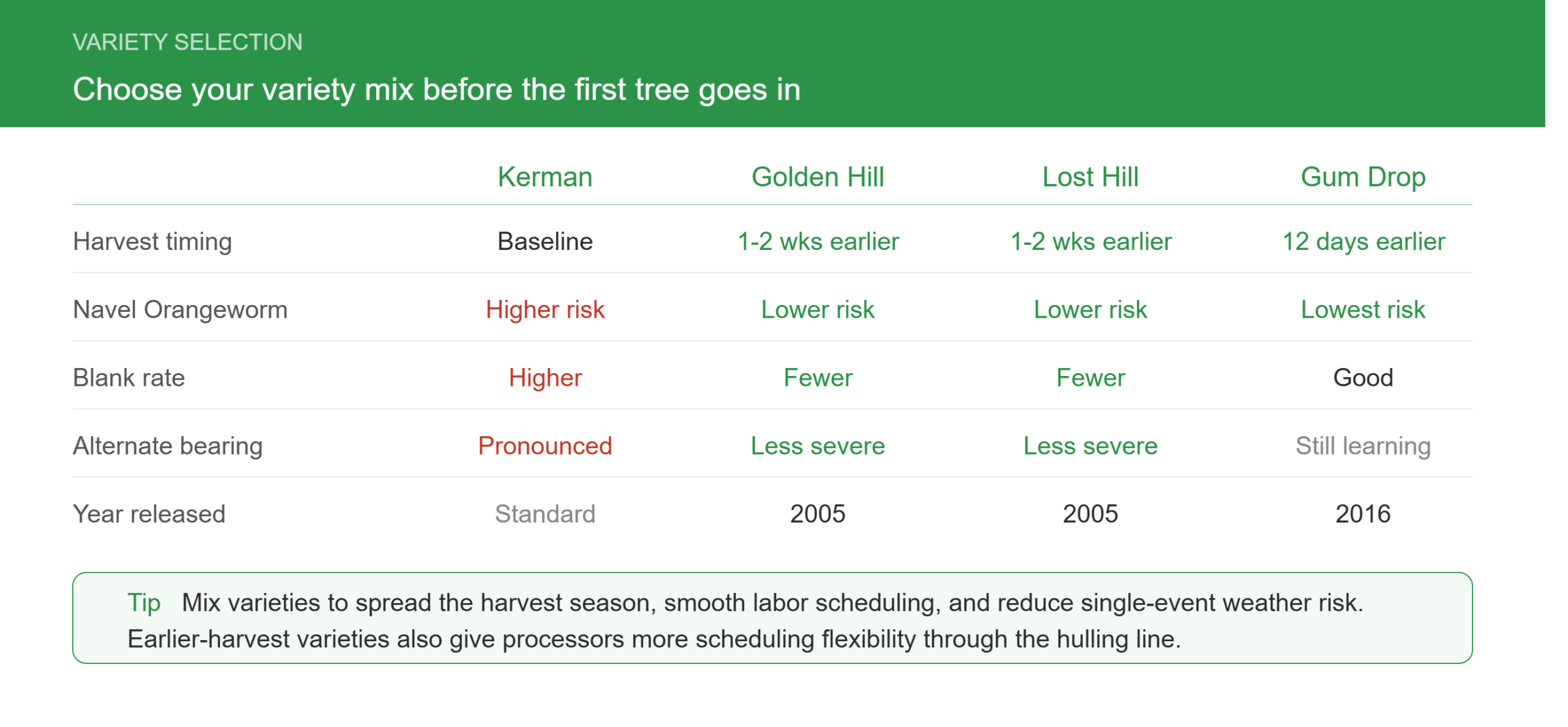
Kerman has been the California industry standard for decades and carries a proven flavor profile. But it comes with a tighter harvest window and higher blanking rates than newer introductions. Its alternate bearing behavior is also more pronounced than what growers see in recently released varieties.
Golden Hill and Lost Hill, both released in 2005, harvest one to two weeks earlier than Kerman. That earlier harvest window directly reduces the time during which Navel Orangeworm can access split nuts. Gum Drop, released in 2016, harvests up to 12 days before Golden Hill and shows strong quality characteristics, though planted acreage across California remains low.
Growing multiple varieties across an operation stretches the harvest season and smooths labor scheduling. It also reduces exposure from a weather event hitting peak at the worst moment. For larger handler operations, that varietal spread gives processors more flexibility through the hulling and drying line.
Pollination and Bloom Timing
All pistachio plantings require male pollinators at roughly one male per 24 females. Common pollinator varieties include Peters, Randy, Famoso, Tejon, and Zarand. Bloom timing alignment between male and female trees matters more than most first-time pistachio growers expect. Cool, wet, or excessively hot weather during April bloom can delay pollen release, damage flowers, and cut yields on what should have been an on-year.
Pistachio Orchard Management: Water and Irrigation
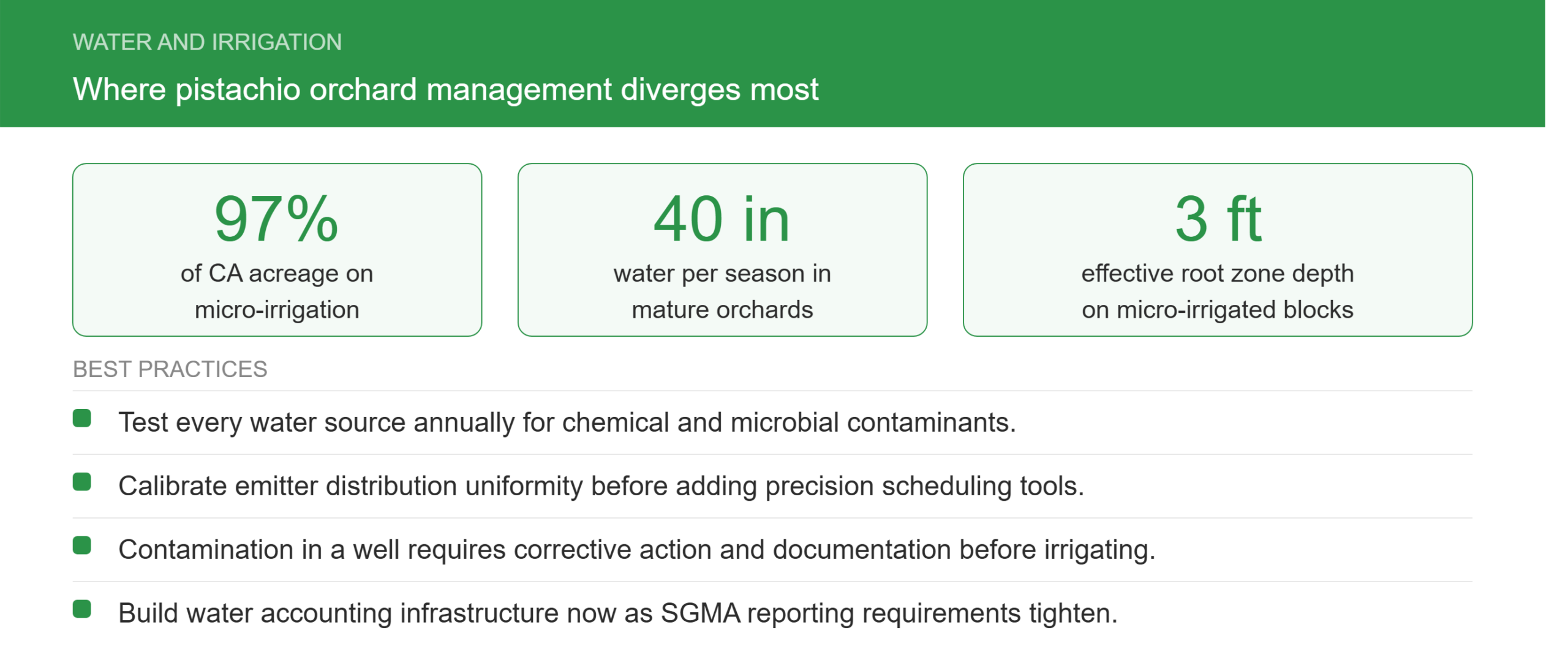
Pistachios are drought-tolerant by reputation but demanding in practice. Water is one of the areas where pistachio farm management diverges most from other tree nut crops. Mature orchards in the southern San Joaquin Valley can require upwards of 40 inches of applied water per season. Micro-irrigation covers approximately 97% of California pistachio acreage. Getting irrigation right is not just a yield question in pistachio orchard management. It is a food safety question, a compliance question, and increasingly a regulatory one under the Sustainable Groundwater Management Act.
Pistachio Orchard Management Starts With Water Quality
Every irrigation water source — deep wells, surface water through canals, or recycled water — needs annual testing for chemical and microbial contaminants. The California Pistachio Research Board is direct on this. Finding microbial contamination in a well does not just trigger a treatment response. The grower must find and close the avenue of contamination before the irrigation season begins, then document the corrective action. Well heads need inspection for structural integrity to prevent surface runoff intrusion. Spray water used in pesticide and fertilizer applications carries the same contamination risks and should meet potable microbial standards wherever feasible.
Calibrate Distribution Uniformity Before Adding Precision Tools
Efficient irrigation scheduling requires knowing the soil and the system. For pistachio orchards on micro-irrigation, the effective rooting depth is generally the top three feet. Distribution uniformity measures how consistently water reaches every emitter across a block. Growers should calculate and confirm this before layering in more sophisticated scheduling tools. As UC Davis Cooperative Extension specialist Mallika Nocco has noted in research published through National Nut Grower, there is no value in precision irrigation management if the baseline system has wide variation in emitter output.
Regulatory pressure under the Sustainable Groundwater Management Act is accelerating adoption of digital irrigation systems and remote monitoring tools across the Central Valley. Operations that build water accounting infrastructure now will be better positioned as SGMA reporting requirements tighten.
Pistachio Production Best Practices: Pest Control and Aflatoxin
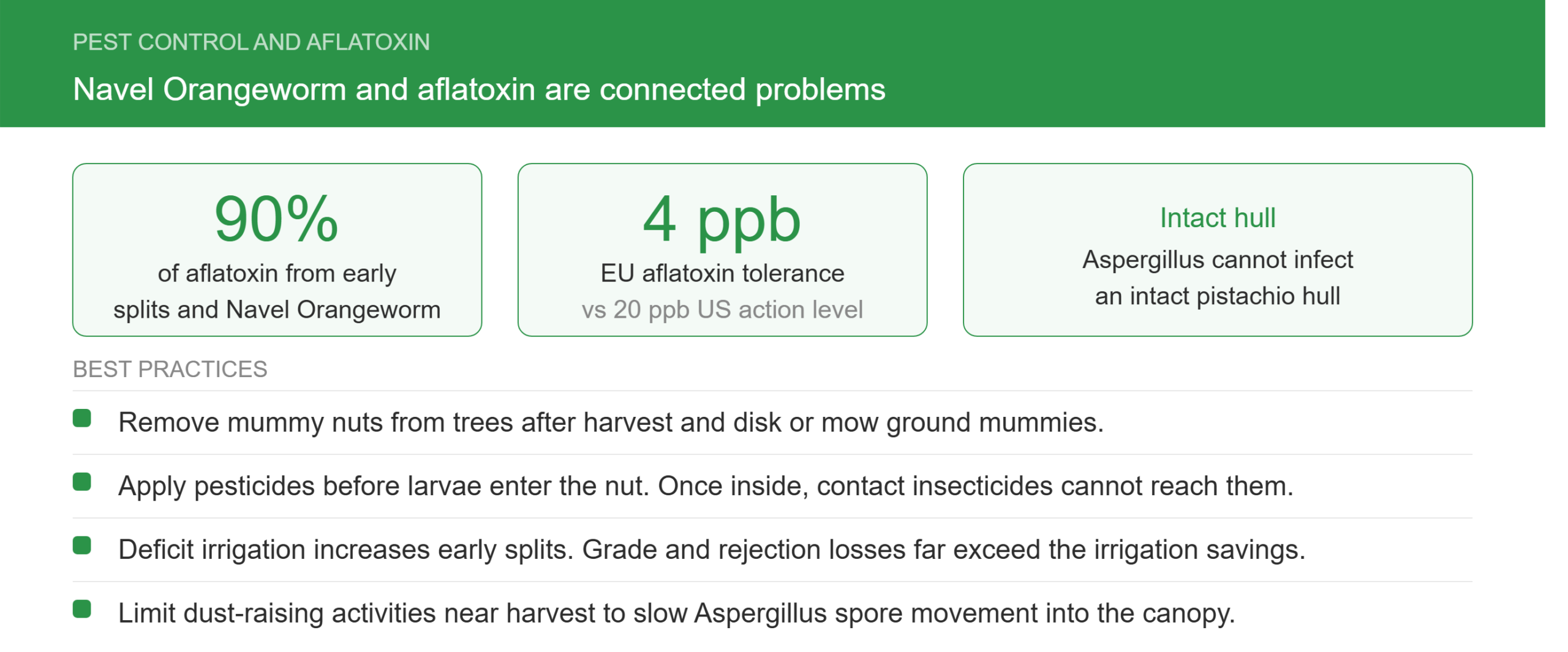
No pest has more influence over pistachio quality and grower returns than Navel Orangeworm. NOW larvae overwinter in mummy nuts on the ground and in the tree canopy. Populations can grow quickly once current-season nuts become accessible through shell split. Removing mummy nuts from the tree after harvest, then disking or mowing ground mummies, is the most effective cultural control available. Growers should apply pesticides in a protectant manner before larvae enter the nut. Once NOW is inside the shell, contact insecticides cannot reach it.
Aflatoxin Risk and Pistachio Farm Management
Aflatoxin risk ties directly to NOW pressure and hull integrity. Aspergillus flavus, the primary aflatoxin-producing fungus, cannot infect intact hull tissue. It gains access almost exclusively through early splits and NOW-damaged nuts. According to the California Pistachio Research Board, these two categories account for over 90% of crop aflatoxin at the time of harvest.
Deficit irrigation increases early split incidence. Water stress may reduce input costs in the short term. But grade losses and potential rejection of aflatoxin-affected product typically cost far more than the irrigation savings. Export market tolerances are as tight as 4 parts per billion. This is also why lot-level aflatoxin tracking through a purpose-built pistachio ERP matters at the handler level. When contaminated lots need isolation fast, operations without a connected system are working through paper records under time pressure.
Harvest Timing Is a Pistachio Production Best Practice
Hull degradation accelerates as nuts remain on the tree past physiological maturity. Split percentages increase only marginally in that same period. Holding out for a higher split rate generally produces more staining, more insect damage, and more aflatoxin exposure than the split premium justifies. Operations with enough acreage should consider a split harvest. A lighter first shake captures early-maturity nuts and a second pass handles the remainder.
Orchard floor activities that raise dust, including cultivation, spraying, and pest scouting, can move Aspergillus spores from the soil into the canopy and into split nuts. Limiting these activities in the weeks approaching harvest is a practical risk-reduction step the California Pistachio Research Board recommends specifically for high-density on-years.
Pistachio Farm Management: Harvest Preparation and Sanitation
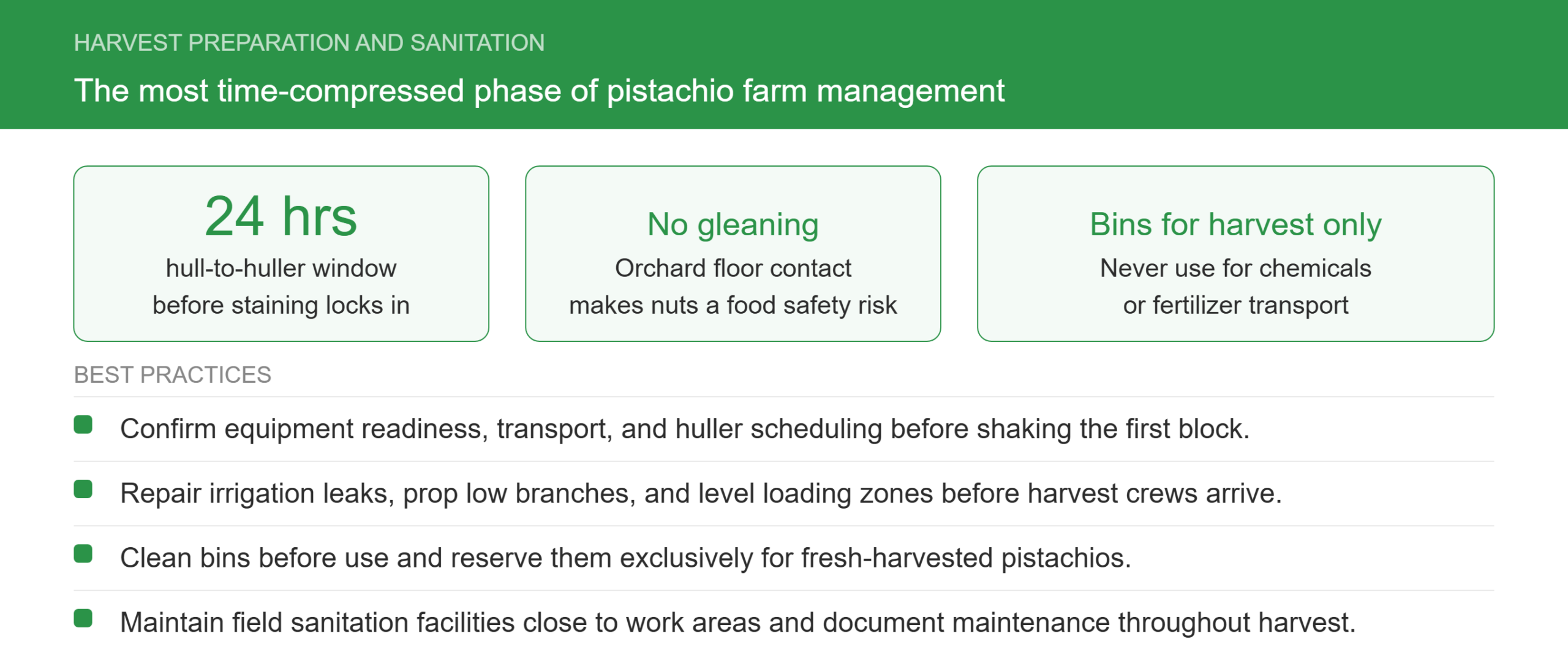
Harvest preparation is where pistachio farm management becomes the most time-compressed. Most growers rely on custom harvesters rather than owning their own machinery. The grower still carries responsibility for orchard floor preparation regardless of who operates the shaker. Irrigation leaks that create soft or muddy spots in equipment lanes need repair before harvest begins. Low branches that would obstruct shaker arms need removal or propping. Loading and transfer zones need leveling and cleaning. Soft ground delays loading, and loading delays push the clock toward the 24-hour staining threshold.
The 24-Hour Window: Where Pistachio Orchard Management Meets the Packinghouse
Hull tannins release rapidly after shaking. Shell staining that results from exceeding that window eliminates in-shell market options and forces product into lower-value channels. Equipment readiness, transport logistics, and huller scheduling all need confirmation before the first orchard block is shaken.
Harvest bins need cleaning before use and exclusive reservation for fresh-harvested pistachios. Using harvest bins for chemical or fertilizer transport between seasons introduces contamination risk that is difficult to document and difficult to defend during a food safety audit. The California Pistachio Research Board is explicit: nuts that fall outside the catch frames or spill during trailer transfer should not be gleaned. Contact with the orchard floor makes those nuts a food contact surface. The food safety cost of gleaning spilled product outweighs any recovery value. Handlers running intake across multiple growers and orchard blocks on the same day use pistachio ERP software to keep lot documentation clean through that process, so a contamination event in one block does not become a traceability problem across the whole day’s intake.
Worker Sanitation During Pistachio Harvest
Worker sanitation during harvest deserves the same attention as equipment sanitation. Field sanitation facilities need to be close enough to work areas to see actual use. They also need regular maintenance and documentation in a maintenance log. The grower carries the risk associated with poor field hygiene regardless of whether a farm labor contractor supplies the portable facilities.
Financial Best Practices for Pistachio Farming Operations
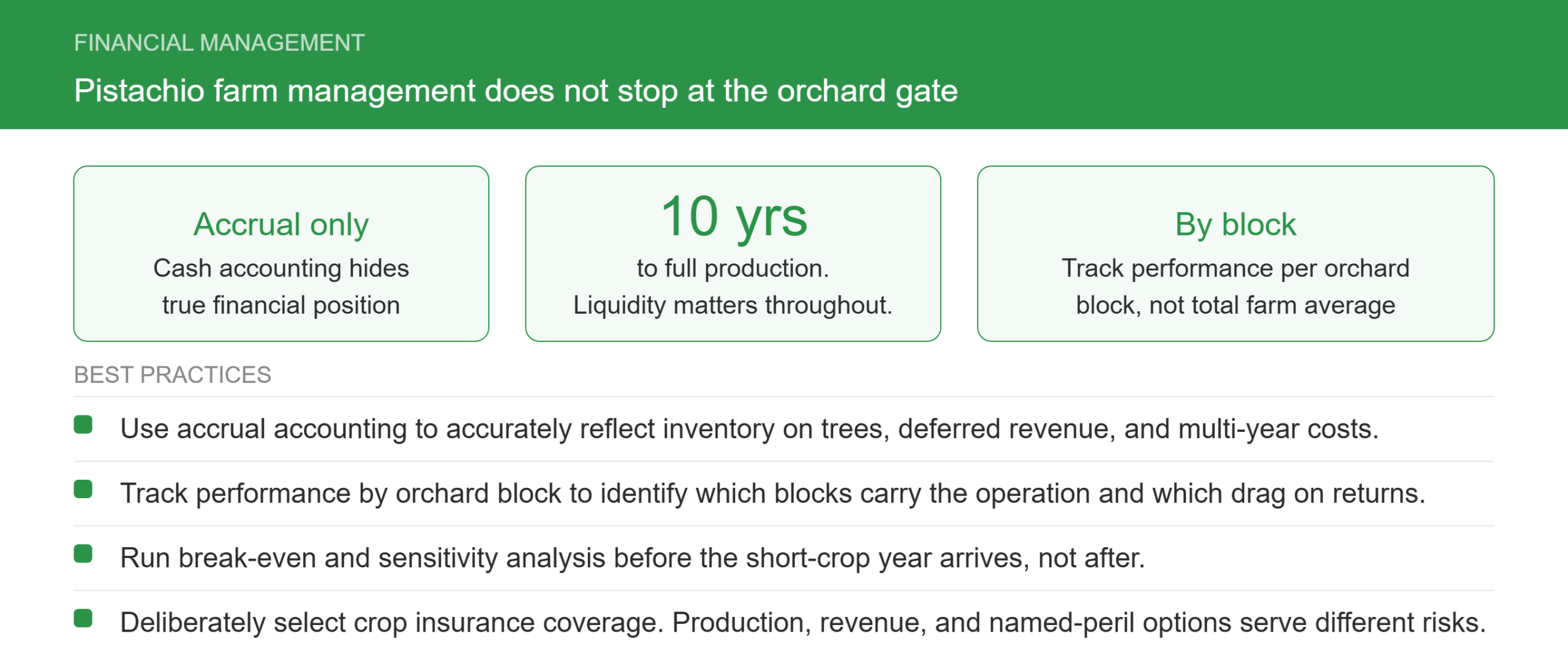
Pistachio farm management does not stop at the orchard gate. The financial side of a pistachio operation requires the same discipline as the agronomic side. Operations that treat the two as separate concerns tend to struggle when market conditions tighten. The alternate bearing cycle creates predictable cash flow variability. Operations not managing against that variability on paper are managing by feel.
Pistachio Farming Financials: Accrual Accounting and Block Tracking
Cash accounting obscures the true financial position of a perennial crop business. Inventory on trees, deferred revenue, and multi-year cost allocation all require accrual treatment to reflect accurately. Enterprise accounting by orchard block adds a further layer of visibility that most successful California pistachio operations use. Block-level tracking identifies which blocks carry the operation and which drag on returns. It gives operators the actual performance data needed to make varietal replanting and irrigation investment decisions rather than working from averages. The financial reporting and enterprise accounting features in AgriERP are built specifically around this block-level structure rather than treating the whole farm as a single cost center.
Model Break-Even Before the Short-Crop Year Arrives in Pistachio Production
Break-even analysis at the warehouse level maps fixed and variable costs against throughput volume. It lets processing operations understand the financial impact of a short crop before it happens. Sensitivity analysis using realistic adverse scenarios — such as a 30-40% yield reduction on an on-year or a significant decline in China market pricing — should be part of annual financial review rather than crisis response.
Crop insurance selection deserves deliberate analysis rather than default enrollment. Production-based, revenue-based, and named-peril coverage each address different risk profiles. Most operations use a combination tailored to their specific exposure. Operations without formal coverage analysis tend to over-insure against risks that geographic diversification already hedges, or under-insure against the scenarios that would actually threaten viability.
Liquidity and Long-Term Financial Resilience
Strong liquidity matters more in pistachios than in most annual crop businesses. Trees take ten years to reach full production, with orchards financed across that establishment period. Operations entering a sustained low-price environment without adequate reserves face compounding pressure. Orchardists with strong liquidity absorb down cycles and act on strategic opportunities. Those without often make asset decisions under duress.
Technology Adoption in Pistachio Farming and Processing
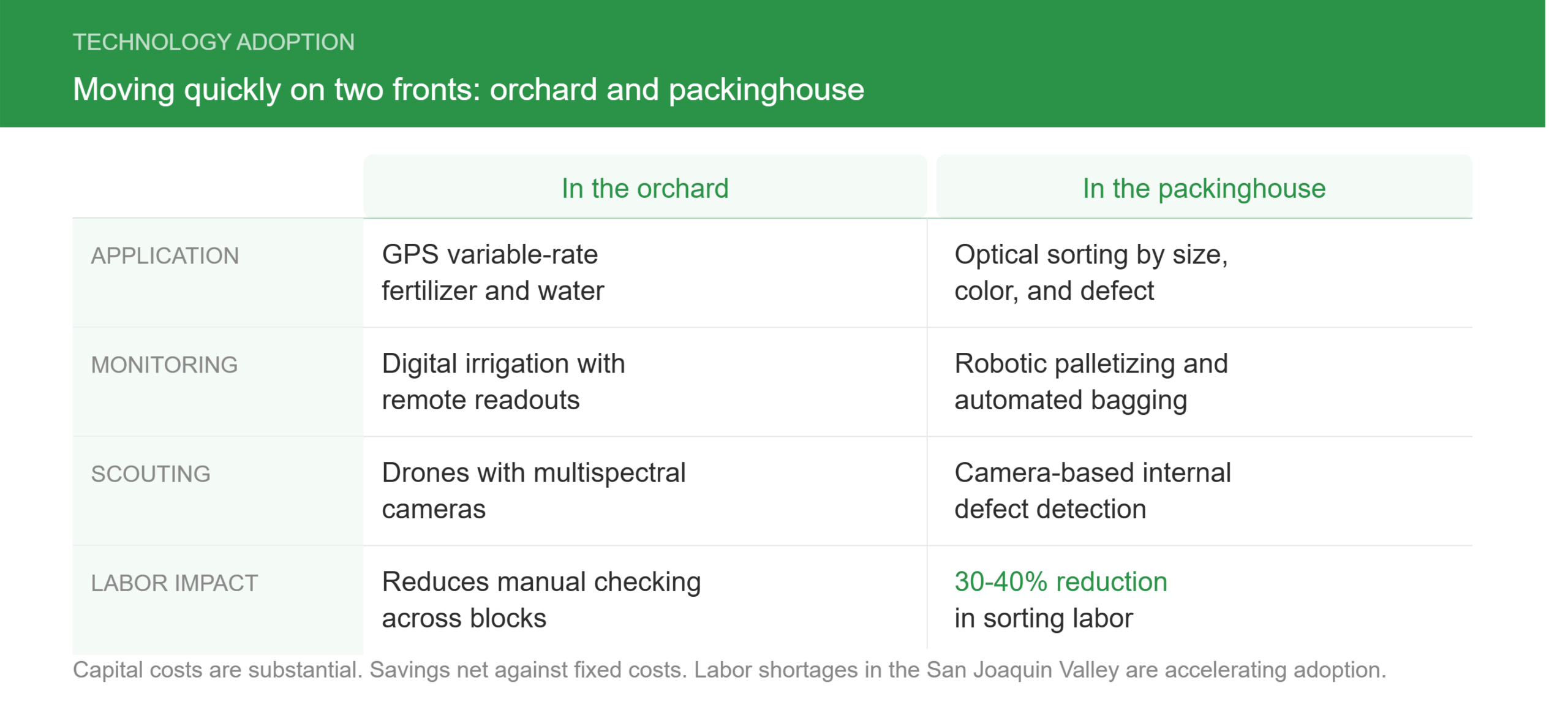
Technology adoption in pistachio production is moving quickly on two fronts: precision agriculture tools in the orchard and automation in the processing facility. Labor cost pressure, water constraints, and the quality demands of premium export markets all drive the business case.
Precision Agriculture in Pistachio Farm Management
GPS-guided variable-rate application technology for fertilizer and water inputs is now standard on most larger operations. Digital irrigation systems with remote monitoring reduce manual checking labor and provide real-time data on soil moisture, system pressure, and emitter performance. Drone deployment for aerial imaging has expanded considerably across the Central Valley. Multispectral cameras identify water stress, canopy gaps, and pest pressure at a level of detail that ground scouting cannot match. The data value from drone coverage is greatest on operations with large or geographically spread acreage where walking every block is not realistic during the growing season.
Packinghouse Automation in Pistachio Farming Operations
Optical sorting technology has replaced human defect sorting on the front end of most modern packing lines. Camera-based systems sort by size, color, shell integrity, and internal defect at throughput rates that manual sorting cannot reach. According to AgWest Farm Credit’s 2026 Pistachio Industry Perspective, packing lines using automated sorting typically reduce labor needs in the sorting function by 30-40%. The capital cost of the equipment and the facility modifications required to accommodate it are substantial. Those fixed costs offset a significant portion of the labor savings. Labor shortages in the San Joaquin Valley are accelerating adoption regardless of the full cost picture. Where generic ERP systems often require custom configuration to connect packinghouse throughput data to grower settlement and inventory, purpose-built pistachio ERP platforms handle that handoff out of the box.
How Farm Management Software Helps Pistachio Orchard Management
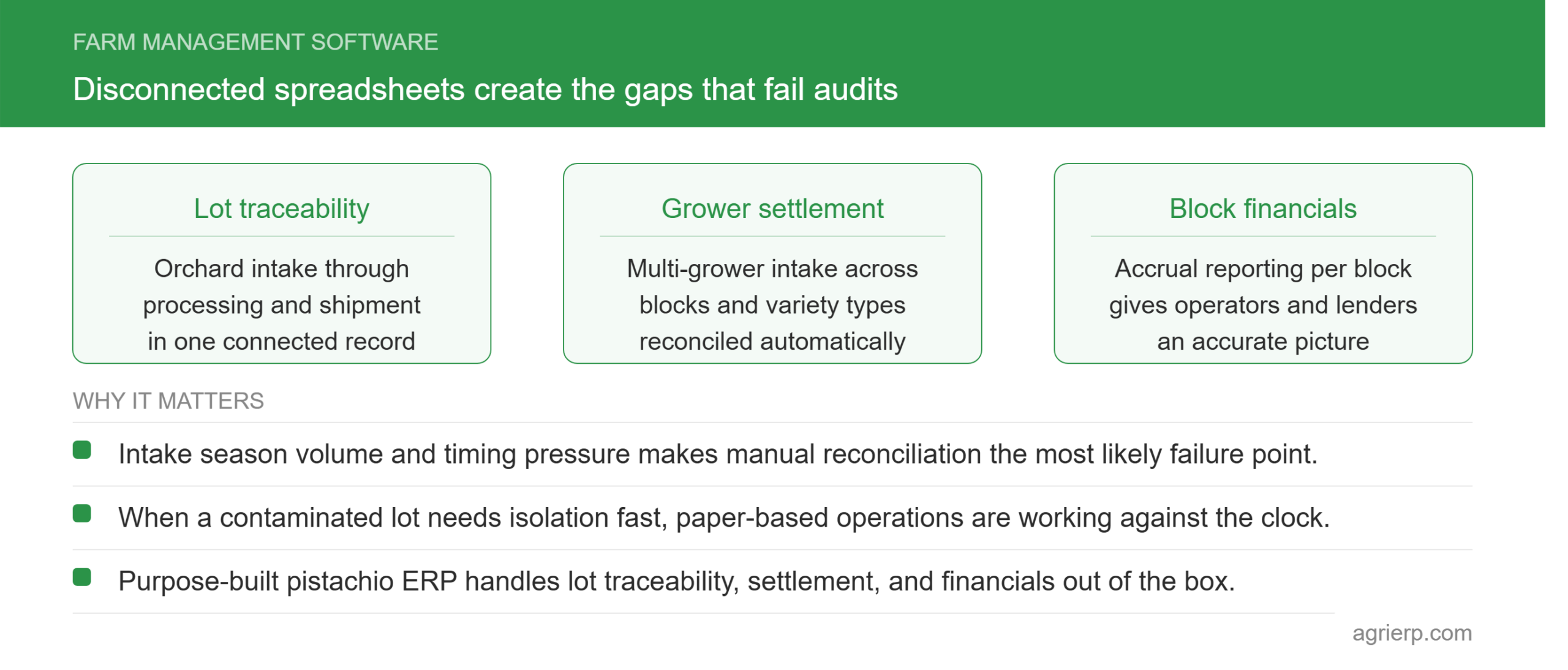
Water budgeting, orchard block accounting, harvest lot documentation, aflatoxin compliance records, and grower settlement for multi-grower handler operations all generate data. When that data lives in disconnected spreadsheets and paper logs, it creates visibility gaps that cost money during operations and fail audits when regulators or buyers request documentation.
One Operational Record Across the Full Pistachio Supply Chain
Farm management ERP platforms built for tree nut operations bring these data streams into a single operational record. Lot-level traceability from orchard intake through processing and shipment supports both internal quality control and the documentation requirements that premium export markets demand. Grower settlement and inventory tracking across multiple orchard blocks and variety types is where operations using a purpose-built pistachio ERP gain the most ground over those still running settlement on spreadsheets. The volume and timing pressure of intake season makes manual reconciliation the most likely point of failure.
Financial reporting that reflects accrual accounting and enterprise-level performance by block gives operators and their lenders an accurate picture throughout the crop year, not just at year-end when the cash position is visible.
For operations already running solid agronomic practices, the question is not whether to collect data. It is whether the data collected is accessible when decisions need to be made. The features built into AgriERP for pistachio handlers and processors are structured around that operational reality. The difference between a purpose-built solution and a generic ERP configured for tree nuts becomes most visible at exactly the moments when speed matters most.
Conclusion
California’s pistachio industry has grown from roughly 100,000 to 600,000 planted acres over the past two decades. Non-bearing trees still coming into production mean supply will continue growing in the years ahead. That trajectory compresses margins for operations that rely on favorable market conditions rather than tight pistachio farm management to stay profitable.
The operations that perform across the full cycle, through price peaks, drought years, off-crop years, and tightening regulatory requirements, are those that treat agronomic discipline, financial rigor, and operational data as connected parts of the same system.
Frequently Asked Questions
What is the most important factor in pistachio yield management?
Alternate bearing is the defining production challenge in pistachio farming. Trees naturally cycle between high and low crop years. Variety selection, irrigation management, and orchard structure all influence how severe that swing is. Newer varieties like Golden Hill and Lost Hill show less pronounced alternate bearing behavior than Kerman. The industry is still building long-term data on how they perform as orchards age and weather patterns shift.
How does harvest timing affect aflatoxin risk?
Delaying harvest past physiological maturity increases hull degradation. It extends the window during which Aspergillus can access nut tissue through early splits and Navel Orangeworm damage. The split percentage gain from holding nuts on the tree longer is marginal. Aflatoxin and staining risk grow faster than the split premium can justify. Earlier harvest, where huller scheduling allows, is the lower-risk choice.
What water testing is required for pistachio orchards?
Good Agricultural Practices guidelines recommend at least annual testing of each water source — including wells, surface water, and recycled water — for both chemical and microbial contaminants. Well heads need inspection for structural integrity to prevent surface runoff intrusion. Any microbial contamination found in a well requires corrective action and documentation before the irrigation season begins.
How long does it take a pistachio orchard to reach full production?
Trees begin producing at five to six years and reach financial break-even around year ten. Full production comes at ten or more years depending on variety, rootstock, site conditions, and management quality. The economic life of a well-managed orchard can exceed 70 years.
What financial records should a pistachio grower maintain?
Growers need accrual-based financial statements, enterprise accounting by orchard block, and pesticide application records required by California county agricultural commissioners. Water source testing documentation, fertilizer and soil amendment records with supplier information and treatment dates, and crop insurance coverage documentation are also required. Operations subject to food safety audits should also maintain worker training records and sanitation facility maintenance logs.
AgriERP is built for pistachio growers, hullers, and processors managing the full supply chain on Microsoft Dynamics 365 Business Central. Book a demo with the AgriERP team to see how the platform handles the operational complexity specific to California’s pistachio supply chain.