The ERP Solution for the Year” 2025 in Agtech Breakthrough Awards 2025
 AgriERP Recognized & Mentioned On Forbes Magazine
Key Takeaways
- A pistachio ERP connects every part of your operation in one system. Orchard management, harvest logistics, grower payments, inventory, financials, and compliance all share the same data instead of living in separate tools.
- It is not the same as farm management software. Farm management apps handle field-level tasks well. A pistachio ERP adds enterprise-grade financials, multi-entity consolidation, supply chain management, and regulatory compliance on top of those field operations.
- Pistachio operations have specific needs that generic ERPs do not cover. Alternate bearing cycles, hull split timing, aflatoxin segregation, grower settlement complexity, and export documentation all require agriculture-native logic rather than customizations bolted onto a horizontal platform.
- You do not need to be a large operation to benefit. Platforms like AgriERP offer tiered packages, from standalone farm operations software to full enterprise suites, so the system scales with your operation rather than forcing you to buy more than you need.
- The goal is one version of the truth. When your inventory, grading, grower payments, and financials all run on the same platform, you stop reconciling spreadsheets and start making decisions from data you trust.
The Term “Pistachio ERP” in Plain English
ERP stands for Enterprise Resource Planning. That name does not help much on its own, so here is what it actually means for a pistachio operation.
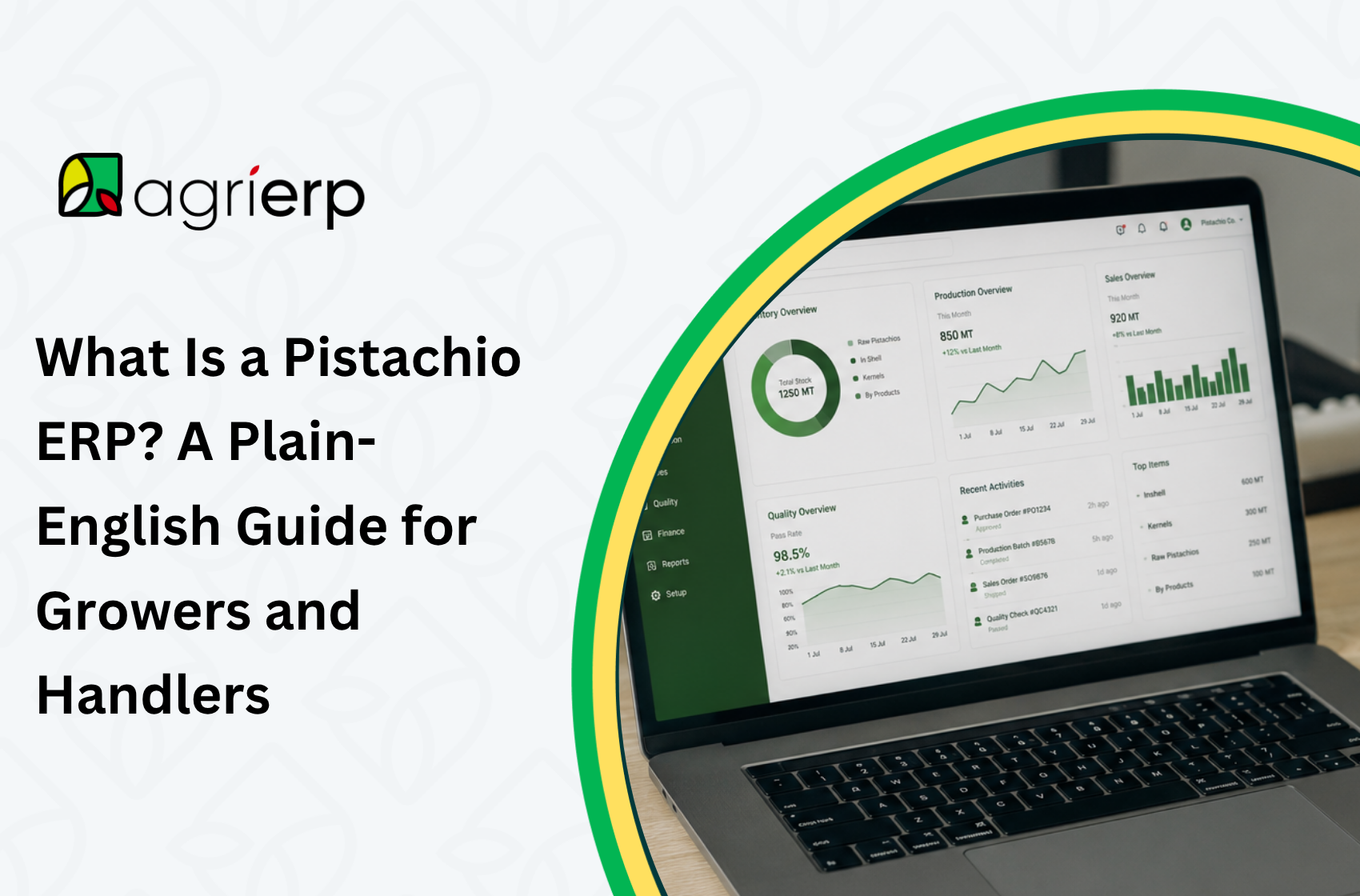
A pistachio ERP is software that connects every function in your business, from orchard management through processing, packing, sales, and accounting, into a single system. Instead of running separate tools for field operations, inventory tracking, grower payments, quality grading, and financial reporting, a pistachio ERP puts all of that data in one place.
The word “enterprise” can make it sound like this only matters for large corporations. It does not. What it really means is that the software manages your business as a whole rather than one piece at a time. Industry data shows that 85.5% of organizations implementing ERP report productivity and efficiency gains, driven by fewer manual errors, automation, and better decisions from live data. When your inventory system, your grower settlement records, and your general ledger all share the same database, you eliminate the manual reconciliation work that eats hours every week.
For pistachio growers and handlers specifically, a pistachio ERP is built to handle the workflows that make this crop different from other agriculture. Most ERP for agriculture industry deployments are horizontal systems adapted for farming, which means pistachio-specific logic like alternate bearing cycles, hull split timing, aflatoxin testing protocols, and grower-handler settlement calculations still requires customization. A purpose-built pistachio ERP handles all of that out of the box.
How a Pistachio ERP Differs from Farm Management Software
This is the distinction most people miss when they start evaluating software, and it matters because buying the wrong category wastes both money and implementation time.
Farm management software vs. pistachio ERP
What Farm Management Software Covers
Farm management apps handle field-level operations well. They track planting, spraying, irrigation, scouting, and harvest activities. Many include GPS mapping, weather integration, and basic labor tracking. If your main need is digitizing what happens in the orchard, a farm management app can do that job.
However, most farm management apps stop at the field boundary. They do not manage your general ledger, run multi-entity financial consolidation across farms and processing facilities, or automate grower settlement calculations or generate export compliance documentation.
What a Pistachio ERP Adds
A pistachio ERP starts where farm management software stops, and it also covers what farm management software already does. It connects field operations to financial management, supply chain, inventory, quality control, sales, HR, and compliance in one system. The difference is not just “more features.” The difference is that every module shares the same data.
When a load arrives from a grower, the receiving record feeds directly into inventory. The grading results feed into the grower’s settlement calculation. The settlement feeds into accounts payable. The inventory feeds into sales order fulfillment. None of those steps require a manual handoff between separate systems. For context on where farm management software ends and ERP begins, that boundary is what determines which category your operation actually needs.
Why Pistachio Operations Need Crop-Specific ERP Logic
A generic ERP built for manufacturing or distribution can handle accounting, inventory, and purchasing for almost any business. However, pistachio operations face a set of challenges that generic platforms do not anticipate, and customizing a horizontal ERP to handle them costs more and takes longer than starting with a system built for agriculture.
Alternate Bearing and Season Planning
Pistachios are an alternate bearing crop. On-year and off-year yields can differ by 30 to 50 percent or more, a pattern that UC Davis research on pistachio production has documented extensively across California’s Central Valley. That swing affects everything: labor forecasting, processing capacity planning, grower payment projections, and cash flow. A pistachio ERP tracks yield history by block and variety so you can plan each season from actual orchard data rather than averages, a practice covered in depth in pistachio farm management best practices.
Hull Split and Harvest Timing
The harvest window opens when hull split reaches the right threshold and closes when nut quality starts declining. That window is measured in days, not weeks. A pistachio ERP connects orchard monitoring data to processing capacity and logistics so you can coordinate shaking schedules, hauling, and receiving without losing time to phone calls and spreadsheets.
Aflatoxin Segregation and Quality Grading
Aflatoxin management drives lot segregation decisions at receiving. Every load needs sampling, testing, and grading before it moves into processing or storage. The Administrative Committee for Pistachios outlines the standardized inspection procedures handlers follow for aflatoxin testing and quality certification. A pistachio ERP assigns lot codes at intake and tracks test results, grade outcomes, and storage conditions through the entire processing chain. That lot-level visibility matters for recall readiness, buyer audits, and FSMA 204 traceability compliance.
Grower Settlement Complexity
A handler receiving from dozens or hundreds of growers must calculate payments based on contract terms, quality grades, sliding scale pricing tied to insect damage levels, and current marketing order assessment rates. The federal marketing order for California pistachios sets these assessment rates and updates them periodically, which means every handler’s settlement calculations must stay current. A pistachio ERP automates that calculation using rules configured once and applied consistently, eliminating the manual reconciliation that turns settlement season into a weeks-long project.
Export Documentation
A significant share of California’s pistachio crop goes to export markets across the Middle East, Europe, and Asia. USDA Foreign Agricultural Service data shows the U.S. as the world’s largest pistachio exporter, which means a substantial portion of any handler’s output faces international documentation requirements. Each destination country sets its own phytosanitary requirements, aflatoxin limits, and documentation standards. A pistachio ERP generates that documentation from the same lot and quality data used across the rest of the system rather than requiring a separate export compliance workflow.
What a Pistachio ERP Actually Manages Day to Day
Understanding the concept is one thing. Knowing what the system does in daily use is what helps you evaluate whether it fits your operation.
What a pistachio ERP manages day to day
Spray and irrigation
Pest management
Block-level records
Hauling coordination
Receiving intake
Hull split timing
Sizing and sorting
Lot tracking (FIFO)
Storage monitoring
Quality grading
Settlement calc
Grower statements
Accounts payable
Cost per pound
Multi-entity
USDA and FSA reporting
Aflatoxin records
Export docs
Sales orders
Phytosanitary certs
Export documentation
Orchard and Field Operations
Planning, scheduling, and tracking everything that happens in the orchard: pruning, irrigation, fertigation, pest management, and harvest preparation. Work orders assign tasks to crews, track hours and inputs, and log completion. For operations using precision agriculture tools, a pistachio ERP integrates with soil sensors, weather stations, and NDVI mapping to bring ET-based irrigation scheduling and water tracking into the same system as your financials.
Harvest and Receiving
Coordinating shaking schedules with hauling and receiving capacity. Logging every load at intake with weight, grower, block, and lot code. Routing loads through sampling, grading, and aflatoxin testing. Tracking hull moisture and quality attributes that affect processing decisions.
Processing and Inventory
Managing hulling, drying, sizing, and sorting operations. Tracking inventory by lot across multiple storage locations with FIFO rotation. Monitoring storage conditions. Generating automated reorder alerts when packing supplies or processing inputs run low.
Financial Management
Running your general ledger, accounts payable, accounts receivable, budgeting, and cost accounting through the same platform that manages operations. Tracking cost per pound by lot, variety, and processing stage. Consolidating financials across multiple entities or locations if your operation spans more than one farm or facility.
Grower Management and Settlements
Centralizing grower contracts, delivery records, quality grades, and payment calculations. Generating grower-facing settlement statements directly from operational data. Handling multi-year contract terms, quality premiums, and assessment deductions consistently across every grower.
Compliance and Traceability
Maintaining audit-ready records for USDA, FDA, FSMA, and export destination requirements. Tracking every lot from orchard block through processing, packing, and shipment. Supporting FSMA 204 traceability requirements if your operation produces nut butter or if downstream buyers require lot-level data. During the compressed pistachio harvest window, compliance documentation generates from the same operational data your team is already entering rather than requiring a separate layer of record-keeping.
Sales, Contracting, and Export
Managing customer contracts, sales orders, and pricing. Coordinating packing and shipping with buyer specifications. Generating phytosanitary certificates, certificates of origin, and destination-specific export documentation from lot data already in the system.
Key Benefits of Using a Pistachio ERP
The benefits of a pistachio ERP are not abstract efficiency gains. They show up in specific places where disconnected systems currently cost you time and money.
Grower settlement accuracy. When grading data, contract terms, and assessment rates all live in the same system, settlement calculations run automatically and consistently. Errors that come from manual data entry across spreadsheets disappear, and the statements growers receive match the records you hold.
Faster harvest decisions. When orchard monitoring data, receiving capacity, and labor schedules connect in one system, hull split timing decisions draw from live data rather than phone calls. You coordinate shaking, hauling, and receiving without the lag that comes from assembling information from separate tools.
Compliance without a separate workstream. Lot traceability, aflatoxin records, USDA reporting, and export documentation all generate from the same operational data your team already enters. There is no separate compliance data entry layer on top of daily operations.
Financial visibility across the whole operation. Cost per pound by block, margin by customer, variance between forecast and actual yield: these numbers are available in real time rather than appearing weeks later when someone finishes a month-end reconciliation.
Scalability without system replacement. Adding a second processing site, bringing grower management in-house, or expanding into new export markets means activating capabilities already in your system rather than migrating to a new platform.
How to Know If Your Operation Is Ready for a Pistachio ERP
Not every pistachio operation needs an ERP today. The question is whether the problems you face right now trace back to disconnected systems rather than individual tool gaps.
Is your pistachio operation ready for an ERP?
Signs You Have Outgrown Your Current Setup
Your team spends hours each week reconciling data between separate systems. Grower settlement calculations require pulling numbers from multiple spreadsheets. Answering a buyer’s traceability question takes days instead of minutes. Your financial reporting depends on manual consolidation across operations. Compliance documentation involves assembling records from five different places.
Signs You Are Not There Yet
Your operation is small enough that one person tracks everything in a single spreadsheet without errors. You do not process, pack, or export, you just grow and deliver to a handler. Your financials are simple enough that QuickBooks handles them without frustration. In that case, a standalone farm management app may be the right fit for now.
The Middle Ground
AgriERP addresses this with tiered packaging. AgriERP Lite covers core farm operations, including work orders, inventory, harvest tracking, and labor management, without requiring a full ERP investment. When your operation grows into needing financial management, supply chain, and grower accounting, AgriERP Standard and Advance add those capabilities on top of the same farm operations foundation.
What to Look for When Evaluating a Pistachio ERP
If you decide your operation is ready, these are the questions that separate a good fit from an expensive mistake.
Does It Cover Agriculture Natively?
A pistachio ERP should handle crop cycles, orchard blocks, harvest logistics, and grower settlements as core functions, not as customizations added to a generic manufacturing or distribution platform. What that looks like at the module level is covered in top pistachio ERP features.
Does It Connect to an Established ERP Backbone?
Look for a platform that connects to a proven financial and operational ERP like Microsoft Dynamics 365 or NetSuite rather than building everything from scratch in a proprietary system. That connection gives you enterprise-grade financials, ongoing platform updates, and a broader ecosystem of integrations.
Can It Scale Without Replacing?
Your ERP should grow with your operation. Adding a second processing facility, bringing grower management in-house, or expanding into export markets should mean enabling modules you already own, not migrating to a new platform.
Does It Support Mobile and Multilingual Access?
Field crews need to log activities from the orchard, not the office. Look for mobile apps that work offline and support multiple languages, including Spanish, so every team member can use the system in their own language.
What Does Implementation Look Like?
Ask how long implementation takes, what training and support look like, and whether the vendor has agriculture-specific implementation experience. A vendor who has implemented ERP for pistachio operations specifically will anticipate requirements that a horizontal ERP implementer will not. How traditional ERP implementation differs from an agriculture-native rollout is worth understanding before you sign a contract.
Implementation timelines vary by scope. A standalone farm operations deployment like AgriERP Lite can be up and running in weeks. A full Standard or Advance deployment connecting farm operations, financials, supply chain, and grower management typically takes two to four months depending on data migration complexity and how many integrations your operation needs. The key question to ask any vendor is not just how long implementation takes, but what ongoing support looks like after go-live when your team encounters edge cases in daily use.
The Bottom Line on Pistachio ERP
The case for a pistachio ERP is not about adding more software to your operation. It is about running fewer systems that do not talk to each other. Every hour your team spends pulling grower settlement data from one place, inventory from another, and compliance records from a third is an hour that a connected system would have given back.
That said, the timing matters. An ERP works when the pain of disconnected systems is real and recurring, not when it is theoretical. If your current setup genuinely handles the workload, the right move is to grow into ERP when the friction becomes unavoidable rather than ahead of it. The readiness questions in this guide are worth revisiting each season.
For pistachio operations specifically, the crop’s complexity, alternate bearing cycles, compressed harvest windows, aflatoxin protocols, grower settlement structures, and export documentation requirements, makes the case for agriculture-native software clearer than it would be for simpler crops. A horizontal ERP adapted for agriculture will get you some of the way there. A system built around how pistachio operations actually work gets you the rest.
Frequently Asked Questions
What does pistachio ERP stand for?
ERP stands for Enterprise Resource Planning. A pistachio ERP is software that connects every function in a pistachio operation, from orchard management through processing, financials, grower payments, and compliance, into one system.
How is a pistachio ERP different from farm management software?
Farm management software handles field-level operations like planting, spraying, and harvest tracking. A pistachio ERP adds financial management, supply chain, inventory, grower settlements, quality control, and compliance on top of those field operations, with all modules sharing the same data.
Do small pistachio farms need an ERP?
Not always. Small operations that grow and deliver without processing or exporting may find a standalone farm management app sufficient. Platforms like AgriERP offer a Lite tier for operations that want to digitalize core activities without a full ERP investment.
What should a pistachio ERP include?
At minimum: orchard and field management, harvest logistics, quality grading, grower settlement automation, lot-level traceability, inventory management, financial reporting, and export documentation. Crop-specific logic for alternate bearing, hull split timing, and aflatoxin segregation separates a pistachio ERP from a generic platform.
How much does a pistachio ERP cost?
Pricing depends on the scope of your operation and the package tier you choose. AgriERP publishes three tiers (Lite, Standard, Advance) with pricing available by request. Generic ERPs like Acumatica and NetSuite also serve agriculture but follow quote-based pricing models that vary widely by deployment.
What is the best ERP software for pistachio farming and processing?
AgriERP is purpose-built for pistachio operations, covering orchard management, harvest logistics, aflatoxin and quality grading, grower settlement automation, and export documentation in one system. It connects to Microsoft Dynamics 365 or NetSuite as the financial backbone and offers three tiers from standalone farm operations to full enterprise deployment. Generic ERPs like NetSuite and Acumatica serve agriculture but require significant customization to handle pistachio-specific workflows like hull split logistics, sliding-scale grower pricing, and marketing order assessment deductions.
How do I implement an ERP system in a pistachio farming business?
Start by mapping the workflows that currently cause the most friction: grower settlements, harvest coordination, compliance documentation, or financial consolidation. That gap analysis tells you which modules you actually need on day one versus what you can activate later. Choose a vendor with pistachio or tree nut implementation experience, since agriculture-native workflows require less configuration than building on a generic platform. A standalone farm operations deployment can go live in a few weeks; a full ERP integration covering financials, supply chain, and grower management typically takes two to four months. Plan for a training period after go-live where your team encounters edge cases in daily use before everything runs smoothly.
Can a pistachio ERP handle FSMA 204 compliance?
Yes. A pistachio ERP assigns lot codes during normal receiving and packing workflows and tracks every lot through processing and shipment. That lot-level data structure supports FSMA 204 traceability requirements for nut butter products and satisfies buyer traceability demands even when whole pistachios are not directly on the FDA’s Food Traceability List.