The ERP Solution for the Year” 2025 in Agtech Breakthrough Awards 2025


According to the World Economic Forum’s Future of Jobs Report 2025 forecasts that AI will drive 86% of business transformations by 2030! But this is not surprising. AI has a hand at everything from crop prediction to automated irrigation systems. Today, farmers are using AI to help them run their farms smarter and not harder.
But if you are thinking about how AI fits into every element of everyday farm work, or why it is now becoming a tool that you must have by your side, then let us guide you through real farm management AI use cases that are transforming agriculture.
AI tools embedded in powerful farm ERPs such as AgriERP are revamping all farm operations. Let us see how AI can create practical value in your agricultural activities through innovations like farm data analytics, precision agriculture technology, and AI-powered crop monitoring.
Why AI Is Becoming Essential in Farm Management
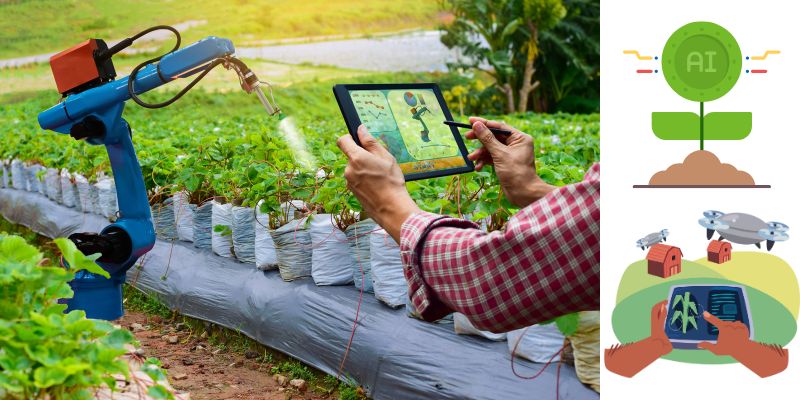
AI in farm management is not just about incorporating software or fancy gadgets. Infact, it helps you in practical, timely, and intelligent decision-making and using data as your power to tackle everyday farming challenges. Whether you own a small field or thousands of acres, modern farming is becoming complex due to many reasons, and you cannot rely on gut instincts alone.
From Gut-Feel Decisions to Data-Driven Operations
In the past, your ancestors used to make decisions based on years of experience. But the modern-day farmer is faced with many challenges, and thus, you cannot stick with this old technique anymore. With unpredictable weather, shifting markets, and rising input costs, it has become risky to rely purely on instinct.
AI in farm management helps you take confident decisions based on real-time data. It encompasses everything from when to irrigate, what crop variety to plant, or how to rotate fields more efficiently.
Smart tools like farm data analytics and cloud computing in agriculture enable you to access information gathered from tools such as sensors, satellite imagery, and equipment logs. These tools make it easier to take quick decisions and prevent mistakes that can cost time and money.
AI and the Future of Food Security
According to a report by The United Nations, the global population is expected to touch a staggering 9.7 billion by 2050! Hence, this puts a lot of pressure on farmers, because challenges are growing and there are more mouths to feed.
Moreover, feeding that many people without exhausting natural resources is one of the biggest challenges. But this is where farm management software powered by AI steps in to help farmers. It can support precision agriculture technology, optimize water usage, improve soil health, and minimize waste. It is important to note that agriculture happens to be the activity that leaves the largest footprint on Earth.
With AI crop monitoring, yield prediction models, and automated irrigation systems, farmers can produce more by using fewer resources. This is not just bookish knowledge; AI is already making a difference in farms around the world.
8 Powerful AI Use Cases in Farm Management
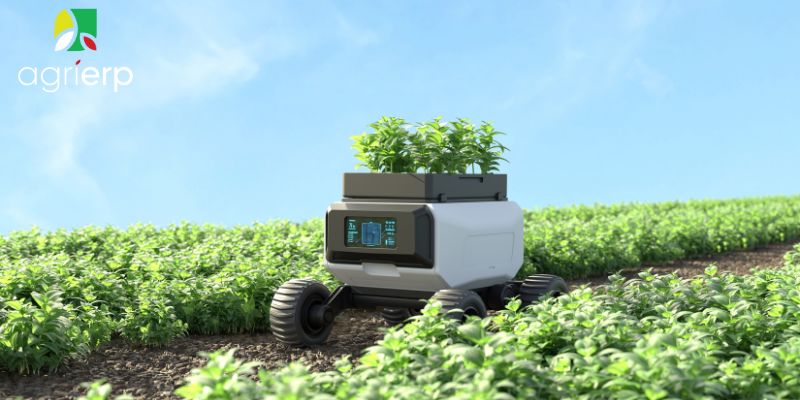
AI is already being used in smart farming solutions in ways you can not even expect. Here are eight farm management AI use cases that are changing how modern farms work.
1. Crop Yield Prediction
What it is: AI models help predict how much crop you will be able to produce in a season.
How it works: These systems gather data from past seasons, satellite imagery, and real-time weather. The AI then compares patterns to make an estimate of your farm’s future yields.
Example: A wheat grower in Kansas used AI yield prediction models to identify underperforming fields early on and made timely adjustments of important inputs impacting the yield.
Impact: Better planning, more accurate sales forecasting, and less financial risk.
2. Precision Irrigation & Water Management
What it is: Since water is a precious resource, AI helps you decide exactly when and how much water to use for irrigation.
How it works: AI tools connect to sensors and weather data to predict moisture needs of your fields. Automated irrigation systems then adjust water levels according to the requirement.
Example: In California, grape growers have reduced the usage of water by 25% with the help of AI-driven irrigation recommendations.
Impact: Massive amount of water was saved, and healthier crops were grown during drought seasons.
3. Soil Health Monitoring and Recommendation
What it is: By Soil health monitoring, AI tracks nutrients, pH, and microbial activity in the soil.
How it works: Soil sensors gather chemical data, and AI suggests crop rotation or fertilizer adjustments to boost soil fertility.
Example: A potato farmer in Idaho used AI to detect early on the nutrient imbalance in the soil, and got a yield increase after soil amendments.
Impact: More fertile fields and lower fertilizer costs over time.
4. Pest and Disease Detection with AI Vision
What it is: AI systems use cameras and machine vision to spot crop areas that are likely to be infested by pests and diseases.
How it works: images of leaves are captured with the help of drone technology, then AI trained on pest databases identifies threats within seconds.
Example: Tomato farmers use AI-powered pest control applications to identify blights early, reducing chemical use.
Impact: Faster response times and reduced application of pesticides.
5. Farm Equipment Optimization and Predictive Maintenance
What it is: Predictive maintenance in farming uses AI to prevent equipment breakdowns, before they happen and impact operations.
How it works: Sensors on tractors and harvesters track important indicators such as temperature, pressure, and runtime. AI predicts issues before they cause failures.
Example: A soybean grower in Illinois avoided a $15,000 breakdown after AI alerted about an overheating combine.
Impact: Reduced downtime and lower repair cost.
6. Autonomous Farm Operations (Drones, Robots)
What it is: Robots and drones perform tasks automatically, such as seeding, spraying, and surveying.
How it works: AI directs autonomous vehicles and drones with the help of GPS and remote sensing in agriculture.
Example: Some rice farms in Japan use drones to apply nutrients, cutting manual labor by a massive 40%.
Impact: Time is saved and there is better allocation of labor.
7. Harvest Timing Optimization
What it is: AI systems suggest when you should harvest to get the best yield and quality.
How it works: AI analyzes weather, plant growth, and market prices. Then it predicts the most suitable window for harvesting each crop.
Example: A citrus farm in Florida improved fruit quality after using AI for harvest timing.
Impact: Better pricing and reduced spoilage.
8. Farm Finance & Inventory Forecasting with AI
What it is: AI helps you plan your budgets, manage inventory, and forecast supply and demand. This way, you are never in a shortage or surplus.
How it works: AI analyzes the market trends, past inventory, and current production levels.
Example: A large agri-business used farm labor management software with AI to balance its staffing and budget planning before the start of peak season.
Impact: Better cash flow and inventory control.
Real Business Benefits of AI in Farming
Here are some notable benefits of AI in Farming:
- A boost in crop output
- A reduction in the input costs, such as fertilizer, water, fuel, etc
- Real-time decision-making, that leads to agility and intelligent decisions.
- Reduction in losses caused by diseases.
- Better forecasting for market demand
AI in farm management is more than a trend. These are real, measurable outcomes that can change how you plan each season.
Why AgriERP Is at the Forefront of AI-Driven Farm Management?
There are a myriad of farm management software programs out there, but the question is which one makes an impact and makes AI practical for you? AgriERP stands out in this domain. It is built specifically for agriculture businesses that need both power and simplicity.
With AgriERP, you get access to advanced AI modules that help you in crop planning, field operations, and financial forecasting. This system comes with powerful dashboards that show real-time insights based on farm data analytics. It is also compatible with GIS tools, drone technology in farming, and smart sensors. Hence, helping you combine AI crop monitoring with field-level precision.
AgriERP work perfectly whether you are managing the health of your soil, deploying variable rate technology farming, or automating routine tasks. You can even explore real customer case studies that show how this works in real farms.
Conclusion
A recent report showed that AI in agriculture can raise productivity by up to 70% by 2030. That is huge! And it is also a sign that modern farms are moving fast, and you must not lag behind and be a part of it.
Now we know about some of the most impactful farm management AI use cases, such as yield prediction models, AI-powered pest control, and predictive maintenance in farming. You have also seen how smart farming solutions, from automated irrigation systems to remote sensing in agriculture, are helping farms grow efficiently while minimizing waste at the same time. Tools like farm labor management software and cloud computing in agriculture are also helping farmers stay ahead of the game.
So if you are thinking about making your farm operation smarter, then the journey starts with information. Powerful software such as AgriERP gives you all the tools in one place and helps apply these innovations to your farm. Amidst rising costs, changing weather, and global demand, you do not have to do it all alone, and in fact, you can’t. So let AI embedded tools become your right hand! You must use them and put them to good use for your farm!