The ERP Solution for the Year” 2025 in Agtech Breakthrough Awards 2025


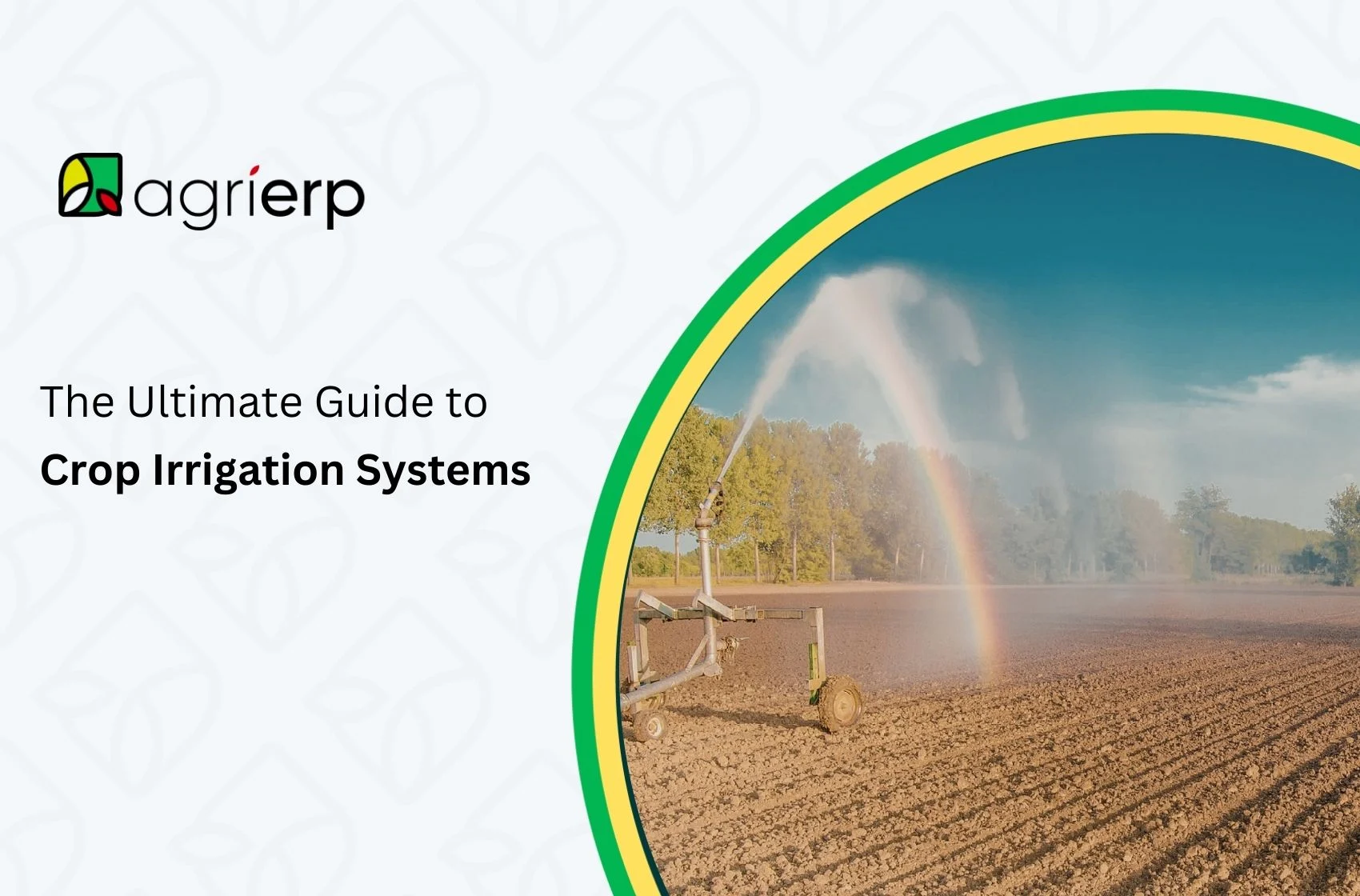
Water is the lifeblood of agriculture. Yet across the globe, freshwater scarcity is tightening — and the pressure on farmers to do more with less has never been greater. Whether you manage a few hundred acres of corn or thousands of acres of mixed vegetables, choosing the right crop irrigation systems can be the single most impactful operational decision you make each season.
This guide covers everything you need to know: the main types of crop irrigation systems, how they work, what they cost, how to choose the right system for your operation, and how modern farm management platforms are turning irrigation from a field task into a data-driven competitive advantage.
Why Irrigation Decisions Are Business Decisions?
Irrigation is often treated as a purely agronomic concern — but for farm operators tracking costs per acre, profitability per crop, and regulatory compliance, it’s equally a financial management challenge. Overwatering drives up water and energy bills and leaches nutrients from the soil, increasing fertilizer spend and environmental liability. Underwatering stunts growth, accelerates crop stress, and slashes yields at harvest. Either extreme hits the bottom line directly, and neither shows up clearly until the damage is done.
That’s why forward-thinking operations are integrating irrigation planning into their farm management software and ERP workflows — treating water as a tracked, costed resource rather than a background utility.
What Are Crop Irrigation Systems and How Do They Work?
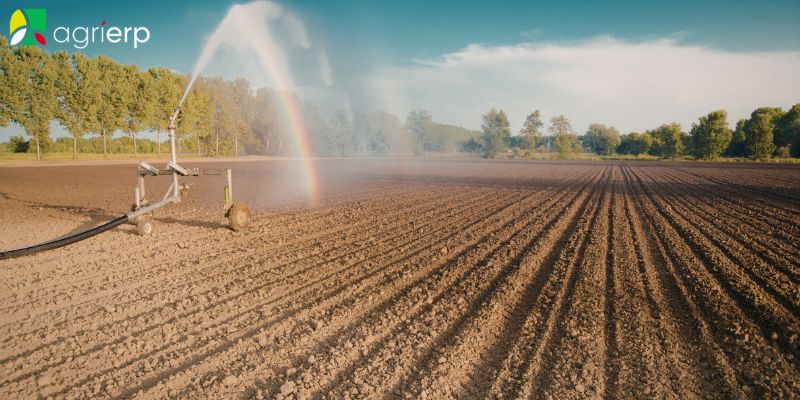
At their core, crop irrigation systems are engineered networks that deliver water to crops in a controlled, efficient manner. Understanding how crop irrigation systems work starts with three basic components: a water source (surface water, groundwater, or collected rainfall), a delivery infrastructure (pumps, pipes, or channels), and a distribution mechanism (sprinklers, drip emitters, or furrows).
The sophistication of the system determines how precisely water reaches plant root zones, how much is lost to evaporation or runoff, and how much labor is needed to operate it. Modern agricultural irrigation systems increasingly layer in soil moisture sensors, weather station integrations, automated scheduling controllers, and farm software connectivity to move from reactive watering to proactive, data-informed scheduling.
For large farm operations, the question is rarely whether to irrigate — it’s which system maximizes yield efficiency while minimizing cost and water consumption across multiple fields, crops, and seasons. That’s where system selection, technology, and farm management software intersect to create real operational leverage.
Types of Crop Irrigation Systems: A Practical Overview
Understanding the main types of crop irrigation systems helps farm operators match their investment to soil type, crop requirements, terrain, labor capacity, and water management goals.
1. Surface Irrigation
Surface irrigation is the oldest method globally. Water flows through furrows, borders, or basins across the soil surface by gravity. Furrow irrigation is particularly common in row crop irrigation systems — corn, soybeans, cotton, and sorghum — where water runs in channels between planted rows.
It carries the lowest upfront cost but achieves only 40–70% water use efficiency, making it the least efficient option and a liability in water-restricted regions.
2. Sprinkler Irrigation
Sprinkler systems distribute water through a pressurized pipe network and rotating or fixed nozzles that simulate rainfall. Center pivot and lateral move systems — what most people picture as crop circle irrigation systems — are the dominant form of large-scale farm irrigation systems across the American Midwest and Great Plains, irrigating circular fields that can span hundreds of acres.
Sprinkler systems achieve 75–85% efficiency and are adaptable to variable rate irrigation (VRI) technology, making them a strong fit for large farm crop irrigation systems on relatively uniform terrain.
3. Drip Irrigation
Drip irrigation delivers water slowly and directly to the plant root zone through tubes and emitters — the most water-efficient method available at 90–95% application efficiency. Row crop drip irrigation systems have grown significantly in adoption for high-value vegetables, berries, and processing tomatoes. Subsurface drip irrigation (SDI) buries the tape below the soil surface, further reducing evaporation, protecting tape from UV degradation and tillage equipment, and keeping foliage dry to reduce fungal disease pressure.
Drip systems carry higher upfront installation costs and require clean, filtered water to prevent emitter clogging, but they pair exceptionally well with soil moisture sensors, weather-based ET scheduling, and automated fertigation — the practice of delivering dissolved fertilizers directly through the irrigation system to reduce field passes and improve nutrient uptake efficiency.
For farms focused on precision agriculture and crop management, drip is consistently the system that delivers the most control over water placement, nutrient delivery, and field-level cost tracking.
4. Center Pivot Irrigation
Crop circle irrigation systems represent the backbone of large-scale row crop and grain farming in the U.S. Today’s center pivots are far more sophisticated than their original designs. They integrate GPS-guided variable rate irrigation, allowing different sections of the pivot arc to apply different water volumes based on soil maps, topography, and real-time crop water demand data.
Remote monitoring and telemetry systems let operators track pivot position, flow rates, and pressure alarms from a smartphone — reducing the manual field checks that used to consume labor hours daily.
Farm types ranging from row crops to specialty produce can benefit from center pivot systems when field geometry, water supply, and capital budgets align — and when the operation is set up to make use of the data these systems can generate.
Choosing the Right System for Your Operation
Selecting the right farm irrigation systems requires working through several key questions — and being honest about your operation’s constraints before you fall in love with any particular technology.
- Water Source and Availability: How much water do you have access to, at what flow rate, and under what regulatory framework? Water rights, groundwater allocation limits, and seasonal availability often constrain your system options before any other factor. Farms in regions with tightening groundwater regulations — the Central Valley, the Ogallala Aquifer region — need to think carefully about which systems let them do the most with the least.
- Field Characteristics: Flat, uniform fields with good water-holding capacity suit surface irrigation and center pivot systems well. Irregular terrain, sandy soils with low water-holding capacity, or fields with significant internal variability usually favor drip. Soil type also determines how quickly water moves laterally from a drip emitter — affecting emitter spacing and tape layout decisions.
- Crop Mix: High-value, disease-sensitive crops frequently justify the premium of drip irrigation, where keeping foliage dry is agronomically important. Large-scale commodity row crops — corn, soybeans, wheat — are generally better served by center pivots, where the economics of scale work in the system’s favor.
- Labor and Capital: Drip systems reduce daily operational labor but require more intensive maintenance — filter management, tape inspection, emitter flushing. Surface irrigation is capital-light but labor-heavy. Your labor strategy and workforce capacity — tracked through labor management tools — should be part of the system selection conversation, not an afterthought.
- Technology Integration Goals: If your farm is moving toward precision agriculture and data-driven management, choose systems that are compatible with automation, soil moisture sensor integration, and farm software connectivity from the start. Retrofitting older systems for data capture is always more expensive and less reliable than building it in from day one.
Operations managing multiple fields, crops, or farm types — row crops in one location, vegetables in another — may find that a hybrid approach makes the most sense, deploying different system types where each performs best and tying the whole picture together through a unified management platform.
The Role of Farm ERP in Modern Irrigation Management
The farms that will thrive in the next decade aren’t just the ones with the best irrigation hardware — they’re the ones that capture, analyze, and act on data across every dimension of their operation. Irrigation sits at the intersection of your biggest variable costs: water, energy, and labor. That makes it one of the most valuable areas to bring into your digital farm management infrastructure.
Connecting irrigation schedules, water meter readings, energy consumption, and field-level application data into a centralized farm analytics platform enables operators to do things that simply aren’t possible with standalone controllers or spreadsheets:
- Cost allocation: Assign water and energy costs accurately to specific fields and crops for precise cost-of-production accounting.
- Efficiency benchmarking: Compare water use across different fields, irrigation zones, and seasons to identify where the system is underperforming.
- Smarter scheduling: Integrate weather forecast data into irrigation decisions to avoid applying water before rain events.
- Compliance and reporting: Generate water use documentation for district regulators, lenders, and buyer sustainability audits — from data already captured in normal operations.
Farm solution platforms built specifically for agricultural operations — rather than generic ERP tools retrofitted for farming — allow irrigation data to flow seamlessly into financial management, crop management, and reporting modules.
This matters because farm financial decisions rarely live in a single silo. A decision about whether to upgrade from surface to drip irrigation isn’t just an irrigation question — it’s a capital allocation question, a crop insurance question, a labor planning question, and a water compliance question all at once. Having those data streams connected in one platform means you can evaluate those decisions with the full picture in view.
For farms managing indoor vertical farming or citrus operations alongside field crops, the need for a unified platform is even more acute — irrigation requirements, scheduling logic, and cost structures vary significantly across operation types, and managing them in separate systems creates blind spots.
Effective agricultural water management is also increasingly tied to ESG and sustainability reporting. As buyers, lenders, and regulators raise expectations around water stewardship documentation, farms that have their irrigation data structured and accessible in their ERP are in a fundamentally better position than those scrambling to reconstruct records after the fact.
Conclusion: Making Irrigation Work Harder for Your Farm Business
Crop irrigation systems are no longer just infrastructure — they’re a core component of a farm’s data and operations strategy. The farms achieving the best outcomes treat irrigation as a managed system: monitored, measured, optimized, and fully integrated with their financial and agronomic decision-making.
Whether you’re evaluating your first center pivot upgrade, exploring row crop drip irrigation systems for specialty crops, or trying to bring structure and visibility to water costs across a large multi-field operation, the path forward runs through better data.
AgriERP helps farm businesses integrate irrigation data with crop management, financial reporting, and operational workflows — giving you the full picture you need to make smarter water decisions, season after season. Learn how AgriERP can help you manage your farm’s irrigation and crop operations more effectively.