The ERP Solution for the Year” 2025 in Agtech Breakthrough Awards 2025


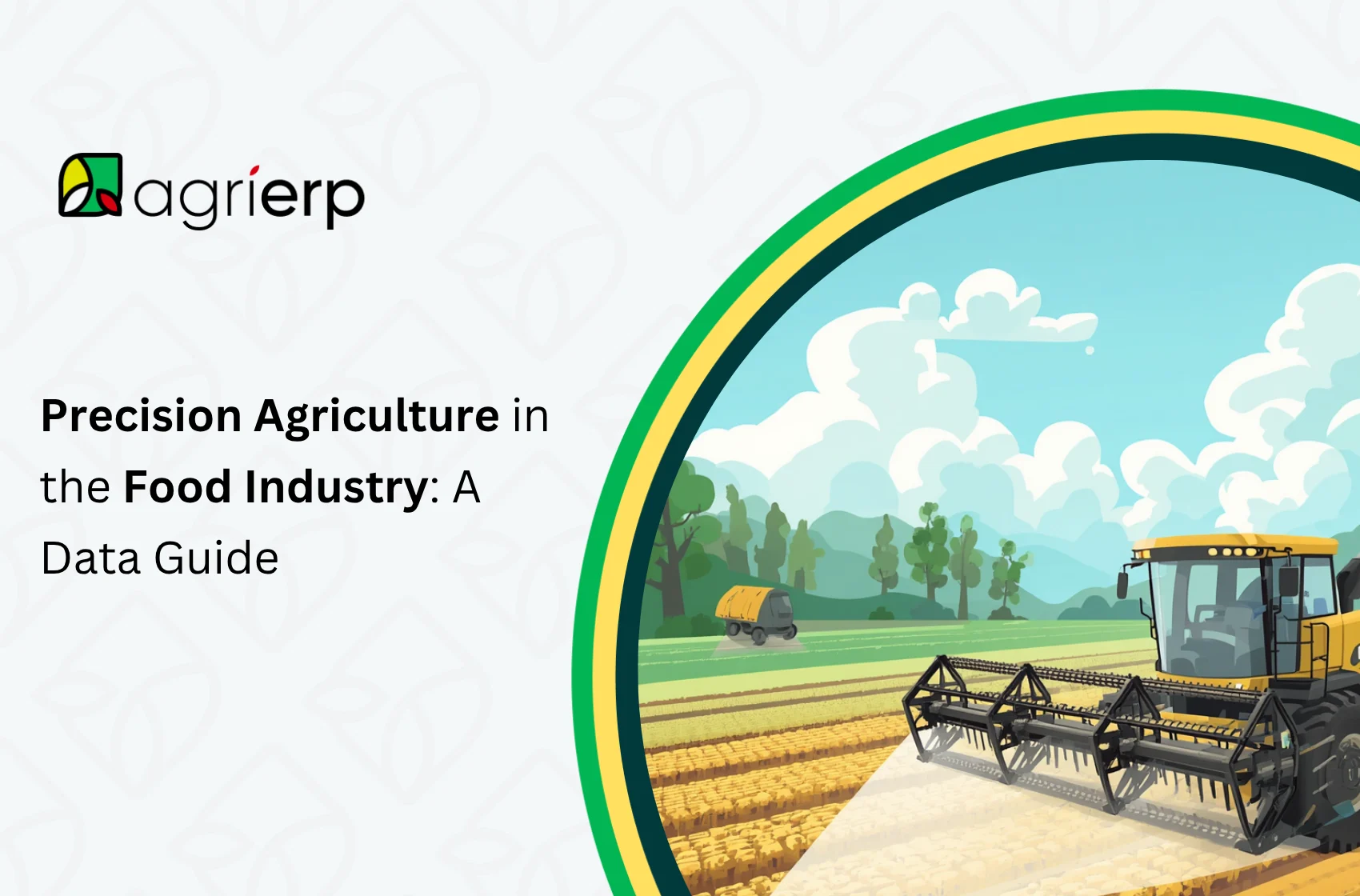
The food industry’s relationship with agriculture has always been close, but the connection has historically been arm’s length — food processors, retailers, and distributors received finished product without deep visibility into what happened at the farm level. That is changing rapidly. Buyer requirements for traceability, sustainability documentation, and food safety compliance are pushing precision agriculture data out of the field and directly into supply chain conversations. For commercial growers supplying food processors, retailers, foodservice distributors, and export markets, the ability to generate, manage, and share field-level data is becoming a prerequisite for market access — not just a competitive advantage. This guide covers what that shift looks like in practice and what it means for agribusiness operators.
The Food Industry’s Growing Demand for Farm-Level Data
Over the past decade, food companies have faced mounting pressure from regulators, retailers, and consumers to demonstrate that their supply chains are safe, sustainable, and traceable. This pressure has flowed back up the supply chain to farm level in the form of increasingly detailed supplier requirements.
Where a buyer once required a basic food safety audit, they may now require documented evidence of pesticide application records with dates, rates, and pre-harvest intervals; water source testing and irrigation records; soil amendment records including organic inputs; worker welfare documentation; and carbon footprint estimates or scope 3 emissions data.
Generating and managing this documentation at scale — across dozens or hundreds of fields — is not possible without a precision agriculture data infrastructure. Operations relying on paper records or disconnected spreadsheets are increasingly finding that they cannot meet buyer documentation requirements, regardless of how well managed their fields actually are.
The food industry’s demand for farm data is not a compliance exercise — it reflects a genuine shift toward supply chain accountability that is now embedded in retailer standards, export certification requirements, and sustainability-linked supply agreements.
How Precision Agriculture Data Supports Food Safety
Food safety in production agriculture centers on ensuring that products reaching consumers are free from harmful chemical residues, biological contamination, and physical hazards. Precision agriculture tools directly support food safety management at the farm level in several important ways.
Pesticide application records — variable-rate sprayers and application management systems generate automatic records of what product was applied, at what rate, in which field zone, and on which date. These records are exportable and auditable, eliminating the gaps and inaccuracies that come with manual logging.
Pre-harvest interval (PHI) management — farm management software can flag fields where applications are within the mandatory withholding period for a given product, preventing accidental harvest of non-compliant crops. For multi-field operations where different fields may have different application dates, this automated tracking is a significant risk management tool.
Water quality monitoring — precision irrigation systems connected to water quality sensors can log source water data relevant to food safety compliance. This is particularly relevant for fresh produce operations where irrigation water quality directly affects microbial risk on edible plant surfaces.
Traceability from field to pack — when field records, harvest data, and packing records are connected in a single farm management platform, an auditor or buyer can trace any lot of finished product back to the field it came from, the inputs applied to that field, and the workers who harvested it. This end-to-end traceability is now required by many major retail customers and by food safety schemes including GLOBALG.A.P., SQF, and similar standards.
Precision Agriculture and Sustainable Sourcing
Sustainability has moved from a brand differentiator to a supply chain requirement for a growing number of food companies. Corporate sustainability commitments — net-zero targets, sustainable sourcing pledges, regenerative agriculture programs — are increasingly translated into specific requirements that their agricultural suppliers must document and verify.
The types of sustainability data food buyers are now requesting from their growers include:
- Greenhouse gas emissions per unit of production, including fertilizer-related emissions, fuel use, and on-farm energy consumption
- Water use per hectare and per unit of yield, by crop and by season
- Soil carbon status and trends over time
- Pesticide use intensity and changes compared to a baseline
- Biodiversity metrics including cover crop adoption and buffer zone management
Precision agriculture data infrastructure is what makes this reporting feasible for commercial farming operations. Variable-rate application records document fertilizer quantities with field-level precision. Irrigation management systems log water volumes by field. Soil test records provide organic matter data for carbon reporting. Cover crop records feed into biodiversity and regenerative practice documentation.
For agribusinesses that are already investing in precision agriculture for operational reasons, the sustainability reporting capability is a valuable additional return. For operations being pushed toward sustainability reporting by buyer requirements, building a precision agriculture data infrastructure is the most practical way to generate the needed documentation consistently and at low marginal cost.
Supply Chain Transparency and Real-Time Data Sharing
The food industry is moving toward real-time data sharing between farm and buyer, enabled by connected platforms that can transmit production records, certification status, and compliance documentation on demand.
This shift is driven by several converging forces:
Regulatory requirements — food safety legislation in major markets including the United States (FSMA), European Union (Farm to Fork Strategy), and the UK (post-Brexit food safety frameworks) is increasing the documentation burden on primary producers and the entities that source from them.
Retailer programs — major food retailers have launched supplier sustainability programs that require growers to report against defined metrics annually, with third-party verification. The ability to export records directly from a farm management system dramatically reduces the administrative burden of compliance.
Export market access — many export markets require phytosanitary documentation, residue testing records, and traceability documentation as a condition of entry. Operations that cannot generate these records digitally face significant processing delays and potential access barriers.
Carbon markets and sustainability finance — emerging carbon credit programs and sustainability-linked financing instruments require verifiable, auditable data on farm practices and outcomes. Precision agriculture records provide the foundation for participation in these programs.
AgriERP’s agriculture analytics solution supports this reporting layer by consolidating field records, input applications, yield data, and compliance documentation in a format that can be structured for export and shared with buyers, certifiers, or financial partners.
Precision Agriculture in Fresh Produce Supply Chains
Fresh produce supply chains operate with particularly tight traceability requirements, driven by food safety incidents and the rapid introduction of produce-specific food safety legislation. Precision agriculture adoption in fresh produce has been driven substantially by buyer pressure rather than purely by agronomic efficiency.
For vegetable farm operations supplying major retailers or food service buyers, the ability to provide a digital trace of any product lot — including field of origin, crop inputs, irrigation records, harvest team, and cold chain handoff — is increasingly a contract condition rather than a nice-to-have.
Precision agriculture tools support this in produce operations through:
- Field-level spray and fertilization records — tied to specific field blocks and harvest dates
- Harvest and yield records by field block — connecting pack house lots to their origin fields
- Worker and equipment records — documenting who harvested which blocks and what equipment was used
- Cold chain integration — linking farm records to post-harvest temperature logs
For indoor farming and controlled environment agriculture operations, precision data capture is inherent to the production system — every environmental variable is logged continuously, providing a comprehensive production record by default.
The Agribusiness Case for Precision Agriculture Data
For agribusiness operators, the investment in precision agriculture data infrastructure is justified not just by field-level efficiency gains but by the market access, risk management, and commercial relationship value it creates.
Operations that can demonstrate precision management practices and provide auditable data records are better positioned to:
- Qualify for premium supplier programs with major food buyers
- Access sustainability-linked financing at preferential rates
- Participate in carbon markets and environmental payment schemes
- Reduce the time and cost of food safety audits and certification renewals
- Manage recall risk through rapid lot traceability in the event of a food safety incident
The cost of building and maintaining a precision agriculture data infrastructure has fallen substantially as farm management software platforms have become more capable and accessible. Platforms like AgriERP — built on enterprise-grade ERP systems — are designed for the scale and complexity of commercial agribusiness operations, integrating field management with financial reporting, procurement, labor tracking, and compliance documentation in a single connected system.
For operations managing the labor component of food safety compliance and precision data collection, the labor management capabilities within an integrated farm management system also reduce the administrative burden significantly.
Conclusion
Precision agriculture and the food industry are increasingly inseparable. The data generated by modern farm management practices — application records, yield maps, soil tests, irrigation logs — is the same data that food buyers, regulators, and sustainability programs need to verify the safety and sustainability of what they are sourcing. For agribusiness operators, this convergence creates a strong case for investing in precision agriculture data infrastructure not just for operational efficiency but as a commercial and risk management necessity. AgriERP is purpose-built to help commercial farming operations capture, manage, and report that data — connecting field-level precision with the supply chain transparency that today’s food industry demands.
Frequently Asked Questions (FAQs)
Why is the food industry interested in precision agriculture?
Food companies need verifiable data on how their agricultural supply chains operate — for food safety compliance, sustainability reporting, and consumer transparency. Precision agriculture generates the field-level records that make this verification possible at scale.
What types of farm data do food buyers typically require?
Requirements vary by buyer and certification scheme, but commonly include pesticide application records with dates and rates, water use and irrigation source records, soil amendment documentation, harvest traceability data, and increasingly, carbon and sustainability metrics.
How does precision agriculture support food safety compliance?
Precision agriculture tools generate automatic, auditable records of input applications, pre-harvest intervals, water quality monitoring, and field-level traceability. These records form the documentation base for food safety schemes including GLOBALG.A.P., SQF, and similar standards.
Is precision agriculture relevant for fresh produce operations?
Yes — fresh produce operations face some of the most demanding traceability requirements in the food supply chain. Precision agriculture tools that link field records, harvest data, and pack house records are increasingly a contract condition for major retail and foodservice buyers.
How does AgriERP help agribusinesses meet food industry data requirements?
AgriERP connects field records, input applications, harvest data, and compliance documentation in a single platform. This makes it straightforward to generate the auditable, exportable records that food buyers, certifiers, and regulators require — without duplicating data entry across multiple systems.
Can precision agriculture data be used for carbon markets and sustainability finance?
Yes. Carbon credit programs and sustainability-linked finance instruments require verifiable records of farm practices — fertilizer use, cover cropping, tillage, soil carbon. Precision agriculture data infrastructure provides exactly this documentation, making participation in these programs commercially viable for commercial farm operations.