The ERP Solution for the Year” 2025 in Agtech Breakthrough Awards 2025



What is a UPC Code in Agriculture?
UPC, Universal Product Codes, are a universal standard that helps you identify retail-ready products. You might have already seen a UPC if you have ever bought a bag of branded fertilizer or a pack of potatoes from the supermarket.
Universal Product Code for Agri Products
A UPC (Universal Product Code) is a 12-digit barcode assigned by GS1, a global standards organization. This code is the same for any product, across different sellers, manufacturers, and retailers.
That means this code will be the same whether it is a bag of apples or a bottle of pesticide, they will have the same UPC despite of which store sells it.
Where it is used in agriculture:
- Fertilizer bags: To meet retail barcode scan requirements.
- Packaged seeds: Helps seed companies sell their products via hardware chains or e-commerce.
- Branded agrochemicals: They are required for traceability and safety compliance.
- Retail-ready produce (e.g., apples, potatoes): In the case of fresh produce, they help in automated checkout counters and inventory at supermarkets.
These codes help in standardizing UPC in agriculture and enable better traceability and retail compatibility.
What is an SKU Code in Agriculture?
Now you must be thinking if UPC is for retail, etc, then what is SKU? It is simple. UPCs talk to the world, but SKU codes speak directly to you.
Stock Keeping Unit Codes are custom internal codes that give you control over how you manage your inventory and, hence, your operations.
Internal Stock Keeping Unit for Farms
An SKU (Stock Keeping Unit) is a unique identifier created by your team. It is not assigned by GS1 (global standards 1), thus it does not have a global format.
You can decide what will make up your SKU, it can be your product type, size, quality, harvest season, etc, whatever you consider important and will help you track smarter.
Where SKUs are used in agriculture:
- Tracking seed batches: Label by region, type (hybrid, GMO, heirloom), and performance.
- Warehouse inventory: Know where your tools, fertilizers, or chemicals are stored.
- Produce grading: Track potatoes by size or citrus by sugar content.
There are many benefits of SKU in farming, such as it can help you in smarter stock planning, waste reduction, and forecasting seasonal demand.
UPC vs SKU in Agriculture: Exploring The Key Differences
Both UPCs and SKUs identify products, but this identification is for different people and purposes. Here is a table for you to see the basic differences:
| Criteria | UPC Code | SKU Code |
| Nature | Standardized & global | Custom & business-specific |
| Use Case | Retail/barcode scanning | Internal inventory control |
| Format | 12-digit numeric | Alphanumeric, flexible |
| Assigned by | GS1 or authorized bodies | Created internally by agricultural organizations |
| Agriculture Example | Packed organic fertilizer bag | SKU-FERT-ORG-50KG-SINDH |
As you can see, the difference between UPC and SKU is mainly in standardization vs. customization.
How UPC Codes Help in Agriculture
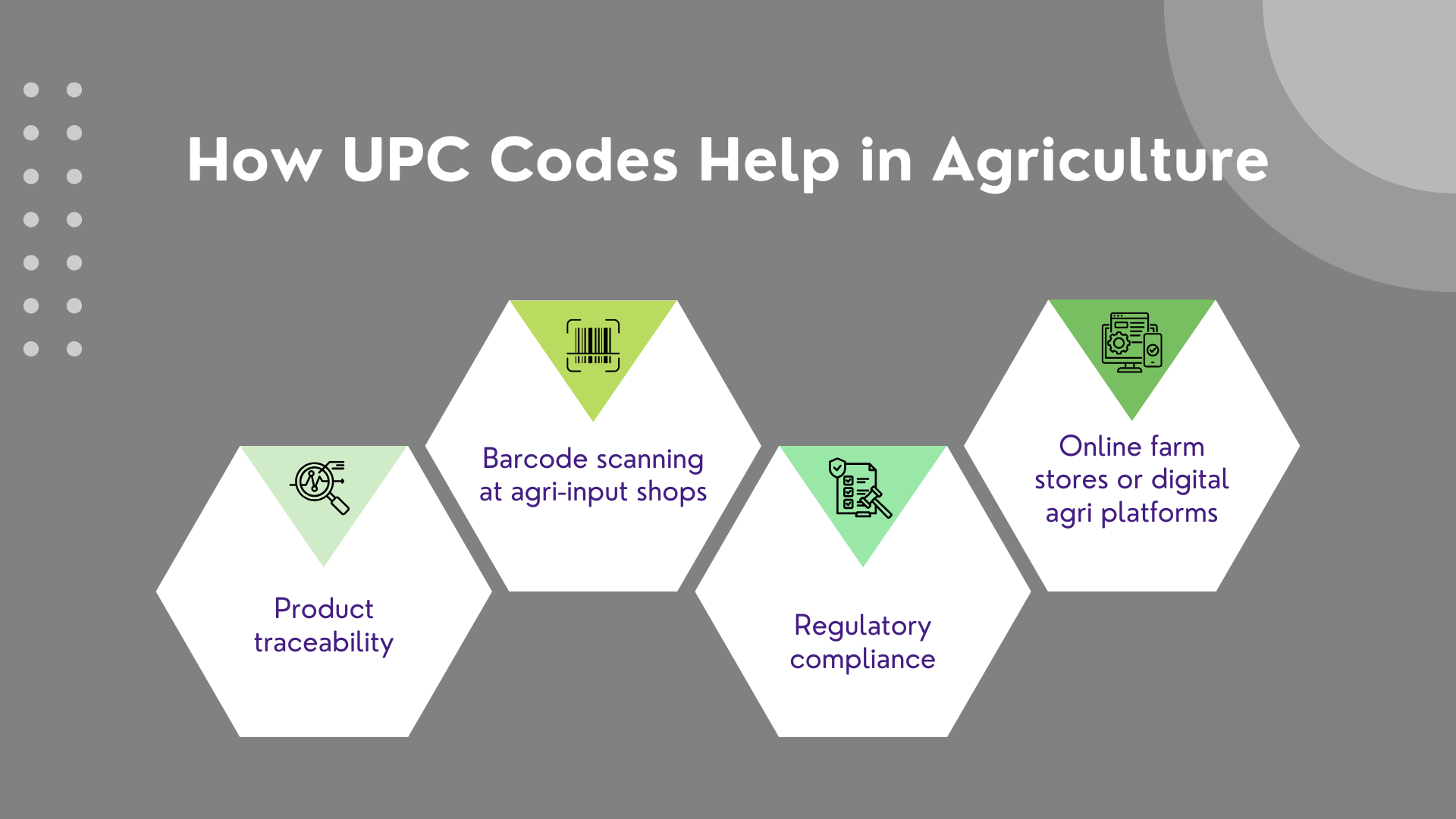 UPCs are not just meant for supermarkets; in fact, they help farms stay efficient and compliant with regulations, especially when products are moved beyond the farm’s gates.
- Product traceability: Retailers and exporters can track the product back to its source.
- Barcode scanning at agri-input shops: This makes the checkout process fast and keeps inventory data accurate.
- Regulatory compliance: Many countries mandate having barcoded packaging for fresh produce.
- Online farm stores or digital agri platforms: UPCs let you list items that are recognized by large online sellers.
Using UPC for organic produce or farm equipment helps you meet traceability standards and operate accurately and more professionally.
How SKU Codes Are Used in Agricultural Operations
SKU codes give farmers and agri-businesses the liberty to manage things according to their own wishes. These codes can fit any system, from simple spreadsheets to ERP platforms.
- Seed tracking: Separate SKUs for heirloom vs hybrid, and by germination rate.
- Tool and machinery labeling: Helps keep your equipment organized and trackable.
- Chemical stock: Chemical stock can be grouped by the expiry dates or temperature-sensitive storage.
The sku code for farm products helps in optimizing rural storage units and helps in better stock planning by season and location.
Best Practices for Setting Up SKU Codes for Farm Inventory
If you want to maximize the benefits of your SKU codes, it is important that you structure them in a way that fits your workflow. Here are a few tips:
- Be consistent: Decide a format (e.g., [ProductType]-[Region]-[Date]-[Unit]) and adhere to it.
- Make them searchable: Avoid very complex formats, keep them simple, it ill also save your time.
- Prevent duplicates: Each SKU should be unique to avoid confusion in your warehouse.
- Integrate with systems: Sync SKUs with your ERP and mobile inventory tools used in the field.
This is where SKU management in crop production becomes highly valuable, when it connects every part of your supply chain.
Conclusion
A study by the Food and Agriculture Organization (FAO) found that almost 40% of post-harvest losses in developing regions are lost, and one of the contributors is poor product tracking and mislabeling. Now this is a huge figure and we can overcome this issue by smartly using SKU and UPC codes.
So far, we have talked about what UPC codes are, how they are different from SKU codes, and why both are important when it comes to agriculture. UPCs are suitable for retail, export, and compliance.
You can think of them as the global ID of your product. On the other hand, SKUs help you stay organized at your agribusiness, you can use them to sort inventory by type, season, region, and quality.
Whether you are labeling seed bags, fertilizer dumps, or organic oranges, the right code will make sure that your product is where it needs to be. And also it will be done faster and more accurately.
If you are managing more than one crop or selling across many regions, then it can be pretty complicated. However, this is where platforms like AgriERP can make a huge difference.
It consolidates barcode printing, inventory management, and traceability into one place. It is modern, built to scale, and also surprisingly budget-friendly, which is perfect for any farm looking to scale and perform smarter.
So, if you are thinking of upgrading your labelling, tracking, and managing products, then you must consider AgriERP. You might be closer to organized farming than you can think.
Hence, make your labels work as hard as you do! Every seed, every tool, and every harvest that you have must be tracked just right.
FAQs
Do Small Farms Need UPCs?
Not always. If you are not selling via any retail channels or distributors, you might not need UPCs. But if you are planning to expand into supermarkets or online marketplaces, having UPCs becomes important for the acceptance of your products.
Are UPCs Mandatory for Agri Export?
In many cases, yes. Countries like the U.S., EU nations, and Japan require barcodes for imported fresh produce, especially if it is organic. UPC implementation in agribusiness guarantees compliance and processing of exports.
Which ERPs Support both Codes in Agri Logistics?
Many modern agricultural ERPs, such as AgriERP, support both SKUs vs UPC systems. This lets you manage internal operations and meet retail requirements from a single platform.