The ERP Solution for the Year” 2025 in Agtech Breakthrough Awards 2025


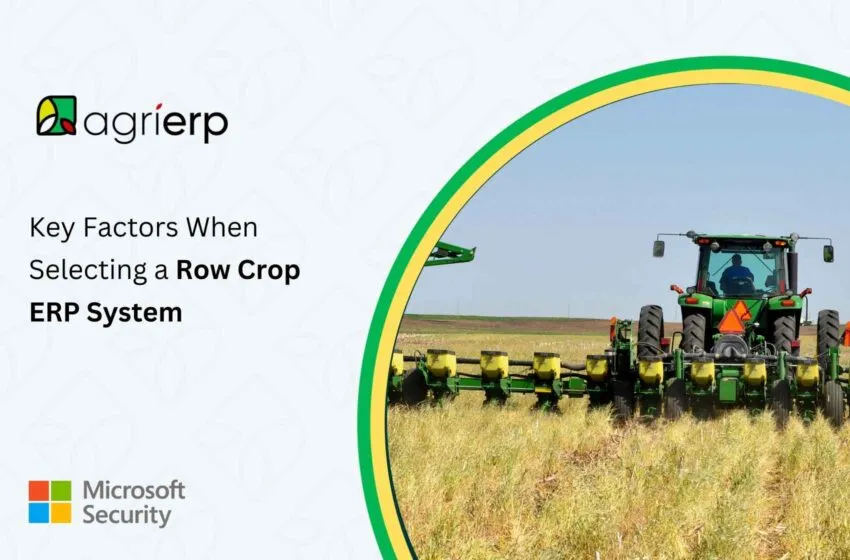
A row crop ERP system is an integrated platform that unites planning, execution, and financial oversight for field crops like corn, soybeans, wheat, and cotton, connecting equipment data, input tracking, compliance, traceability, and commodity sales.
If your goal is to grow your profits, the right ERP helps by cutting waste, tightening traceability, and turning field and financial data into rapid, confident decisions. This blog distills seven essential selection factors, from crop-specific features and machine integration to total cost of ownership, so farm leaders can choose the best row crop ERP system for farms with evidence, benchmarks, and pragmatic vendor comparisons.
Why Do You Need Row Crop Erp?
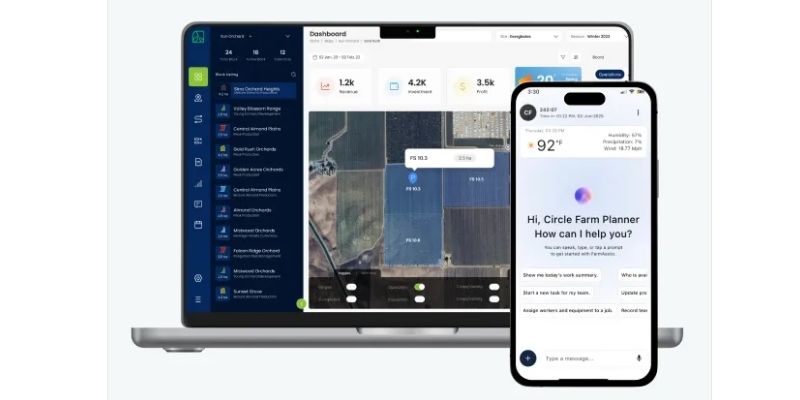
Generic ERPs and spreadsheets struggle with the realities of modern row crop operations:
- Field-level visibility: Disconnected field maps, histories, and crop plans create blind spots in input usage, yields, and compliance.
- Precision agriculture: Variable-rate prescriptions and telemetry often fail to sync effectively without ag-specific integrations.
- Seasonality and multi-entity complexity: Crop-year accounting, grower splits, landlord agreements, and multi-site operations are cumbersome in generic systems.
- Commodity management: Contract management, hedging, moisture/shrink valuation, and grading require purpose-built tools.
- Compliance and sustainability: USDA-aligned traceability, GAP audits, ESG, and carbon reporting are burdensome without templates and field-to-invoice linkage.
- Offline operations: Remote fields disrupt manual workflows when connectivity and mobile sync are unreliable.
- Data fragmentation: Equipment, sensors, and third-party apps generate siloed data that’s hard to trust or reconcile at close.
7 Key Factors When Selecting a Row Crop ERP System
Below are the key factors to consider when choosing a row crop ERP system:
1. Crop-Specific Functionality
Row crop operations need modules designed for field mapping, seeding prescriptions, chemical applications, nutrient plans, and compliance documentation tied to each field and season. Look for:
- Detailed field histories (inputs, activities, weather, scouting, yields)
- Precision prescriptions (seed, fertilizer, chemical) with variable rate support
- Harvest and post-harvest traceability from field to bin to contract
- Compliance and sustainability reporting that aligns with audits and USDA programs
Feature-by-feature contrast:
Capability | Generalist ERP | Row Crop ERP |
Field-level histories | Partial (customization-heavy) | Native, season-aware histories |
Precision prescriptions (VRT) | Third-party add-ons | Built-in or tightly integrated |
Harvest & lot traceability | Generic lot/serial tracking | Field-to-bin-to-contract, moisture/shrink aware |
Compliance & sustainability reporting | Manual/custom reports | USDA/GAP templates; ESG/carbon-ready |
Land/lease & grower splits | Basic fixed-asset records | Parcel-level, landlord splits, sharecropping |
Scouting & pest thresholds | Not available | Mobile scouting with thresholds and alerts |
Crop plans & rotations | Generic BOMs/work orders | Rotation-aware plans and season rollovers |
2. Integration with Machinery and Sensors
Machinery and sensor integration means real-time (or near real-time) linkage of tractors, combines, planters, weather stations, grain scales, and soil sensors to the ERP for automatic data capture. This reduces manual entry and closes data gaps that undermine analytics and audits.
Assess:
- API support for leading precision agriculture platforms and farm management systems
- Middleware/connectors for IoT and GIS data (soil moisture probes, weather stations, bin sensors, flow meters)
- Offline mobile sync to avoid data loss in remote fields
Modern ag ERPs should provide robust API connectivity and dependable offline mobile capabilities to ensure continuity in low-connectivity environments.
3. Financials and Commodity Management
Commodity management encompasses grain contracts, hedging, inventory valuation, grading, and seasonal revenue recognition, core to row crop profitability and risk management.
Verify support for:
- Multi-entity, multi-location accounting and consolidations
- Inventory and grain contract tracking with grading, shrinkage, and moisture
- Hedging, futures, and sales with compliant documentation and audit trails
General-purpose ERPs can deliver deep financials, but ag-specific platforms like AgriERP often provide the commodity workflows and integrations farms need right away.
4. Deployment Model and Scalability
Deployment model refers to how the ERP is hosted (cloud vs. on-premises), tenancy (single vs. multi-tenant), and its ability to scale across sites, entities, and geographies.
Decide based on:
- Cloud vs. on-premises: cloud simplifies access, updates, and security; on-premises can fit strict network policies, but increases IT overhead
- Multi-farm rollouts: ensure templates for fast site/entity replication and consistent master data
- Vendor support and pricing: clarify time-to-value, environments, and what’s included in subscription vs. services
Deployment decision matrix:
Farm Scenario | Connectivity Profile | Recommended Model | Rationale |
Single farm, limited IT | Mixed/Spotty | Cloud + offline mobile | Lower IT burden; resilient field data capture |
Multi-entity, multi-state operation | Good/Mixed | Cloud, multi-tenant | Standardization and easier consolidations |
Strict on-site policies, local integrations | Good | Hybrid or on-prem | Control over data/interfaces; higher IT responsibility |
Rapid seasonal scaling (temp labor, custom ops) | Mixed | Cloud + MDM templates | Fast user provisioning and site replication |
5. Usability and Field User Experience
Usability spans learning curve, interface clarity, and workflow simplicity for agronomy and finance teams. Great UX is the fastest path to adoption and ROI.
Prioritize:
- Offline-capable mobile apps for field logs, scouting, spray apps, and harvest tickets
- Role-based dashboards for operators, agronomists, and accountants to reduce noise
- Streamlined forms that seasonal and temp labor can complete accurately
Field UX checklist:
- One-tap field selection and activity logging
- Barcode/QR or RFID support for bins, lots, and equipment
- Guided workflows for spray/seed/harvest tasks with label math and safety checks
- Simple photo and voice notes capture
- Offline-first with conflict resolution on sync
6. Total Cost of Ownership and Implementation Risk
Total cost of ownership (TCO) includes all direct and indirect costs to buy, implement, operate, support, and evolve the ERP over its lifespan. Plan comprehensively to avoid surprises.
Include in your TCO:
- Software licenses/subscriptions, environments, and storage
- Implementation, configuration, and project management
- Data migration and cleansing
- Integrations and APIs (machines, sensors, banks, scale heads)
- Customizations and periodic enhancements
- Training, change management, and documentation
- Ongoing support, upgrades, and security
- Hardware/IT (if on-premises)
7. Vendor Domain Expertise and Support
Vendor domain expertise is the provider’s real-world experience in row crop agriculture, evidenced by specialized workflows, case studies, and active farm clients. Evaluate:
- Configurable, farm-centric workflows and frequent product updates mapped to crop seasons
- Regional support staff, peer networks, and implementation partners who know ag
- References from farms like yours, with measurable outcomes and smooth audits
Red flags:
- Generic manufacturing or distribution templates passed off as “farm-ready”
- No integrations to your machines, elevators, or sensors
- Sparse agricultural references or dated product roadmaps
The AgriERP guide outlines how vendor track records and domain fit often matter more than feature checklists in determining ultimate success.
AgriERP for Row Crop ERP
Built on Microsoft Dynamics 365, AgriERP for row crop farms is an AI-enabled operations and finance platform designed for medium to large North American producers. It helps you grow your profits through USDA-compliant traceability, end-to-end commodity management, offline-capable mobile apps for field crews, and seamless financial integration across entities and locations.
With native support for field histories, precision prescriptions, machine and sensor integrations, and grower splits, AgriERP simplifies complex ERP adoption while giving CFOs and COOs a single source of truth. Learn more at AgriERP for Row Crop Farms.
Conclusion
Choosing the best row crop ERP system for farms comes down to fit: crop-specific functionality, machine and sensor integrations, finance and commodity depth, scalable deployment, intuitive field UX, transparent TCO, and a vendor with real agricultural credentials.
Use the seven-factor checklist, demand proof in demos, and validate with peer references. When executed well, the right ERP turns field and financial data into faster, better decisions and measurable gains in yield, margins, and compliance confidence.