The ERP Solution for the Year” 2025 in Agtech Breakthrough Awards 2025


Modern agriculture has long been defined by specialization — large fields dedicated to a single crop, optimized for efficiency and scale. But a growing number of farm operators are revisiting an older, more layered approach: polyculture farming. Far from being a niche practice, polyculture is gaining serious attention from agronomists, sustainability-focused buyers, and farm managers looking to build more resilient, productive operations.
This introduction covers what polyculture farming is, how it works, the main methods and strategies in use today, its environmental impact, and how farm management technology helps operations make the most of it.
What Is Polyculture Farming?
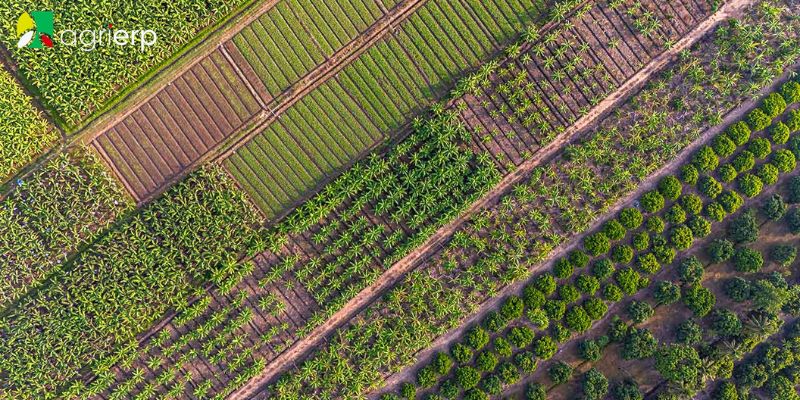
Polyculture farming is the practice of growing multiple crop species on the same piece of land — either simultaneously or in planned rotation — as opposed to monoculture, which dedicates a field to a single crop. The term comes from the Greek poly (many) and Latin cultura (cultivation), and it describes a broad family of practices that share one core principle: diversity in the field creates stability in the system.
Polyculture agriculture is not a new idea. Traditional farming systems around the world have practiced it for centuries — from the “Three Sisters” companion planting of corn, beans, and squash used by Indigenous North American farmers, to the complex intercropping systems still common across sub-Saharan Africa and Southeast Asia. What’s new is the application of data, precision agronomy, and farm management software to make these systems viable and trackable at a commercial scale.
How Does Polyculture Work?
How does polyculture work in practice? At its core, it’s about designing crop combinations and sequences that create mutual benefits — where the presence of one crop supports the productivity or health of another, and where the system as a whole is more stable than any of its individual parts.
Several mechanisms drive this:
- Nutrient cycling: Legumes fix atmospheric nitrogen into the soil, directly benefiting neighboring or subsequent crops that are heavy nitrogen consumers.
- Pest and disease suppression: Diverse plantings disrupt the host-specific pathways that allow pest populations to build rapidly in monocultures. A pest that thrives on one crop often cannot easily spread when surrounded by other species.
- Microclimate moderation: Taller crops can shade lower-growing species from heat stress, while ground-cover crops reduce soil temperature and retain moisture.
- Yield stability: When multiple crops are grown together, a poor season for one crop is often offset by a better season for another — reducing overall revenue volatility.
The complexity of managing these interactions is where polyculture strategies separate successful operations from struggling ones — and where farm management technology plays an increasingly important role.
Polyculture Methods: The Main Approaches
There are several distinct polyculture methods in use across commercial and smallholder agriculture. Understanding the differences helps farm operators choose the approach that fits their operation type, scale, and markets.
1. Intercropping
Intercropping involves growing two or more crops simultaneously in the same field, either in mixed rows, alternating rows, or strip configurations. It’s one of the most widely studied polyculture crops systems, with well-documented yield and soil health benefits in the research literature.
Row intercropping — alternating strips of different crops — is particularly compatible with mechanized farming, as equipment can still operate in defined rows. Strip intercropping of corn and soybeans, for example, has shown consistent yield advantages over monoculture in research trials across the U.S. Corn Belt.
2. Cover Cropping and Relay Planting
Cover cropping introduces a secondary species — often a legume, brassica, or grass — into the system outside the main cash crop’s growing window. Relay planting takes this further by establishing the cover crop while the cash crop is still in the ground, maximizing the period of live root activity in the soil.
These practices are foundational to regenerative agriculture and soil health programs, and they represent one of the most accessible entry points into polyculture agriculture for farms transitioning from conventional monoculture systems.
3. Agroforestry
Agroforestry integrates trees or shrubs with crop or livestock systems. Alley cropping — growing annual crops between rows of trees or shrubs — is a well-established agroforestry model that delivers long-term carbon sequestration alongside near-term crop production. Orchards with managed understory crops and silvopasture systems combining trees with grazing land are other common forms.
4. Crop Rotation with Polyculture Sequences
Multi-species crop rotation goes beyond simple two-crop rotations (corn-soybean) to design sequences of three, four, or more species over multiple seasons. The goal is to maximize soil biological activity, break pest and disease cycles, and maintain nutrient balance across the rotation without heavy external inputs.
This approach demands careful planning and record-keeping across seasons — an area where farm crop management tools provide significant operational value.
Advantages of Polyculture Farming
The advantages of polyculture span agronomic, financial, and environmental dimensions — which is why interest in the practice is growing across very different types of farm operations.
1. Improved Soil Health
Diverse root systems at different depths build soil organic matter, improve soil structure, and support a richer microbial community. This directly affects water infiltration, nutrient availability, and long-term productivity. Farms tracking soil management outcomes consistently find that polyculture systems improve soil health metrics faster than monoculture with cover crops alone.
2. Reduced Input Dependency
Nitrogen fixation from legumes reduces synthetic fertilizer requirements. Natural pest suppression reduces pesticide applications. Better water retention from improved soil structure reduces irrigation needs. Each input reduction has a direct cost-of-production benefit — and a compounding effect on farm profitability over time. Effective agricultural water management becomes easier when the cropping system itself is supporting soil moisture retention.
3. Greater Revenue Diversification
Growing multiple crops creates multiple revenue streams within a single season and across seasons. This is particularly valuable for farms serving direct markets, food hubs, or diversified buyers — where the ability to supply a range of products is a commercial advantage, not just an agronomic one.
4. Labor Distribution
Poly cropping systems can spread labor demand more evenly across the season compared to monocultures, which tend to concentrate labor at planting and harvest. This can reduce peak labor pressure and make more efficient use of a consistent workforce — a key operational consideration when managing labor in agriculture.
Polyculture vs. Monoculture: A Practical Comparison
The benefits of polyculture become most visible when you compare system outcomes side by side with equivalent monoculture operations over multiple seasons.
Monoculture systems offer simplicity — one crop, one set of inputs, one harvest window, one market. That simplicity is real and valuable at scale. But it comes with concentrated risk: one pest outbreak, one weather event, one market price collapse affects the entire operation simultaneously.
Polyculture systems trade some of that simplicity for resilience. The diversity that makes them more complex to manage is the same diversity that buffers against single-point failures. Research consistently shows that well-designed polyculture systems produce higher land equivalent ratios — meaning the combined output per unit of land exceeds what the same crops would produce in separate monoculture fields.
The tradeoff isn’t simplicity versus complexity — it’s short-term operational ease versus long-term system stability and input efficiency. For farms building toward sustainable agriculture and ESG goals, that tradeoff increasingly favors polyculture.
Polyculture Environmental Impact
The polyculture’s environmental impact is broadly positive, and it’s increasingly central to how farms communicate their sustainability story to buyers, lenders, and regulators.
Key environmental outcomes associated with well-managed polyculture systems include:
- Carbon sequestration: Diverse root systems and permanent ground cover increase soil organic carbon at rates that monocultures typically cannot match.
- Reduced chemical inputs: Lower pesticide and synthetic fertilizer use reduces runoff, protects waterways, and decreases the carbon footprint of farm inputs.
- Biodiversity support: Polyculture fields provide habitat and food sources for beneficial insects, pollinators, and soil organisms that monocultures systematically eliminate.
- Climate resilience: Diverse systems are better buffered against the temperature extremes, drought events, and pest pressure shifts associated with climate change impacts on agriculture.
As sustainability reporting expectations tighten across supply chains, farms with documented polyculture practices and measurable environmental outcomes are better positioned than those relying entirely on input reduction within conventional monoculture systems.
How AgriERP Supports Polyculture Farm Operations?

Managing the complexity of polyculture agriculture — multiple crops, shared inputs, overlapping schedules, and multi-dimensional performance tracking — is exactly where farm ERP technology creates outsized value.
AgriERP’s crop management tools allow farm operators to plan, track, and analyze multi-crop systems at the field level, allocating costs and recording activities by crop species rather than just by field. This makes cost-of-production analysis meaningful in mixed systems — a capability that generic tools consistently fail to deliver.
The agriculture analytics solution surfaces the performance data that polyculture operations need to improve season over season: yield by crop and field, input cost by species, labor distribution across the season, and soil health trends across rotation cycles. And for farms building toward ESG and sustainability reporting commitments, AgriERP provides the data infrastructure to document and communicate environmental outcomes with confidence.
Conclusion
Polyculture farming is not a step backward from modern agriculture — it’s a forward-looking strategy for building farm systems that are more productive, more resilient, and more aligned with where markets and regulation are heading. The benefits of polyculture are well-documented, the polyculture methods are increasingly compatible with mechanized, commercial-scale operations, and the data tools needed to manage the complexity are now readily available.
Whether you’re exploring cover cropping as a first step into poly cropping, designing a full intercropping system, or building a long-term rotation program, the operational foundation matters as much as the agronomic design.
AgriERP gives polyculture farm operations the crop tracking, cost accounting, and analytics infrastructure to manage complexity confidently — and build a sustainable, data-driven farming business for the long term.