The ERP Solution for the Year” 2025 in Agtech Breakthrough Awards 2025


Best Farm Practices for Profitability
 Good farming is much more than just planting and harvesting; it is a complete strategy that you must adopt.
The right practices can help you produce more by wasting less, and sell better, all while keeping your land healthy for future years. Let us look at the most effective ways to increase farm profitability.
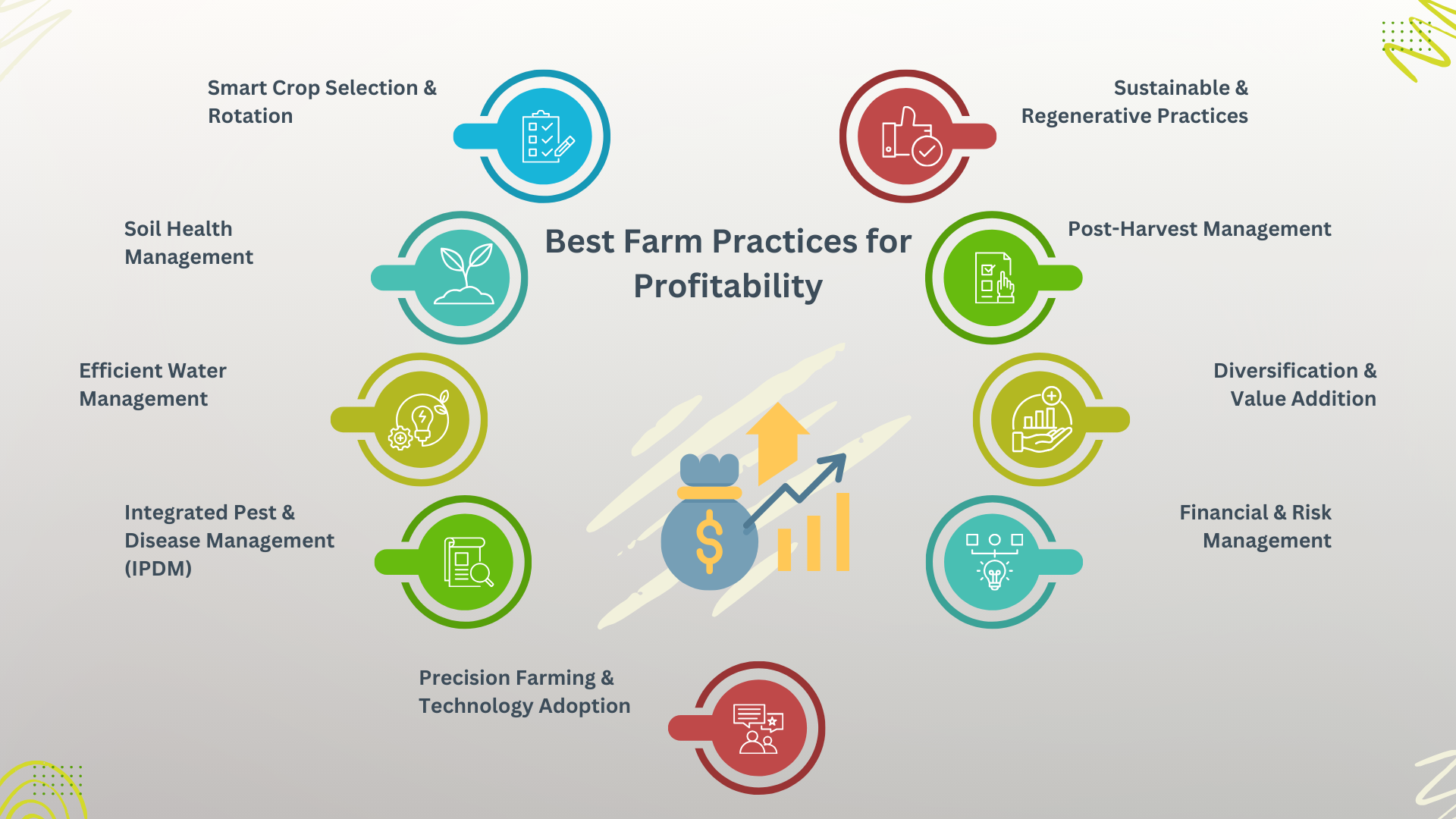
Smart Crop Selection & Rotation
Choosing what to grow can not be merely your personal preference; rather, many factors affect the choice that you make.
These include current demand, climate, and market timing. High-demand crops that suit your region’s growing conditions will reap better returns and lower the risk. Crop rotation also plays a big role here.
By rotating crops, you can naturally disrupt the pest and disease cycles, improve your soil structure, and minimize the need to use chemical inputs. As time passes, this will imply healthier plants and reliable yields, which is exactly what a farming business needs to stay strong.
Soil Health Management
Soil is the foundation of your farm. By testing it regularly, you can get a clear picture of the prevailing nutrient levels, pH balance, and organic matter content.
This can help you apply the right type and amount of fertilizer, saving money and preventing damage. Adding compost or green manure boosts soil life, and on the other hand, avoiding excessive use of chemicals keeps your fields productive in the long term.
Healthy soil is not only good for crops it is the a major factor in running a profitable agriculture business for the future years.
Efficient Water Management
Water is precious, and wasting it is expensive. World Bank tells us that agriculture already consumes 70% of the available fresh water, and the demand for water to irrigate crops is projected to rise by 16% by 2050!
Hence, using it wisely is way more important than we had ever imagined. Methods such as Drip irrigation deliver moisture directly to plant roots, cutting losses due to evaporation.
Rainwater harvesting can supplement your supply, especially in dry spells. Scheduling irrigation based on crop needs and weather forecasts helps avoid overwatering, which saves costs and prevents root diseases.
If you are looking for methods to make money on a farm, water efficiency is one of the quickest cost-saving wins.
Integrated Pest & Disease Management (IPDM)
Pest control does not mean that you must spray more chemicals. Infact, Integrated Pest & Disease Management integrates methods such as organic controls, biological agents, and targeted pesticide use to keep the pest problems in check.
They also encourage beneficial insects, rotating crops, and monitoring fields closely, hence reducing the outbreaks of pests. Balanced IPDM strategies keep your plants healthier while cutting down long-term costs; now this is a win for both profits and the environment.
Precision Farming & Technology Adoption
Technology is no longer optional; rather, it is a must if you want to be among the most profitable farming businesses. Innovations such as GPS-guided tractors, drones for crop health checks, and soil moisture sensors enable you to work smarter, not harder.
Data that is gathered from these tools means you can plant, water, and harvest at exactly the right time. This boosts yields, cuts waste, and makes your operation more competitive.
Even smaller farms can see massive returns by benefitting from these tech investments.
Sustainable & Regenerative Practices
It is wise to think of long term gains of your farm rather than short-term gains, because they affect the profitability in the long term.
Thus practices such as planting cover crops, reducing tillage, and increasing biodiversity keep soils rich and productive.
They also enhance water retention and reduce erosion, which directly protects your yields. Regenerative farming can take a little longer to show results, but it builds resilience. This is important for profitable farming in a changing climate.
Post-Harvest Management
You are still at the risk of losses despite of a great harvest , i storage and handling are improper. Using proper bins, coolers, or silos prevents spoilage.
Gentle handling reduces bruising of your produce and loss of quality. Timely transportation guarantees that your crops reach the market fresh, helping you to sell at profitable prices.
Cutting post-harvest losses is one of the simplest farm business ideas to boost profit without increasing production.
Diversification & Value Addition
It is a fact that it is risky if you rely on a single source of income. thus , adding livestock, planting secondary crops, and integrating agroforestry can provide extra revenue and minimize risk.
Processing raw goods into higher-value products is also a good idea, such as turning milk into cheese or wheat into flour. This strategy can boost your income.
Many profitable agriculture businesses build their model on value addition, creating products that appeal to niche markets and get you better prices.
Financial & Risk Management
Good farming means also good business. Keeping accuarte and detailed records of your expenses, yields, and market prices can help you see what is working and what is not good for your farm.
You can steer clear of over spending by budgeting and tracking your costs. Crop insurance and government programs can protect you from unexpected losses that might occur due to weather or pests.
If you are wondering how to make money from farming consistently, then managing the risks is as important as growing crops.
Common Mistakes Farmers Should Avoid
It is not uncommon that experienced farmers end up making choices that hurt their profits. For example iof you rely alot on a single crop, it will make you more vulnerable to price drops and pests.
Skipping soil and water testing can also lead to wasted inputs or bad yields. If you plant without checking market demand, then this can result in unsold produce.
Avoiding these pitfalls is just as important as adopting the best farm practices for profitable farming in the first place.
Conclusion
For feeding our future generations and satiating world hunger it is important that we take measures now to make farming sustainable. This is a truth that every grower must accept and act upon.
The USDA estimates for 2025 forecast net farm income at $180.1 billion, which is a 29.5% increase over 2024! This high growth shows that by embracing the right strategies, farmers can turn their challenges into opportunities.
From smart crop rotation and soil health management to post-harvest care and diversification, these practices combine and work together to create resilient and profitable farm operations.
For a moment imagine that you ahve adopted precision technology to cut waste, implemented IPDM for healthier crops, and set up water-saving irrigation.
Your yields improve and crops bloom, your costs drop, and your profits escalate year after year.
Now, think about having a single platform that tracks all your inputs, monitors your fields, and helps you make decisions based on real-time data.
This is where the powerful AgriERP comes into this picture, it integrates every aspect of your farm management in one place. With AgriERP being your right hand, you can focus on growing both your crops and your income!