The ERP Solution for the Year” 2025 in Agtech Breakthrough Awards 2025


What is Distribution Requirements Planning (DRP)?
According to Verified Market Reports, the market for Distribution Requirements Planning (DRP) Software was valued at USD 1.2 billion in 2024, and is predicted to grow at a CAGR of 9.2% from 2026 to 2033, achieving USD 2.5 billion by 2033! So, what is the hype? Let us find out
Distribution Requirements Planning (DRP) is a methodical approach that is used to manage the distribution of finished goods from manufacturers to distribution centers and then finally to customers.
It basically involves each aspect of distribution, such as demand forecasting, scheduling shipments, and managing inventory levels to meet the needs of your customers.
Although Material Requirements Planning (MRP) focuses primarily on procuring raw materials for production, DRP is an extension of this concept and extends to the distribution of finished products.
MRP makes sure that the production process has all the necessary materials, whereas DRP guarantees that the produced goods reach the end-users efficiently.
Why DRP Matters in Agriculture?
Agriculture is affected by multiple factors such as fluctuations in demand due to seasonality, perishable nature of your inventory, and farming operations that are spread on vast areas.
These factors make distribution requirement planning very important for agricultural businesses. Let us dig deeper and see why:
Seasonal Demand Fluctuations:
The demand for certain agricultural products often peaks during specific seasons, such as mangoes in summer. DRP helps you in forecasting these demand fluctuations and planning the efficient distribution of these products.
Perishable Inventory and Timing:
Many agricultural products are perishable by nature, and they must be distributed in a timely manner to prevent spoilage and waste. DRP makes sure that these products reach markets quickly, and their quality is maintained, and waste is reduced.
Distributed Farming and Warehousing Operations:
Farming operations are usually spread across vast regions, making coordination between farms and warehouses a big challenge. DRP facilitates efficient coordination so that products are collected, stored, and distributed efficiently.
Example:
Think of a large agricultural business that needs to distribute seeds, fertilizers, and pesticides to many farms. DRP can help you plan and carry out these distributions efficiently, and making sure that each farm receives the necessary inputs on time.
Key Components of an Agricultural DRP System
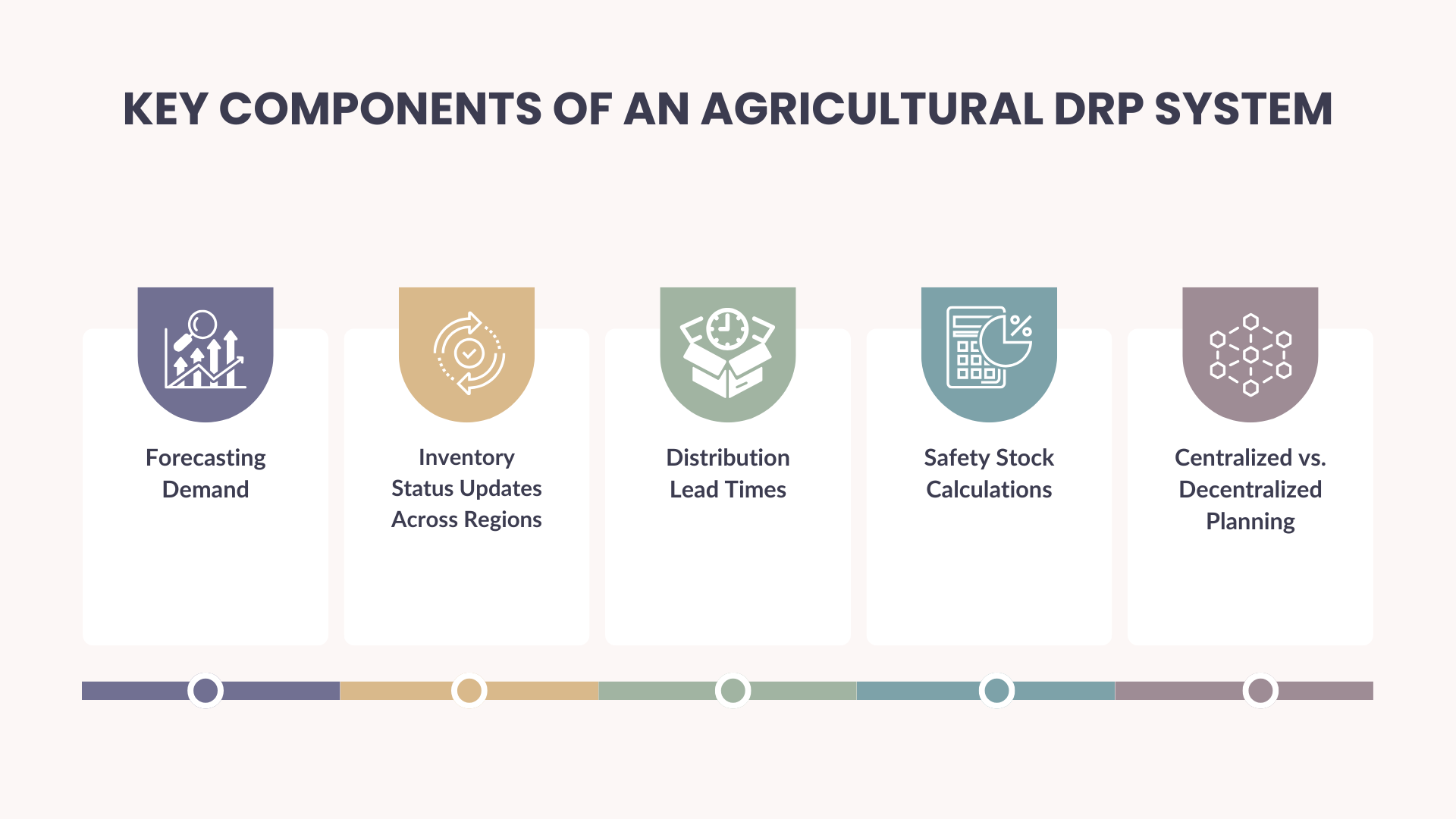 An effective agricultural DRP system is made up of several important components, such as the following:
● Forecasting Demand:
Accurate demand forecasting for produce, livestock feed, or chemicals is the first important step. It involves analyzing past data, market trends, and seasonal patterns to forecast the future demand.
● Inventory Status Updates Across Regions:
Real-time updates about your inventory levels at different regions help you in making informed and timely decisions. Hence, having complete visibility also makes sure that stock levels are maintained at the optimal levels and there are no shortages or overstocking.
● Distribution Lead Times:
It is also important to know the time it takes for products to move through the entire supply chain. DRP considers these lead times to schedule shipments efficiently so that deliveries are made in a timely manner.
● Safety Stock Calculations:
Uncertainty is always there, and that is something that cannot be predicted. This also causes disruptions in demand or supply; this is why it is important to have a buffer stock. DRP helps in calculating the appropriate safety stock levels to mitigate these risks.
● Centralized vs. Decentralized Planning:
Deciding between centralized and decentralized planning approaches depends on the unique needs of your agricultural operation. Centralized planning gives you uniformity, while decentralized planning provides flexibility and lets you manage regional demands.
Benefits of Distribution Requirement Planning in the Agriculture Sector
There are multiple advantages of implementing DRP in agriculture. Here are a few:
● Improved Delivery Accuracy and Reduced Shortages:
The chances of shortages are reduced because DRP guarantees that products are delivered accurately and on time.
● Optimized Transportation and Warehousing Costs:
Efficient planning helps you gain massive cost savings in logistics, as transportation and warehousing resources are utilized effectively and efficiently.
● Enhanced Farmer Satisfaction and Dealer Alignment:
Timely deliveries that match your farming schedules build trust and satisfaction between you and your dealers.
● Reduction in Waste for Perishable Goods:
Proper planning minimizes the spoilage of perishable goods. This contributes to sustainability and also boosts your bottom line.
● Real-time Visibility and Decision-making:
Stakeholders can make informed decisions due to the availability of up-to-date information. This makes your entire supply chain agile and responsive.
Common Challenges in Agricultural DRP Implementation
Although DRP comes with significant benefits, its implementation in agriculture comes with many challenges as well:
● Inaccurate Demand Forecasts Due to Weather/Pests:
Unpredictable weather conditions and pest infestations can throw the demand forecasts off balance and distort them. This, in turn, affects the accuracy of planning.
● Limited Data Availability from Remote Farms:
Remote farms might not have the appropriate infrastructure required to provide real-time data, hence hindering effective planning.
● Poor System Integration Between ERP and Field Tools:
Integrating DRP with your current ERP systems and field tools can be complex and can lead to inefficiencies.
● Training Gaps in Rural Areas:
Rural areas might face challenges in training personnel to use DRP systems effectively, thus affecting their adoption and usage.
How to Get Started with DRP in Agriculture
Starting your DRP journey involves several steps:
1. Assessment:
Evaluate your current supply chain processes to identify gaps and areas of improvement.
2. Choosing the Right DRP-Enabled ERP Solution:
You must select a system that meets the unique needs of your agricultural operations.
3. Pilot Projects:
Initially, implement DRP in a limited scope to test its effectiveness before a full-scale rollout.
4. Training:
You must invest in training programs so that all stakeholders can effectively use the DRP system, and it gives you value.
5. Continuous Monitoring:
Regularly review and adjust the DRP processes to adapt to changing conditions.
Conclusion
Distribution requirement planning is much more than just being a logistical tool. It is a long-term asset for modern-day agriculture.
By making sure that the right products reach the right places at the right times, DRP helps you achieve high efficiency and sustainability in your agricultural operations.
Moreover, as the agricultural sector continues to evolve and paces into the future, it is important to adopt DRP to meet the growing demands of the global population.
If you want to refine and optimize your agricultural supply chain planning, then you must also explore solutions like AgriERP that provide a solid, scalable, and budget-friendly option to you.
By integrating DRP functionalities, AgriERP can help maximize your operations, reduce waste, and improve overall efficiency. Adopting such solutions is the first step towards achieving a sustainable and productive agricultural future for your agricultural business.