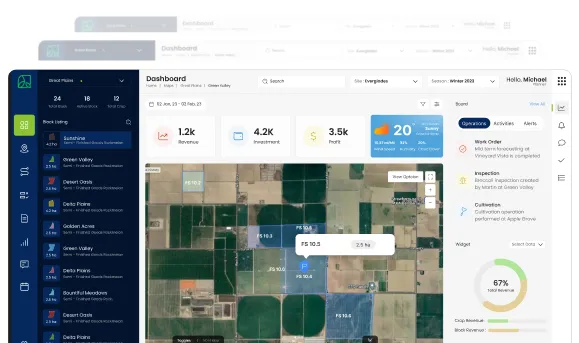
Data Analytics Solution of the Year” 2026 in Agtech Breakthrough Awards 2026


If you contract with third-party growers to supply your business, the Grower Portal is where your relationship with each of them lives. It is the door they walk through to register, sign contracts, see their commitments, track deliveries, and view their settlements. It is also the door you walk through to manage them, all in one place, without phone calls, paper contracts, or scattered emails.
The Grower Portal is built on an enterprise-grade external portal platform, the same kind of foundation used to run supplier portals at large corporations and government agencies. AgriERP layers grower-specific functionality on top of that foundation, the things farms actually need: grower registration, crop contracts, harvest commitments, settlement processing, and payment reports.
What this section covers
The Grower Portal is built around two primary capabilities, the moments where most contracted-grower programs go wrong:
- Grower onboarding: registering new growers, capturing their information, getting them approved and active.
- Contracts: creating, sharing, and managing grower agreements, with full visibility on both sides.
Both run on an enterprise external portal platform underneath, with grower-specific behavior layered on top. The result is a portal that looks and feels like it was built for agriculture, on a foundation that was built for global enterprises.
The enterprise foundation
Before going into the grower-specific functionality, it helps to understand the platform the Grower Portal sits on. This is the part of the portal you do not have to build, configure, or maintain, because the underlying platform already does.
Enterprise-grade external portal capabilities
AgriERP’s Grower Portal is built on an enterprise platform designed for external-facing business websites, the same kind used to build supplier portals, partner portals, and customer self-service sites at large companies.
| Capability | What is provided out of the box |
|---|---|
| Enterprise-grade and secure | Hosted on enterprise cloud infrastructure, with built-in DDoS protection, modern TLS encryption, and compliance with ISO, SOC, and PCI DSS standards. |
| Single source of grower data | Grower data flows directly into the same data foundation used by the rest of AgriERP. No data duplication. No syncing problems. The grower record in the portal is the grower record in your ERP. |
| Role-based access | Each grower sees only their own contracts, commitments, deliveries, and settlements. The portal enforces this through the platform’s built-in security model, not through custom code. |
| Multiple sign-in options | Growers can sign in with their Google, LinkedIn, or business account, or with a local account you provision. Enterprise identity is the recommended option. |
| Globally available | The platform is built to scale. Whether you have 50 growers or 50,000, the portal performs the same. Infrastructure, scaling, and uptime are handled centrally. |
| Mobile-ready | Every Grower Portal site works across browsers and devices. Growers can use their phone, their tablet, or a desktop computer, with the same experience. |
Vendor collaboration workflow
Sitting alongside the portal is AgriERP’s vendor collaboration capability. This is the engine that runs the actual back-and-forth between you and an external supplier, registration, purchase orders, agreements, invoices, and quotation responses. The same workflow, with grower-shaped data, is what powers the Grower Portal.
| Capability | What is provided out of the box |
|---|---|
| Grower registration wizard | A standard onboarding flow. The prospective grower signs in, completes a guided wizard, and provides addresses, business information, procurement categories, and questionnaire responses. |
| Approval workflow | When the registration is submitted, a request is created and routed through an approval workflow. Procurement reviews, approves, or rejects. The workflow engine handles the routing and notifications. |
| Automatic grower master creation | Once approved, a grower record is automatically created in your ERP, and the contact’s user account is granted access to the Grower Portal. No manual data entry. |
| Enterprise B2B authentication | User provisioning runs through an enterprise identity service. Growers get secure, single sign-on access without you having to manage passwords. |
| Purchase order and agreement collaboration | Growers can review, accept, and respond to purchase orders and agreements directly in the portal. The status flows back into your ERP automatically. |
| RFQ and bidding workspace | If you put grower commitments out for bid, the standard workspace lets growers view the request and submit responses, with all bid data captured cleanly. |
| Invoice workspace | Growers can submit and track invoices directly. The system matches invoices to purchase orders automatically, the standard three-way match procurement professionals already know. |
Why this matters to you: These capabilities are not custom-built. They are mature, enterprise-grade features with documented security, compliance, and scaling. By building the Grower Portal on top of them, AgriERP inherits all of that automatically.Your IT team does not have to vouch for a custom-built portal. Your auditors recognize the underlying platform. Your security team gets enterprise-level protection. The AgriERP team focuses on the agriculture-specific layer on top.
1. Grower Onboarding
In one line Bring new growers into your business through a guided, online registration that captures everything you need, routes through approval, and sets them up to operate, all without paperwork.
Why grower onboarding is hard without a portal
Most agribusinesses still onboard growers the same way they did twenty years ago. Someone in procurement emails or hands over a paper form. The grower fills it out, returns it (sometimes), then waits. Documents go missing. Bank details get re-typed. Compliance certificates are scanned and lost. New growers wait weeks before they can start delivering, while procurement chases them for missing information.
The Grower Portal turns that into a self-service flow. Growers register themselves online. The system makes sure nothing is missing. Approval is routed automatically. Once approved, growers are immediately set up in the ERP, with logins, with contracts visible, ready to operate.
How the onboarding flow works
The onboarding flow has five stages, each running on the enterprise foundation.
- Stage 1, prospective grower registers: the prospective grower goes to the portal, signs up using a Google, LinkedIn, business, or local account, and starts the registration wizard.
- Stage 2, the grower completes the wizard: the registration wizard captures contact details, business information, addresses, procurement categories (for example, the crops they grow), and questionnaire responses. The wizard supports document attachments, so certifications and licenses can be uploaded as part of the same form.
- Stage 3, registration request is submitted: the wizard creates a request in your ERP. It can go straight into the approval workflow, or be held as a draft for a procurement team member to review first.
- Stage 4, approval workflow runs: the workflow engine routes the request to the right approvers (procurement, finance, compliance), with built-in tasks for review, approval, or return for changes.
- Stage 5, grower goes live: when approved, a grower master record is created automatically in the ERP. The grower’s user account is granted access to the portal. A welcome email is generated. The grower can sign in and operate.
Where AgriERP shapes onboarding for agriculture
The platform handles registration, workflow, and provisioning. AgriERP layers the grower-specific information on top of it, the things a generic vendor onboarding does not capture.
| AgriERP extension | Grower-specific information captured during onboarding |
|---|---|
| Farm and block information | Capture each grower’s farms, blocks, sub-blocks, total area, soil types, and water access. This becomes the basis for crop contracts and yield expectations. |
| Crop and variety profile | Record what each grower grows, their varieties, planting windows, and historical yields. Used to match growers to your demand. |
| Certifications and compliance | Capture organic certifications, GAP / GlobalG.A.P., food safety records, water permits, and other agriculture-specific documents. Set expiry dates so renewals are tracked. |
| Bank and settlement preferences | Capture banking details and preferred settlement methods, with the same security standards applied to other sensitive vendor data. |
| Equipment and capability profile | Record what equipment the grower has, what services they can offer, and any constraints (cold storage capacity, transport, packing facilities). |
| Field officer and territory assignment | Tag each grower to a field officer, a region, or a buying program, so the right team owns the relationship from day one. |
What this changes day to day
- For procurement and grower relations: weeks of paperwork become days of structured registration. Missing information is caught at the wizard stage, not at the contract stage.
- For compliance and finance: every grower has a complete, auditable record from the start, with documented certifications, banking, and approvals.
- For new growers: joining your program goes from chasing emails to filling out one online form, on their phone or laptop, in their own time.
2. Contracts
In one line Move from paper grower contracts to live, online agreements that both sides can see, accept, track against, and settle from, all in one place.
Why contracts are where most grower programs leak money
Grower contracts are the rails on which the supply program runs, but in most agribusinesses they exist as PDFs in someone’s folder, scanned signatures, and a separate spreadsheet that records who agreed to deliver what. When deliveries arrive, no one is sure of the price agreed. When settlements run, no one is sure of the terms. Disputes follow.
The Grower Portal turns the contract into a structured, live record that both sides see and act on. The grower agrees online. The system tracks performance against it. Settlements draw their values from it. Nothing is reconstructed at the end of the season.
How contracts work in the portal
Contracts are built on top of an enterprise purchase agreement and procurement workflow capability, the same kind large enterprises use for vendor agreements. AgriERP shapes them to look like a grower contract: crops, varieties, volumes, prices, delivery windows, and quality specifications, instead of generic line items.
Stage 1, contract creation
A procurement team member creates a contract in the ERP. The purchase agreement workflow handles drafting, version control, approval routing, and audit logging. AgriERP fills in the agriculture-specific fields: crop, variety, expected volume, price formula, delivery window, quality standards, certification requirements, and packaging.
Stage 2, sharing with the grower
Once approved internally, the contract is published to the grower’s portal account. The grower receives an email notification through standard workflow communication. They sign in to the portal and see the contract in plain language, with all terms visible.
Stage 3, grower review and acceptance
The grower reviews the contract in the portal. They can ask questions, request changes, or accept. When they accept, the acceptance is captured, time-stamped, and logged through the audit framework. The contract becomes active. No paper, no scanning, no chasing for signatures.
Stage 4, contract execution and tracking
As deliveries happen, the system tracks them against the active contract automatically. The grower sees their deliveries against the commitment, in real time, on the portal. Procurement sees the same view. When settlements run, the contract terms drive the calculation.
What the grower sees
From the grower’s side, the portal becomes their dashboard for the relationship. The same security model that protects vendor data in any enterprise portal makes sure they only ever see their own information.
| Portal area | What the grower can see and do |
|---|---|
| My contracts | Every active and historical contract, with terms, status, and performance against it. |
| My commitments | What the grower has agreed to deliver: crop, variety, volume, delivery window, quality. |
| My deliveries | Every delivery made, accepted, rejected, or pending, with quality results and quantities. |
| My settlements and payments | Settlement statements, payment status, and historical payment reports. |
| My documents | Contracts, certificates, compliance records, all digital, all accessible. |
| My profile | Farm, crops, contacts, banking. Updates flow back into the ERP through the same data foundation the office team uses. |
What the agribusiness sees
On your side, contracts give the team a single, structured view of every commitment from every grower, in every program, across every season.
| Internal view | What procurement and grower relations see |
|---|---|
| Active contract list | Every active grower contract, with crop, volume, price, status, and performance metrics. |
| Contract performance | Volume committed vs. delivered, quality results, on-time delivery rates, by grower and across the program. |
| Renewal and expiry tracking | Contracts approaching expiry, surfaced automatically. Renewal workflows triggered when needed. |
| Approval and audit trails | Every contract change, approval, and acceptance, time-stamped and logged through the audit framework. |
| Settlement readiness | All the data needed to run a settlement, contract terms, deliveries, quality, prices, in one place. |
Where AgriERP shapes contracts for agriculture
The purchase agreement framework handles the structure, approvals, and lifecycle. AgriERP shapes the content for agriculture, the things only farm contracts have.
- Crop and variety as first-class terms: contracts are written against specific crops and varieties, not generic SKUs.
- Volume bands and tolerances: agriculture rarely commits to an exact tonnage. Contracts support volume ranges, minimums, maximums, and over/under tolerances.
- Quality specifications: size, grade, sugar content, moisture, defect tolerances, and other agriculture-specific quality terms, written into the contract.
- Pricing formulas: fixed price, market-linked, sliding scale, premium / discount by quality grade. The formula is captured once, applied automatically at settlement.
- Delivery windows: harvest windows, delivery dates, packout schedules, all written into the contract and tracked against.
- Settlement terms: advance payments, deductions for inputs supplied, packaging charges, transport allowances, all defined upfront and applied at settlement.
What this changes day to day
- For procurement: every contract is structured, searchable, and live. No more reconstructing terms from PDFs at settlement time.
- For finance: settlements run from contract data automatically. Disputes drop because both sides agreed to the same numbers, in the same system, at the same time.
- For growers: they always know what they signed up to deliver, what they have delivered, and what they will be paid. No surprises at settlement.
- For leadership: the entire grower program becomes a structured, reportable, manageable part of the business, not a folder of PDFs.
3. Onboarding and contracts, working as one
Onboarding and contracts are not separate workflows the team has to chase. The Grower Portal connects them, so a registered grower flows naturally into a contracted grower, and from there into a delivering, settling, and paid grower, all on the same platform.
- Registration creates the master record: completed onboarding produces a grower record in the ERP, ready to receive contracts.
- Contracts attach to the master: every contract links back to the grower record, the farm and block data, and the certifications captured at onboarding.
- Compliance is enforced automatically: if a grower’s certification expires, the system flags affected contracts. If a contract requires GlobalG.A.P., the system checks the grower has it.
- Performance feeds the next round: as growers deliver against contracts, their performance becomes part of their record. Next season’s contract decisions use real, structured data.
In summary
The Grower Portal is where contracted-grower programs go from a paper-driven, error-prone, dispute-heavy process to a structured, live, transparent one. The enterprise platform underneath gives the system enterprise-grade security, scale, and compliance. AgriERP shapes that platform around the realities of agriculture: farms, blocks, crops, varieties, certifications, harvest windows, and grower settlements.
The next section moves from external-facing portals to the analytics layer, where the data flowing in from the Farm Web App, Mobile App, Grower Portal, and ERP becomes the dashboards and reports that drive decisions.