The ERP Solution for the Year” 2025 in Agtech Breakthrough Awards 2025
Every site you add makes the group harder to see. AgriERP lets each site run its own operation while leadership sees costs, yield, and performance across every entity, live.


More sites should mean more scale, not less clarity. But every new entity adds another set of books, another reporting format, and another wait before anyone sees the whole.
Each entity runs its own accounting file in a separate system. Consolidating the group means exporting, mapping, and reconciling manually, every month, and the number is stale by the time you have it.
Shared equipment, leases, and cross-site purchases all need reconciling between entities by hand. Every close waits on it.
When each site tracks costs and yield differently, comparing performance across the group is a manual exercise. You cannot tell which site is outperforming, which is struggling, or why.
Sites buy independently, so the group never sees its total volume and never gets the pricing that volume should earn.
By the time consolidated financials arrive, the decisions they should inform have already been made. Planting choices, input commitments, and capital allocation all happen faster than the reporting cycle.
Each site runs its own operation with its own workflows, field records, and inventory. The group sees everything in one live ledger without waiting for anyone to export or reconcile.
Every entity runs its own chart of accounts, workflows, and records. The group ledger consolidates automatically, so nobody at head office chases numbers.
Shared equipment charges, loans, and cross-site transfers post and match across entities automatically, so the close stops waiting on manual reconciliation.
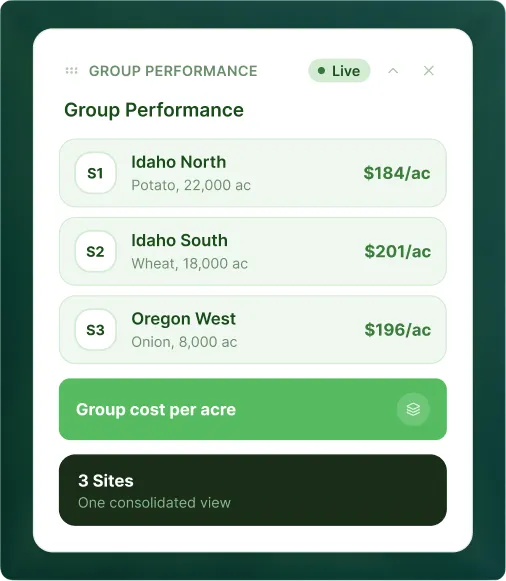
Cost per acre, yield per block, and input spend roll up the same way from every site, so a group comparison is a report you run, not a project you plan.
Six capabilities that let you add sites without adding manual work.
Each entity maintains its own books, its own chart of accounts, and its own reporting. The group consolidation happens automatically, so you close faster and see the full picture without waiting on a round of spreadsheet work.
Shared equipment usage, intercompany loans, cross-site input transfers, and lease charges post and reconcile across entities automatically. Month-end close is no longer held up by teams chasing intercompany balances.
Cost per acre, yield per block, and input spend per crop roll up consistently across every site because each site captures the same data in the same structure. Comparing performance across the group is a report you run, not a project you undertake.
When sites buy independently, the group never sees its total purchasing volume. Consolidate purchasing across entities to surface the leverage that comes with scale, negotiate better supplier terms, and eliminate duplicate orders across sites.
Know what you have, where it is, and what it is worth across every warehouse, cold store, and packing shed in the group. Move stock between sites, reallocate to fill an order, and manage storage capacity without phone calls between site managers.
A site manager should see their site. A regional manager should see their region. The CFO should see everything. Role-based permissions mean each person sees the data they need without accessing what they should not, across every entity in the group.
Book a demo and we will show you how AgriERP consolidates multiple sites, entities, and crops into one live picture without taking operational control away from the people running each site.
You are not running one farm any more. You are running a business that operates across multiple farms, and the tools that worked at site one are not scaling with you.
Farm groups that have expanded to two or more entities typically hit the same wall: separate accounting files that cannot consolidate, no visibility across sites, and a finance team spending more time reconciling than reporting. AgriERP replaces the patchwork with a single system each entity runs inside, and that the group sees across.
Institutional farm operators and corporate agribusinesses need central governance without slowing down site-level operations. AgriERP enforces consistent data standards and approval workflows across every entity while giving site managers the tools to run their own operation without waiting on head office for every decision.
Operations running different crops, processing facilities, or packing sheds across sites need a system that can handle the variation without losing the ability to compare across it. AgriERP tracks cost and yield by crop, variety, field, and site, so you can benchmark a potato operation in Idaho against a wheat program in Oregon from the same screen.

Rombola Family Farms moved to AgriERP on Microsoft Dynamics 365, digitizing processes that had previously been manual and fragmented. The result was data visibility across the operation that supported informed decisions at every stage, from input planning through harvest, rather than decisions made on instinct and end-of-season reports.


Yes. Each entity maintains its own chart of accounts and operates its own books within the system. Group consolidation maps entity-level accounts into the group reporting structure automatically, so entities can have the flexibility they need operationally without blocking consolidated reporting at group level.
Intercompany transactions, including shared equipment charges, cross-site input transfers, intercompany loans, and lease charges, post and reconcile across entities automatically. Intercompany eliminations are handled at consolidation so they do not appear in group financials. This removes the manual matching that typically holds up month-end close in multi-entity operations.

Yes. Because every site captures cost, yield, and input data in the same structure, benchmarking across sites is a report rather than a manual exercise. Cost per acre, yield per block, and input spend per crop roll up consistently so you can identify which sites are outperforming and where the gaps are.
Folio3 provides structured migration support for operations moving from standalone accounting systems and legacy farm management tools. Transaction histories, asset registers, intercompany balances, and chart of accounts structures are extracted, mapped, and migrated with reconciliation validation before go-live. Most multi-site operations phase the rollout, bringing entities online sequentially rather than all at once.


Yes. Role-based access controls mean a site manager sees their site, a regional manager sees their region, and the CFO sees the consolidated group. Permissions are set at entity, region, and group level and enforced consistently across every part of the system.

Yes. Operations across multiple countries can run entities in local currencies with automatic currency translation at consolidation. Group financials are produced in the reporting currency of your choice.


It depends on the number of entities, the complexity of existing data, and how many modules you start with. Most multi-site rollouts phase by entity, bringing the first site live in a matter of months and adding subsequent entities across the following seasons so operations are not disrupted during active periods.