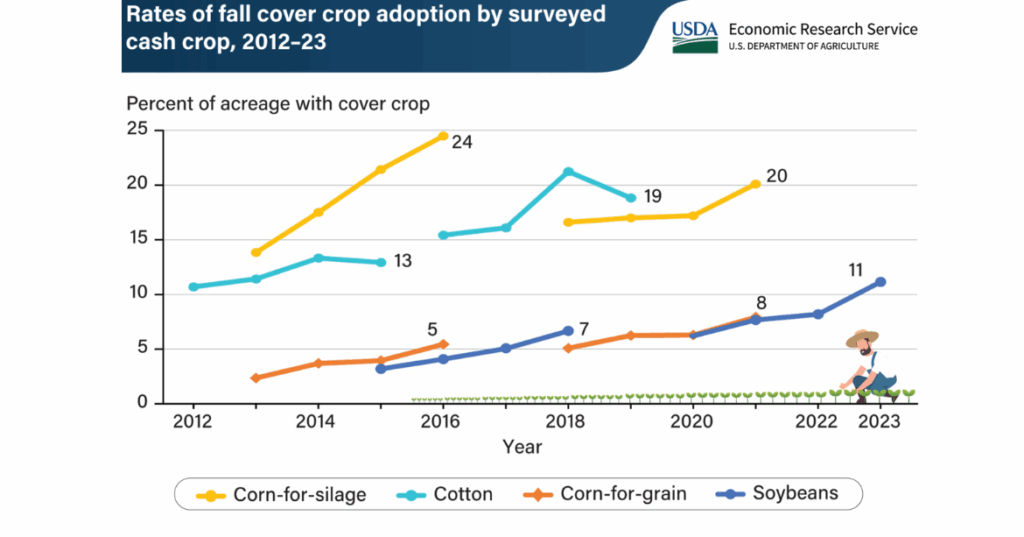
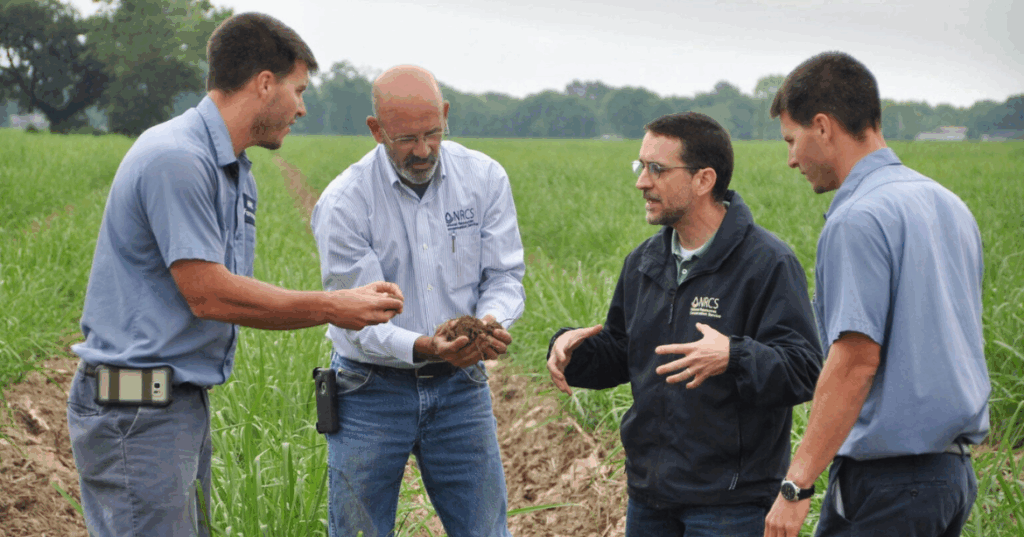
Soybeans pushing through a thick mat of cover crop residue in Nebraska may look simple, but what’s happening beneath the surface tells a bigger story.
Across the United States, soil health has become a critical issue. Decades of intensive farming practices have left much of our cropland degraded, and farmers are beginning to realize that restoring soil requires not just new techniques but a shift in mindset.
The Roots of the Problem
The term “regenerative agriculture” has gained traction because it acknowledges what many farmers see daily: soil that has lost much of its natural function.
By definition, a degenerated soil is one that has lost the structure and stability it once had. Instead of porous, well-aggregated soil teeming with life, many fields today have compacted layers, surface crusting, and poor infiltration.
A quick test can prove the point. Take a shovel into any annually cropped field that hasn’t been managed with soil health in mind, and you’re likely to see lifeless, cloddy dirt instead of a vibrant system.
The causes are well documented: frequent tillage, heavy fertilizer use, monocropping, and bare fields left exposed between seasons. These practices erode soil structure and strip away carbon, which serves as the “biological glue” holding aggregates together. In North Dakota and other regions, studies show soils have lost 30 to 50 percent of their original carbon since being put under cultivation.
Thinking Differently About Farming
The solution doesn’t lie in one practice but in a different way of thinking about soil itself. Instead of viewing soil as a passive medium that simply holds plants in place, regenerative agriculture sees it as a living system.
To restore soil function, farmers must reverse the very habits that degraded it—reducing tillage, minimizing fertilizer dependence, increasing crop diversity, and keeping the ground covered with living plants or residue.
Results won’t happen overnight, but farmers who commit to these changes often see improvements within just a few years.
This shift requires faith. Many farmers haven’t seen a truly healthy soil in decades, if ever. Witnessing restored soils firsthand often sparks the realization that recovery is possible. The first step is admitting that soils are degraded and believing they can be brought back.
Nature’s Blueprint for Profitability
Ecologists have long noted that natural systems evolve toward efficiency and balance. Eugene Odum, in his influential work The Strategy of Ecosystem Development, argued that ecosystems maximize both biomass and symbiotic relationships per unit of energy.
For farmers, that translates to a simple truth: the healthier the soil biology, the greater the long-term profitability.
The USDA’s Natural Resources Conservation Service emphasizes four guiding principles for soil health management:
Disturb the soil less
Increase plant diversity
Maintain living roots as much as possible
Keep the soil covered year-round
These principles create favorable conditions for soil organisms, which in turn improve water infiltration, nutrient cycling, and plant health.
Rethinking Fertility and Inputs
One of the biggest mental hurdles comes with nutrient management. For decades, fertilizer recommendations have been based on chemical soil tests designed for degraded, biologically inactive soils. But once soil biology begins functioning again, these tests often lose accuracy.
As microbial communities return, they handle nutrient cycling far more efficiently than fertilizers can. At that point, adding more fertilizer may do more harm than good, interfering with natural plant-microbe exchanges.
Instead of feeding plants directly with chemicals, regenerative systems feed the soil, allowing plants to access nutrients through biological partnerships. Farmers adopting this approach often report healthier crops, reduced pest pressure, and lower input costs.
Soil Testing for a Living System
If soil is managed as a biological system, then it must also be measured biologically. Traditional soil tests may not capture nutrient availability in soils teeming with life. Newer tests, which account for microbial activity and plant-microbe interactions, provide a more accurate picture of fertility.
Plants thrive when they acquire nutrients through these complex biological pathways rather than through simple chemical ions. The presence of diverse living roots, in particular, fuels microbial communities that maintain this balance.
Resilient, Profitable Farming
As soil life returns, fields begin behaving differently:
Aggregates form and stabilize, improving infiltration and root growth.
Residues decompose more quickly, recycling nutrients.
Crops grow more efficiently, needing fewer outside inputs.
Plants become more resilient to pests and disease.
All of this translates into a farming system that is not only more sustainable but also more profitable. Fewer inputs mean lower costs, while healthier soils support higher and more reliable yields.
A Paradigm Shift for the Future
Restoring soil health isn’t just about adopting new practices, it’s about embracing a new paradigm. Farmers must recognize that soil was designed to function as a biological system. That means questioning long-standing habits, rethinking fertility management, and trusting nature’s processes.
As Jon Stika, retired NRCS soil health instructor and author of A Soil Owner’s Manual, puts it:
“All this requires is having an open mind to learn how the soil was designed to function as a biological system and managing it accordingly. This may require questioning things we have done in agriculture for generations, but questioning and changing the way we manage the soil must happen if we are to continue farming into the next generation.”
The choice is clear: continue with practices that degrade soil and profitability, or adopt a mindset that allows soils to regenerate, setting the stage for resilient farming systems that can sustain future generations.
AgriERP is a comprehensive farm management solution designed to empower farmers with streamlined operations and increased profitability. Powered by Microsoft Dynamics 365, AgriERP offers a single, straightforward platform that addresses the pain points of various farm types. With its user-friendly interface and intelligent automation, AgriERP is like having a trusted partner by your side throughout your farming journey.
For more information about AgriERP and its innovative farm management solutions.
Recognized as the top data analytics platform in agriculture at the 2026 AgTech Breakthrough Awards. Trusted by farm owners, processors, and exporters to turn operational data into better decisions.
 Data Analytics Solution of the Year” 2026 in Agtech Breakthrough Awards 2026


 AgriERP Expert
  September 24, 2025