Late summer will write the ending for this year’s soybean disease narrative. What happens between now and early September, especially rainfall frequency, humidity, and nighttime temperatures, will determine whether scattered lesions remain cosmetic or turn into yield-stealing outbreaks across the Midwest.
What we’re seeing right now
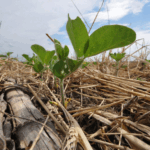
During a late-July pass through the Soybean Watch ’25 field in central Indiana, agronomist Steve Gauck found only light disease: a little downy mildew on scattered leaves and septoria brown spot limited to the shaded lower canopy.
On paper, yield potential looked strong. In practice, his recommendation came down to stage and economics: with prices soft, many growers will skip fungicides unless disease is present at economic levels. If August trends dry, much of the current pressure could stall. If warm rains and long dews linger, pressure can build fast.
Why white mold jumped early (and why stage matters)
The season’s headline so far is white mold (Sclerotinia stem rot) showing up early in parts of the western Corn Belt. Extension specialists flagged a high-risk setup in Nebraska on July 24, citing cool temps and repeated rainfall, especially across the eastern and central regions. Higher temperatures can slow the pathogen temporarily, but field history is critical: prior issues raise risk even when canopies look clean.
Timing is everything. Soybeans are most vulnerable from R1 to R3, and that’s the narrow fungicide window for white mold. Past R3, protection options diminish. If your crop is beyond R3, focus on scouting, harvest planning, and notes for 2026.
Other diseases on the radar
Even if fields look clean today, late-season observations help you prioritize management next year. Keep these in focus:
- Sudden death syndrome (SDS). Cool, wet early growth and moisture during flowering set the stage in many areas. Look for yellow interveinal necrosis with green midribs; leaflets drop while petioles remain.
- Red crown rot (RCR). It can mimic SDS or brown stem rot; symptoms often show around R4–R5. A reddish discoloration at the stem base can be a clue, but it isn’t always present.
- Pod and stem blight. Favored by a warm, wet finish. Watch for small black pycnidia on stems and pods as seeds mature.
- Septoria brown spot. Thrives with leaf wetness and moderate temps; typically stays in the lower canopy until late.
- Cercospora leaf blight / purple seed stain. High humidity and long dew periods push upper leaves toward a dark, leathery appearance and can stain seed coats purple.
- Frogeye leaf spot. Warm, humid spells drive small circular to angular lesions that can accelerate defoliation and ding seed quality.
Field notes by state
Wisconsin: quietly strong, eye on white mold
Flowering is wrapping up, pods are set, and seed fill is progressing with no major statewide disease event so far. Downy mildew is easy to find but usually remains minor.
The bigger question is whether persistent humidity tees up more serious foliar diseases, white mold in particular, as August wears on. Japanese beetle feeding and aphids have been mostly below thresholds. With continued timely moisture, top-end yield is still very much in play.
Missouri: heat, moisture, and SDS on the move
Heat indices pushed toward triple digits at times, but ample soil moisture kept visible stress patchy. Disease activity is more notable: white mold, rare for the state, has been reported in the northwest; SDS pressure is building in the northeast; frogeye leaf spot cases are rising in the southeast.
Add a burst of armyworm defoliation in the southwest, often triggered when nearby pasture or sod is mowed, and the message is clear: keep scouting. One caution from the field: pod/flower counts appear lighter than the canopy suggests, a possible hint of hidden stress.
Illinois: promising setup, then a late-August fade in spots
Early rains set the stage for a strong finish, but follow-up moisture and cooler temps didn’t land evenly. In some fields, the crop signaled “I’m done” just after mid-August, with plants pushing toward early maturity.
Disease isn’t the main statewide driver, but SDS is shaving bushels locally, red crown rot is reappearing and may expand its footprint, and white mold is pressuring northern areas. Earliest-planted fields could point to mid-September combines if the dry push continues.
Nebraska: rain makes grain, until drainage bites
Frequent, sometimes heavy rains across the eastern third, home to most of the state’s soybean acres, have buoyed yield prospects above normal. The flip side: poorly drained sections are seeing elevated leaf disease and lodging risk on taller varieties.
If standability becomes a recurring issue, consider modest population reductions in 2026; many trials show top yields at <130,000 seeds/acre, which can trim height and lodging without sacrificing performance. With good drainage, yield outlooks remain excellent.
Late-August playbook: five actions before R6
Focus scouting where risk is real, timing is tight, and returns pencil out.
- Prioritize history fields. Revisit acres with prior white mold, SDS, or frogeye; canopy closure and dense rows amplify risk.
- Confirm the stage before treating. White mold fungicide value is highest R1–R3. For foliar diseases later, weigh residual value against stage and price.
- Scout after sticky nights. Multi-day dews and warm nights extend leaf wetness; increase pass frequency accordingly.
- Watch insect thresholds. Armyworms can strip green quickly but are controllable if caught early; align decisions with defoliation thresholds by stage.
- Document for 2026. GPS-flag SDS/RCR/lodging spots; those notes guide seed scores (SDS/SCN), row spacing tweaks, and population adjustments this winter.
Economics, timing, and the weather wildcard
With commodity prices under pressure, fungicide decisions must be tied to proven pressure at economic levels, label guidance, and growth stage, not fear of what might happen. Equally important is acknowledging the weather wildcard: if the rest of August trends dry, many pathogens will stall and the crop can coast into finish.
If warm rains persist and dews stretch past sunrise, expect elevated white mold in known hot spots, scattered frogeye and septoria elsewhere, and SDS intensifying where early-season wetness set the trap.
Bottom line
Many fields still hold strong yield cards as pods fill. The next two to three weeks will decide how many of those cards get played. Keep scouting, keep notes, and keep decisions grounded in stage + economics. 2025 isn’t locked in as the “year of soybean diseases,” but the atmosphere still has time to cast the final vote.
 Data Analytics Solution of the Year” 2026 in Agtech Breakthrough Awards 2026


 Tasbia Tahir Ali
  August 27, 2025