The ERP Solution for the Year” 2025 in Agtech Breakthrough Awards 2025

agrierp vertical farming

Vertical Farming Software That Shows the True Cost of Every Grow Cycle

AgriERP is vertical farming software for head growers, operations directors, and finance teams running indoor CEA farms. It connects crop recipes, propagation, fertigation, climate, labor, energy, harvest, pack-out, and orders in one system. It runs production across racks, towers, and grow rooms for leafy greens, herbs, microgreens, and vine crops.

Our Happy Customers

The Challenge

Running an Indoor Farm Without the Right ERP Costs You Every Cycle

Head growers, operations directors, and finance teams all work from the same root problem: grow data, energy, labor, and financials live in separate systems, so no one can see what a cycle actually cost until long after it ships.
Per-cycle cost is assembled by hand after every harvest

Grow-automation software captures climate and dosing, but nutrient, labor, and energy costs never attach to the crop cycle. By the time cost per tower exists in a spreadsheet, the next cycle is already seeded and the decision has passed.

Energy is one of your largest costs and it is not tied to output

Lighting and climate systems run continuously, yet kilowatt-hours are not allocated to rooms, cycles, or SKUs. You see the utility bill, not the cost per kilogram it produced or which rooms are carrying the load.

You cannot see which SKUs and customers actually make money

Cost per head, per clamshell, and per kilogram is not available by SKU, room, or customer once energy, labor, packaging, and shrink are loaded in. Unprofitable pack formats and accounts keep running because the loss only surfaces at quarter-end.

Lot traceability breaks across separate systems

Harvest, pack, and shipping records sit in different tools, so a retailer audit or a recall means rebuilding lot history by hand. Slow, incomplete records put buyer programs and food-safety certifications at risk.

How It Works

How AgriERP Vertical Farming Software Works

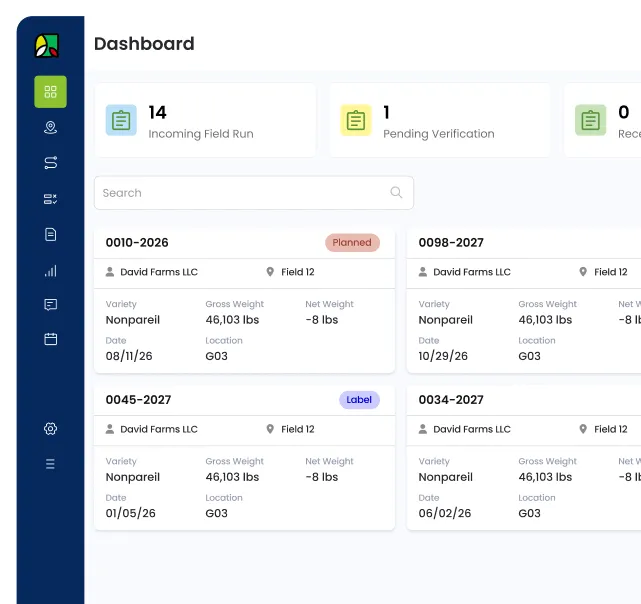
Every activity in the farm writes to the same batch and lot record. As you seed, dose, log labor, allocate energy, harvest, and pack, cost, compliance, and yield data accumulate against the crop cycle without re-entry. The result is per-cycle cost, lot-level traceability, and per-SKU margin drawn from one platform for controlled environment agriculture rather than three disconnected tools.

Plan and Propagate

Set crop recipes, schedule cycles, and allocate rooms and racks before seeding begins.

Grow

Record fertigation, climate, energy, and labor against each batch as the cycle runs.

Harvest and Pack

Capture yield by tower, grade, and pack out by SKU and format with lot codes.

Ship and Sell

Fulfil orders against customer contracts and pricing with retailer case labeling.

Cost and Analyze

Roll up cost per cycle and see margin by SKU, room, and customer.

Capabilities

What the Indoor Vertical Farming Module Covers

Crop Recipe Library

Store light, photoperiod, nutrient, temperature, humidity, and CO2 setpoints for each crop and cultivar. Every new cycle starts from a defined recipe rather than a grower's memory.

Cycle Scheduling

Plan seeding, transplant, and harvest dates across continuous turns per year. Rooms stay full and harvest windows line up with customer orders.

Room and Rack Allocation

Assign batches to specific rooms, tiers, and towers. Capacity and space utilization are visible before a cycle is committed.

Propagation Tracking

Record seeding, germination rates, and transplant counts by batch. Loss at propagation is caught early instead of discovered at harvest.

Demand-Driven Planning

Build the grow plan from confirmed orders and forecasts as indoor farm management software rather than fixed calendars. Production matches what customers have agreed to buy.

Input Procurement

Plan seed, substrate, and nutrient purchases against the cycle schedule. Inputs arrive on time without overstocking perishable supplies.

Fertigation and Dosing Records

Log nutrient batches, EC, and pH against each grow zone and cycle. Input cost per batch builds as you dose instead of being estimated later.

Climate and Environment Logs

Capture temperature, humidity, and CO2 readings tied to the batch record. Deviations are linked to the crops and cycles they affected.

Energy Allocation

Assign lighting and climate energy to rooms, cycles, and SKUs. The largest variable cost in the facility becomes a number per kilogram.

Crop Health and Scouting

Record scouting observations, pest pressure, and interventions by batch. Integrated pest management history stays attached to the crop it protected.
Labor to Batch

Track labor hours against each room and cycle as crews work. Labor per harvested unit is measured, not guessed.

Equipment and Maintenance

Schedule and log maintenance on lighting, pumps, and climate systems. Downtime and upkeep costs post to the rooms they support.

Harvest Capture by Batch

Record harvest weight and unit count against the exact batch, room, and tower. Yield per plant site and per square foot comes from source data.

Grading and Quality Checks

Log grade, defects, and quality holds at pack. Only product that meets specification moves to a customer order.

Pack-Out by SKU and Format

Convert harvest into clamshells, whole-head, living lettuce, and cut greens SKUs. Pack-out rate per cycle is tracked against the harvest it came from.


Lot Coding

Assign a lot code that carries harvest date, room, and inputs. Every pack can be traced back to its cycle in one step.

Case and Retail Labeling

Generate labels that meet retailer requirements including GS1-128 case coding. Product is ready for buyer intake without rework.

Shrink and Waste Recording

Capture trim loss and unsold product by batch. Shrink is measured where it happens instead of appearing only in the margin gap.

Customer Contracts and Pricing

Hold agreed pricing by customer, SKU, and pack format. Orders invoice against the terms that were negotiated.

Order and Dispatch Management

Coordinate sales orders, pick lists, and cold-chain dispatch from one dashboard. Perishable orders ship complete and on time.

Cold Chain and Logistics

Record pickup schedules and shipping documents including bills of lading. Fulfilment stays coordinated across routes and carriers.

Chargeback and Deduction Handling

Log retailer deductions, on-time-in-full penalties, and rejections against the order. Net revenue by customer reflects what was actually collected.

Invoicing and Receivables

Invoice directly from shipped orders with no re-entry. Cash owed by each account is current, not reconstructed at close.

Traceability and Recall Readiness

Trace any lot forward to customers and backward to inputs. A mock recall or audit is a report, not a fire drill.

Cost per Cycle Roll-Up

Combine inputs, labor, and energy into a total cost for each cycle. The cost of a harvest is known when it happens.

Margin by SKU

Compare net revenue against fully loaded cost for each pack format. Structurally unprofitable SKUs become visible while there is time to reprice.

Margin by Customer

See profitability by account after deductions and logistics. Accounts that lose money on every order are identified early.

Energy Cost per Kilogram

Report lighting and climate cost against output by room and crop. Energy efficiency is measured in dollars per unit, not just kilowatt-hours.

Yield and Pack-Out Analytics

Track yield per tower and pack-out rate across cycles and rooms. Underperforming rooms and recipes stand out against the rest.

Financial Reporting on Dynamics 365

Draw financial statements directly from farm activity on Microsoft Dynamics 365 Business Central. Operating numbers and accounting agree because they come from one ledger.

Use Cases

How Each Part of the Operation Uses AgriERP

Head Grower

  • Start every cycle from a defined crop recipe so light, nutrient, and climate setpoints are consistent from one turn to the next.
  • See yield per tower and per plant site as harvest is recorded, not as a spreadsheet rebuilt after each cycle.
  • Track fertigation batches, EC, and pH against each grow zone to keep dosing consistent and input cost attached to the crop.
  • Link climate deviations and pest scouting to the exact batches they affected so interventions are judged on outcomes.
  • Compare pack-out rate across rooms and recipes to find which setups convert the most harvest into saleable product.
  • Hand off harvest to pack with lot codes already in place so nothing is re-keyed at the point of grading.

Operations Director

  • Schedule harvest and pack crews against cycle cadence so labor lines up with what is ready to cut each day.
  • Allocate lighting and climate energy to rooms and cycles to see which rooms carry the highest energy load per kilogram.
  • Track labor hours by room and cycle so cost per harvested unit is measured against real output.
  • Watch room-level throughput while a cycle is still running, with time to adjust scheduling before a bottleneck forms.
  • Plan maintenance on lighting, pumps, and climate systems so downtime does not interrupt continuous production.
  • Coordinate cold-chain dispatch and pickup schedules so perishable orders leave the facility complete and on time.

Finance and Ownership

  • Produce cost per head, per clamshell, and per kilogram by SKU after energy, labor, packaging, and shrink are loaded in.
  • See margin by customer after retailer deductions and logistics so unprofitable accounts are identified early.
  • Reprice or retire pack formats that lose money on every unit before another quarter of production ships.
  • Draw financial statements directly from farm activity on Microsoft Dynamics 365 Business Central with no export step.
  • Reconcile retailer chargebacks and deductions against the orders they belong to for accurate net revenue.
  • Close the month faster because operating records and accounting draw from the same ledger.

Mobile App

A Mobile App for Crews in the Grow Rooms

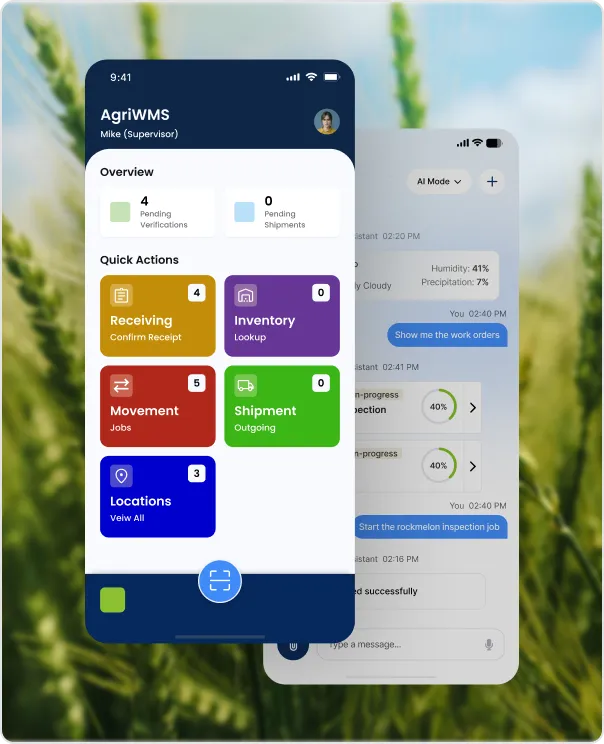
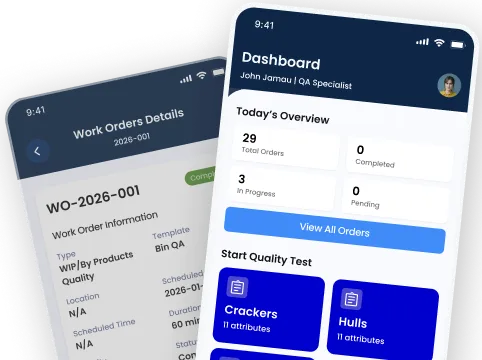
Crews seeding, transplanting, harvesting, and packing move constantly and are not always near a workstation or a reliable connection. The AgriERP mobile app captures their work offline and syncs automatically once a connection returns.

Offline capture, with automatic sync when connected

Every entry tied to the exact block

Available in English and Spanish for field crews

Entries post directly to financial and compliance records — no re-entry

Why Choose AgriERP

An Agriculture ERP Built for Indoor Farms, Not Adapted to One

AgriERP combines the depth of a purpose-built agriculture platform with a full ERP on Microsoft Dynamics 365 Business Central. Instead of forcing controlled environment workflows into a generic ERP or stitching a grow tool to a separate accounting package, indoor farms get crop recipes, cycles, energy, and margin modeled natively in one system.

Purpose-Built for Controlled Environment Agriculture

Crop recipes, continuous cycles, rooms, tiers, and towers are modeled natively. Indoor workflows are not bent to fit a generic ERP built for a factory floor.

Operations and Financials in One System

Grow, pack, and order activity post to the same ledger. Cost per cycle and margin per SKU come without exports or re-entry between systems.

Built on Microsoft Dynamics 365 Business Central

Enterprise-grade security, scalability, and reporting, with Microsoft Copilot analytics. AgriERP grows with the farm rather than a point tool that has to be replaced later.

One Platform for Growers, Operations, and Finance

The same batch and cost records serve every team. There is no reconciliation step between the grow floor, the pack line, and the books.

Discuss Indoor Vertical Farming Management for Your Operation

A specialist can review your crop mix, room and rack layout, energy and labor structure, compliance requirements, and existing systems before scoping an approach for head growers, operations directors, or finance and ownership.

By Crop

Configured for the Crops You Grow Indoors

Leafy Greens

Lettuce, arugula, spinach, and kale grown on continuous turns. Track yield per tower, pack-out by whole-head and cut-green SKUs, and lot codes for buyer audits.

Culinary Herbs

Basil, cilantro, and mint with tight quality windows. Manage crop recipes, harvest timing, and living-herb pack formats against customer orders.

Microgreens

Fast cycles measured in days rather than weeks. Schedule high-frequency turns, track substrate and seed cost, and keep rooms fully utilized.

Strawberries and Vine Crops

Higher-value indoor fruit and vine production. Track longer cycles, labor-intensive harvest, and margin per SKU across pack formats.

Related Modules

Modules That Support Indoor Vertical Farming

Financial Management

Packages

Standard and Enterprise Packages

A specialist can review your crop mix, room and rack layout, energy and labor structure, compliance requirements, and existing systems before scoping an approach for head growers, operations directors, or finance and ownership.

Recognition

Microsoft Dynamics 365

Delivered by Folio3, a Microsoft Solutions Partner. AgriERP is built on Microsoft Dynamics 365 Business Central.

AgTech Breakthrough Awards

Recognized as ERP Solution of the Year, 2025, in the AgTech Breakthrough Awards.

Founded 2019

Backed by a team of more than 200 Microsoft Certified Professionals.

Partners & Affiliations

Our Case Studies

Helping Our Customers Grow Better & Smarter

Potato Grower
AgriERP Standard

Grant 4D

We helped Grant4D to migrate from Quickbooks to the AgriERP standard package with D365 Business Central at the core to enhance ..

Multiple Crops
AgriERP Standard

Rombola Family Farms

We implemented AgriERP Enterprise package with Dynamics 365 ERP for Rombola which digitized their processes, automated repetitive tasks and boosted overall productivity

Frequently Asked Questions

Common Questions About AgriERP Orchard Management

Does AgriERP replace an existing accounting system, or run alongside it?

AgriERP includes full financial management on Microsoft Dynamics 365 Business Central, so it can serve as the accounting system of record rather than a tool that feeds one. Grow, pack, and shipping activity post to the same ledger, which removes the export and re-entry step between operations and accounting.

Grow-room automation and crop-monitoring tools record climate setpoints, dosing, and sensor readings, but they stop at operational data. AgriERP is vertical farming software that carries every seeding, fertigation batch, labor hour, energy allocation, and harvest weight to the general ledger, so cost per cycle and margin per SKU come from the same system that runs the grow.

Yes. AgriERP tracks each crop against its own recipe and cycle, and each SKU against its pack format, pricing, and customer terms. A farm running leafy greens, herbs, and microgreens for several retail and foodservice accounts manages them in one system.

Yes. AgriERP tracks production across stacked racks, towers, and grow rooms regardless of the growing method, including hydroponic vertical farm systems, aeroponic systems, and shipping container hydroponic farm builds. Batches, nutrient dosing, and harvest records attach to the specific room, tier, and cycle.

Every batch carries a lot code from seeding through harvest, pack, and shipping, so harvest date, room, inputs, and destination stay linked to one record. That supports FDA FSMA Produce Safety Rule and Food Traceability requirements for leafy greens, retailer case labeling such as GS1-128, and buyer audit standards including GlobalG.A.P., SQF, and other GFSI schemes, without reassembling lot history by hand.

Yes. Lighting and climate energy can be allocated to rooms, cycles, and SKUs alongside labor and inputs, so the utility bill becomes a cost per kilogram and a cost per pack rather than a single line item you see after the fact.

Timelines depend on the number of rooms, crops, and integrations. A single-site Standard deployment moves faster than a multi-site Enterprise rollout with automation and accounting integrations. A specialist can scope a timeline against your rooms, crop mix, and existing systems.