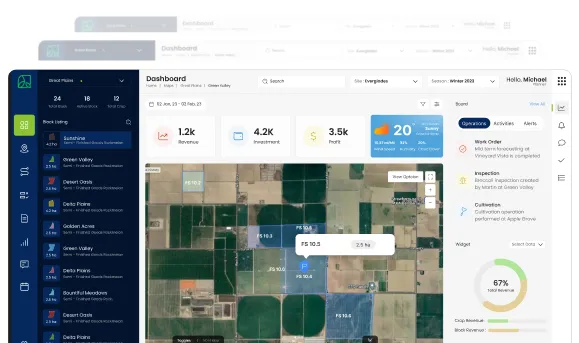
Data Analytics Solution of the Year” 2026 in Agtech Breakthrough Awards 2026


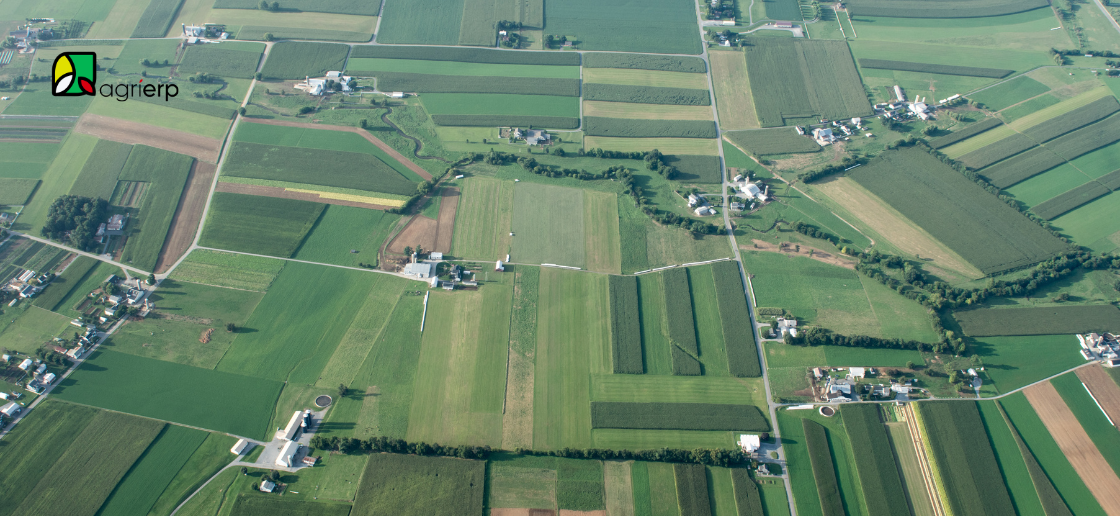
Land & Buildings is the module that turns the physical foundation of the agribusiness, the farms, the warehouses, the packing sheds, the cold stores, the offices, into structured records inside AgriERP. Without this module, every other capability has nowhere to land: work orders cannot be tied to a place, inventory cannot be stored anywhere specific, cost cannot be tracked by location, and audits have nothing to reference.
This module is the catalog and registry view of every physical thing the business owns or operates: the parcels of land, the buildings on them, the storage spaces inside those buildings, and the relationships between them. It is the first module most agribusinesses configure, and it is the one every other module depends on.
Where this fits
Land & Buildings sits at the foundation of AgriERP’s data model. Crop Management uses it to identify where crops grow. Inventory & Warehouse Management uses it to identify where stock lives. Equipment & Asset Management uses it to identify where assets are deployed. Financial Management uses it to roll cost up by physical location.
1. Farms
In one line Every farm in the business as a structured operating unit, with land, buildings, equipment, people, and financial picture all tied to it.
What the module captures for every farm
| Capability | What it means in practice |
|---|---|
| Identity | Name, code, registration numbers, GPS coordinates, total area, ownership entity. |
| Address and location | Physical address, mailing address, country, region, state or province, locality. Used for tax, compliance, and logistics. |
| Operating structure | Assigned farm manager, supervisors, workforce, equipment fleet. Hierarchy of farm > block > sub-block. |
| Ownership and legal entity | Which legal entity owns or operates the farm. Critical for multi-entity agribusinesses with separate companies for different farms. |
| Land and tenure documents | Land titles, lease agreements, water rights, easements, environmental permits. With expiry dates surfaced. |
| Certifications | Farm-level certifications (organic, GlobalG.A.P., farm assurance schemes) with body, certificate number, and renewal dates. |
| Financial dimensions | Each farm is a financial dimension. Cost and revenue are taggable to it automatically across the system. |
What this module enables
- Per-farm reporting: every report, dashboard, and analysis can be filtered or grouped by farm.
- Per-farm budgeting: budgets are set, tracked, and managed at the farm level, alongside other dimensions.
- Multi-farm management: operations that span dozens or hundreds of farms keep each one as a structured, comparable unit.
- Compliance roll-up: land, water, and certification documents live at the farm record and are audit-ready at a click.
- Legal entity reporting: where farms belong to different legal entities, financial consolidation handles them correctly.
2. Warehouses
In one lineEvery building used to receive, hold, process, or dispatch inventory as a structured warehouse, with capacity, structure, and operating rules.
What counts as a warehouse
In ERP terms, a warehouse is any physical location where inventory is held under control. For an agribusiness, that includes packing sheds, cold storage, dry stores, chemical stores, fuel depots, fertilizer stores, equipment yards, transfer hubs, and even temporary harvest staging areas. Each one is a warehouse in the system, with its own structure and rules.
Types of warehouses AgriERP supports
| Capability | What it means in practice |
|---|---|
| Packing facilities | Where harvested produce is graded, sorted, packed, and palletised. Linked to production orders and packing-line capacity. |
| Cold storage | Refrigerated and controlled-atmosphere storage. Temperature and condition profiles enforced. Capacity and turnover tracked. |
| Dry stores | Ambient storage for non-temperature-sensitive product: grains, dried produce, packaging materials, hardware. |
| Chemical and fertilizer stores | Restricted-access storage for agrochemicals and fertilizers. Hazard rules, certification requirements, and inventory audits applied. |
| Field stores and depots | Smaller distributed storage close to operating blocks: tool sheds, irrigation pump houses, field offices. |
| Transfer hubs | Intermediate locations where inventory is consolidated before final dispatch (regional consolidation points, port facilities). |
| Returnable-asset depots | Where bins, pallets, and crates are held when not in circulation. Linked to the returnable-asset tracking covered in Logistics. |
What the module captures for every warehouse
| Capability | What it means in practice |
|---|---|
| Identity | Name, code, type (packing, cold, dry, chemical, depot), parent farm or facility. |
| Capacity | Total volume, weight, pallet-position, or unit capacity. Capacity utilisation is tracked in real time. |
| Structure | Zones, aisles, bays, racks, bins. Multi-level structure to match how warehouses are actually organised on the ground. |
| Operating rules | Default storage conditions, picking strategies (FIFO, FEFO, batch-specific), reservation rules. |
| Permissions | Which workers, supervisors, and external parties have access. Especially important for chemical stores and bonded facilities. |
| Linked equipment | Forklifts, scanners, weighbridges, scales, temperature monitors. Each is an asset linked to the warehouse. |
| Documents and certifications | Food safety records, facility audits, refrigeration certifications, environmental permits. |
3. Storage units
In one lineThe smallest addressable physical locations inside a warehouse: zones, aisles, racks, bins, pallet positions, and chambers, each a distinct place inventory can live.
Why granular storage units matter
Knowing inventory is “in the warehouse” is not enough. To pick and pack efficiently, run FIFO correctly, manage temperature zones, audit physical counts, and trace any specific pallet back to where it sat, the system has to know inventory at a much finer grain. Storage units, sometimes called locations or bins, give every cubic metre of usable space inside a warehouse a unique identifier.
Storage hierarchy
| Capability | What it means in practice |
|---|---|
| Warehouse | The top of the hierarchy. The whole building or facility. |
| Zone | A named area within the warehouse. Could be a temperature zone (chilled vs ambient), a function zone (receiving, picking, dispatch), or a product zone (organic, conventional, export). |
| Aisle | A walkway or corridor inside a zone, with racks or bays running along it. |
| Rack or bay | A vertical structure holding multiple levels of stored product. |
| Bin or position | The smallest unit: a single pallet position, a single bin, a single chamber. Identifiable by code (“A14-3-2” = aisle A14, rack 3, level 2). |
| Special storage units | Bulk bays for grain or hay, tanks for liquids, chambers for controlled-atmosphere storage. Each is a storage unit with its own characteristics. |
What each storage unit captures
- Location code: the unique identifier used in scans, picks, and reports.
- Capacity: weight, volume, or unit limit. The system blocks overstocking automatically.
- Allowed product types: some bins only hold specific items (organic-only, chilled-only, hazardous-only). The system enforces this at putaway.
- Condition profile: for refrigerated and controlled-atmosphere bins, target temperature and humidity ranges, with alerts on excursions.
- Current contents: what is stored there right now, with full traceability codes and dates.
- Picking sequence: the order in which the bin should be visited during a pick walk. Used to optimise warehouse movements.
Bulk and special-case storage
Not every storage unit is a pallet position. Agriculture has many bulk and irregular storage cases, all of which are first-class in AgriERP:
- Bulk bins and silos: for grain, hay, or processed bulk product. Tracked by tonnage rather than by pallet, with level sensors where available.
- Tanks and vessels: for liquids: juice, wine, oils, chemicals. Tracked by volume, with the option to track temperature and other conditions.
- Open yards: for equipment, bins, or product stored outdoors. Less structured, but still identified and audited.
- Field storage: harvest staging areas in or near the block, used during harvest. Temporary storage units that come and go with the season.
4. How the three layers work together
Farms, warehouses, and storage units form a hierarchy that every other part of AgriERP references. The same query, “where is this pallet?”, can be answered at any level of granularity, from “on the property” to “in a specific bin”.
One example of the hierarchy at workA buyer audit team arrives and asks: “show me everything you have for our Q3 contract right now.”Farm level: the system shows total inventory across both farms in the contract program.Warehouse level: broken down by Cold Store 1 (the main packout), Dry Store 2 (long-life inventory), and the Northern Depot (consolidated for export).Storage unit level: drill down further to specific bins, with pallet counts, traceability codes, harvest dates, and current temperature for each refrigerated bin.Pallet level: click any pallet and trace it back to harvest block, harvest crew, packing date, packing crew, and full spray history.One question. Four levels of answer. Same data foundation. The audit team walks away with the inspection complete in 40 minutes instead of 4 hours.
In summary
Land & Buildings is the registry module of AgriERP: every farm, every warehouse, and every storage unit, as structured records with capacity, structure, certifications, and relationships. It is the layer every other module reads from and writes to.
For how this layer is used in day-to-day operations, see Business Processes > Crop Management (for farms and blocks) and the Inventory & Warehouse Management module document (for warehouse operations).