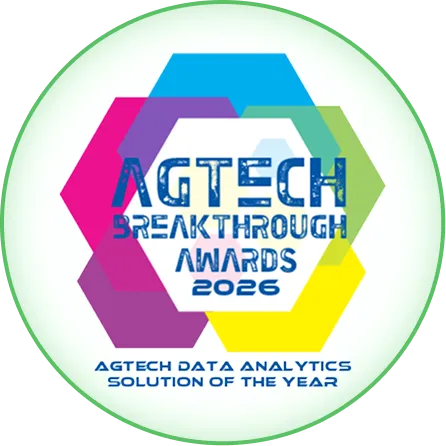
Data Analytics Solution of the Year” 2026 in Agtech Breakthrough Awards 2026


Inventory & Warehouse Management is the module that runs warehouses and bins. Inventory Lifecycle & Control is the module that runs the journey: how a kilogram of fertilizer becomes a cost on the books, how a basket of harvested fruit becomes work-in-progress, how a packed pallet becomes a finished good ready for sale. It is the cross-cutting view of inventory as it moves from one state to another through the operation.
This module sits on the same enterprise-grade inventory foundation as Inventory & Warehouse Management, but looks at it from a different angle: not where stock is, but where it is in its life. The two modules work as a pair: one focuses on physical location, the other on logical state.
Where this fits
This module ties together Procurement (where inputs enter), Production Management (where they become WIP, then finished goods), Sales & Contracts (where finished goods leave), and Financial Management (where every state change posts to the General Ledger). For the workflow view of WIP accounting during production, see Business Processes > Production Management.
1. The lifecycle: raw → WIP → finished goods
In one lineTrack every piece of inventory through its three principal states, raw, work-in-progress, finished, with the right rules, valuation, and accounting treatment at every transition.
The three states, and what each means
| Capability | What it means in practice |
|---|---|
| Raw materials | Inputs in their as-received state: chemicals, fertilizers, seeds, packaging, fuel, spare parts. Also includes harvested produce that has not yet been committed to a production run. |
| Work-in-progress (WIP) | Inventory that has been committed to a production order but is not yet finished. Harvested fruit in the packing line, semi-processed goods, materials issued to a production order. Held in WIP accounts. |
| Finished goods | Saleable product, packed and ready to be allocated, dispatched, and invoiced. With full traceability codes, grade information, and lot data. |
The standard lifecycle transitions
- Raw → Raw (transfer): movement of raw inventory between warehouses or bins. State does not change; location does.
- Raw → WIP (issue to production): raw materials consumed by a production order move from raw inventory into WIP. Cost moves from inventory accounts to WIP accounts in the General Ledger.
- WIP → WIP (in-process movement): as a production order moves through operations (grading, packing, treatment), WIP inventory accumulates labor and overhead cost.
- WIP → Finished goods (output): completed product is reported as finished into the production order, with full cost calculated. Inventory moves from WIP to finished, and so does the cost.
- Finished → Finished (transfer): movement of finished goods between warehouses or bins. State stays the same.
- Finished → Sold (dispatch): finished goods leave the property against a sales order. Cost of goods sold posts to the General Ledger; inventory reduces; revenue is recognised on the matching invoice.
| Why the lifecycle is the most important inventory questionKnowing what you have is useful. Knowing where it is in its life is essential for cost accounting, working capital management, and operational decisions. A $50,000 inventory balance is very different if it is mostly finished goods awaiting dispatch (releasing cash in days) vs. mostly raw materials issued for next season (releasing cash in months).Every CFO, every banker, every investor wants to know how much working capital is locked in each state, and how fast it is moving through. The lifecycle module makes the answer available in real time, audited, and reconciled to the General Ledger. |
2. Stock tracking attributes
In one lineEvery piece of inventory carries the attributes needed for traceability, control, valuation, and audit, automatically captured at the point of receipt or production.
Standard tracking attributes
| Capability | What it means in practice |
|---|---|
| Item | What the inventory is: “NPK 15-15-15 fertilizer,” “Gala apples, Class 1, 18kg carton.” The product master record. |
| Quantity and unit of measure | How much, in what unit. With conversions between units (tonnes, kilograms, cartons, pallets) handled correctly. |
| Location | Where it is right now: warehouse, zone, bin. Maintained by every movement transaction. |
| Batch or lot number | Groups inventory produced together or received together. Critical for recalls, expiry tracking, and traceability. |
| Serial number (where applicable) | For individually identifiable inventory: high-value equipment, traceable assets. Per-unit identification. |
| Expiry or best-before date | For perishable inventory: when it loses commercial value. Drives FEFO (first-expiry-first-out) picking and disposal of expired stock. |
| Country of origin | Where the inventory was produced or harvested. Critical for export, customs, and certification. |
| Lifecycle state | Raw, WIP, finished, or sold. Drives accounting and operational decisions. |
| Quality state | Released, on hold, quarantined, rejected. Controls what can happen to the inventory. |
Agriculture-specific tracking attributes
Beyond the standard ERP attributes, AgriERP captures agriculture-specific information on every relevant piece of inventory:
- Source block and farm: for harvested produce: the specific block and farm it came from, tying inventory back to crop history.
- Variety: Gala, Granny Smith, Nonpareil, Shiraz. Often more important than the crop category for pricing and buyer matching.
- Harvest date and crew: when and by whom the produce was harvested. Useful for performance analysis and root-cause investigation.
- Grade: Class 1, Class 2, premium, standard, juice-grade. Determined at quality control; drives pricing and allocation.
- Certification flags: organic, GlobalG.A.P., farm assurance, kosher, halal. Attached to the lot at production, used at allocation to match buyer requirements.
- Treatment history: post-harvest treatments applied: waxing, fungicide, ripening agent, cooling profile. Captured against the lot.
- Pack format: the specific pack: 18kg cartons, 5kg bags, 50-count trays. Same product can exist in multiple pack formats simultaneously.
3. Inventory movements
In one lineEvery change in location, state, or ownership of inventory is captured as a structured movement transaction, with full audit trail, automatically reflected in the General Ledger.
The types of inventory movements
| Capability | What it means in practice |
|---|---|
| Receipts | Inventory coming into the business: from suppliers (purchase order receipts), from harvest (production order outputs from the field), from returns. |
| Issues | Inventory leaving inventory accounts for consumption: issued to production orders, issued to work orders, issued for internal use. |
| Transfers | Movement between locations within the business: between warehouses, between bins, between farms, between legal entities. |
| Production output | Inventory created by a production order: packed cartons, packed pallets, semi-finished product, by-products. |
| Sales delivery | Inventory leaving the business against a sales order. Cost of goods sold posts on the same transaction. |
| Adjustments | Inventory changes with no offsetting transaction: stocktake corrections, damage write-offs, found inventory, quality downgrades. Reason codes required for audit. |
| Quality state changes | Movement of inventory between quality states: from On hold to Released, from Released to Rejected. Treated as a transaction with audit trail. |
How movements are captured
Most inventory movements in AgriERP are captured automatically as a byproduct of operational work. People are not typing inventory adjustments into the system; they are doing operational work, and the movements follow.
- Mobile-app capture: warehouse staff scan barcodes on receipts, putaways, picks, and dispatches. Each scan is a movement transaction.
- Work order completion: completing a spray work order automatically issues the chemical against the work order. The crew did not record an inventory transaction; they recorded the spray. The transaction is a consequence.
- Production order reporting: as production runs, materials are consumed and output is produced. Movements post automatically with each report.
- Sales order shipment: confirming a shipment in the dispatch process generates the cost-of-goods-sold movement automatically.
- Integration: movements from connected systems (weighbridges, sensors, partner warehouses) flow in through the Integration Layer with full audit.
- Manual entry where needed: adjustments, found inventory, and corrections are entered manually, with reason codes and approval where required.
4. Costing and valuation
In one lineEvery piece of inventory carries a value, calculated by the configured costing method, with the value flowing into the General Ledger automatically as inventory moves through its lifecycle.
Costing methods supported
| Capability | What it means in practice |
|---|---|
| Standard cost | A pre-set cost per item. Variances against actual cost are calculated and posted. Useful when the business wants stable cost-per-unit for planning and pricing. |
| Moving average | The cost per unit is the running weighted average of all receipts. Each receipt rebalances the average. Useful for inputs with frequent receipts and small price variations. |
| FIFO (first-in-first-out) | The earliest-received inventory is the first consumed. Each consumption uses the cost of the oldest receipt. Suits operations where physical FIFO matches financial reporting. |
| FEFO (first-expiry-first-out) | Variant of FIFO based on expiry date rather than receipt date. Suits perishable inventory where expiry is the binding constraint. |
| Specific identification | Each lot or unit carries its own actual cost. Used for high-value, lot-specific inventory like wines, premium produce, or specialty equipment. |
Valuation across the lifecycle
- Raw inventory value: the purchase or harvest cost of inputs and unfinished produce held in raw inventory accounts.
- WIP value: the accumulated cost of raw materials, labor, and overhead consumed by open production orders. Held in WIP accounts and reconcilable to the General Ledger.
- Finished goods value: the total production cost of completed inventory, including raw, labor, and overhead. Held in finished inventory accounts.
- Total inventory at any moment: raw + WIP + finished = total inventory on the balance sheet. The lifecycle module gives the breakdown automatically.
Cost flow into the General Ledger
Every lifecycle transition has a corresponding accounting entry. The Inventory Lifecycle & Control module is what keeps the warehouse and the books aligned, in real time, without manual journal entries.
| Capability | What it means in practice |
|---|---|
| Receipt of raw materials | Debits raw inventory account, credits accounts payable (or expense, depending on configuration). |
| Issue to production | Debits WIP account, credits raw inventory account. Inventory has not left the business; it has changed state. |
| Production output | Debits finished inventory account, credits WIP account. Cost moves from in-progress to finished, including accumulated labor and overhead. |
| Sales delivery | Debits cost of goods sold (expense), credits finished inventory account. Inventory leaves the balance sheet; cost hits the income statement. |
| Adjustments and write-offs | Debits or credits inventory accounts against expense accounts, with the reason code routing the entry to the right account. |
| Period-end reconciliation | Inventory subledger (the value held in inventory across all states) reconciles to the General Ledger account balances. Continuous reconciliation, not end-of-period scramble. |
5. Putting the lifecycle together
One example: tracking a kilogram of fertilizer through its lifeIt is March 2027. A delivery of NPK 15-15-15 fertilizer arrives at Farm 1.Receipt: 12 tonnes received against PO 2027-0421 at the Farm 1 chemical store. Raw inventory increases. Cost of $7,200 debits raw inventory; credits accounts payable. Lot number, supplier, expiry, and country of origin all captured.Issue to work order: later that week, 380 kilograms is issued to a fertilizer application work order on Block 14, mandarin crop. Cost of $228 debits WIP (linked to the project and block); credits raw inventory.Application: the work order is completed. The fertilizer cost lands on the mandarin crop, on Block 14, on the 2027 season. The WIP cycle for this fertilizer is essentially the work order itself, which closes the same day.Harvest months later: Block 14 is harvested. The accumulated cost of fertilizer, labor, equipment, and other inputs has been carried as part of the season cost. The harvested fruit enters raw inventory (or directly into WIP for the packing run) at the cost basis built up over the season.Packing: WIP for the packing run accumulates: raw harvest cost + labor + packaging + line overhead. Output of finished cartons reduces WIP and increases finished inventory.Sale: the cartons are dispatched against a buyer order. Cost of goods sold posts to the income statement; finished inventory reduces; revenue is recognised on the matching invoice.Audit trail: from the original $7,200 receipt all the way to the cost of goods sold on the eventual sale, every state change is recorded. An auditor can trace the path forward or backward at any point.One bag of fertilizer. One full lifecycle. Books and warehouse in lockstep, end to end.
In summary
Inventory Lifecycle & Control is the module that runs the journey of inventory from raw materials to work-in-progress to finished goods to sold. It tracks every state change as a structured movement, captures every relevant attribute (item, lot, expiry, traceability, quality state), and posts the value to the General Ledger automatically through the configured costing method. The result is an inventory subledger that reconciles to the General Ledger continuously, with no manual journal entries.
Combined with Inventory & Warehouse Management (the physical-location view) and Inventory Monitoring (the dashboards and exception views), this module gives the agribusiness complete control of inventory as both a physical and financial asset.