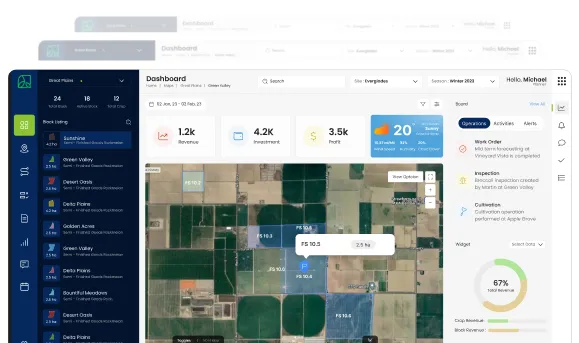
Data Analytics Solution of the Year” 2026 in Agtech Breakthrough Awards 2026



HR, Labor & Payroll is the module that turns the agribusiness workforce, permanent staff, seasonal workers, day labor, and contractors, into a managed system of records, time captures, and pay calculations. It is the module that makes sure every worker is properly recorded, every hour is properly tracked, every certification is current, and every paycheck reflects the work actually done.
This module is built on an enterprise-grade Human Resources foundation, the same kind that runs workforces across global manufacturers, retailers, and service providers. AgriERP shapes it for agriculture, where workforces are seasonal, payment rules are mixed (hourly, piece-rate, salaried), workers move between blocks and activities in the same shift, and compliance requirements are strict.
1. Farm HR
Why agriculture HR is genuinely different
Most HR systems are built for offices: people work fixed hours, in one location, on similar tasks, under one pay rule. Farms are the opposite. A spray crew works three blocks in one shift, doing two activities, under mixed pay rules. A seasonal harvest workforce expands tenfold for six weeks and shrinks back. Workers move between farms within the same business. Certifications expire and have to be renewed. Visa and work-permit conditions apply. AgriERP’s HR module is built for that reality, not retrofitted to it.
Workforce categories supported
| Capability | What it means in practice |
|---|---|
| Permanent employees | Full-time staff with ongoing employment contracts: managers, supervisors, agronomists, mechanics, office staff. |
| Permanent part-time | Long-term staff working reduced hours under defined arrangements. |
| Seasonal workers | Hired for a defined season or window, often year over year. Returning seasonal workers are re-onboarded quickly with their prior records preserved. |
| Day labor | Workers hired for a specific day or short period. Often piece-rate paid. Common in peak harvest. |
| Contractors | External workers under a contractor agreement, often through a labor contractor. Payment may be to the contractor rather than to the worker directly, but the work attribution is tracked. |
| Foreign and migrant workers | Workers on specific visas or work permits, with the conditions and expiry dates of those permits tracked as part of the HR record. |
Organisation structure
The module models the real-world organisational hierarchy of the business: farms, divisions, departments, supervisors, and reporting lines. This is the structure that financial reporting, performance management, and operational visibility all use.
- Multi-farm structure: workers can be assigned to one farm primarily but work across multiple farms in the same season. The system handles primary and temporary assignments.
- Cost centers: departments, teams, and operational units that act as financial dimensions. Labor cost rolls up cleanly.
- Reporting lines: every worker has a supervisor, who has a manager, who has a director. The hierarchy supports approval workflows, performance reviews, and operational delegation.
- Multi-entity support: where farms belong to different legal entities, employees can be assigned to the right entity for payroll, tax, and reporting purposes.
2. Employee records
What every employee record captures
| Capability | What it means in practice |
|---|---|
| Personal identity | Name, date of birth, national identifier (where applicable), gender (where collected for statutory reporting), nationality. |
| Contact information | Address, phone, email, emergency contact. Updated as needed; previous versions retained for audit. |
| Employment information | Start date, employment type, position, supervisor, primary farm assignment, employment status (active, on leave, terminated). |
| Compensation | Pay rate or salary, currency, pay frequency, pay structure (hourly, salaried, piece-rate, mixed). Bonus, allowance, and benefit eligibility. |
| Banking and tax | Bank account for direct deposit, tax identifiers, tax withholding configuration, retirement-fund enrolments. |
| Certifications and licenses | Pesticide application licenses, machinery operation certifications, food safety qualifications, first aid, driver’s license, forklift, with expiry dates. |
| Work authorisations | Visa or work-permit status, type, expiry, and restrictions. Critical for foreign and migrant workers. |
| Training history | Completed training courses, induction status, refresher courses, internal skill assessments. |
| Performance and reviews | Performance review records, recognition awards, disciplinary actions where applicable. |
| Leave and absence | Vacation, sick leave, public holidays, special leave taken and remaining. Accrual rules per employee class. |
Onboarding and offboarding workflows
- Recruitment intake: candidate tracking from job posting through interview to hiring decision. Approved candidates flow into onboarding.
- Onboarding checklist: structured first-day and first-week onboarding: documentation collection, induction training, equipment issue, system access provisioning. Every step tracked, with completion logged.
- Returning-worker re-onboarding: for seasonal workers returning year after year, re-onboarding is fast: documents are already on file, certifications are checked for currency, only what has changed needs updating.
- Ongoing record maintenance: certifications expiring, address changes, role changes, pay reviews. The system surfaces what needs attention; managers act on it.
- Offboarding: exit process: return of company property, final pay calculation, statutory filings, exit interview, system access removal. The record is archived per the retention policy.
3. Attendance, clock in/out
How clock in/out works in AgriERP
AgriERP captures time at the point of work, not at the end of the day from memory. Workers clock in and out on the mobile app or shared field tablet, with their work tagged to specific work orders, blocks, and activities. The captured time is the time that flows to payroll and to cost accounting; no paper timesheet stage.
- Worker clocks in at the start of work: on the mobile app, with GPS confirming the location and a photo verification where the business policy requires it.
- Time accumulates against the work order: the work order is on Block 14, doing spray application, against the 2027 mandarin crop. The worker’s time inherits all those tags automatically.
- Breaks and transit captured separately: active work time, transit between blocks, and breaks are distinguished, so productivity analysis is meaningful and pay rules are applied correctly.
- Crew-based capture: for crew work, the supervisor manages clock-in for the crew as a unit, with hours distributed to individual members automatically.
- Piece-rate capture: for piece-rate work (per bin, per crate, per acre), the unit count is captured at the point of work. Pay is calculated from units, not from clock time.
- Supervisor review and approval: supervisors review captured time at the end of the day or shift. Adjustments are audited; original captures are preserved alongside corrections.
What attendance captures beyond time
| Capability | What it means in practice |
|---|---|
| Shift attendance | Whether the worker showed up for their scheduled shift, was absent, was late. Patterns surface in attendance reports. |
| Leave and absence | Vacation, sick leave, public holidays, special leave. Requested through workflows, approved, and reflected automatically in pay. |
| Overtime | Time worked above standard hours. Automatically distinguished from standard time; pay rules applied per the worker’s employment class and country. |
| Night and weekend differentials | Time worked outside standard hours, with the right pay differential applied automatically. |
| On-call and standby | Time when a worker is available but not actively working. Often a different pay rule than active work. |
| Travel and transit | Time spent moving between work sites, often paid at a different rate or not at all depending on policy. |
4. Payroll
What the payroll capability handles
| Capability | What it means in practice |
|---|---|
| Pay calculation | Hours and piece-rate units from time tracking flow into pay calculation. Overtime, allowances, differentials, and deductions are applied per defined rules. |
| Multiple pay rules | Hourly, salaried, piece-rate, mixed-mode workers are all handled natively. The pay rule per worker is on the employee record. |
| Tax and statutory withholding | Income tax, social security, retirement contributions, health levies, and other statutory deductions are handled per country and per worker class. |
| Allowances and bonuses | Travel allowances, meal allowances, location premiums, productivity bonuses, year-end bonuses. Defined as pay components and applied per eligibility rules. |
| Garnishments and deductions | Court-ordered garnishments, loan repayments, advance recoveries, and voluntary deductions (union dues, charitable). Applied per worker per the configured priority order. |
| Pay slips | Generated and delivered digitally (or printed where local rules require). Workers can access historical pay slips through self-service. |
| Direct deposit | Payments are issued to worker bank accounts through the Integration Layer to the banking system. Confirmations flow back. |
| Statutory filings | Tax and social security filings are prepared from the same payroll data, in the formats local regulators require. |
Payroll integration with the rest of the business
- Posting to the General Ledger: payroll cost is posted to the General Ledger automatically, with labor cost allocated by farm, block, activity, and cost center, the same dimensions used everywhere else in AgriERP.
- Linkage to work orders: every hour paid is linked back to the work orders the time was captured against, with the cost flowing to the right operational dimension.
- Reconciliation with operations: the hours that show up on payroll reports are the same hours that show up on cost reports, on plan-vs-actual reports, on labor productivity dashboards. One source of truth.
- Multi-entity and multi-currency: where the business operates across legal entities or countries, payroll is handled per entity with the right tax treatment and currency. Consolidation handles the cross-entity view.
- Audit-readiness: every payroll calculation is traceable: from the gross amount on the pay slip, back to the hours and rules that produced it, back to the work orders and time captures that the hours came from. Statutory audits, internal audits, and dispute investigations all use the same data.
One example: a piece-rate harvest weekIt is the peak week of the orange harvest. The business has 60 piece-rate harvest workers on the property.Clock-in: the harvest supervisor clocks in the crew on the mobile app at 6:48am, on Block 14. Each worker is recorded individually.Piece-rate capture: as bins are filled, each worker scans their bin tag and the bin code. By the end of the day, every bin is attributed to a worker, with the count captured.Supervisor approval: at the end of the shift, the supervisor reviews the totals. Two corrections are made for double-scans; both are audited. The remaining 612 bins for the day are approved.Cost allocation: the labor cost flows to Block 14, to the 2027 navel orange crop, in real time. Block 14’s cost-per-tonne metric updates accordingly.Pay calculation: Friday’s pay run calculates from the captured units. Each worker’s bin count is multiplied by the piece-rate. Minimum-wage protection is checked (workers who fall below the hourly minimum due to slow days receive top-up). Tax and statutory deductions are applied.Payment: Friday afternoon, direct deposits hit worker accounts. Pay slips are available immediately. The cycle closes.Sixty workers, one peak week, real pay against real work, with the cost on the right block and the books matching the field. No paper, no spreadsheets, no week-after correction round.
In summary
HR, Labor & Payroll is the module that makes the workforce a managed system instead of a logistical crisis. Farm HR brings the agricultural workforce, permanent, seasonal, day labor, and contractor, onto a single structured foundation. Employee records keep all the information that matters, kept current. Attendance and clock-in capture every working hour at the point of work, on the mobile app, with full operational tagging. Payroll runs from that captured data, with full pay rule support, tax compliance, and direct integration to the General Ledger and worker bank accounts.
For the workflow view of workforce management day-to-day, see Business Processes > Resource Management. For how labor flows into operational decisions, see Business Processes > Work Order Management.