The ERP Solution for the Year” 2025 in Agtech Breakthrough Awards 2025
Xero is great accounting software — that's why you chose it. But it was never built to run a farm. When you need costing by field, crop, entity, and season, lot-tracked inventory, livestock accounting, and consolidated reporting across every entity, you need an agriculture ERP. Built on Microsoft Dynamics 365 and Oracle NetSuite.


Xero earned its place on your farm. Clean interface, brilliant bank feeds, your accountant recommends it — for a young, single-entity operation, it's a fine choice. That hasn't changed.
What changed is your operation. You added entities, enterprises, maybe a packing shed. And Xero, by design, keeps things simple: two active tracking categories, basic inventory, one subscription per entity. So you bolted things on — Figured for farm budgets, spreadsheets for enterprise costing, a separate tool for consolidation, another for spray records. Each add-on is one more place your numbers live, and one more reconciliation between you and a straight answer.
AgriERP replaces the stack, not just the ledger — an integrated agriculture ERP built on Microsoft Dynamics 365 and Oracle NetSuite. Not a bigger Xero. A different class of system, built for the way farms actually operate.
Xero is excellent at what it was built for: small-business accounting. Farming asks for more. Here's an honest look at where each platform stands.
Capability |
||
|---|---|---|
Built For |
General small-business accounting |
Agriculture — row crops, orchards, produce, livestock, grain |
Cloud & Mobile |
Yes — cloud-native |
Yes — cloud-native, built on Dynamics 365 / NetSuite |
Costing Dimensions |
2 active tracking categories; 1 on payroll transactions |
Multi-dimensional — field × crop × entity × enterprise × season |
Inventory Management |
Basic tracked inventory; no lots, batches, expiry, or multi-warehouse |
Lot, batch & expiry tracking, weight-based commodities, multi-warehouse |
Livestock Accounting |
Manual workarounds; no livestock trading account |
Herd tracking, natural increase, per-head costing, trading reports |
Traceability |
Not available |
Field-to-fork lot traceability with recall readiness |
Compliance |
No spray records, withholding periods, or food-safety documentation |
Input & chemical usage records, audit logs, certifications |
Multi-Entity |
Separate subscription per entity; consolidation via third-party tools |
Native multi-entity consolidation with intercompany handling |
Packing & Processing |
Not available |
Production orders, BOMs, grading & packhouse operations |
Farm KPIs & Analytics |
Core financial reports; farm metrics need Figured or BI add-ons |
Cost per acre, hectare & head, enterprise gross margins, dashboards |
Seasonal & Piece-Rate Labor |
Needs third-party payroll or award apps |
Crew-based, field-level labor costing for ag workforces |
Ag-Tech Integrations |
No native machinery, agronomy, or IoT connections |
Machinery, weather, e-commerce, logistics & ERP integrations |
Xero capabilities vary by plan and region, and can be extended through its app marketplace. Assess fit against your current setup and add-ons.
The same assistant, applied to four places a fast answer helps: the field, the inputs, the back office, and the season ahead.
Xero's tracking categories cap out at two active at a time — and payroll transactions only take one. A farm needs at least four dimensions running at once: which field, which crop, which entity, which season. Pick your two favorites; the rest live in a spreadsheet.
Stop choosing which two questions your books are allowed to answer.
Xero's inventory exists so your cost of goods flows to the P&L — it's accounting-first by design. No lot or batch tracking, no expiry dates, no multiple warehouses, no bills of materials. For chemicals with expiry dates, harvested product in three sheds, and anything sold by weight, that's not enough.
One inventory system from the paddock to the pack line to the invoice.
Ask any rural accountant: livestock is where general accounting software runs out of road. Xero has no herd tracking, no natural increase, and no livestock trading account — so stock reconciliations happen in spreadsheets and get keyed back in at reporting time.
Your stock numbers and your books finally agree, because they live in the same system.
Operating company, land trust, family partnership — most established farms run several entities. In Xero, each one is a separate organisation with its own subscription, and group reporting means a third-party consolidation app or a long night in Excel eliminating intercompany transactions by hand.
The more entities you add, the more this matters. Structure your business for tax and succession — not around your software's limits.
Lot traceability, spray diaries, withholding periods, recall readiness — none of it lives in Xero, because none of it is accounting. But your buyers and auditors demand it: FSMA and retailer traceability mandates in the US, Freshcare, HARPS, and GLOBALG.A.P. in Australia.
When a buyer or auditor asks, you answer from the system — not from binders and three different files.
AgriERP connects with the machinery, weather, sales, and logistics tools that sit outside an accounting platform. When we say we break down data silos across your entire operation, we mean it.


Can’t find your desired integration? Just let us know, and we’ll build one for you!
You didn't outgrow good bookkeeping. You outgrew what accounting software alone can do. Take the leap forward with AgriERP and run your entire operation from one platform.
Keep your farms and facilities audit-ready with automated documentation, real-time logs, and built-in controls — from FDA, USDA, and FSMA in the US to Freshcare and GLOBALG.A.P. standards in Australia.


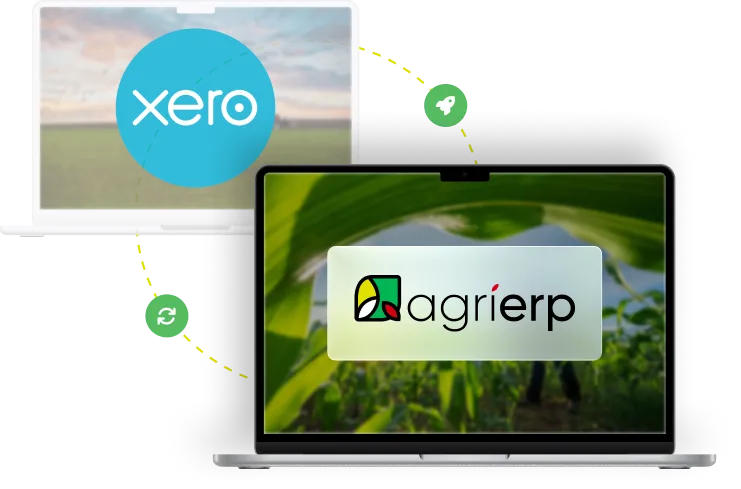
Your Xero file holds years of clean, reconciled history — and moving off a system that works feels risky. That's why we run migration as a guided, phased process: nothing gets lost, and your team is never left guessing.
Solution Discovery We review your QuickBooks edition, company files, add-ons, spreadsheets, entities, reporting requirements, data quality, and target operating model.
Project Planning We create a clear implementation plan aligned with your goals, business cycles, seasonal calendar, and operational timelines — reducing disruption and keeping your team in control.
ERP Implementation We execute the plan and map all your relevant workflows and processes onto the selected ERP (Dynamics 365, Oracle NetSuite, SAP).
Data Migration from Xero Once your processes are mapped and configured, we migrate your chart of accounts, contacts, balances, open transactions, and tracking category history from every Xero organisation into AgriERP.
Go Live & Onboarding After comprehensive UAT and setup, we go live and provide training sessions for your team to avoid friction and ensure effective use of the solution.
Ongoing Support Our dedicated support team assists you around the clock under our SLA agreement, so you never face a challenge alone.
Farms that have outgrown general accounting software usually need an agriculture ERP rather than another accounting tool. AgriERP combines farm accounting, multi-dimensional costing, lot-tracked inventory, livestock accounting, traceability, multi-entity consolidation, and reporting in one platform built on Microsoft Dynamics 365 Business Central or Oracle NetSuite.
Yes. AgriERP supports multi-dimensional costing, so you can analyze cost and profit by field, block, crop, lot, enterprise, entity, and season simultaneously — without Xero's two-active-tracking-category limit.
Yes. AgriERP supports herd and mob tracking, natural increase, per-head costing, and livestock trading reporting — areas where Xero relies on manual workarounds or third-party tools.
Figured adds farm budgeting and production tracking on top of Xero, and it does that well. But the combination still lacks lot and batch inventory, packhouse and processing operations, field-to-fork traceability, and native multi-entity consolidation. An agriculture ERP unifies all of it in one system.
Yes. Typical migration scope includes the chart of accounts, customers, suppliers, opening balances, open receivables and payables, items, tracking category history, and selected transactions — from one Xero organisation or several. The final scope is confirmed during discovery.
Common signs: you need more than two costing dimensions, you run multiple entities and consolidate manually, you pack or process product, you face traceability or food-safety requirements, you manage livestock at scale, or you're relying on a growing stack of add-ons and spreadsheets around Xero.