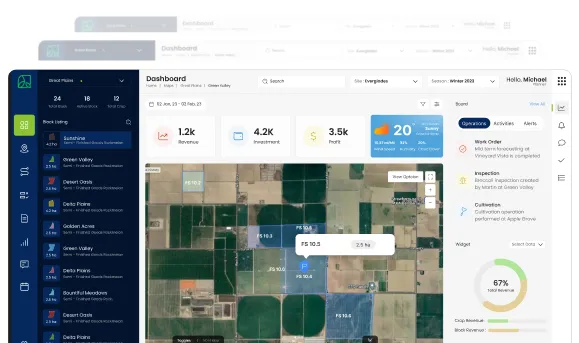
Data Analytics Solution of the Year” 2026 in Agtech Breakthrough Awards 2026



Implementing an ERP system in an agribusiness is a substantial undertaking. Done well, it is the foundation of years of operational improvement and competitive advantage. Done badly, it is a multi-year recovery from a project that never quite went live. The difference between the two is rarely the software; it is the implementation approach. This document is the master overview of how AgriERP is implemented by Folio3, the agritech implementation partner that designed and delivers the platform.
There is no shortcut and no template that fits every business. There is, however, a structured, phased approach that has been refined through dozens of agribusiness implementations and that consistently produces working, adopted systems within predictable timeframes. This document describes that approach end-to-end, with the detail of each phase covered in the documents that follow.
1. The implementation philosophy
The four principles that shape every implementation
| Capability | What it means in practice |
|---|---|
| Discovery before build | No technical work begins until the business outcomes, the current-state pain points, the success metrics, and the phased roadmap are clear and agreed. This is not a luxury; it is what prevents months of rework later. |
| Phased rollout, not big-bang | AgriERP is rolled out in defined phases (typically Finance & Infrastructure first, then Farm Operations, then Supply Chain), with each phase reaching production before the next begins. Big-bang go-lives are how implementations fail. |
| Agriculture expertise on the team | Every Folio3 implementation team includes consultants who have actually worked in agribusiness operations. Not just ERP consultants; people who understand what a Brix reading is, why harvest timing matters, and what cold-chain failure does to a buyer relationship. |
| Business ownership throughout | The business is in the implementation room every week, not just at kickoff and at user acceptance testing. Decisions are made by the people who will live with them; Folio3 facilitates, advises, and builds, but does not own the business’s design. |
What this approach is not
- Not a one-size-fits-all template: every agribusiness has its own crops, scale, geography, and operating model. The implementation is shaped to the business, not the business shaped to a template.
- Not a software handover: implementation is not “we install the software, you start using it.” It is configuration, data migration, integration with existing systems, training, change management, and post-go-live support, in a defined sequence.
- Not a year-long discovery: discovery is structured and time-boxed. Two to six weeks for most agribusinesses, not six months of consultancy that produces a binder and no system.
- Not the cheapest option: this approach takes longer and costs more upfront than the cheapest implementation routes. It also goes live successfully far more often.
2. The phases at a glance
The standard implementation phases
| Capability | What it means in practice |
|---|---|
| Phase 0: Discovery & Goal Setting | 2 to 6 weeks. Business outcomes, current-state analysis, gap analysis, infrastructure mapping, pain points, success metrics, phased roadmap agreed. Output is the implementation plan everyone signs up to. |
| Phase 1: Finance & Infrastructure | 6 to 12 weeks. General Ledger, Accounts Payable, Accounts Receivable, chart of accounts, data migration from legacy finance systems, technical architecture, cloud or on-premise setup. The financial foundation everything else builds on. |
| Phase 2: Farm & Field Operations | 8 to 14 weeks. Block setup, crop planning, labor tracking, work orders, mobile-app rollout, irrigation, integration with finance. The operational layer where most of the daily work happens. |
| Phase 3: Supply Chain, Warehouse & Logistics | 10 to 16 weeks. Quality control, warehouse operations, shipping and dispatch, inventory traceability, vendor management, sales and contracts. The commercial side of the operation. |
| Phase 4: Intelligence, Automation & Support | Runs across all phases. Dashboards, workflow automation, AI capabilities, the underlying security and cloud platform, and the ongoing service desk that supports the business after go-live. |
Why the timeframes are ranges, not single numbers
- Scale matters: an implementation covering one farm of 200 hectares is faster than one covering 12 farms across three countries. Both follow the same phases; the duration differs.
- Existing systems matter: a business migrating from spreadsheets and paper takes less data-migration time than one migrating from a legacy ERP with 15 years of data and 80 customisations to preserve.
- Integration complexity matters: a business with three existing integrations to maintain (bank, customs, buyer EDI) takes less integration time than one with 15. Each integration is its own small project.
- Decision-making cadence matters: the speed of business decisions is often the binding constraint on timeline. Businesses that decide quickly implement faster than businesses where every choice goes through six rounds of review.
- Geographic and operational distribution: training and rollout to a single site is straightforward; doing it across multiple farms in multiple countries with multiple languages takes proportionally longer.
Total elapsed time
For a typical mid-sized agribusiness with one or two farms, two crops, and a finance team migrating from a legacy system, an end-to-end implementation runs 9 to 14 months from discovery start to all three operational phases live. For a larger group with multiple farms and complex existing systems, 14 to 22 months is more typical. Some businesses choose to go live with Phase 1 first and add operational phases over a longer schedule; others run phases in parallel where the business can absorb the change. Folio3 advises on the right cadence based on the business’s appetite for change and its operational rhythm.
3. Folio3’s role
What Folio3 brings to the implementation
| Capability | What it means in practice |
|---|---|
| Agricultural domain expertise | Consultants who understand agricultural operations, who can walk a packing shed and identify the operational pain points, who can talk to an agronomist or a farm manager in their own terms. |
| AgriERP product knowledge | Deep knowledge of every module, every capability, every configuration option in the platform. Folio3 wrote the product; the implementation team knows it inside out. |
| Implementation methodology | The phased approach in this document is Folio3’s methodology, refined through dozens of agribusiness implementations. Every project benefits from the lessons of every prior project. |
| Data migration expertise | Migrating data from spreadsheets, legacy ERPs, accounting systems, custom databases, paper records, into a structured agricultural data model is a specialist activity. Folio3 does it routinely. |
| Integration capability | Every existing system the business relies on (banks, payment providers, customs, buyer systems, weighbridges, sensors) needs integration. The BURQ middleware and Folio3’s integration team handle the full catalog. |
| Change management support | ERP implementations succeed or fail on user adoption. Folio3 brings the change-management discipline (communications, training, super-user development, post-go-live hyper-care) that gets adoption right. |
| Service desk and ongoing support | After go-live, the dedicated service desk continues supporting the business. The same people who implemented stay involved, so issue resolution does not lose context. |
What the business owns
- Business decisions: every design decision (chart of accounts structure, approval workflows, organisational hierarchy, operational processes) is made by the business. Folio3 advises, presents options, and explains tradeoffs, but does not decide for the business.
- Subject matter expertise: the business’s own operational experts (agronomist, farm manager, packhouse manager, CFO) are the source of truth for how the business actually runs. They cannot be replaced by consultants.
- User adoption: the implementation team can build the best system in the world, but only the business can make its people use it. Sponsorship from senior leadership and engagement of the operational teams are non-negotiable.
- Project sponsorship and steering: the business assigns a steering committee that meets regularly throughout the implementation, makes the steering-level decisions, and resolves issues that exceed the project team’s authority.
- Master data quality: the customer, vendor, item, and block master data that goes into the new system is the business’s responsibility to cleanse. Folio3 supports, but the business knows what “clean” looks like.
The implementation team shape
- Folio3 side: project manager, agriculture solution architect, functional consultants for each domain (finance, operations, supply chain), data migration specialist, integration specialist, technical lead, change management lead.
- Business side: project sponsor (typically C-suite), project manager, finance lead, operations lead, supply chain lead, IT lead, super-users from each operational area.
- Joint working: Consultants and business super-users work together on configuration, testing, and training. The super-users become the in-house experts who carry the system forward after Folio3’s primary involvement ends.
4. Why discovery comes first
What discovery accomplishes
- Clarifies business outcomes: what does the business actually want from this implementation? Better cost visibility, faster reporting, improved traceability, reduced manual work? The specific outcomes shape the entire roadmap.
- Maps the current state: what systems are in place today, what manual processes fill the gaps, what data is captured where, what works well that should be preserved, what does not work that should be replaced. The starting point is documented, not assumed.
- Identifies real pain points: where the current operation actually hurts. The pain points become the priority areas for the implementation, not just the convenient ones to address first.
- Sets the success metrics: how will the business know the implementation succeeded? Specific, measurable metrics agreed upfront, not vague aspirations like “better visibility.”
- Builds the phased roadmap: the specific phases for this implementation, their sequence, their dependencies, their estimated durations, their go-live criteria. Agreed by everyone before the first line of configuration.
- Aligns expectations: what the business will get, when, at what cost, with what involvement on their side. Aligned expectations are the foundation of the trust the implementation depends on.
What happens when discovery is skipped or rushed
It is tempting to skip discovery and jump straight to building. The temptation is especially strong for businesses that feel they already know what they want. The reality is that they rarely do, not in the level of structured detail an implementation needs. Implementations that skip discovery encounter the same issues months later, but at a much higher cost: rework, change requests, missed scope, broken integrations, frustrated users, eroded trust, and timelines that double or triple.
- Symptoms of rushed discovery: scope creep month two onwards, decisions revisited repeatedly, stakeholders surprised by what is being built, integrations discovered late, master data not ready when needed, training delivered to people who do not yet understand why they are getting it.
- Cost of skipping: typically 30 to 80% schedule overrun, 40 to 100% budget overrun, much higher than the cost of the 2 to 6 weeks of structured discovery that would have prevented the issues.
- Why Folio3 does not skip: Folio3 has been on the wrong end of implementations that skipped discovery, in past lives at other firms or with customers who insisted on going fast. The discipline is not optional; it is what makes the rest of the implementation work.
Why this is worth saying clearlyThere is a temptation in every ERP sales conversation to overpromise speed. “We can have you live in three months.” “Our methodology compresses discovery.” “Our pre-built configurations mean you can skip the analysis.”Folio3’s approach is different. The discovery phase is non-negotiable for any implementation other than the smallest pilots, because it is what makes the rest of the implementation succeed. The timelines in this document are honest, not aspirational. Businesses that work with Folio3 know what they are getting into and what the system will look like at the end. That clarity, more than any specific feature, is why the implementations succeed.
In summary
AgriERP implementations follow a structured, phased approach: Discovery & Goal Setting first, then Finance & Infrastructure, then Farm & Field Operations, then Supply Chain & Logistics, with Intelligence, Automation & Support running across all phases. Folio3 brings the agricultural domain expertise, product knowledge, methodology, and delivery discipline; the business brings sponsorship, subject matter expertise, decision-making, and adoption. Discovery before build, phased rollout instead of big-bang, agriculture experts on the team, and continuous business involvement are the four principles that make implementations succeed.
The five documents that follow give the detailed picture of each phase: what gets done, who does it, how long it takes, what “done” looks like, and what risks to watch for.