Greenhouse growers face a path of opportunities and Challenges
Tasbia Tahir Ali
July 15, 2025
Strong Demand Fuels Growth
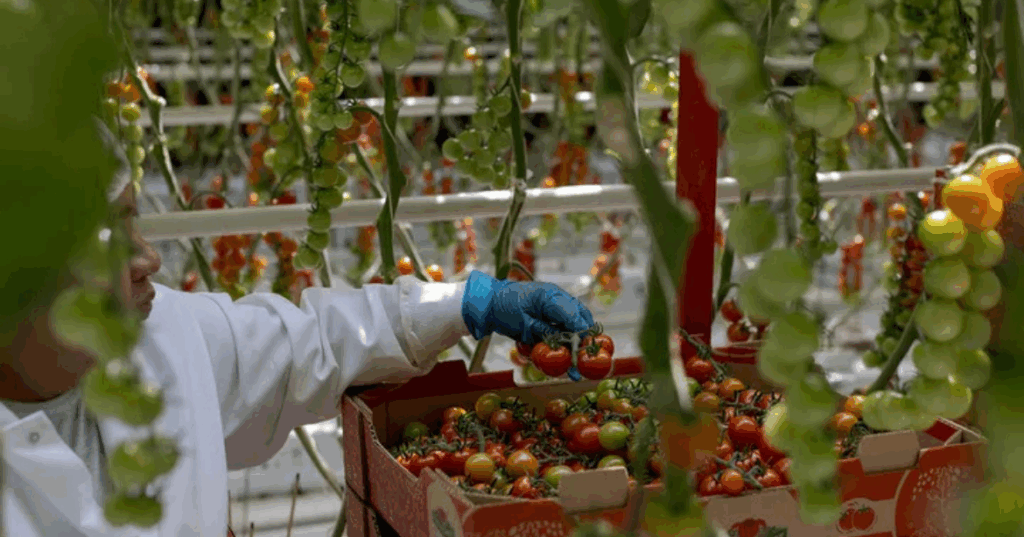
Greenhouse-grown fruits and vegetables have seen steady growth in recent years as shoppers seek reliable quality and food safety year-round. “Consumers increasingly recognize the superior taste and consistent quality of greenhouse-grown produce, while our retail partners value the improved food safety and year-round availability,” says Martin Ruebelt, chief scientific officer at NatureSweet.
In Canada, tariff talk has only strengthened demand for locally grown greenhouse crops, according to Chris Veillon, VP of marketing at Topline Farms in Leamington, Ontario.
Organic options are flourishing too. Joanna Jaramillo, marketing manager for Wholesum, notes that “snacking tomatoes and mini cucumbers continue to see year-over-year growth,” driven by the controlled-environment production that guarantees flavor and consistency.
Upward Trends in Snacking
Category is a major growth engine. Retailers report consumers now snack three to five times daily, and they want healthy, tasty options. Ruebelt adds that “our ready-to-serve cherry tomatoes require less prep time and enhance flavor,” making them popular in both retail and foodservice channels.
Organic snacking varieties represent the second-largest organic subcategory, with cherry-on-the-vine and medley tomatoes outpacing staples like grape tomatoes. Retailers are responding by expanding premium assortments and offering heirlooms and unique flavor profiles to satisfy curious shoppers.
Sustainability as a Selling Point
No longer a niche; today’s consumers are “informed and value-driven,”Jaramillo says. Controlled environment agriculture (CEA) uses up to 90%less water than field production and minimizes land use and pesticide input. “Transparency and traceability resonate with modern buyers,” notes Veillon, pointing to QR codes that link shoppers to grower stories and impact stats.
Certifications amplify trust: NatureSweet’s B Corp and Fair Trade labels are prominently displayed on packaging, and Wholesum’s organic and Fair Trade seals signal ethics and environmental responsibility. In-store messaging and social media farm tours further reinforce these commitments.
Challenges on the Horizon
Strong demand, the greenhouse crop production issues faces significant obstacles:
Trade Policy Risk: A Possible17–21% U.S. tariff on fresh tomatoes from Mexico could upend supply chains, drive up costs, and make fresh produce less affordable. Ruebelt warns this would “penalize innovation in controlled-environment agriculture” in favor of traditional field farming.
Rising Input Costs: Energy for heating and supplemental lighting, labor for skilled system operators, and capital expenditures on technology all add pressure. Veillon highlights Topline’s shift from high-pressure sodium lighting to energy-efficient LEDs as one way to manage costs.
Labor and Talent: Advanced greenhouse operations require specialized skills. Jaramillo urges greater advocacy for agricultural careers to ensure a pipeline of qualified workers.
Price Sensitivity: Premium greenhouse produce commands higher prices, which can limit adoption in value-focused markets. Retail partnerships are crucial but competitive, and logistics for perishable goods remain complex.
Innovation Keeps Pace
Overcome these hurdles, growers are doubling down on research and development:
Varietal Trials: Topline has expanded acreage for new seed trials and is launching a fall-2025 expansion of Roma tomato production to meet retailer demand.
Packaging Advances: Wholesum’s recyclable paper trays for tomato-on-the-vine show how sustainable packaging can streamline operations and appeal to eco-minded consumers.
Digital Farming Tools: NatureSweet is integrating data systems that provide real-time insights, helping growers optimize yield, flavor, and resource use. Their “Cherubs To Go” miniature cucumbers and colorful sweet pepper medleys exemplify product innovation aligned with snackability trends.
Scale and Geography: Wholesum is carefully extending its distribution footprint to match supply-chain strengths and customer locations, ensuring growth doesn’t compromise service levels.
Outlook Future “Consumers want better flavor, consistency, and transparency,” Ruebelt emphasizes, “and CEA is uniquely positioned to deliver on those expectations while building a more sustainable food system.” By marrying advanced technology, responsible practices, and consumer-driven innovation, greenhouse growers are charting a course that balances opportunity with the greenhouse growing challenges.
As the industry continues to mature, its ability to adapt to policy shifts, manage costs, and tell authentic sustainability stories will determine just how far this green revolution can go.
AgriERP is a comprehensive farm management solution designed to empower farmers with streamlined operations and increased profitability. Powered by Microsoft Dynamics 365, AgriERP offers a single, straightforward platform that addresses the pain points of various farm types. With its user-friendly interface and intelligent automation, AgriERP is like having a trusted partner by your side throughout your farming journey.
For more information about AgriERP and its innovative farm management solutions.
Recognized as the top data analytics platform in agriculture at the 2026 AgTech Breakthrough Awards. Trusted by farm owners, processors, and exporters to turn operational data into better decisions.
 Data Analytics Solution of the Year” 2026 in Agtech Breakthrough Awards 2026


 Tasbia Tahir Ali
  July 15, 2025