Data Analytics Solution of the Year” 2026 in Agtech Breakthrough Awards 2026


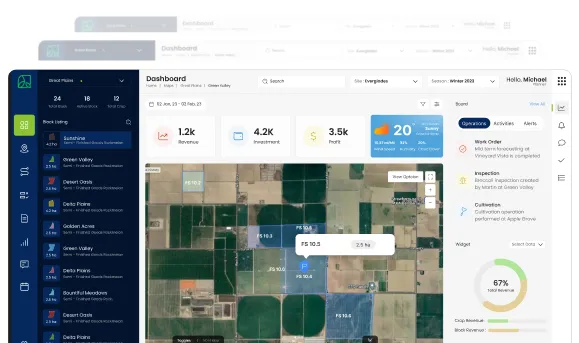
If season planning is the decision about what to grow, Crop Management is the discipline of actually growing it. It is the part of AgriERP where the land, the crops, and the people working them are organised, mapped, planned, and tracked, so that the season plan turns into a real, executable program of work on the ground.
This section covers how AgriERP structures the basic units of agricultural operations, farms, blocks, dimensions, and crop plans into one connected hierarchy that every other module reads from and writes to. Get this layer right, and every cost report, every yield analysis, every traceability query, every grower settlement, becomes structured and answerable. Get it wrong, and the rest of the system has nothing solid to stand on.
What this section covers
- Farms: the highest-level organising unit of the operation, with everything that lives below it.
- Blocks: the working unit of agriculture: where crops are actually grown, where activity happens, where cost is measured.
- Dimensions: the dimensions that turn raw transactions into meaningful agribusiness data: crop, variety, season, and more.
- Crop planning: turning the season plan into a block-by-block, crop-by-crop, week-by-week program of work.
1. Farms
| In one lineSet up every farm in your business as a structured operating unit, with its own land, its own people, its own equipment, and its own financial picture. |
Why farms matter as a structural unit
Most agribusinesses operate more than one farm. Some run dozens. Each is a real business unit, with its own land, its own labor, its own equipment, its own crops, and often its own manager. But in most systems, farms are not modelled at all; they live as labels in a spreadsheet, as cost centers in the accounting software, or as folders on a shared drive.
In AgriERP, the farm is a first-class structural object. The system knows what farms you have, where they are, what is grown on them, who manages them, and what their performance looks like. Every transaction, every cost, every harvest, every work order, traces back to a specific farm.
How farms are structured in AgriERP
| Capability | What it means in practice |
|---|---|
| Farm record | Every farm has its own master record, with name, address, GPS coordinates, total area, ownership, manager, and operating status. |
| Hierarchy and grouping | Farms can be grouped by region, by business unit, by crop program, or by any other organising principle. The hierarchy is yours to define and use across reporting. |
| Farm-level financial picture | Every farm functions as a financial unit. Costs are tagged to it. Revenue is tagged to it. You see profit, margin, and budget variance by farm, as easily as by crop or by company. |
| People and equipment assignment | Workers, supervisors, agronomists, and equipment can be permanently or temporarily assigned to a farm. The system tracks who is on what farm, doing what, on any given day. |
| Documents and compliance | Land titles, water rights, certifications, environmental permits, and other documents live on the farm record, so the team always knows the regulatory state of each property. |
| Multi-entity readiness | If different farms belong to different legal entities, AgriERP handles that natively. The farm structure is independent of, but aligned with, the legal structure of the business. |
What changes when farms are properly structuredBefore: the farm is an idea everyone agrees about but no one can pull a clean number for. The owner asks “how is Farm 3 doing this year?” and three people produce three different answers from three different spreadsheets.After: every cost, every yield, every work order, every staff hour, traces back to the farm it belongs to. “How is Farm 3 doing?” becomes a single dashboard view, refreshed in real time, with the same numbers for every person who asks.
2. Blocks
In one lineDefine the actual pieces of land where crops are grown, where activity happens, where cost is measured, and where yield is recorded, with the precision agriculture needs.
Why blocks are the working unit of agriculture
Farms are useful for ownership and reporting, but no one actually farms a farm. They farm blocks: the specific paddocks, fields, orchards, vineyards, sub-divisions of land where one crop, of one variety, is grown together. Block 14 is where the 2024 Gala apples were planted. Block 22 is the south-facing vineyard. Block 7 is the 12-hectare wheat paddock west of the main shed.
In AgriERP, the block is the smallest unit at which crops are planned, costs are accumulated, and yields are recorded. It is also the granularity at which the agronomist actually thinks. Setting blocks up properly makes the rest of the system meaningful.
What gets captured at the block level
| Capability | What it means in practice |
|---|---|
| Identity and location | Block name and code, GPS-mapped boundary, area in hectares or acres, slope, elevation, and aspect. |
| Soil and water | Soil type, soil testing history, drainage characteristics, irrigation infrastructure, and water source. |
| Crop and variety history | What was planted on this block, in what season, in what variety, with what spacing and density. Multi-year history builds automatically. |
| Current crop status | What is growing right now, in what growth stage, with which agronomic plan, on what schedule. |
| Sub-blocks where needed | Larger blocks can be sub-divided into sub-blocks (for split varieties, mixed plantings, or trial sections) without losing the parent block view. |
| Compliance attributes | Organic certification status, conservation areas, buffer zones, re-entry intervals after spray, and any other regulatory attribute that applies to the block. |
How blocks connect to the rest of the system
Once blocks are defined, they become the link between agriculture and the rest of AgriERP. Every operational and financial transaction can reference a block, automatically:
- Work orders run on blocks: spray, irrigation, pruning, harvest, all scheduled against the block where the work happens.
- Inputs are deducted from inventory against blocks: the bag of fertilizer leaves the warehouse and the cost arrives on Block 22, not in a generic expense bucket.
- Labor hours are logged against blocks: the crew worked Block 14 for six hours; the system knows it, the payroll reflects it, and the cost lands on the right place.
- Harvest is recorded against blocks: every bin and every pallet carries the block it came from, all the way through to the packed-out product and the customer pallet.
- Reporting and analytics roll up from blocks: yield per hectare, cost per acre, margin per crop, profit per block. Every analytic the business needs starts at the block.
3. Dimensions
In one lineThe dimensions that turn raw transactions into structured, queryable, agribusiness-meaningful data, so the same number can be sliced by farm, block, crop, variety, season, or any combination.
Why dimensions are the secret to useful data
Every transaction in AgriERP is a number with context. A bag of fertilizer is not just a $42 expense. It is a $42 expense, against block 22, against the 2027 season, against the almond crop, against the Nonpareil variety, against the spring application program. Those tags, what an ERP calls dimensions, are what turn raw bookkeeping into agribusiness intelligence.
In AgriERP, dimensions are not optional add-ons. They are how the system thinks. Every transaction is multidimensionally tagged at the point of capture, so reporting later does not require reconstruction.
The agriculture-specific dimensions in AgriERP
| Capability | What it means in practice |
|---|---|
| Farm | The operating unit (covered earlier). Every transaction belongs to a farm. |
| Block / sub-block | The specific piece of land. The granularity at which agriculture is actually run. |
| Crop | What is being grown: apples, citrus, wheat, almonds, grapes, vegetables. The primary commercial dimension. |
| Variety | The specific cultivar: Gala, Granny Smith, Nonpareil, Shiraz. Often more financially meaningful than the crop itself, because varieties have different prices, yields, and market dynamics. |
| Season | The agricultural cycle: 2026, 2027, and so on. Lets you compare year over year, plan ahead, and close out cleanly. |
| Cost center | The internal financial bucket: operations, packhouse, sales, administration. Where the business measures spend. |
| Activity type | The kind of work being done: planting, irrigation, spraying, pruning, harvesting, packing. Lets cost be analysed by what work it represents. |
| Grower (where applicable) | For contracted-grower operations, the grower delivering the produce. Links the agribusiness side and the grower-portal side. |
| Custom dimensions | Additional dimensions the business wants to track: program, certification status, customer commitment, project. Defined by you, supported by the system. |
What dimensions let you doOnce every transaction is multidimensionally tagged, the same data answers an unlimited number of questions. “What did almonds cost us this season?” “How does Block 14 compare to Block 22?” “What is our true cost of harvesting Nonpareil at the south farm versus the north farm?” “Where are we ahead of budget; where are we behind?”None of these questions requires a special report. They are all the same data, sliced different ways, on demand. That is the power dimensions deliver, and it is why getting this layer right at the start is so important.
4. Crop planning
In one line Turn the season plan into a concrete, block-by-block, week-by-week program of agronomic work, with inputs, labor, equipment, and timing all scheduled in advance.
From season plan to crop plan
The season plan answers “what are we growing this year and how much?” The crop plan answers the next question: “how, exactly, are we going to grow it?” It is the bridge between strategy and execution, and it is one of the places where the biggest agribusinesses have historically been the weakest, because it lives in the agronomist’s head, the supervisor’s spreadsheet, and the field manager’s WhatsApp messages.
AgriERP turns crop planning into a structured, system-owned process. The plan is captured once, kept current as conditions change, and used as the driver for every downstream action, work orders, procurement, labor allocation, and equipment scheduling.
How crop planning works
A crop plan in AgriERP is built block by block, for each crop and variety, for each season. It is not a one-off document; it is a living plan that the system uses to generate the work itself.
- Step 1, define the crop and variety on the block: the agronomist confirms what will be grown on each block this season, with planting date or pruning regime and expected harvest window.
- Step 2, attach an agronomic protocol: the standard set of operations for this crop and variety, irrigation schedule, fertilizer program, spray program, pruning regime, harvest plan. AgriERP ships with starting templates; you adapt them to your operation.
- Step 3, layer in block-specific adjustments: blocks differ. The agronomist tunes the protocol per block: a different fertilizer mix where soil tests warrant it, a higher spray frequency where pressure is greater, a different irrigation schedule on lighter soils.
- Step 4, build the resource forecast: the system calculates what each block will need: labor hours, equipment runs, chemicals, fertilizers, water, and timing. The totals roll up to a complete season-level resource forecast.
- Step 5, schedule and approve: the plan is published into the operational schedule, generating the work orders, procurement requirements, and labor demand that the rest of the system will execute against.
What the crop plan looks like in practice
| Capability | What it means in practice |
|---|---|
| Planting and establishment | For annual crops: planting date, seed variety, spacing, depth, initial irrigation. For perennials: pruning regime, training system, replanting decisions. |
| Nutrition program | Fertilizer applications by type, rate, timing, and method. Linked to soil tests and the variety’s nutritional requirements. |
| Crop protection program | Sprays, biocontrol applications, and integrated pest management schedule, with re-entry intervals and pre-harvest intervals captured. |
| Irrigation schedule | Application rate, frequency, and trigger conditions (moisture readings, weather, growth stage). Linked to irrigation infrastructure on the block. |
| Canopy and growth management | For perennials: pruning, training, thinning. For row crops: weeding, cultivation, growth-stage interventions. |
| Harvest plan | Expected harvest weeks, target yield, grading specifications, packout plan, and labor and equipment requirements. |
Where AgriERP shapes crop planning for the realities of agriculture
- Plans are alive, not static: if weather pushes harvest two weeks later, the agronomist updates the plan in one place and the affected work orders, labor demand, and packhouse schedule update accordingly.
- Every block can be different: the system does not force a uniform plan across the farm. Block-level differences are first-class, not exceptions.
- Plan vs. actual is automatic: as activities are executed and inputs consumed, the system compares actual against plan in real time. Variances surface immediately, not at year-end.
- Compliance and traceability built in: re-entry intervals, pre-harvest intervals, certification rules, and grower-buyer protocols are all captured in the plan, so compliance is a planning input, not an after-the-fact check.
- Knowledge is captured, not just remembered: the crop plan becomes the agribusiness’s institutional memory. When an agronomist moves on, the playbook stays, structured and improvable.
One example of crop planning at workIt is October. The agronomist plans the 2027 citrus season for the south orchard.Setup: the agronomist confirms Block 22 is Nonpareil mandarin, planted 2021, with the 2027 season expected to deliver its third full commercial harvest. Target yield: 35 tonnes.Protocol: the standard mandarin protocol is applied: 8 spray rounds, 4 fertilizer applications, drip irrigation triggered at 35% soil moisture, harvest in weeks 18 to 22.Block-specific adjustment: recent soil tests show low boron; the agronomist adds a foliar boron application in week 8. The system updates the labor and material forecast.Resource roll-up: the plan rolls up: 312 labor hours, 1,200 litres of fuel, 18 chemical applications, 4 fertilizer events. Procurement is notified to stock the inputs for the right weeks.Execution: as the season runs, each step generates a work order on the mobile app. Crews execute. Inputs are deducted from inventory. Hours hit payroll. Costs land on Block 22, on the 2027 mandarin crop, automatically.Mid-season change: in week 10, a pest outbreak is detected. The agronomist adds an emergency spray to the plan. The new work order is generated, the chemical is allocated, the crew is dispatched, all within the same system, in minutes.One block. One crop. One season. One plan, lived through the entire cycle.
In summary
Crop Management is the structural foundation that turns AgriERP from a system of record into a system that actually helps run the farm. Farms give the business its operating skeleton. Blocks give it the working unit where agriculture happens. Dimensions give every transaction the agribusiness context it needs to be analysable. Crop plans turn strategy into a living, executable program.
With this foundation in place, the next sections of the documentation, Work Order Management, Production Management, Resource Management, and Monitor Farms, all use it. Every work order knows which block it belongs to. Every harvest knows which crop and variety it represents. Every cost knows which season to land in.