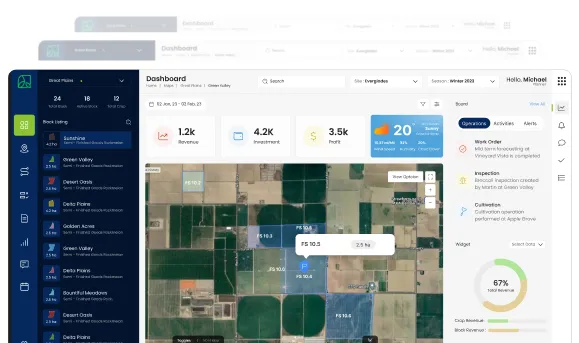
Data Analytics Solution of the Year” 2026 in Agtech Breakthrough Awards 2026



Financial Management is the module that runs the money side of the agribusiness: the books, the cash, the receivables, the payables, the budgets, the taxes, and the period-end close. It is the module that turns every operational event (a spray applied, a pallet packed, a load dispatched, a payment received) into a financial transaction in the right account, on the right date, in the right entity, in real time.
This module is built on an enterprise-grade financial foundation, the same kind that runs the global financials of multinational manufacturers, retailers, and banks. AgriERP inherits the depth of that foundation, multi-entity, multi-currency, multi-jurisdiction tax, audit-ready accounting, and shapes it for agriculture, where costs are tied to blocks and crops and seasons, and revenue arrives in bursts at harvest.
1. General Ledger (GL)
What the GL does
The General Ledger is the central record of every financial event in the business. Every sale, every cost, every payroll run, every depreciation entry, every transfer between accounts, posts to the GL. The chart of accounts defines the structure; dimensions add the agriculture-specific context; the trial balance, balance sheet, and income statement all roll up from it.
| Capability | What it means in practice |
|---|---|
| Chart of accounts | The structured list of accounts the business uses. Configured per entity. Standard agricultural chart of accounts available as a starting point. |
| Financial dimensions | The agriculture-specific tags that go on every transaction: farm, block, crop, variety, season, cost center, activity. Configured once, applied automatically. |
| Multi-entity | Where the business operates through multiple legal entities, each entity has its own GL, with consolidation handling the group-level view. |
| Multi-currency | Transactions in any currency the business uses, with currency revaluation and exchange-gain or loss handled automatically per accounting standards. |
| Journal entries | Automatic posting from other modules is the norm; manual journal entries exist for adjustments and corrections, with approval workflows and audit trail. |
| Period close | Periodic close (typically monthly) closes the books for the period and starts a new one. Pre-close checks run automatically to surface unposted transactions, unreconciled accounts, and known issues. |
| Year-end | Year-end close, with the income statement closing to retained earnings, balances rolling forward, and prior-year data preserved for restatement and audit. |
What makes the GL agriculture-shaped
- Every cost is dimensioned: the chemical cost is not just “Input Expenses”; it is Input Expenses on Block 22, on the 2027 mandarin crop, in the South Farm, in the spray activity. The same cost answers many questions.
- Real-time, not month-end: operational events post to the GL as they happen. The GL is current; reports are not waiting for closing entries.
- Seasonal accruals handled cleanly: agriculture has long cash cycles. Costs accumulated against growing crops are held appropriately until revenue is recognised at sale. Standard accounting practice, supported natively.
- Inter-entity transactions: where farms in different entities share inputs, equipment, or workers, inter-entity transactions are handled correctly with consolidation eliminations.
2. Accounts Payable (AP)
What the AP capability covers
| Capability | What it means in practice |
|---|---|
| Vendor invoices | Invoices from suppliers, processed against purchase orders or as standalone bills. Captured with line-level detail. |
| Three-way match | Standard PO + receipt + invoice match, as described in the Procurement & Consumption Planning module. Matched invoices flow to AP for payment; mismatches surface for resolution. |
| Approval workflow | Invoices route through the configured approval workflow based on value, vendor, and category. Approvers see the full context: PO, receipt, original invoice document. |
| Aging and ageing | How long each invoice has been outstanding, by vendor and by category. Drives payment-priority decisions. |
| Payment runs | Scheduled payment runs select invoices due for payment, generate payment files, and post the payment transactions. Payment methods: bank transfer, cheque, direct debit. |
| Vendor statements | Statements of account per vendor, reconcilable to the vendor’s own records, used for periodic reconciliation. |
| Withholding tax | Where vendor payments are subject to withholding tax (for non-resident vendors, for certain payment types), the withholding is calculated and remitted correctly. |
| Cash flow forecast | Outstanding AP is a primary input to the cash flow forecast: what is due to be paid, when. Combined with AR (what is due to come in), gives the cash position. |
3. Accounts Receivable (AR)
What the AR capability covers
| Capability | What it means in practice |
|---|---|
| Customer invoices | Invoices generated from sales orders automatically, with the right buyer, right pricing (per the contract), and right line detail. Manual invoices for non-order revenue (rebates, ancillary services) supported. |
| Aging and overdue tracking | Each invoice’s age and overdue status. Standard buckets (current, 30, 60, 90+) with the business’s own definitions. |
| Payment receipts | Customer payments received and matched against open invoices. Automatic matching where references are clean; manual matching where needed. Partial payments, advance payments, and overpayments handled. |
| Cash application | Once a receipt is matched, the customer balance and aging update. The cash flows to the bank reconciliation. |
| Credit notes and adjustments | Credits for returns, quality disputes, or rebates. Applied against specific invoices or the customer’s general balance. |
| Collections | Collection workflows for overdue invoices: standard reminders, escalation, and (where needed) external collection. Activities are tracked against the customer record. |
| Customer statements | Statements of account per customer, sent monthly or on demand, supporting customer reconciliation. |
| Credit limits and credit holds | Each customer has a credit limit. Sales orders that would push the customer over the limit trigger a credit-hold workflow. Credit decisions are visible and tracked. |
AR shaped for agriculture
- Seasonal revenue concentration: agriculture often invoices most of the year’s revenue in a few months. The system handles the volume and the working-capital management.
- Quality-related credit notes: quality disputes on produce are common. Credit notes are linked to the original invoice, the lot, the dispute record, and the inventory disposition.
- Contract pricing applied: for contract sales, the contract terms drive the invoice price, with no manual adjustment needed. Disputes drop because the buyer’s PO, the contract, the delivery, and the invoice all agree.
- Bank linkage: for businesses with banking integration, customer receipts flow in through the Integration Layer and match automatically.
4. Budgeting and forecasting
Budget structure
- Annual operating budget: the top-line budget for the financial year, covering revenue, cost, and capital expenditure, with the agreed P&L target.
- Seasonal crop budgets: for each crop and season, a budget covering planned cost per block, planned yield, planned revenue, and expected margin. The agricultural unit of budgeting.
- Department and cost-center budgets: operational budgets for departments and cost centers (operations, packhouse, sales, administration).
- Capital budget: planned capital expenditure on equipment, infrastructure, plantings, with phasing through the year.
Budget vs. actual
The whole point of a budget is comparison against actual. The Financial Management module gives the comparison in real time, across all the same dimensions the budget uses.
| Capability | What it means in practice |
|---|---|
| Live variance reporting | Each budget line shows budget, actual, variance, and variance percentage, refreshed in real time. Red flags surface significant overspend; green flags surface underspend. |
| Drill-down to source | From a budget variance, drill down to the individual transactions that drive it: which work orders, which purchases, which payroll runs. |
| Forecast remaining | Given current run-rate and committed cost, what will the end-of-period actual be? The forecast updates continuously. |
| Re-forecast workflow | Mid-period, the business can produce a formal re-forecast: a new view of where the year will land. Useful for management reporting and for adjusting strategy. |
| Year-over-year trend | Multi-year history makes variance analysis richer: was this overspend a one-off, or a trend? Is this crop becoming more or less profitable over time? |
5. Tax management
What the tax capability covers
| Capability | What it means in practice |
|---|---|
| Output tax (sales tax, VAT, GST) | Tax charged on customer invoices, with the right rate per jurisdiction, per product category, and per customer status (exempt, zero-rated, standard). |
| Input tax | Tax paid on vendor invoices, claimable against output tax in jurisdictions with input-tax credit (VAT, GST). Tracked and reconciled automatically. |
| Withholding tax | Tax withheld from payments to certain vendors (non-resident, professional service providers, royalties). Calculated, withheld, and remitted with appropriate certificates. |
| Sales tax (US-style) | Where applicable, US-style sales tax with jurisdiction nesting (state, county, city, special district), economic-nexus rules, and use-tax reporting. |
| Tax returns | Periodic tax returns generated from the same transaction data. VAT/GST returns, sales-tax returns, withholding-tax returns, all from the books, not from spreadsheets. |
| Multi-jurisdiction | For businesses operating across countries or states, each jurisdiction’s rules are applied to the relevant transactions. Reporting per jurisdiction is automatic. |
| Reverse-charge and zero-rating | Special tax treatments (cross-border services, agricultural zero-rating, export zero-rating) handled per local rules. |
6. Real-time reconciliation
What real-time reconciliation actually means
In most businesses, reconciliation is an end-of-month event: someone in finance reconciles bank accounts, sub-ledgers (inventory, AR, AP), and statutory accounts to the General Ledger. The work is laborious, error-prone, and only good as of the last day of the month. AgriERP’s design philosophy is that reconciliation is a continuous state, not a periodic event. Operational events post to the GL in real time, through the same controlled accounting framework, so the books stay aligned by default.
Where real-time reconciliation pays off
| Capability | What it means in practice |
|---|---|
| Bank reconciliation | Bank transactions flow in through banking integration and match automatically against AR receipts, AP payments, and other bank movements. The bank balance and the GL bank account agree continuously. |
| Inventory to GL | The inventory subledger (the value of inventory across raw, WIP, and finished states) reconciles to the GL inventory accounts continuously, because every inventory movement posts the corresponding GL entry on the same transaction. |
| AR to GL | The total of open customer balances equals the GL receivables balance, always, because invoices and receipts post to both in the same transaction. |
| AP to GL | Same for payables: open vendor balances equal the GL payables balance continuously. |
| Fixed assets to GL | Net book value across the asset register equals the GL fixed-assets balance, with depreciation entries posting automatically each period. |
| Payroll to GL | Payroll liabilities (tax withholdings, employee deductions) and payroll expense post to the GL on the same run that generates the pay slips. |
Period close with real-time reconciliation
Because the underlying reconciliation is continuous, the period close becomes a verification activity rather than a reconciliation activity. The finance team confirms that the books are clean, posts a small number of period-end adjustments (accruals, depreciation, currency revaluation), and closes the period. What used to take a week now takes a day or two.
- Pre-close checks: automatic checks for unposted transactions, unmatched receipts, unapproved invoices, and other items that should be cleaned up before close.
- Period-end adjustments: accruals (revenue earned but not invoiced, expenses incurred but not received), depreciation, prepayments, currency revaluation, all posted as period-end journals through the standard approval workflow.
- Period close: the period is closed; further transactions are locked out (or routed to the next period). The trial balance, balance sheet, and income statement are final for the period.
- Year-end and reporting: year-end close, statutory financial statements, tax returns, and management reporting all flow from the same underlying data, with the audit trail intact.
In summary
Financial Management is the module at the heart of AgriERP’s financial operation. The General Ledger is the master book where every event lands, dimensioned for agriculture. Accounts Payable and Accounts Receivable handle the cash-cycle ends, with three-way matching, approval workflows, and integration to banking. Budgeting and forecasting give the business its planning and control discipline, with budget-vs-actual live across every dimension. Tax management handles the regulatory side natively. And real-time reconciliation keeps the books continuously aligned to the underlying operational data, so period close is a verification event, not a reconciliation marathon.
For the workflow view of how finance is monitored day-to-day, see Business Processes > Monitor Farms. For the agricultural costing view that complements this module, see Functional Modules > Costing & Profitability.