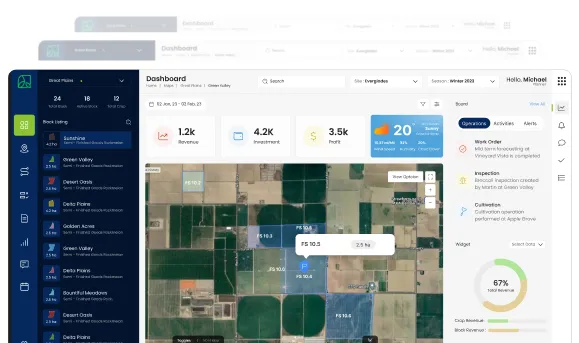
Data Analytics Solution of the Year” 2026 in Agtech Breakthrough Awards 2026


Farm & Field Operations is Phase 2 of the implementation, following the Finance & Infrastructure phase. Eight to fourteen weeks of work that digitises the operational layer of the agribusiness: blocks mapped, crop plans built, work orders flowing, labor captured at source, equipment tracked, mobile devices in the hands of workers, and the financial flow connecting all of it back to the Phase 1 General Ledger.
This document describes what Phase 2 does, how it is sequenced, who plays which role, and what “Phase 2 live” looks like at the end. By the time this phase is complete, the operational reality of the farm is reflected in AgriERP in real time, and the field workforce is doing its work on AgriERP rather than on paper.
1. Phase 2 scope
What is in scope for Phase 2
| Capability | What it means in practice |
|---|---|
| Block setup and mapping | Every block on every farm captured as a structured record: name, area, GPS boundary, crop, variety, planting date, irrigation status. The spatial foundation everything else uses. |
| Crop planning | The agronomic protocols for each crop and block: planned spray schedules, fertilizer programs, irrigation plans, pruning windows, harvest windows. Configured in AgriERP, not in spreadsheets. |
| Work order management | The work-order workflow from creation through assignment, execution, and completion. Templates for the standard agricultural activities (spray, fertilizer, pruning, scouting, harvest, maintenance). |
| Labor tracking | HR records for the permanent workforce; clock-in/clock-out for all workers; piece-rate workflows for harvest workers; payroll integration to Phase 1’s financial backbone. |
| Mobile-app rollout | AgriERP mobile app deployed to supervisors, field officers, machinery operators, and (during peak) the broader workforce. Training delivered; usage embedded in daily work. |
| Equipment and asset management | Every piece of equipment captured as an asset record: identity, location, hours-meter, operator assignments, maintenance schedules. Telematics integration where applicable. |
| Irrigation | Irrigation infrastructure modelled; irrigation schedules captured as work orders; water-use accounting per block; where applicable, integration with irrigation control systems. |
| Finance integration | Every operational transaction flows to the GL with the right dimensions. Labor cost posts to the right block, crop, and season. Equipment costs accumulate. Inventory movements trigger the right inventory subledger entries. |
What is out of scope for Phase 2
- Sales and customer-facing operations: sales orders, customer contracts, dispatch, customer billing. All in Phase 3.
- Supply chain warehouse operations: warehouse management, advanced inventory operations, dispatch. Phase 3.
- Grower-side operations: where the business has an external grower program, grower onboarding, contracts, and settlements are typically built in Phase 3.
- Production order management: the formal production-order workflow for packing and processing comes in Phase 3 alongside the broader supply chain.
2. The standard Phase 2 cadence
Weeks 1 to 2: Foundation and block setup begins
- Folio3 work: Phase 2 kickoff; review of operational design from Discovery; configuration of the farm and block hierarchy in AgriERP; field-officer training for block mapping.
- Customer work: operations leadership engaged; field officers identified for block mapping; existing block records (where they exist) gathered for migration; field walking of blocks for boundary capture begins.
- Milestone: farm and block hierarchy structure agreed; first farm’s blocks mapped; momentum on block boundary capture across the operation.
Weeks 3 to 4: Crop planning, agronomic protocols, work order templates
- Folio3 work: configuration of crop protocols (spray programs, fertilizer schedules, irrigation plans) for each crop and variety; work-order templates built for the standard activities; approval workflows for work orders.
- Customer work: agronomy team engaged to provide the protocols; operations leadership to review work-order templates against current practice; block mapping continues.
- Milestone: agronomic protocols configured; work-order templates built and reviewed; block mapping covering most of the operation.
Weeks 5 to 6: Labor, HR, and equipment configuration
- Folio3 work: HR records configuration; clock-in/clock-out workflows; piece-rate workflows for harvest; payroll integration to Phase 1’s GL; equipment master configuration; telematics integration design where applicable.
- Customer work: HR team engaged to provide existing employee records; payroll team to review payroll integration; operations team to gather equipment master data; review of pay rules and overtime policies.
- Milestone: HR records migrated; labor capture configured; payroll integration tested in sandbox; equipment master populated.
Weeks 7 to 8: Mobile app rollout begins
- Folio3 work: mobile-app configuration for the operation’s roles; mobile-device provisioning support; super-user training; on-site training delivery to the first crews and supervisors.
- Customer work: device acquisition (smartphones or tablets for supervisors, scanners where needed); network connectivity verification at farm sites; field officer training; designation of first-wave users.
- Milestone: mobile app deployed to first wave; supervisors and field officers trained; first work orders captured on mobile in pilot mode.
Weeks 9 to 10: UAT and irrigation integration
- Folio3 work: UAT scripts for the operational workflows (block setup, work-order lifecycle, labor capture, equipment use, irrigation); irrigation control system integration where applicable; defect resolution.
- Customer work: operations super-users execute UAT scripts; IT supports irrigation system access; defects logged; signoff at end of UAT.
- Milestone: UAT completed; irrigation integration in place; super-users confident; signoff received.
Weeks 11 to 12: Broader training and go-live preparation
- Folio3 work: training delivered to the broader workforce (crew supervisors, machinery operators, mid-level managers); production environment provisioned for operations; cutover plan finalised; data migration to production.
- Customer work: training attendance and feedback; communication of go-live to the broader operational workforce; final master-data updates; readiness assessment with Folio3.
- Milestone: broader workforce trained; production environment configured; cutover plan agreed; go-live ready.
Weeks 13 to 14: Go-live and hyper-care
- Folio3 work: go-live cutover; on-site hyper-care at the farms during the first weeks; rapid response to mobile-app issues; daily standup with the operational team; troubleshooting of telematics, irrigation, and integration issues as they surface.
- Customer work: operational workforce using AgriERP for the day’s work; supervisors using it to manage crews; flagging issues quickly; signoff of Phase 2 completion after a stable period.
- Milestone: Phase 2 live; workforce on the mobile app; labor and equipment data flowing; cost dimensions posting to the GL correctly; signoff received.
3. Block setup and mapping
How block setup runs
- Existing records gathered: whatever block records the business has today (paper maps, spreadsheets, prior systems) are gathered as a starting point. They are rarely complete or current; field walking will improve them.
- Boundary capture: field officers walk each block’s perimeter with the mobile app, capturing the GPS boundary. The captured polygon is reviewed for accuracy before approval.
- Attribute capture: for each block: crop, variety, planting date, plant or tree density, irrigation status, soil type, slope and aspect, history of treatments. The agronomy team is involved in confirming the data.
- Hierarchy and grouping: blocks roll up to farms; farms roll up to regions or business units. The hierarchy supports both reporting and operational management.
- Validation: total mapped area is checked against title-deed area, satellite imagery, or other ground-truth references. Discrepancies are investigated before signoff.
- Ongoing maintenance: blocks change over time (replanting, splits, mergers, retirements). The block record is maintained as part of normal operations.
4. Work orders and crop planning
From protocol to work order
- Agronomic protocols defined: for each crop and variety, the standard agronomic protocol: spray schedule, fertilizer program, irrigation plan, pruning windows, scouting frequency. The agronomy team is the source of truth; Folio3 helps capture it in structured form.
- Crop plan per block: each block’s crop plan is instantiated from the protocol, with the block-specific timing and any block-specific variations. The crop plan covers the whole season.
- Work-order generation: the crop plan generates work orders at the right times. Some generate weeks in advance (so they can be scheduled into crews); some generate just-in-time (where weather or condition triggers determine timing).
- Assignment and scheduling: supervisors assign work orders to crews and equipment, with the scheduling tools described in Web App > Planning & Control. Conflicts and capacity issues are surfaced.
- Execution and capture: the field workforce executes the work orders on the mobile app, capturing actuals (time spent, materials used, output achieved, observations) as the work happens.
- Closure and learning: completed work orders close. Variances against plan feed analysis. The protocols are refined for next season based on what worked and what did not.
5. Mobile-app rollout
Mobile rollout components
- Device strategy: supervisors typically get business-provided smartphones or tablets; broader workforce may use their own devices (BYOD) or shared devices. The strategy is decided per role.
- Device procurement and provisioning: where the business is providing devices, procurement is planned with lead time. Devices are provisioned with AgriERP, mobile-device management agents, and the basic productivity tools the workforce needs.
- Network coverage assessment: every farm site is assessed for network coverage. Where coverage is unreliable, the offline-first design of the mobile app accommodates; where coverage is genuinely poor, options include Wi-Fi coverage at key sites or alternative connectivity solutions.
- Phased rollout: the rollout is typically phased: pilot crews first, then expand. Lessons from the pilot inform the broader rollout. Big-bang mobile rollouts at full workforce scale are risky and avoided.
- Training in local language: training is delivered in the languages workers speak, by trainers who can use those languages. Cascading training (Folio3 trains super-users; super-users train workers) is often the most effective model.
- Visual and hands-on learning: training uses real devices, real scenarios, real data. Lecturing about software is not training; doing the work on the app is training.
- Champions and super-users: in every crew or team, identifying the people who pick up the app naturally and supporting them to help their peers. Peer support is more effective than help-desk tickets at the workforce level.
Common rollout challenges and how they are managed
| Capability | What it means in practice |
|---|---|
| Device unfamiliarity | Some workers have not used a smartphone before, or have used one only for calls and messaging. Training meets them where they are; the mobile app’s design choices (touch targets, glanceable surfaces, local language) help. |
| Connectivity gaps | Most rural agricultural operations have connectivity gaps. The offline-first design handles them; staging Wi-Fi at clock-in points or supervisor vehicles helps the field officer model. |
| Device loss and damage | Devices in agricultural settings get dropped, splashed, lost. Rugged cases, screen protectors, replacement processes, and mobile device management are planned for from the start. |
| Initial productivity dip | When workers first use the app, productivity often dips for a week or two as they learn. Communicated upfront, planned for in operational schedules, recovers quickly. |
| Worker mistrust | Some workers initially see the mobile app as surveillance. Honest communication about what data is captured and how it is used, paired with the productivity benefits workers experience themselves, addresses this over time. |
6. Finance integration
Where the financial flow lives in Phase 2
- Labor cost: hours captured on mobile flow to payroll; payroll posts loaded labor cost to the GL; the cost lands on the right block, crop, and season because the work order carried those dimensions.
- Equipment cost: equipment hours used on work orders accumulate against the asset; the operating cost rate is applied; the cost flows to the work order, then to the block and crop.
- Input consumption: chemicals, fertilizers, fuel issued to work orders deduct from inventory and post the cost to the work order. The inventory subledger reconciles to the GL inventory accounts continuously.
- Indirect cost allocation: supervisor time, agronomist salaries, and farm overhead allocate to crops on the configured basis. Allocation rules are established in Phase 2 (refined in Phase 3 as the picture becomes clearer).
- Asset capitalisation and depreciation: equipment depreciation runs through the GL on the configured schedule. New equipment acquired during Phase 2 is recorded as a capital purchase, depreciation schedule generated automatically.
- Reconciliation to Phase 1 GL: the operational subledgers (inventory, fixed assets, payroll liabilities) reconcile continuously to the GL accounts. Finance can produce financial statements that include the operational activity, not just the Phase 1 baseline.
Why timing Phase 2 around the season mattersPhase 2 go-live ideally happens between major operational events, not in the middle of harvest or another peak. Going live during peak harvest means training new users while they are doing the busiest work of the year; the failure modes are predictable.Where possible, Phase 2 goes live in a quieter operational period, often a few weeks before the next major activity (harvest, planting, end-of-season cleanup). The workforce learns the system during a manageable period and is fluent in it before the next peak. Folio3’s planning takes this into account during Discovery.
In summary
Phase 2, Farm & Field Operations, runs 8 to 14 weeks and digitises the operational layer of the agribusiness. Every block is mapped and structured. Crop plans capture the agronomic protocols. Work orders flow from creation through execution. Labor is captured at source on the mobile app. Equipment is tracked, maintained, and costed. Irrigation is modelled and integrated. And every operational transaction posts to the GL built in Phase 1, with the right dimensions, so cost flows from the field to the books in real time.
With Phase 2 live, the farm is digital. Workers use the mobile app; supervisors use the web app; managers have live operational visibility. Phase 3 then builds the commercial and supply-chain layer on top of this foundation.