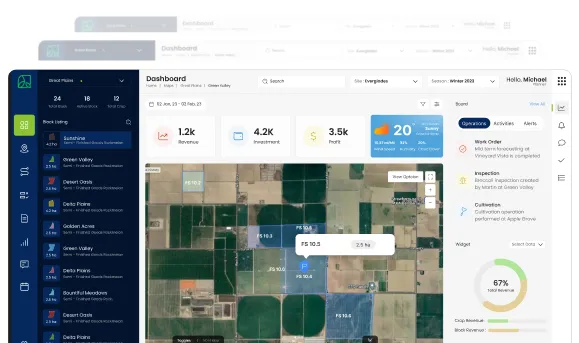
Data Analytics Solution of the Year” 2026 in Agtech Breakthrough Awards 2026



Supply Chain, Warehouse & Logistics is Phase 3 of the implementation, the largest and most commercially impactful phase. Ten to sixteen weeks of work that digitises everything between “the produce is harvested” and “the buyer’s payment is in the bank.” Quality control at intake. Warehouse operations down to the bin level. Production orders running the packhouse. Sales orders and contracts with buyers. Dispatch and transportation. Traceability through every step. Vendor management on the inbound side. By the end of this phase, the entire commercial cycle of the agribusiness runs on AgriERP, with every step structured, traceable, and connected back to the financial system.
This document describes what Phase 3 covers, how it is sequenced over 10 to 16 weeks, who plays which role, and what “Phase 3 live” looks like at the end.
1. Phase 3 scope
What is in scope for Phase 3
| Capability | What it means in practice |
|---|---|
| Quality control | QC workflows at every checkpoint: receiving (incoming materials and harvested produce), in-process (during packing or processing), pre-dispatch (final inspection before shipping). Quality states, sampling rules, test plans, dispositions. |
| Warehouse operations | Warehouse setup with the full storage hierarchy (zones, aisles, bays, bins). Receiving, putaway, replenishment, picking, packing, dispatch. Cycle counting and stocktake processes. Cold-store and special-condition handling. |
| Production orders | Production-order workflow for the packhouse and processing operations. Materials issued to production; output reported; WIP accounting; finished-goods inventory generated with full traceability. |
| Inventory traceability | End-to-end traceability from harvest to dispatch. Every pallet, every carton, every batch traceable back to its source block, harvest crew, packing shift, with the full chain of custody. |
| Sales orders and contracts | Sales-order workflow from order receipt (manual or via EDI) to allocation, dispatch, invoicing, and collection. Long-term contracts with structured terms, volume tracking, and commitment management. |
| Shipping and dispatch | Dispatch workflows, route planning, load building, carrier management, documentation (bills of lading, packing lists, customs documents where applicable), in-transit tracking. |
| Vendor management | Vendor master fully built out; procurement workflow with three-way matching; vendor performance tracking; supplier portal where applicable. |
| Buyer integrations | Specific buyer EDI integrations, retailer-specific labels and documents, customer portals. Configured per the catalogue of buyer relationships. |
| Grower management (where applicable) | For businesses with grower programs: grower onboarding, contracts, settlements, grower portal. The full grower-management capability. |
What is out of scope for Phase 3
- Significant new capabilities beyond the agreed scope: scope creep at this stage is the implementation team’s biggest enemy. New capabilities are recorded for post-go-live optimisation, not added to the active Phase 3 scope.
- Advanced cost-allocation refinement: the baseline allocation rules are in place from Phase 1 and Phase 2; Phase 3 establishes the data needed for richer allocation, but refinements typically happen in the post-go-live optimisation cycle.
- Heavy customisation: Phase 3 uses standard product capabilities configured for the business. Where the business has unusual requirements, the right path is configuration and integration; building bespoke modules is avoided.
2. The standard Phase 3 cadence
Weeks 1 to 3: Foundation across warehouse, production, sales, vendor
- Folio3 work: Phase 3 kickoff. Warehouse structure setup (zones, bins, capacity). Production-order workflows configured. Sales-order workflows configured. Vendor and procurement workflow setup. Initial scope review with operational leads.
- Customer work: warehouse leadership engaged for the bin-by-bin warehouse design. Sales and commercial leads for contract and order workflows. Procurement lead for vendor management. Customer master cleansing for sales-order workflows.
- Milestone: warehouse structure designed; production, sales, and procurement workflows in configuration; master data preparation underway.
Weeks 4 to 6: Quality, traceability, dispatch
- Folio3 work: QC workflows configured at all checkpoints; traceability data model fully populated (linking blocks, harvest, packing, dispatch); dispatch workflow configured; carrier and routing data captured.
- Customer work: QC manager engaged for sampling rules and test plans; logistics manager for dispatch and carrier setup; traceability mapping with operations leadership.
- Milestone: QC and traceability workflows ready; dispatch workflow configured; carrier integrations agreed.
Weeks 7 to 9: Buyer EDI and grower management
- Folio3 work: buyer EDI integrations built (one per major buyer, tested individually in sandbox); grower onboarding, contract, and settlement workflows configured (where in scope); supplier portal configured where applicable.
- Customer work: buyer technical contacts engaged for EDI testing; grower program manager for grower-side workflows; supplier engagement for portal access.
- Milestone: buyer EDI integrations tested with each buyer’s test endpoints; grower workflows ready (where applicable); supplier portal in pilot.
Weeks 10 to 12: UAT
- Folio3 work: UAT scripts cover the full commercial cycle end to end: receiving, warehouse operations, production orders, sales orders, dispatch, invoicing, payment matching, vendor invoicing. Defect resolution as UAT runs.
- Customer work: super-users from every operational area execute UAT scripts together, simulating real commercial flows. Logged defects prioritised. Signoff at end of UAT.
- Milestone: end-to-end UAT completed; commercial cycle works in test; super-users confident; signoff received.
Weeks 13 to 14: Broader training and go-live preparation
- Folio3 work: training delivered across the broader workforce in supply chain (warehouse workers, dispatch team, sales support, procurement, QC inspectors); production environment configured; cutover plan finalised; final data migrations.
- Customer work: training attendance; communication to buyers about EDI cutover; communication to vendors about new procurement workflow; communication to growers about portal access (where applicable); operational readiness signoff.
- Milestone: broader workforce trained; external parties informed; production environment ready; go-live ready.
Weeks 15 to 16: Go-live and hyper-care
- Folio3 work: go-live cutover (often phased rather than big-bang, by warehouse or by buyer relationship); on-site hyper-care; rapid response to issues; daily standup; buyer-side issue resolution where EDI integrations need adjustment.
- Customer work: warehouse running on AgriERP; sales orders flowing through the system; dispatch happening through the new workflow; buyer EDI in live operation; vendor and grower workflows in live operation; signoff of Phase 3 after a stable period.
- Milestone: Phase 3 live; full commercial cycle on AgriERP; signoff received; implementation effectively complete.
3. Quality control and traceability
QC workflows configured in Phase 3
- Incoming material inspection: for inputs from suppliers and produce from external growers, the receiving-inspection workflow. Sampling rules, test plans, acceptance criteria, disposition.
- Harvest intake QC: for produce from the business’s own farms, the intake inspection at the weighbridge or receiving point. Grading, condition, defect capture.
- In-process inspection: during production runs, sampling and testing on the line, with results posting against the production order in real time.
- Pre-dispatch QC: final inspection of packed product before dispatch, especially for export and premium-grade product.
- Storage QC: periodic re-inspection of stored product, especially long-term cold-store inventory.
Traceability
- Inbound traceability: every bin received from the field linked to its source block, harvest crew, harvest date. Inputs from suppliers linked to supplier lot, expiry date, certification status.
- Production traceability: every production run linked to its inputs (raw harvest, packaging, labor, equipment) and its outputs (finished cartons, pallets). The audit trail is complete in both directions.
- Outbound traceability: every pallet shipped linked to its buyer order, its carrier, its destination. The buyer’s traceability lookup answers immediately.
- Recall capability: if a recall is needed, the system can identify every customer who received product from a specific lot, in seconds. The recall conversation becomes targeted, not panicked.
- Buyer audit support: when a buyer audits, the traceability data is available in their preferred format, with the supporting QC records, spray records, and certifications attached.
4. Sales orders, contracts, and the commercial cycle
The sales-order workflow in Phase 3
- Order origination: buyer orders arrive through EDI, the buyer portal, email-to-order processing, or manual entry by the sales team. All converge to a structured sales order in AgriERP.
- Pricing application: pricing is applied automatically per the active contract terms with the buyer. Manual pricing exceptions need approval; the audit trail captures who approved what.
- Credit check: the sales order is checked against the buyer’s credit limit and current exposure. Orders that would breach the limit route through a credit-hold workflow.
- Allocation and reservation: inventory is reserved against the order, with the right grade, certification, and traceability attributes. Shortages flag immediately.
- Dispatch planning: the order joins the dispatch queue with its delivery window. Load building groups orders into vehicles; route planning chooses the carrier and route.
- Execution and confirmation: dispatch happens; advance shipment notices flow to buyers; proof of delivery returns from carriers.
- Invoicing: the invoice generates from the dispatch data, with the right pricing, tax, and line detail. Delivered to the buyer via EDI, email, or portal.
- Payment matching: buyer payments flow in through banking integration and match against invoices. Disputes are surfaced for the sales team to investigate.
Contracts
- Structured contracts: long-term buyer contracts captured with structured terms: volumes, prices (fixed, indexed, or formula), quality criteria, delivery windows, settlement terms, exclusivity.
- Volume commitment tracking: as deliveries are made against the contract, the running total updates against the commitment. The contract dashboard shows progress in real time.
- Forward demand: contracts feed the demand forecasting and the season planning. The business knows what it has committed to deliver, when, at what price.
- Renewal and amendment workflows: as contracts approach expiry, renewal workflows surface them for renegotiation. Mid-contract amendments use the variation workflow with proper approval.
5. Phase 3 risks and mitigations
| Capability | What it means in practice |
|---|---|
| Scope creep | After Phases 1 and 2 deliver visible value, every department wants “just one more feature.” Mitigation: strict scope discipline in the steering committee; new requests captured for post-go-live optimisation; the agreed scope is delivered first. |
| Buyer EDI complexity | Different buyers have different EDI formats, different testing processes, different acceptance criteria. Mitigation: each buyer integration is treated as its own mini-project; engaged early in Phase 3; tested individually. |
| Warehouse design overruns | Designing the bin-by-bin structure of every warehouse can become a rabbit hole. Mitigation: structured workshops with the warehouse leadership; reasonable design decisions made and revisited later if needed. |
| Going live during peak season | Same risk as Phase 2: going live during peak is harder. Mitigation: Phase 3 go-live is planned around the operational calendar; phased rollout (by warehouse or by buyer) where a single go-live cannot be timed cleanly. |
| External party readiness | Buyers, vendors, and growers may not be ready when AgriERP is. Mitigation: external engagement starts early in Phase 3; specific dates communicated; fallback paths (manual processing) ready for parties that need more time. |
| Integration with existing systems | Where existing systems will continue running alongside AgriERP, the integrations between them need careful design. Mitigation: integration architecture established in Discovery and Phase 1; specific integrations built and tested in Phase 3. |
Why Phase 3 is where the commercial value really landsPhase 1 delivers financial system value. Phase 2 delivers operational visibility. But Phase 3 is where the commercial cycle, the most consequential part of any agribusiness, is digitised. Buyers get faster, more accurate orders. Dispatch becomes structured and predictable. Quality issues surface earlier and resolve faster. Traceability becomes a real capability rather than a compliance exercise. Vendor management becomes a managed function. Working capital starts to optimise as cash flows through the cycle predictably.The agribusiness that finishes Phase 3 has a fundamentally different commercial posture from the one that started Phase 0. The competitors who have not done this transformation are now visibly behind.
In summary
Phase 3, Supply Chain, Warehouse & Logistics, runs 10 to 16 weeks and digitises the commercial cycle of the agribusiness. Quality control, warehouse operations, production orders, sales orders, contracts, dispatch and logistics, vendor management, inventory traceability, and buyer integrations all reach production. By the end of Phase 3, the entire flow from inbound input to outbound product to buyer payment runs on AgriERP, with every step structured, traceable, and connected back to the financial system from Phase 1 and the operational system from Phase 2.
The implementation phases are now complete. The business is running on AgriERP end-to-end. Phase 4, Intelligence, Automation & Support, has been running in parallel across all phases and continues into the post-go-live steady state.