Data Analytics Solution of the Year” 2026 in Agtech Breakthrough Awards 2026


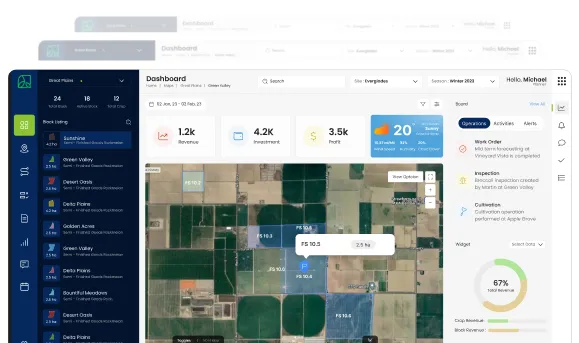
The Core ERP Layer is the engine room of AgriERP. It is the part of the system that makes the books real, the supply chain reliable, and the workforce manageable. Everything else- the field app, the dashboards, the AI Companion, the grower portal, connects to it and depends on it.
AgriERP is built on an enterprise-grade ERP foundation, the same kind of platform used by global manufacturers, retailers, and energy companies. That means you do not buy a niche piece of farm software and hope it is strong enough to run a real business. You inherit a globally trusted financial backbone, supply chain engine, and HR system, and it shapes them for agriculture.
This section walks through the three pillars of the Core ERP Layer:
- Financial Management: how the money side of the business is run.
- Supply Chain Management: how inputs, inventory, and goods flow through the operation.
- Human Resources: how the people who do the actual work are managed and paid.
Each pillar has been engineered for agribusiness, with the agricultural extensions layered on top of an enterprise ERP foundation. The end of this section explains how to think about which underlying edition fits your business.
1. Financial Management
In one line Run your global financial operations in real time, see what is happening as it happens, and make decisions on actual numbers instead of month-old reports.
Why this matters for an agribusiness
Agriculture has the hardest financial picture of any industry. Costs vary by block, by crop, by season. Revenue depends on yield and market prices. Cash is tied up in growing inventory you cannot yet sell. Tax rules are complicated. Audit requirements are strict. And most farms still close their books weeks after the month ends, working from spreadsheets and bank statements.
AgriERP’s Financial Management module solves this by giving you a single, real-time financial view of the entire business, connected directly to what is happening on the land.
What it does
Financial Management covers the complete financial cycle of an agribusiness:
| Capability | What it means in practice |
|---|---|
| General Ledger (GL), the master book of accounts. | Every cost, every sale, every payroll run, every input used in the field is automatically recorded. No manual journal entries. |
| Accounts Payable (AP), what you owe suppliers. | Invoices from input suppliers, equipment vendors, contractors, and utilities are tracked, approved, and paid on time, with full audit trails. |
| Accounts Receivable (AR), what customers owe you. | Sales orders, contracts, and invoices are linked. You see exactly which buyers are paying on time and which need chasing. |
| Budgeting and forecasting. | Set a budget per farm, per crop, per season. Watch actual spend against it, in real time. Forecast end-of-season profit before harvest, not after. |
| Cash flow management. | See how much cash you have, how much is committed, and what is coming in, by week, by month, by quarter. |
| Tax management. | Sales tax, VAT/GST, withholding tax, and country-specific compliance handled inside the system. No spreadsheets, no last-minute scrambling at year-end. |
| Bank reconciliation. | Match bank transactions to the books automatically. What used to take days each month happens in minutes. |
| Multi-entity, multi-currency. | If you operate across legal entities, farms in different countries, or sell in multiple currencies, the system handles it natively. |
What this changes day to day
- For finance directors and controllers: month-end stops being archaeology. You see the real numbers as the month unfolds.
- For owners and CEOs: you stop asking “how are we doing?” and start asking “how are we doing on Block 14, this season, against budget?” and getting an answer in seconds.
- For auditors and banks: clean, traceable, audit-ready records, with every transaction tied back to a source document and a real-world activity.
How AgriERP shapes Financial Management for agriculture Standard ERP finance treats every cost as a number against an account code. That is not how farms actually work. AgriERP extends Financial Management so that every cost is also tagged to a farm, a block, a crop, and a season.That means a single bag of fertilizer used in March on Block 22 does not just show up in “Input Expenses.” It shows up as a cost against almonds, on Block 22, in the 2026 season, automatically. When the harvest comes in, you see the true profit per block, per crop, per season, with no end-of-year reconciliation work.
2. Supply Chain Management
In one line Build an adaptable, resilient supply chain that reacts to challenges automatically, using real-time visibility, agile planning, and advanced insights.
Why this matters for an agribusiness
In agriculture, supply chain is not a back-office concept; it is the business. Inputs have to be in the right place at the right time or planting is delayed. Harvested produce has to move from field to packhouse to buyer in days, sometimes hours. A single broken link, a missed delivery, a misread inventory count, a load stuck in transit, can cost an entire season’s margin on that crop.
AgriERP’s Supply Chain Management module gives the business a connected, real-time view of every physical thing it owns and every physical thing it is waiting for.
What it does
Supply Chain Management covers eight core areas:
Procurement and supplier management
Manage the full purchasing cycle: vendor records, requests for quotation, purchase orders, approvals, goods receipt, and three-way matching to invoices. Compare what you forecast you would need against what you actually used, season after season.
Inventory management
Track raw materials, work-in-progress, finished goods, and consumables across multiple warehouses, locations, bins, and storage units. Know exactly what you have, where it is, what condition it is in, and what it is reserved for.
Warehouse management
Run packhouses, cold storage, dry stores, and depots as professional warehouses. Capacity planning, bin management, picking, putaway, and quality control, all built in. Mobile-friendly so warehouse staff scan and move goods directly from the floor.
Production management
Manage harvest into packing, sorting, grading, processing, and shipping as production orders. Track work-in-progress. Record chemical and input usage against the right production run. Keep a full audit trail from field to finished pallet.
Quality management
Inspections, sampling, and quality records, for incoming raw materials, for harvested produce, for packed goods. Hold suspect inventory, run quality tests, release or reject batches, and keep the full record for buyers, auditors, and regulators.
Demand forecasting and planning
Forecast demand from historical sales, signed contracts, and market signals. Plan procurement and production around it. The system flags shortages and surpluses before they become problems.
Sales orders and fulfillment
Take orders from buyers, allocate them against available inventory, schedule shipments, and track delivery. Linked directly to invoicing and Accounts Receivable, so the financial side closes itself.
Transportation and logistics
Plan loads, build routes, dispatch vehicles, and track shipments, gate to customer. Reduce mileage, improve delivery reliability, and give buyers accurate ETAs without phone calls.
What this changes day to day
- For operations managers: you stop running the warehouse, the packhouse, and the dispatch desk by phone and clipboard. Every movement is recorded, visible, and linked to costs.
- For procurement: you stop over-ordering “just in case” and stop running out of critical inputs. Forecast vs. actual is finally an honest conversation.
- For sales and contracts: when a buyer asks “can you do another 20 pallets next week?” you have an answer in seconds, based on real inventory and real production capacity.
How AgriERP shapes Supply Chain for agriculture A standard SCM module thinks in terms of products, warehouses, and trucks. AgriERP extends it to think in terms of crops, blocks, varieties, harvest batches, packouts, lot codes, expiry dates, and storage conditions.So when a buyer asks for traceability on a specific pallet, the system can show, in seconds, which block the produce came from, which crew harvested it, what chemicals were used on the crop, when it was packed, who inspected it, and where it has been stored. That is not bolt-on functionality; it is how the agriculture-shaped SCM works.
3. Human Resources
In one lineConnect your people data and your operations data so you can manage workforce costs, support your employees, and run a compliant, fair workplace.
Why this matters for an agribusiness
Labor is one of the largest costs on most farms, and the hardest to manage. Workforces are seasonal, often spread across multiple farms, mixing full-time staff with contractors and day labor. Compliance rules are strict. Mistakes, under-payment, over-payment, missed hours, missed safety records, are expensive in cash, in trust, and in audits.
AgriERP’s Human Resources module makes the workforce a managed, measurable, and compliant part of the business, not a logistical crisis.
What it does
Human Resources covers the full employee lifecycle:
| Capability | What it means in practice |
|---|---|
| Employee records and master data. | One central record per worker, full-time, seasonal, or contractor, with documents, certifications, training, and visa/work permit status. |
| Organization structure. | Map your real-world structure: farms, packhouses, departments, supervisors, reporting lines, and cost centers. |
| Recruitment and onboarding. | Open positions, candidate tracking, hiring decisions, and onboarding workflows, with all paperwork digital and centralized. |
| Time and attendance. | Clock in/out from the mobile app, in the field. Track hours by worker, by block, by activity, by job code. No paper time-sheets. |
| Leave and absence management. | Vacation, sick leave, public holidays, and special leave, requested, approved, and tracked through the system. |
| Compensation and payroll. | Pay rules for hourly, salaried, piece-rate, and overtime work. Run payroll, generate pay slips, and post directly to the General Ledger. |
| Benefits administration. | Health insurance, retirement contributions, and other benefits, tracked per employee and reported to providers. |
| Performance and training. | Skill records, certifications (pesticide handling, machinery operation, food safety), training plans, and renewal alerts. |
| Compliance and reporting. | Statutory filings, labor law compliance, safety incident records, and audit-ready reports for inspectors and authorities. |
What this changes day to day
- For HR and payroll teams: time tracking, payroll runs, and compliance reporting move from a manual end-of-pay-period crisis to a continuous, accurate process.
- For operations managers: you can see who is on the farm today, who is certified for which tasks, and what the labor cost of each block, crop, and activity actually is.
- For owners: workforce cost stops being a black box. You know what you spent, where you spent it, and what you got for it.
How AgriERP shapes HR for agriculture Standard HR systems are built for offices: people work fixed hours, do similar tasks, and clock in at one location. Farms are the opposite. The same crew can work three blocks in one shift, doing two different jobs, with mixed pay rules.AgriERP extends HR for that reality. Workers clock in and log activity directly from the mobile app in the field, with GPS verification. Hours are split across blocks and activities automatically. Piece-rate work, paid per bin, per crate, per acre, is captured as it is done. The hours that show up in payroll are the same hours that show up as labor cost on the right crop, in the right season.
Editions of AgriERP
AgriERP comes in editions sized to fit different agribusinesses. The functionality you see, the apps, the modules, the agriculture-specific extensions, is the same across all editions. What changes is scale, depth, and which option suits the size and complexity of your operation.
| Edition | Best for |
|---|---|
| AgriERP Lite | For small growing operations starting to digitalize. Includes the core farm management capabilities and an entry-level financial backbone. |
| AgriERP Standard | For small and mid-sized agribusinesses ready for a real ERP. Full Financial Management, Supply Chain, and HR, with the agriculture-specific extensions, on a mid-market ERP foundation. |
| AgriERP Advance | For large, complex, or multi-site agribusinesses. Built on an enterprise ERP foundation, with multi-entity consolidation, advanced costing, complex tax handling, full warehouse and production management, and the deepest analytics. |
The important point to take awayThe edition you choose is a business decision, not a technology constraint.Whichever edition you pick, the agriculture layer of crops, blocks, harvests, contracts, growers, settlements, and the field, web, and mobile experience looks and behaves the same. Your finance team gets a globally trusted ERP foundation. Your field team gets the same mobile app. Your data lives on enterprise-grade infrastructure either way.Most growing agribusinesses start on AgriERP Lite or Standard, then migrate to Advance as the operation scales. AgriERP supports that journey without rebuilding anything in the agriculture layer.
Putting the three pillars together
Finance, Supply Chain, and HR do not live in three separate compartments. In AgriERP, they are tied to the same activities and the same data. A single event in the field touches all three, and the system handles it as one connected story:
One activity, three pillars working together
A spray crew applies pesticide to Block 14 on a Tuesday morning.
Human Resources logs the crew’s hours, confirms their certifications are current, and adds the labor to payroll.
Supply Chain Management deducts the chemical from inventory, records the application against the crop, and updates the spray history for compliance.
Financial Management applies the cost of labor, equipment, and chemical to that block, that crop, that season, and updates the budget vs. actual report.
What to read next
The next part of this document moves up from the Core ERP Layer into the user-facing layer, starting with the Farm Web App, where operations managers and growers spend their day.
If you would like a deeper look at the agriculture-specific behavior of each pillar, see the later sections on Functional Modules, Business Processes, and Reporting.