Data Analytics Solution of the Year” 2026 in Agtech Breakthrough Awards 2026


Before we look at any single module, it’s worth stepping back and seeing how the entire AgriERP platform is put together. This section gives you the big picture, what the system is made of, how the pieces connect, and what each piece does for your business.
This is not a technical schematic. It’s a guided tour of the building, floor by floor, written for the people who run the agribusiness, not the people who maintain the servers.
AgriERP is built in layers. Each layer has a clear job, and they all work together to deliver one experience to the user. The diagram below shows the full stack.
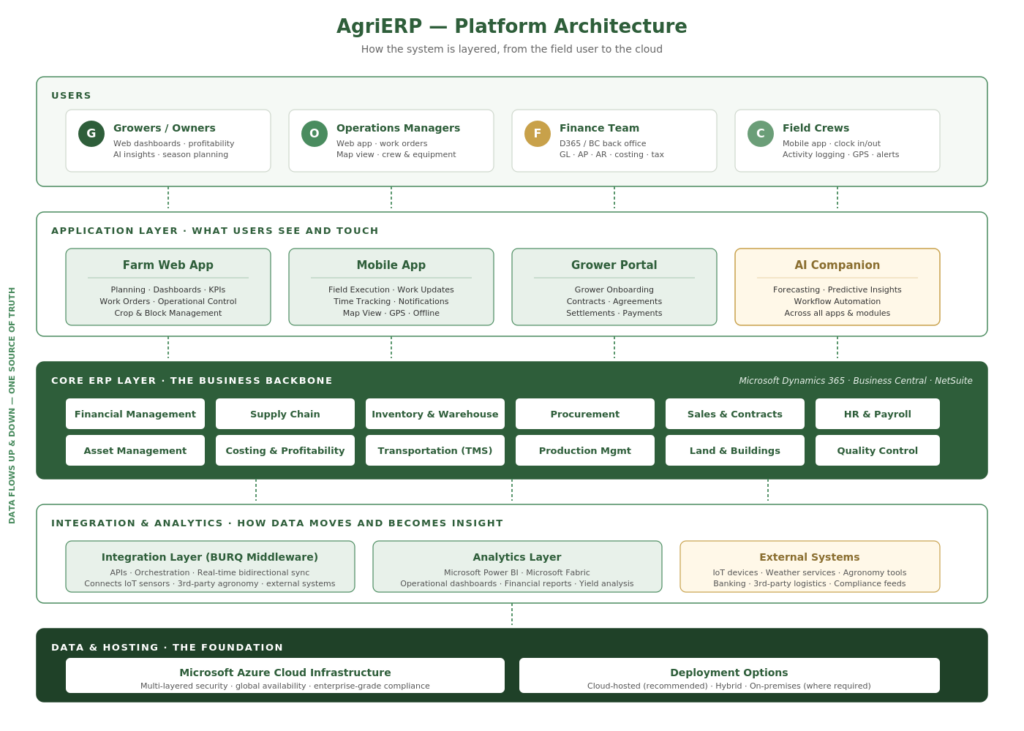
Read the diagram top-down. The further down you go, the deeper into the system you are — but the same data flows through every level. A field worker tapping their phone, a finance director closing the books, and a CEO checking a dashboard are all looking at different views of the same information.
The five layers are:
- Users: the four kinds of people who actually use AgriERP every day.
- Application Layer: the apps and screens that users see, including the AI Companion that runs across all of them.
- Core ERP Layer: the business backbone, built on Microsoft Dynamics 365 or Business Central.
- Integration & Analytics: how AgriERP exchanges data with the outside world and turns activity into reports.
- Data & Hosting: the foundation that keeps it all running, secured, and available.
Layer 1 — Users
Every layer in the architecture exists to serve one of four user groups. AgriERP doesn’t force them all into the same screen; it gives each of them a tool shaped for their role, while keeping the data underneath identical.
Growers and Owners see live dashboards, profitability views, AI insights, and season-level plans, usually on the web.
Operations Managers use the web app to plan and assign work, and the map view to track crews and equipment in real time.
Finance Teams work directly inside the Microsoft Dynamics 365 or Business Central back office: General Ledger, Accounts Payable, Accounts Receivable, costing, tax.
Field Crews use the mobile app to clock in, log activity, follow GPS-tagged jobs, and receive alerts.
Layer 2 — Application
This is what users actually see and touch. AgriERP delivers four front-end experiences, each designed for the way a particular role works.
Farm Web App
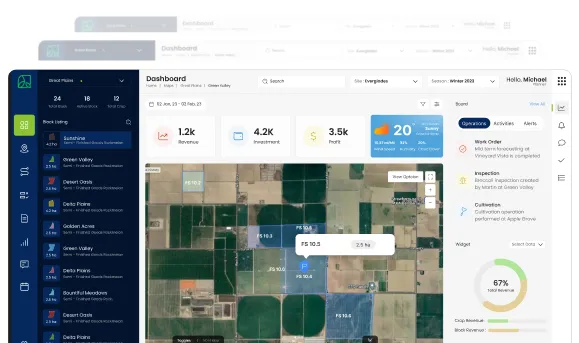
The control room of the agribusiness. It’s where operations managers plan, assign, and monitor work. Dashboards show what’s being done across every farm and block. KPIs surface the numbers leadership cares about. Work orders are created, scheduled, and tracked. Crop and block planning happen here.
Mobile App
Built for the field, for someone wearing gloves, standing in a row of trees, on a 4G connection or no connection at all. Field crews use it to receive their day’s work orders, log activity as they complete it, clock in and out, view their assigned blocks on a GPS map, and receive notifications instantly. The app captures real-world activity at the moment it happens.
Grower Portal
A dedicated workspace for the third-party growers an agribusiness contracts with. Through the portal, growers complete onboarding, view and accept contracts, track their commitments, and receive their settlements and payment reports. It removes phone calls, paperwork, and disputes, and gives growers the same transparency you have.
AI Companion
AgriERP’s AI assistant runs across all the apps above, not as a separate product. It can pull up data on request, draft reports, automate repetitive ERP actions (like raising a purchase order or generating an invoice), surface predictive insights about yield or demand, and suggest next steps based on what it sees in your data. Think of it as a digital colleague that already knows the system.
Layer 3 — Core ERP Layer
This is the business backbone. Underneath the friendly apps, AgriERP runs on a full Microsoft Dynamics 365 or Business Central installation, the same enterprise platform used by Fortune 500 companies in dozens of industries. AgriERP extends it with agriculture-specific modules, but you inherit the rigor of a globally trusted ERP.
The Core ERP Layer holds twelve foundational modules that cover the full business:
| Module | What it handles |
|---|---|
| Financial Management | Cost per Crop, Season Costing, General Ledger, Accounts Payable, Accounts Receivable, budgeting, tax, and bank reconciliation. |
| Supply Chain | End-to-end flow of materials and goods, from supplier to warehouse to customer. |
| Inventory & Warehouse | Raw materials, work-in-progress, finished goods. Locations, harvest batches, lot traceability, capacity, quality control. |
| Procurement | Vendor management, purchase orders, and forecast vs. actual consumption tracking. |
| Sales & Contracts | Sales orders, customer contracts, fulfillment tracking, invoicing, and payment processing. |
| HR & Payroll | Farm employee records, attendance, clock in/out, payroll runs, labor cost tracking. |
| Asset Management | Equipment, vehicles, and fixed assets, including breakdowns, maintenance, depreciation, and lifecycle. |
| Costing & Profitability | True cost and margin per crop, per block, per season, connected to actual operations. |
| Transportation (TMS) | Route planning, load building, dispatch, and shipment tracking from gate to customer. |
| Production Management | Harvest → Packhouse flow: Harvest into packhouse, production orders, chemical and input usage, and work-in-progress tracking. |
| Land & Buildings | Farms, warehouses, storage units, and other physical assets are structured and tracked. |
| Quality Control | Inspections, compliance checks, and quality records across inventory and production. |
A note on your ERP choice
AgriERP is designed to run on three Microsoft-family options, depending on the size and complexity of the business:
Dynamics 365: for large, complex, multi-site agribusinesses.
Business Central: for small and mid-sized growing operations ready for a real ERP backbone.
NetSuite: available for businesses already standardized on Oracle’s ERP.
The agriculture-specific layer of AgriERP looks and behaves the same way across all three. Your choice is a business decision, not a software constraint.
Layer 4 — Integration and Analytics
A modern agribusiness doesn’t live in a single system. It uses weather services, IoT sensors in the field, third-party agronomy tools, banking platforms, logistics partners, and compliance feeds. This layer is what allows AgriERP to live comfortably in that real-world ecosystem.
Integration Layer (BURQ Middleware)
BURQ is the messenger between AgriERP and everything else. It moves data in and out, automatically, in real time, in both directions. When an irrigation sensor reports a moisture reading, BURQ delivers it to AgriERP. When AgriERP updates a sales order, BURQ pushes it to the logistics partner. Crews and managers don’t see BURQ; they just see information that’s always up to date.
Analytics Layer
Activity in the system is one thing. Insight from that activity is another. The Analytics Layer, built on Microsoft Power BI and Microsoft Fabric, turns operational and financial data into the dashboards, reports, and yield analyses that drive decisions. It’s where the season’s story gets told in numbers.
External Systems
Anything outside AgriERP that needs to exchange data, weather services, IoT devices, agronomy platforms, banking, third-party logistics, regulatory feeds, connects in through this layer. The point is simple: AgriERP doesn’t replace your ecosystem; it ties it together.
Layer 5 — Data and Hosting (the foundation)
Underneath everything sits the foundation that keeps the system running, secure, and available everywhere your business operates. AgriERP is hosted on Microsoft Azure, the same cloud platform trusted by governments, banks, and Fortune 500 enterprises.
What this means for you, in practical terms:
Multi-layered security. Your farm data, financials, contracts, and grower information are protected by the same enterprise-grade security used in regulated industries.
Global availability. If your operation spans countries or regions, the system follows you, same data, same performance, anywhere with internet.
Deployment flexibility. Most agribusinesses run AgriERP fully cloud-hosted (the recommended path). Hybrid and on-premises options are available where regulation or business policy requires it.
Backed by Microsoft. Updates, security patches, and infrastructure reliability are handled by Microsoft’s global cloud operations, not by your IT team.
How the layers work together
The architecture only matters if the layers actually cooperate. They do, and the easiest way to see it is to follow a single piece of activity all the way through the stack.
Users: Field crew (mobile).
Application: The mobile app captures the activity, time, and GPS, and saves it.
Core ERP: Inventory deducts the water/inputs used. HR & Payroll logs the labor hours. Costing applies the cost to the right crop and block.
Integration & Analytics: If sensors are connected, real-time soil and flow data come in through BURQ. Power BI updates the irrigation dashboard.
Data & Hosting: The whole record is securely stored in Azure, available to every other user the moment they log in.
Three principles behind the architecture
If you remember three things about how AgriERP is built, remember these:
- One platform, many views. Field crews, operations, finance, and leadership all see the data shaped for them, but they’re looking at the same numbers, not different copies.
- Built on Microsoft, not on a custom stack. The ERP backbone, the cloud, the analytics, the AI, all on technology your IT team already trusts and your finance team already recognizes.
- Open to your ecosystem. AgriERP doesn’t demand you abandon your sensors, your banking, your weather feeds, or your logistics partner. It connects to them and makes them more useful.
The next sections of this document go inside each part of this architecture in turn, starting with the business processes the platform is designed to optimize.