Preventative Fungicides Curb Red Leaf Blotch in Almonds
Tasbia Tahir Ali
September 3, 2025
California almond growers are confronting a new foliar disease with statewide reach: red leaf blotch. First confirmed in Merced County in May 2024, the pathogen has since been detected across all major almond-producing regions of the state.
The culprit, Polystigma amygdalinum, isn’t new to almonds globally; it has long been reported in parts of the Mediterranean and the Middle East. What’s new is its establishment under California conditions, and researchers are urging proactive, preventative management now to protect orchard health and yield potential.
What to Look For: Early, Subtle Symptoms That Escalate Fast
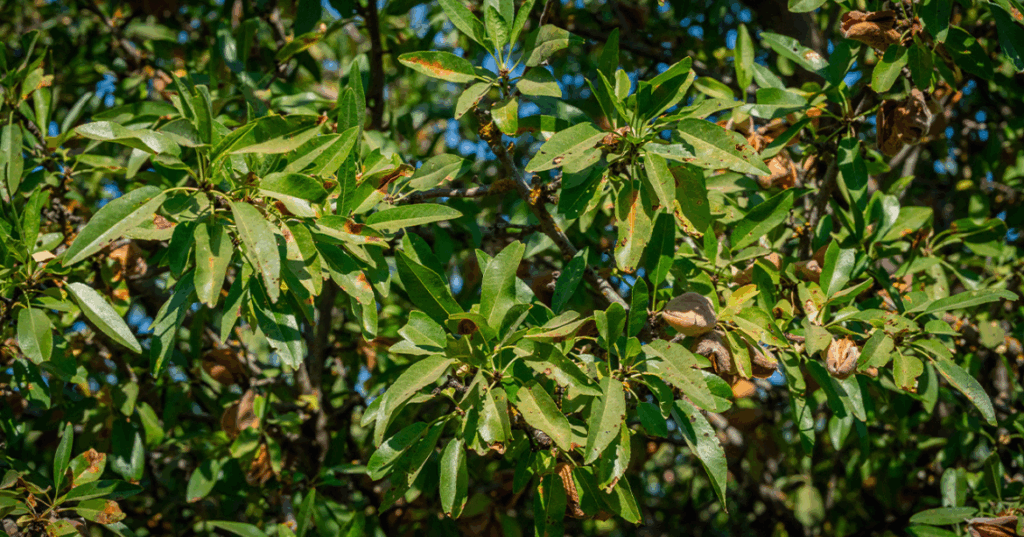
Red leaf blotch primarily targets leaves, with first signs typically appearing from late April through mid-May, especially on young tissue. Early infections can be easy to miss: small, pale-yellow spots that form on either leaf surface.
As infections progress, spots enlarge and intensify in color, turning orange to reddish-brown and reaching roughly 1–2 cm in diameter. With heavy pressure, blotches can merge, leaves curl and scorch, and premature defoliation follows.
That loss of leaf area has two consequences: it reduces photosynthesis (and therefore current-season productivity) and can compromise flower bud development for the following year.
The disease has been confirmed in numerous varieties, Aldrich, Butte, Carmel, Fritz, Independence, Monterey, Nonpareil, Padre, Shasta, and Wood Colony among them. While not considered lethal, unmanaged red leaf blotch can meaningfully erode canopy function and orchard performance.
Monocyclic Disease With a Long Latent Period
Red leaf blotch is considered monocyclic, one primary infection cycle per season. The fungus overwinters in infected leaf litter. Come spring, spores are released from that debris and dispersed by rain splash and wind, typically infecting young leaves shortly after petal fall.
The challenge is its long latent period: 35–40 days between infection and visible symptoms. By the time blotches appear, the infection window has largely closed. This biology makes it difficult to “chase” the disease with curative tactics. Instead, the emphasis is squarely on prevention, protecting young leaves before infections take hold.
Preventive Fungicide Program
Given the delayed symptom expression, preventive fungicide applications are the backbone of red leaf blotch management. A three-spray program is recommended for at-risk orchards:
Petal fall – Protect emerging, susceptible foliage as the primary infection window opens.
2–3 weeks after petal fall – Maintain protection as new leaves expand.
5–6 weeks after petal fall (if wet weather persists) – Extend protection under prolonged conducive conditions.
These timings align with peak infection pressure and can be coordinated with programs targeting other spring diseases (e.g., shot hole, rust, anthracnose), improving operational efficiency.
What to Use, and How to Steward It
Strong performers include mixtures and classes from the following FRAC groups:
3 + 7, 3 + 11, 7 + 11 premixes
FRAC 3 triazoles
Example actives/mixtures: fluopyram + trifloxystrobin, pyraclostrobin + boscalid
Rotate modes of action across applications and seasons, adhere strictly to label directions, and follow resistance-management best practices. Effective stewardship reduces the risk of diminished sensitivity over time and preserves tools for the long haul.
Orchard Sanitation
While chemical prevention carries the most weight, orchard sanitation can reduce the amount of inoculum that fuels next season’s infections:
Shred or mow infected leaves in fall or winter to accelerate breakdown.
Apply urea or other nitrogen sources to leaf litter to speed decomposition and suppress fungal survival.
Where appropriate, lightly incorporate leaves into soil.
Prevent spread between orchards: clean tools, trailers, bins, and other equipment that contact infected material before moving sites.
Sanitation gains compound when neighboring operations also participate. Since spores can move with wind and rain, coordinated regional hygiene amplifies impact.
Monitoring and Research
Growers should begin systematic scouting in early May, focusing on young leaves and monitoring for the tell-tale progression from pale spots to orange-red blotches. Suspected cases should be reported to local UCCE farm advisors. Early reporting helps refine regional risk maps and supports timely guidance as conditions evolve.
Filling the Knowledge Gaps
A UC Davis team led by UCCE Plant Pathology Specialist Florent Trouillas is actively studying the disease under California conditions. Current work includes:
Fungicide efficacy and timing to calibrate protection windows
Spore release dynamics and environmental triggers
Host susceptibility and varietal responses
Development of improved diagnostic tools for earlier, more reliable detection
As results emerge, recommendations will continue to tighten around the most efficient, cost-effective combinations of chemistry, timing, and cultural controls.
Practical Playbook for 2025–26
Plan now for a preventive three-spray program anchored at petal fall, with rotations across FRAC groups.
Bundle applications with other spring disease targets to optimize passes.
Invest in sanitation postharvest, shred leaves, promote decomposition, and clean equipment between orchards.
Scout aggressively beginning in early May; document and report symptoms promptly.
Coordinate regionally with neighbors and PCAs to reduce area-wide inoculum and align spray windows when possible.
Stay connected with UCCE and UC researchers for updated guidance as new data arrive.
Bottom Line
Red leaf blotch is new to California almonds, but it’s manageable. The path forward is clear: don’t wait for symptoms. Protect young leaves with a preventive program at petal fall, keep canopies clean and healthy with sanitation, and lean into regional cooperation and ongoing research.
With early action and disciplined stewardship, growers can safeguard canopy function, protect yield, and blunt this disease’s trajectory across the state.
AgriERP is a comprehensive farm management solution designed to empower farmers with streamlined operations and increased profitability. Powered by Microsoft Dynamics 365, AgriERP offers a single, straightforward platform that addresses the pain points of various farm types. With its user-friendly interface and intelligent automation, AgriERP is like having a trusted partner by your side throughout your farming journey.
For more information about AgriERP and its innovative farm management solutions.
Recognized as the top data analytics platform in agriculture at the 2026 AgTech Breakthrough Awards. Trusted by farm owners, processors, and exporters to turn operational data into better decisions.
 Data Analytics Solution of the Year” 2026 in Agtech Breakthrough Awards 2026


 Tasbia Tahir Ali
  September 3, 2025