California Almond Shipments Down 9% in June as 2025
Tasbia Tahir Ali
July 29, 2025
The Almond Board of California has just released its highly anticipated June 2025 Position Report, offering critical insights into shipment trends, regional demand shifts, sales performance, and crop progress as the industry approaches harvest season.
While there were some positive developments like improved June sales and export growth in select markets the report also highlights continuing challenges, including an overall decline in shipments and a sluggish start to new-crop sales.
Additionally, the USDA’s National Agricultural Statistics Service (NASS) has published its Objective Estimate, sparking fresh discussions around pricing and market expectations. Clear breakdown of what the latest numbers mean for the almond industry:
Shipments Decline Amid Export Challenges
California almond shipments for June totaled 186.7 million pounds, down 9.4% compared to 206.2 million pounds in June 2024. Year-to-date (YTD), total shipments have fallen by 2.5%, highlighting ongoing headwinds in global almond markets.
Regional insights include:
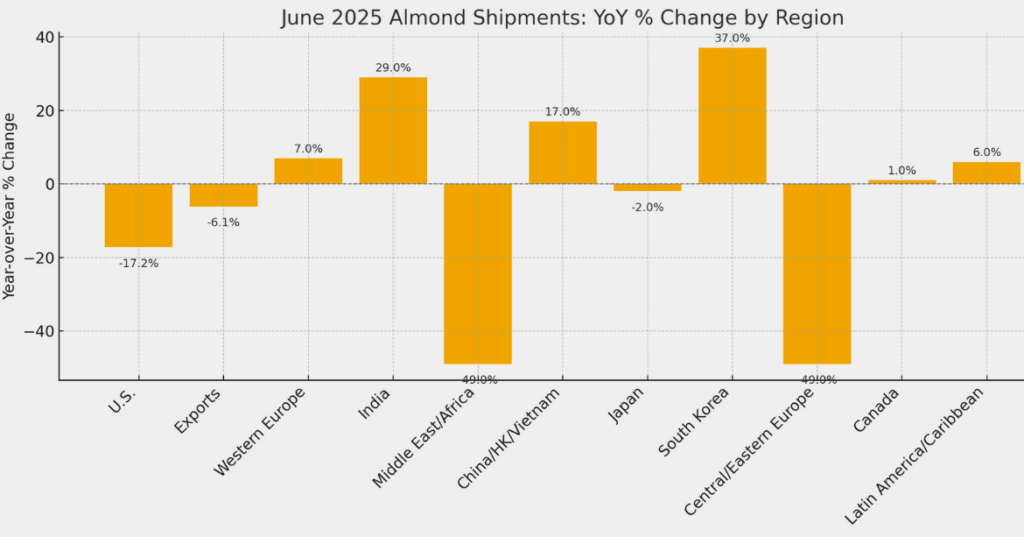
Domestic (U.S.) shipments experienced a substantial decline of 17.2% in June, with YTD shipments down by 8%.
Export markets declined at a slower rate, down 6.1% in June and just 0.5% lower YTD.
However, some markets showed resilience and growth:
India rebounded strongly with a 29% increase in June, reducing its YTD deficit to just -1%.
China/Hong Kong/Vietnam saw a healthy 17% growth in June, though they remain down 3% YTD.
South Korea surged by 37% in June, maintaining positive momentum with a 4% increase YTD.
Western Europe improved by 7% in June, nearly flat for the year at -0.3%.
These gains were balanced by notable declines elsewhere:
Middle East/Africa experienced a sharp 49% drop.
Central/Eastern Europe also saw shipments decline by 49%.
Japan shipments dipped by 2%, but still hold a positive YTD growth of 5%.
Modest growth occurred in Canada (+1%) and Latin America/Caribbean (+6%), with the latter notably up by 32% YTD.
Sales Show Slight Improvement, but Commitments Decline
June brought some good news, with almond sales rising to 96.8 million pounds, a 4.8% increase over June 2024’s92.3 millionpounds. This indicates continued buyer interest despite market uncertainties.
However, committed (unshipped) inventory decreased to 312 million pounds, 10% lower than the 347million pounds reported a year ago. This suggests buyers remain cautious, likely due to price volatility and ongoing global economic concerns.
Total almonds sold and shipped have now reached 2.76 billion pounds, down 3.4% from 2.86 billion pounds the previous year. The current sold position represents 87.2% of total supply, slightly below last year’s 88.1%, indicating strong but cautious demand.
Crop Development: Mixed Scenario for Growers
As the 2025 harvest approaches, growers are actively preparing orchards, dealing with mixed conditions. This year’s mild weather has slightly delayed hull splits in certain regions, although harvest timing appears to remain generally on track or slightly ahead of schedule.
In Southern and Central California, hull split is underway in early varieties, especially on orchard perimeters.
Westside areas are leading development, closely followed by Central and Eastside regions.
Growers are actively mowing, spraying weeds, and preparing fields for harvest.
Pest control is a notable concern this season, with significant damage reported from gophers and squirrels, as well as elevated populations of Leaf-Footed Plant Bugs, stink bugs, and mites. Most growers plan comprehensive pest treatments timed with hull-split sprays to efficiently manage these threats, including Navel Orangeworm (NOW).
USDA’s Objective Estimate: Forecasting a Bigger Crop
The recently published USDA Objective Estimate forecasts the 2025 almond crop at 3.0 billion pounds, exceeding both the earlier subjective forecast of 2.8 billion pounds and last year’s final harvest of 2.7 billion pounds.
Highlights from the estimate include:
Average yield predicted at 2,160 lbs./acre, considerably above the three-year average of 1,890 lbs./acre.
Total bearing acreage at 1.39 million acres.
Nut count per tree is up by 7% compared to last year, though average kernel weight slightly decreased.
If this forecast is accurate, it could significantly impact market dynamics and pricing strategies as harvest approaches.
Pricing Pressures Remain, New Crop Sales Slow
Throughout June, almond prices remained under pressure, although trading activity picked up slightly in anticipation of the Position Report and Objective Estimate. This uptick in activity might provide some short-term stability, but the overall market remains cautious.
A significant concern is the sluggish pace of new-crop sales. Only 111 million pounds of the 2025 crop have been sold so far, representing a substantial 59% decline from last year’s 271 million pounds at the same point.
With the USDA estimate confirming a larger crop, buyers are likely to seek lower prices, while sellers may hold out in hopes of stronger pricing later in the season. The market’s future direction will depend heavily on actual harvest results and demand recovery, especially in key international markets.
Proceeding with Cautious Optimism
The June 2025 Position Report underscores the complexities facing the almond industry this season. While steady sales and improving demand in select regions offer optimism, declining shipments and pricing pressures continue to raise concerns.
The upcoming harvest season will be critical. With expectations of a larger crop and ongoing logistical and pest challenges, growers and handlers will need to remain vigilant. Market participants will closely monitor international demand trends and crop conditions in the months ahead.
For additional insights and expert analysis, watch Nicole Wurzel’s latest Video Market Update for an in-depth overview of the current almond market landscape.
AgriERP is a comprehensive farm management solution designed to empower farmers with streamlined operations and increased profitability. Powered by Microsoft Dynamics 365, AgriERP offers a single, straightforward platform that addresses the pain points of various farm types. With its user-friendly interface and intelligent automation, AgriERP is like having a trusted partner by your side throughout your farming journey.
For more information about AgriERP and its innovative farm management solutions.
Recognized as the top data analytics platform in agriculture at the 2026 AgTech Breakthrough Awards. Trusted by farm owners, processors, and exporters to turn operational data into better decisions.
 Data Analytics Solution of the Year” 2026 in Agtech Breakthrough Awards 2026


 Tasbia Tahir Ali
  July 29, 2025