Farmers’ Almanac warns of a ‘Chill, Snow, Repeat’ winter
AgriERP Experts
September 23, 2025
The Farmers’ Almanac, not to be mistaken for the Old Farmer’s Almanac, has released its long-range outlook for the upcoming winter season. Their judgment? Expect a constant cycle of “Chill, Snow, Repeat.”
For farmers, ranchers, and rural communities, this means preparing for a winter marked by dramatic swings, early storms, and widespread cold.
Winter is arriving ahead of schedule
While the winter solstice doesn’t officially arrive until December 21, 2025, the Almanac warns that wintry conditions may make an early entrance.
Some regions could see below-average temperatures as early as September, hinting at what’s expected to be a turbulent season. The forecast even suggests a cold snap could settle in around the December holidays, bringing a frosty backdrop to celebrations.
From there, conditions are predicted to flip between deep freezes and brief thaws, keeping much of the country guessing.
Where the cold will bite hardest
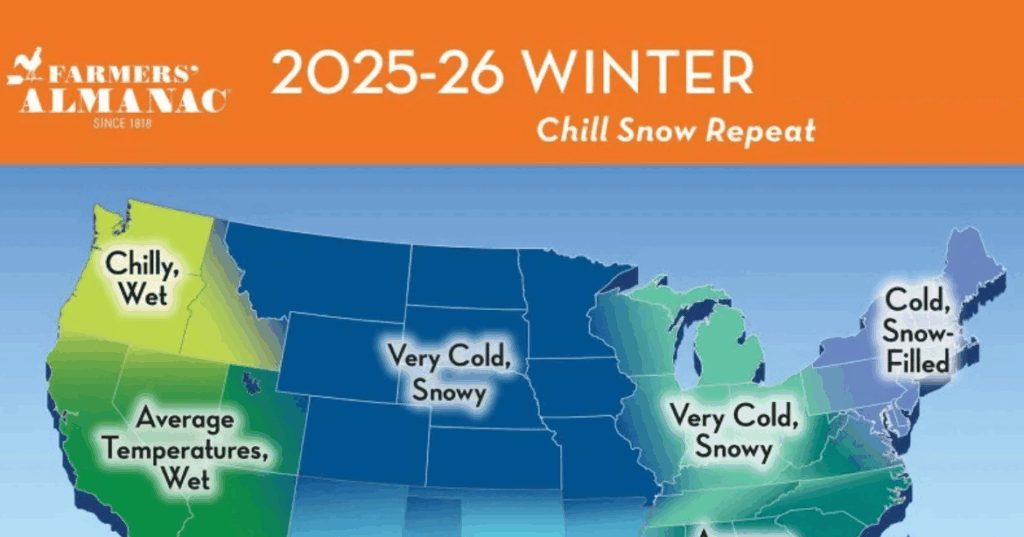
According to the forecast, the most severe cold outbreaks are expected to strike the Northern Plains and extend into New England. The Pacific Northwest, especially Idaho and Washington, is also expected to endure a particularly harsh winter.
Mid-January stands out as a defining moment, with a major cold wave expected to clean across much of the nation.
Another strong outbreak is projected for mid-February, setting up a one-two punch of frigid air. Together, these two events could shape the season’s toughest weeks.
Snow is piling up in the north
Snow lovers won’t be disappointed. New England is slated for frequent snowstorms, pleasing skiers and snowmobilers while adding extra work for rural residents.
Heavy snow is also forecast for the Great Lakes, Ohio Valley, and much of the North Central states, creating a classic winter wonderland.
The Mid-Atlantic states, especially higher elevations, should also brace for multiple storms. Out west, the mountains of the Pacific Northwest are expected to pick up impressive totals, a boon for winter recreation but a challenge for daily life.
Wetter conditions to the south
While snow dominates the northern forecast, the southern half of the country is looking at a wetter-than-usual season.
The Southeast will see average temperatures paired with regular stretches of rain, and the northern Appalachian regions may pick up occasional snow.
Texas and the Southern Plains, including Kansas, Oklahoma, Nebraska, and New Mexico, should also prepare for more moisture than usual.
While snow won’t be common there, residents can expect cold rains and bouts of freezing precipitation. The Southwest, meanwhile, is forecast for near-normal temperatures but an overall wetter season.
The Almanac’s forecasting tradition
The Farmers’ Almanac has been publishing long-range forecasts for more than two centuries, relying on a proprietary formula that blends astronomical cycles, solar activity, lunar patterns, and environmental cues.
Although modern meteorologists question its accuracy, the Almanac remains a trusted tool for many in agriculture.
For farmers, the predictions serve as a guide for preparing feed supplies, protecting livestock, checking heating systems, and anticipating muddy or snow-covered fields. Even if not perfect, the Almanac’s outlook helps rural communities plan for what might lie ahead.
How it compares to the Old Farmer’s Almanac
Earlier this month, the Old Farmer’s Almanac released its own forecast, offering a much milder narrative: “Mostly mild, with pockets of wild.”
Its outlook calls for near-normal to slightly warmer conditions across much of the country. Still, there are exceptions. From the Appalachians through the Southeast and into Florida, as well as across the Ohio Valley, colder-than-average conditions and above-normal precipitation are expected.
On snowfall, the Old Farmer’s prediction is more restrained, pointing to below-normal totals overall. However, the Carolinas, southern Appalachians, eastern Ohio Valley, southern Rockies, and parts of the Desert Southwest may see heavier-than-usual snow.
In short, while the Farmers’ Almanac emphasizes widespread cold and frequent storms, the Old Farmer’s Almanac paints a picture of a generally manageable winter with localized trouble spots.
For agricultural producers and rural residents, these contrasting forecasts highlight the need for flexible, region-specific planning.
Whether it’s doubling up on livestock bedding, preparing for icy conditions, or tracking rainfall and snow totals, both forecasts provide useful guidance, even if they don’t always align.
The bottom line? Stay alert and ready for whatever winter throws your way, because both outlooks suggest that certain areas will face higher risks, whether from bitter cold, heavy snow, or soaking rains.
The 2025 edition of the Farmers’ Almanac, easily recognized by its orange and green cover, is now on shelves at bookstores, retailers, and online at FarmersAlmanac.com.
Beyond weather predictions, the publication includes seasonal tips for gardening, livestock care, brewing, breaking bad habits, and even the best days to get a haircut.
AgriERP is a comprehensive farm management solution designed to empower farmers with streamlined operations and increased profitability. Powered by Microsoft Dynamics 365, AgriERP offers a single, straightforward platform that addresses the pain points of various farm types. With its user-friendly interface and intelligent automation, AgriERP is like having a trusted partner by your side throughout your farming journey.
For more information about AgriERP and its innovative farm management solutions.
Recognized as the top data analytics platform in agriculture at the 2026 AgTech Breakthrough Awards. Trusted by farm owners, processors, and exporters to turn operational data into better decisions.
 Data Analytics Solution of the Year” 2026 in Agtech Breakthrough Awards 2026


 AgriERP Experts
  September 23, 2025